Oct. 21, 1897: Yerkes Observatory is dedicated

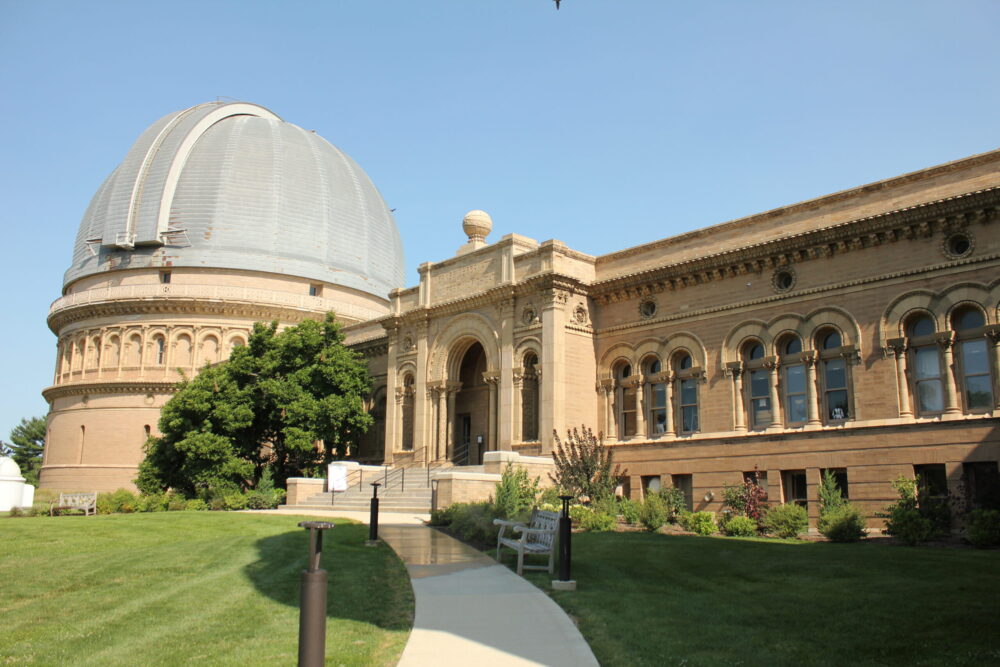
In 1892, George Ellery Hale, a professor of astrophysics at the University of Chicago, convinced the university president to acquire two 40-inch telescope lens blanks. With funding from Charles Yerkes, a Chicago mass-transit tycoon looking to refurbish his image, Hale spearheaded the creation of an observatory to house the Great Refractor made with these blanks. Part of the terms of Yerkes’ financial backing was that the observatory be built within 100 miles (161 kilometers) of Chicago, so a location in Williams Bay, Wisconsin, 90 miles (145 km) north of Chicago, was selected and construction began in 1895. Parklike grounds were designed by the famous Olmstead brothers, and the building itself is ornately Romanesque. A 90-foot-diameter dome houses the famous 40-inch Great Refractor, which remains the largest refracting telescope in the world.

On Oct. 21, 1897, the observatory was formally dedicated. Over the next century, work done at Yerkes led to its recognition as the birthplace of astrophysics and a home for great astronomers, including Edwin Hubble, Edward Barnard, Gerard Kuiper, Carl Sagan, and Nancy Grace Roman. Although the University of Chicago’s attempts to sell the observatory in the first part of 21st century led to a long period of uncertainty, the Yerkes Future Foundation took ownership of the facility in 2020, with a focus on restoration, public outreach and education, and preservation of the historic site.


Elisa Neckar is senior production editor of Astronomy magazine, and the editor of the Today in the History of Astronomy feature on Astronomy.com.

The Sky Today on Wednesday, October 21: Catch early-morning Orionids

Looking for a sky event this week? Check out our full Sky This Week column. 

October 20: Lovely spiral NGC 7331

The Orionid meteor shower peaks this morning — the perfect time to watch for shooting stars, as Earth turns into the meteoroid stream of dusty debris responsible for the show. 

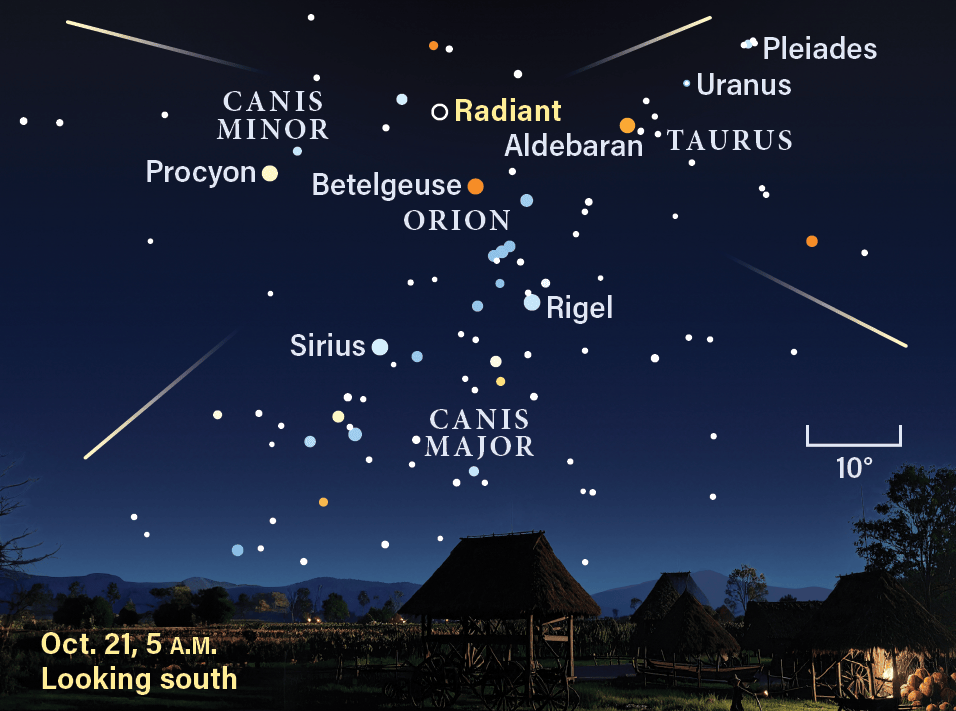
The best time to do some meteor-watching is between 2 A.M. local daylight time and dawn, as the radiant in Orion rises higher and the Moon has already set. Around 5 A.M., the Hunter stands above the southern horizon, his famous three-star Belt easy to find. Meteors in the Orionid shower appear to originate just to the upper left  (northeast) of Betelgeuse, the bright red giant that serves as one of Orion’s shoulders. Once you’ve found this star, cast your gaze some 40° to 60° to either side, away from it — that’s where you’ll see meteors with the longest trains. 

This year’s shower is expected to produce some 15–18 meteors per hour in the early-morning hours. And if you aren’t able to get out in the morning, you can try again late tonight after Orion rises and overnight into tomorrow morning. Even though the peak has passed, meteor rates will still be higher than the sporadic six or so per hour that are visible even without any showers active.

Sunrise: 7:17 A.M.
Sunset: 6:11 P.M.
Moonrise: 3:56 P.M.
Moonset: 2:15 A.M.
Moon Phase: Waxing gibbous (81%)
*Times for sunrise, sunset, moonrise, and moonset are given in local time from 40° N 90° W. The Moon’s illumination is given at 10 P.M. local time from the same location. 


Alison Klesman is senior editor of Astronomy magazine. She holds a Ph.D. in astronomy and has studied a variety of topics, from minor planets to supermassive black holes.

Understanding celestial coordinates

Just as we use latitude and longitude to know the precise position of something on Earth’s surface, it’s useful to have a system for knowing the position of objects in the heavens. The widely used system of right ascension and declination does the job — and dates back at least to the time of Hipparchus (circa 190–120 b.c.e.). 

But one of the hardest parts of getting started in astronomy is comprehending that celestial coordinate system. Rather than looking down at a globe with fixed landmarks, beginners are looking outward to an unfamiliar, ever-shifting sky. So to get an understanding of the celestial sphere, let’s compare to Earth. 

On Earth, latitude describes the distance north and south of the equator, in degrees of a circle, from 0 to 90. Longitude describes the distance east and west of the prime meridian, which runs through the Royal Observatory in Greenwich, U.K., and extends 180° in either direction. The equator marks 0° latitude, while the North and South poles are situated at 90° north and 90° south. Columbus, Ohio, sits on the 40° north latitude line; 115° west longitude runs right through Las Vegas, while 140° east crosses Tokyo. 

Declination (or Dec. for short) is similar to latitude, but projected onto the sky, with ±90° being the North and South celestial poles, respectively, and 0° at the celestial equator. Mintaka, the westernmost star of Orion’s Belt, sits very close to 0° declination, while the Andromeda Galaxy (M31) lies at 41°. From midnorthern latitudes (around 40° north), objects with a declination of –50° will just peek their noses above the southern horizon, while objects at 50° or higher are circumpolar, or visible above the horizon all night. Declination values are subdivided into arcminutes (‘) and arcseconds (“), where there are 60 arcminutes in 1 degree, and 60 arcseconds in 1 arcminute.

RELATED: Michael’s Miscellany: Coordinates

Right ascension (R.A. for short) is similar in concept to longitude, with lines that originate at the celestial poles, but is instead measured in hours, minutes, and seconds. Imagine the sky as a clock, where it takes 24 hours for a particular point to make one complete revolution; since each day is approximately 24 hours, one hour of right ascension is 1/24 of a 360° circle, or 15°. The “prime meridian” of right ascension is the location of the Sun on the vernal equinox, which is currently located in Pisces. The Andromeda Galaxy is near this 0h line; on the opposite side, the Sombrero Galaxy (M104) lies near 12h. 

In astronomy, the meridian refers specifically to the imaginary line that connects the North and South celestial poles through the zenith, the point directly overhead from your location. A helpful reference to know is the time an object crosses the meridian, also known as its transit time. In the Northern Hemisphere, objects with right ascensions between 04h and 09h cross at midnight in winter (December through February), 10h to 15h cross at midnight in springtime (March through May), 16h through 21h transit in summertime (June to August), and 22h to 03h transit in autumn (September through November). 

Now, unlike Earth coordinates, celestial coordinates slowly change position over time due to precession, or the wobble of Earth’s axis. In 2000, the Orion Nebula (M42) was located at R.A. 05h35m17s, Dec. –05°23’28”, but in 2050, it will have shifted slightly to R.A. 05h37m44s, Dec. –05°21’40”. Object locations are referred to by epoch; J2000 is the currently used reference, but will eventually be updated to the J2050 system.

As you observe more, you will start to get a feel for where the different coordinates are on the sky, and you will soon be able to estimate where to find a given galaxy or comet based on its coordinates. Then you can amaze your friends with your celestial navigational skills!


Molly Wakeling is an avid astrophotographer active in STEM outreach. She has a Ph.D. in nuclear engineering.

JWST tours Orion’s hidden stellar nursery

Few sights thrill backyard observers as much as the Orion Nebula (M42). The brightest stellar nursery visible from mid-northern latitudes resolves into a complex web of luminous gas and dusty tendrils even through modest telescopes. And at its core, you’ll see the brilliant young stars of the Trapezium Cluster that provide the energy to set the nebula aglow.

Astronomers likewise study M42, looking for clues about how stars form. But not all of them focus on the glowing clouds that so enamor visual observers. The young stellar embryos known as protostars hide inside thick clouds of cold molecular gas and dust, and are still hundreds of thousands to millions of years from reaching the main sequence and official stardom. To make the observational challenge even worse, much of the action takes place slightly behind M42.

Piercing the murk

That’s where the James Webb Space Telescope (JWST) comes in. It sees infrared light, which largely penetrates cold gas and dust to reveal what lies inside. The telescope recently examined a tiny portion of the vast Orion A complex, which harbors several molecular clouds, bright nebulae, and young star clusters.

JWST’s target lies within the so-called Integral-Shaped Filament. At infrared and radio wavelengths, this region resembles an elongated letter S, so scientists named it after the similar-looking mathematical symbol for an integral. The Orion Nebula sits at the center of the filament. Just behind M42 dwells a chain of four cold molecular clouds called, appropriately, the Orion Molecular Clouds. OMC-1 lies directly behind M42, while OMC-2 and OMC-3 reside to its north and OMC-4 to its south.

JWST imaged a small piece in the northern part of OMC-2. This region lies 1,270 light-years from Earth, close enough to allow astronomers a detailed view of the early stages of star formation. This specific slice of the cloud spans 2.5 by 1.5 light-years.

A protostar develops in a high-density molecular cloud like OMC-2 when gravity starts to win a tug of war against gas pressure. The nascent star slowly pulls in material from its surroundings, growing more massive while also shrinking in size. To conserve angular momentum, the contracting cloud must spin faster. The infalling matter forms an accretion disk in the budding star’s equatorial plane and, like water circling a drain, the gas continues to accumulate on the stellar embryo.

The disk’s inner part boasts powerful magnetic fields, which channel some of the material into high-speed jets that escape along the protostar’s rotation axis. When these jets collide with their dense surroundings, they create shock waves that heat the gas and cause it to glow.

OMC-2 dazzles

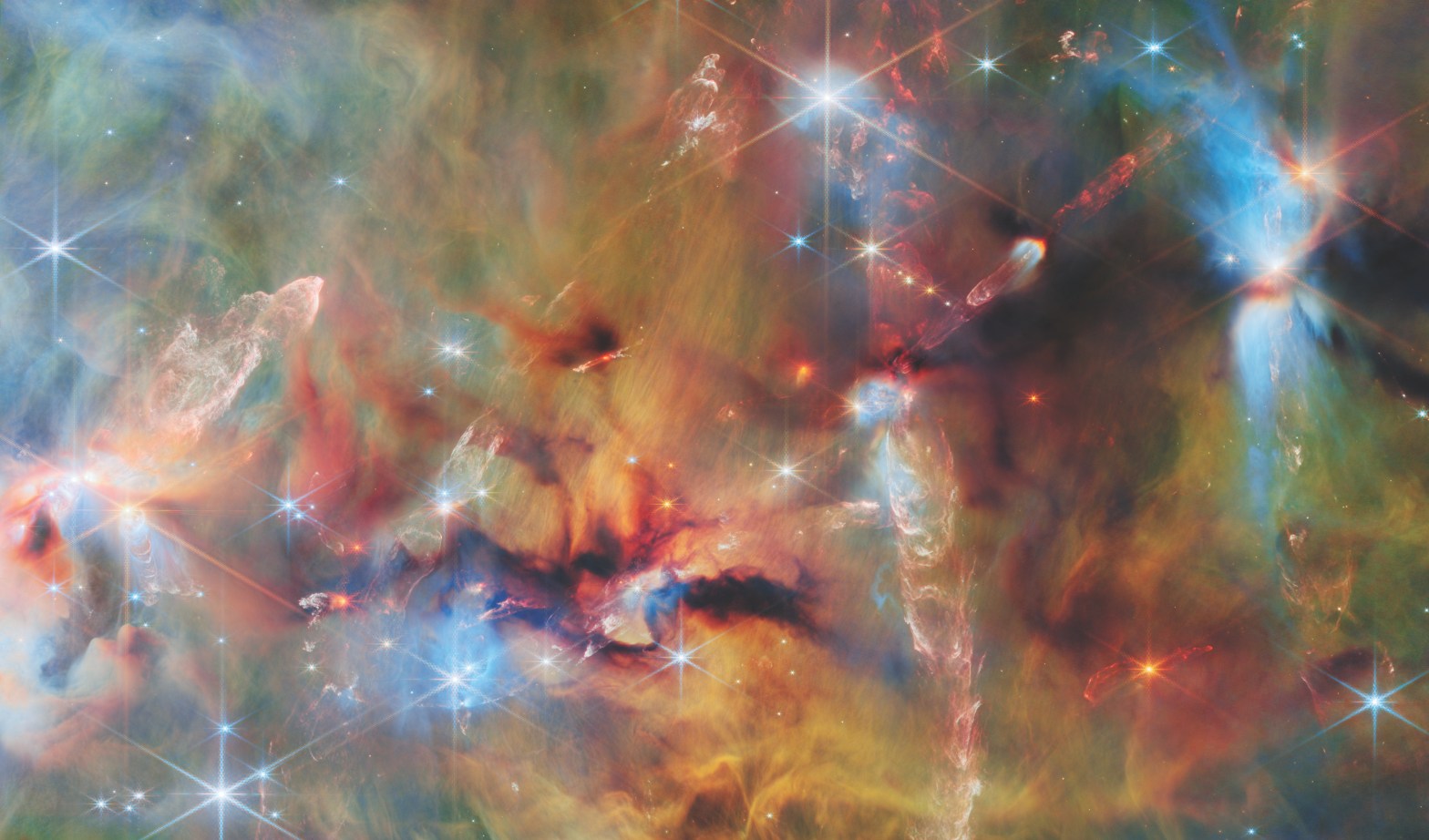
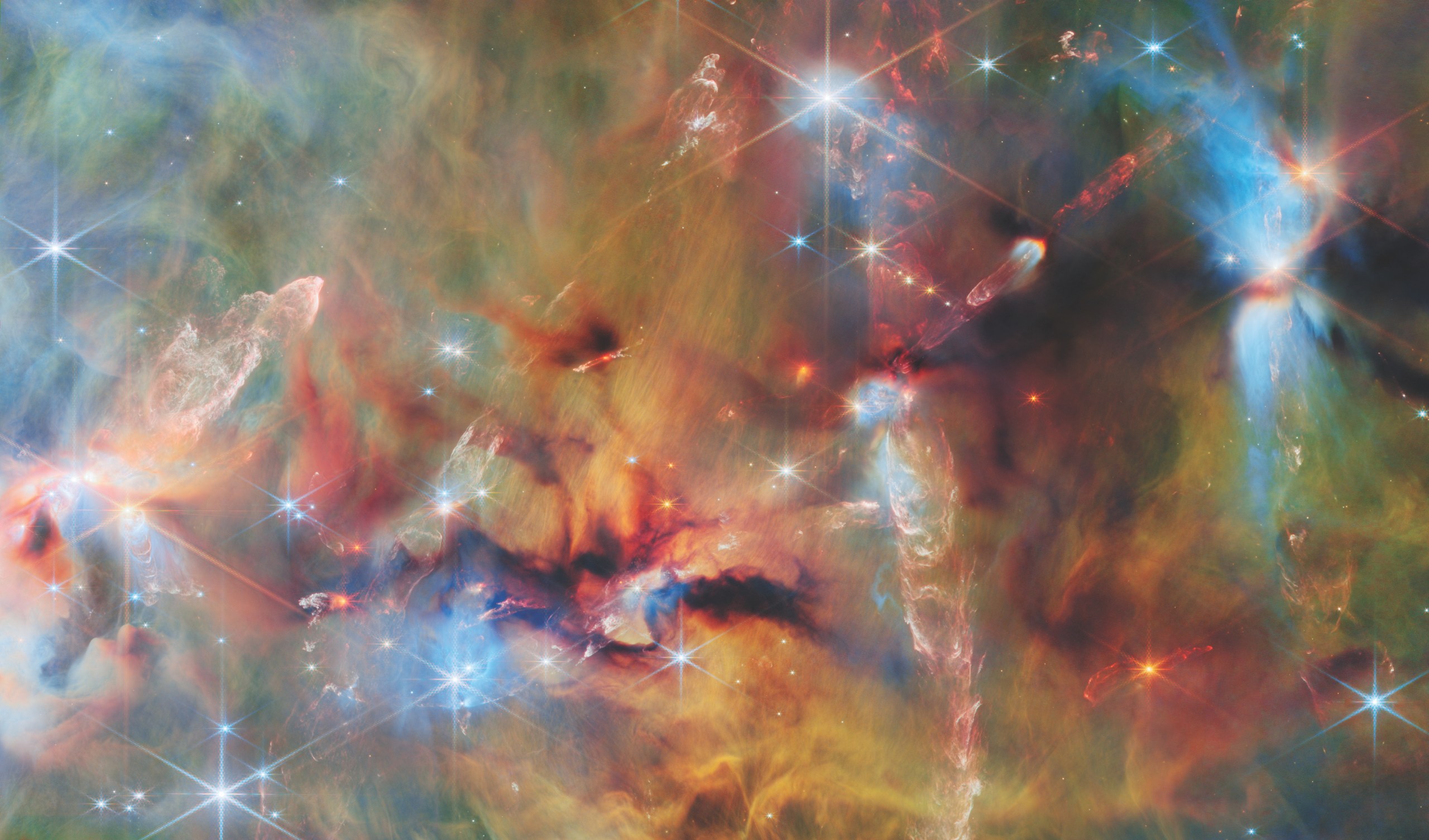
JWST’s infrared eye captures the resulting maelstrom. The jets, which travel hundreds of thousands of miles per hour, create the sharp-edged glows that dot the image. Most of these appear reddish, but you also see a few that veer closer to white. The smaller outflows emanate from younger protostars that have yet to kick into high gear. A small number remain totally hidden — not even JWST can pierce their thick dusty cocoons.

The few “stars” visible in the image, those dots sporting six symmetric diffraction spikes, have largely cleared away their birth clouds. Some may be pre-main sequence stars in OMC-2, while others could lie a bit in the foreground. In either case, they show what the molecular cloud’s protostars will one day become.


Richard Talcott is a former senior editor and current contributing editor of Astronomy.

Oct. 20, 2018: BepiColombo launches

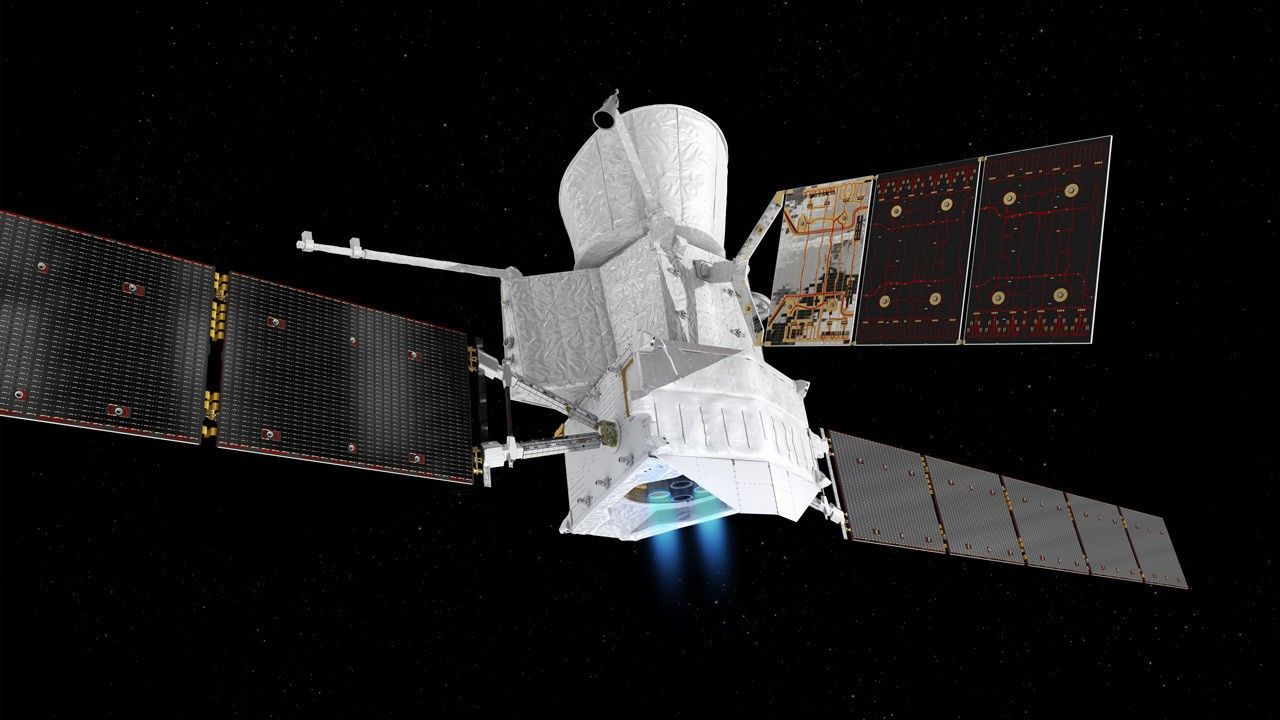
BepiColombo, a joint mission of the European Space Agency and the Japan Aerospace Exploration Agency, launched Oct. 20, 2018. The spacecraft is actually two satellites in one, the Mercury Planetary Orbiter (MPO) and the Mercury Magnetospheric Orbiter (MMO), commissioned with investigating one of the least-visited planets in our solar system.

To reach its final position, BepiColombo received assistance from the gravity of the two inner planets, flying by Venus twice and Mercury six times. That sixth flyby of Mercury occurred Jan. 8, 2025, setting the spacecraft up to reach its destination in November 2026. When it arrives, the two orbiters will separate: The MPO will investigate Mercury’s surface and geophysical makeup, particularly its unusually large core. The MMO will examine the planet’s magnetic field and how it’s generated – another unusual feature of Mercury, since its slow rotation suggests its field should not be possible.


Elisa Neckar is senior production editor of Astronomy magazine, and the editor of the Today in the History of Astronomy feature on Astronomy.com.

The Sky Today on Tuesday, October 20: Lovely spiral NGC 7331

Looking for a sky event this week? Check out our full Sky This Week column. 

October 19: Feast your eyes on the Southern Fish

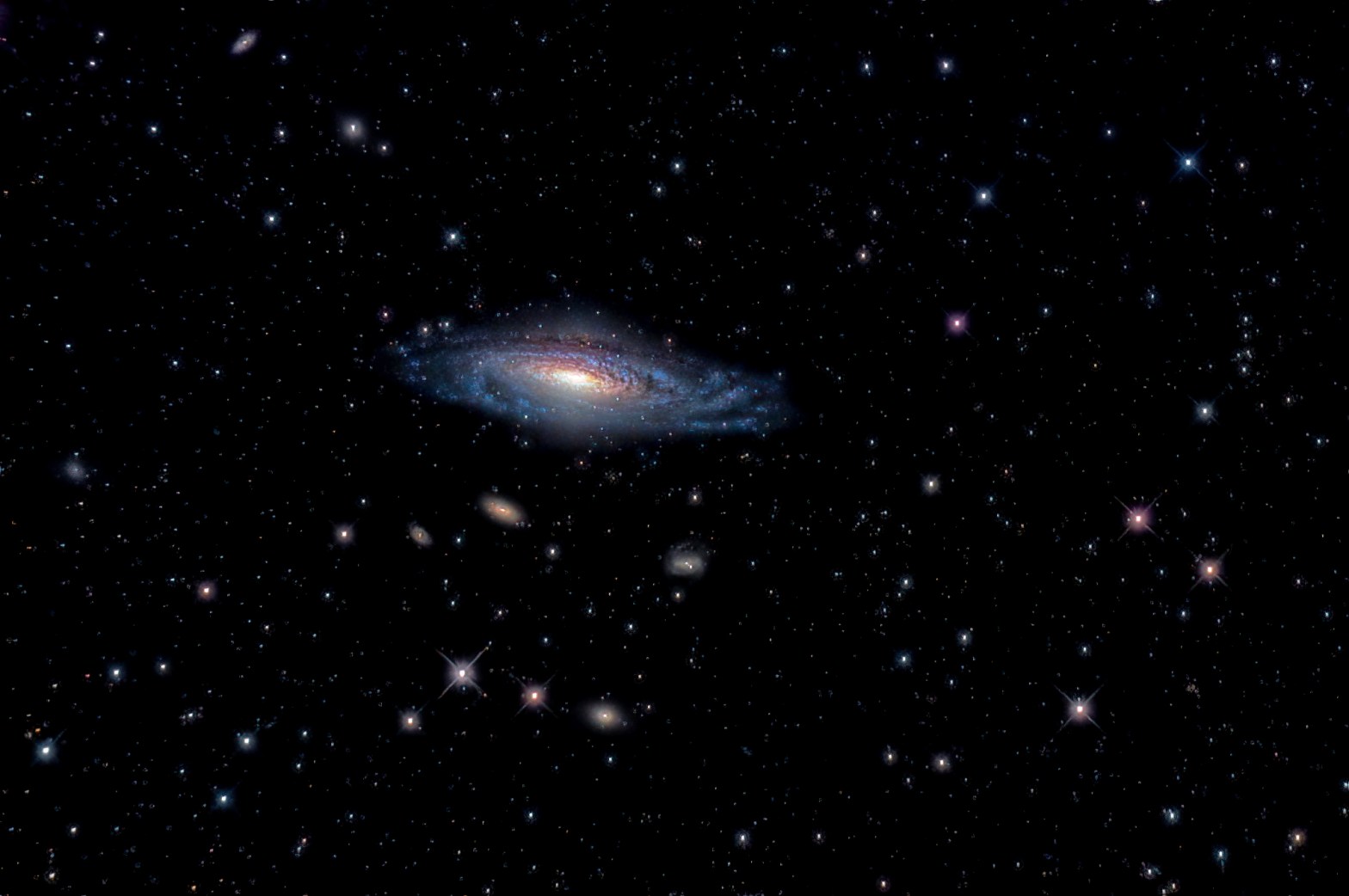
Located in northern Pegasus, NGC 7331 is a bright galaxy that is the largest in a group of five galaxies collectively known as the Deer Lick Group. It’s best viewed in early evening, standing highest around 10 P.M. local daylight time, when it is more than 80° above the southwestern horizon.

You’ll find NGC 7331 glowing at 10th magnitude just 4.4° north of 3rd-magnitude Matar (Eta [η] Pegasi). Stretching some 11’ long and 4’ wide, this lovely galaxy has a large, bright nucleus with no bar, surrounded by delicate spiral arms. Even though the galaxy is nearly edge-on, larger scopes will allow you to see exquisite detail in those arms. 

We see NGC 7331 from a distance of 40 million light-years, but it’s not the only galaxy in sight. Again, a larger scope (11 inches or more) is needed, but will reveal at least three of the Deer Lick Group’s other members, collectively called the “fleas” because they appear much smaller than NGC 7331, clustering around it. But these aren’t smaller dwarf galaxies swarming a larger central body — instead, the fleas are not physically associated with NGC 7331 at all, but lie far beyond it, at distances some 290 million to 370 million light-years away.

Sunrise: 7:16 A.M.
Sunset: 6:13 P.M.
Moonrise: 3:32 P.M.
Moonset: 1:11 A.M.
Moon Phase: Waxing gibbous (73%)
*Times for sunrise, sunset, moonrise, and moonset are given in local time from 40° N 90° W. The Moon’s illumination is given at 10 P.M. local time from the same location. 

The Orionid meteor shower peaks the morning of October 21 — the perfect time to watch for shooting stars, as Earth turns into the meteoroid stream of dusty debris responsible for the show. 

The best time to do some meteor-watching is between 2 A.M. local daylight time and dawn, as the radiant in Orion rises higher and the Moon has already set. Around 5 A.M., the Hunter stands above the southern horizon, his famous three-star Belt easy to find. Meteors in the Orionid shower appear to originate just to the upper left  (northeast) of Betelgeuse, the bright red giant that serves as one of Orion’s shoulders. Once you’ve found this star, cast your gaze some 40° to 60° to either side, away from it — that’s where you’ll see meteors with the longest trains. 

This year’s shower is expected to produce some 15–18 meteors per hour in the early-morning hours. And if you aren’t able to get out in the morning, you can try again late tonight after Orion rises and overnight into tomorrow morning. Even though the peak has passed, meteor rates will still be higher than the sporadic six or so per hour that are visible even without any showers active. 


Alison Klesman is senior editor of Astronomy magazine. She holds a Ph.D. in astronomy and has studied a variety of topics, from minor planets to supermassive black holes.

Japan sends MMX toward the martian moons

Rocket launches this week

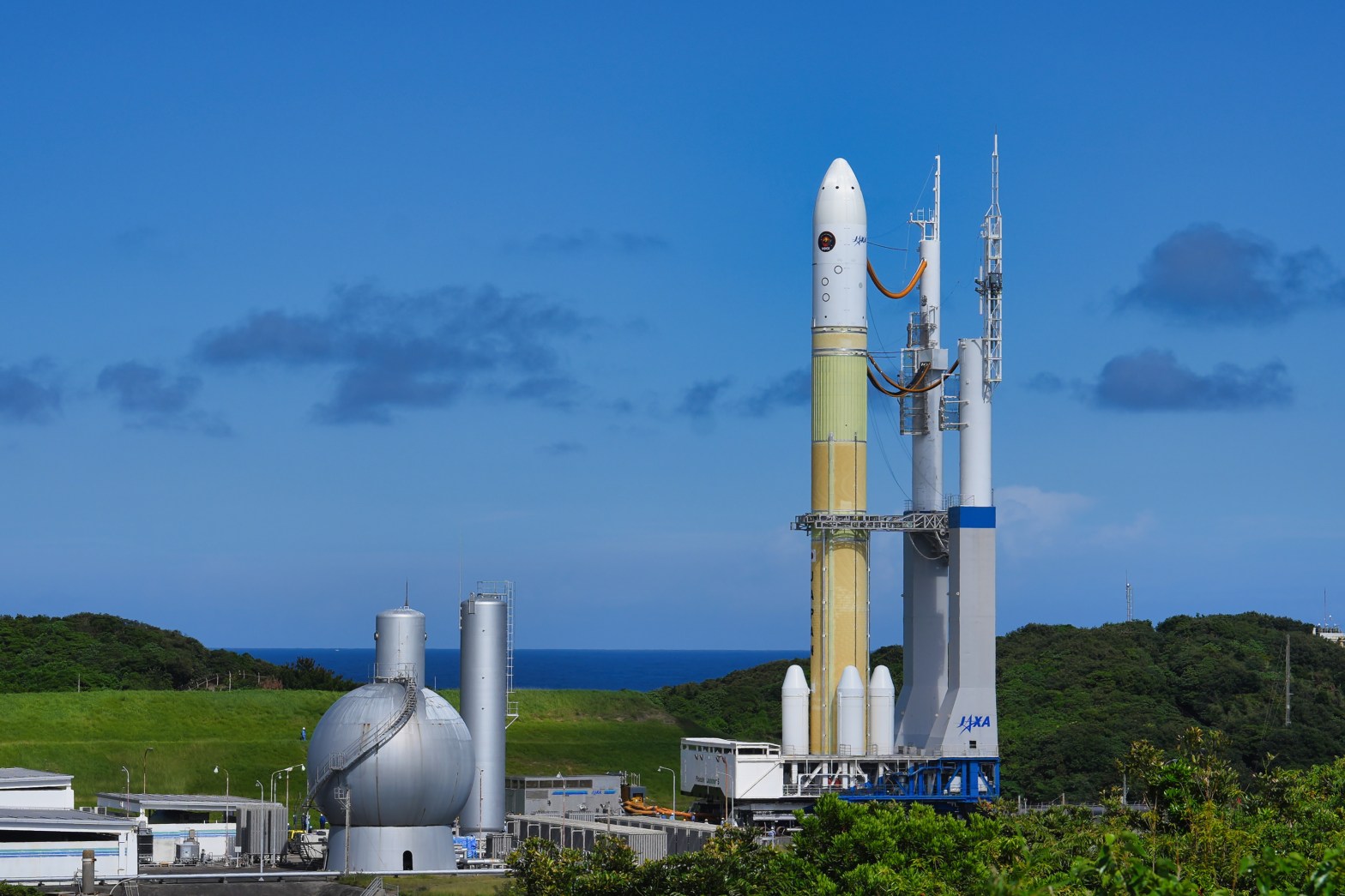
On Monday, Oct. 19, the Japan Aerospace Exploration Agency (JAXA) successfully launched its Martian Moons eXploration (MMX) mission aboard an H3-24L rocket from Tanegashima Space Center in southern Japan at 3:41 p.m. EDT. MMX will study the martian moons Phobos and Deimos and is designed to return a sample from Phobos by 2031.

RELATED: Japan prepares to launch sample return mission to Phobos 

On Tuesday, Oct. 20, SpaceX will launch its Bandwagon-5 rideshare mission from Cape Canaveral Space Force Station in Florida at 6:30 a.m. EDT. Bandwagon flights carry customer satellites to mid-inclination orbits tilted partway between the equator and the poles, which SpaceX says offer “higher revisit rates” for satellites, meaning they pass over the same point on Earth more frequently. The Falcon 9 booster is expected to land on the droneship A Shortfall of Gravitas in the Atlantic Ocean.

Later on Tuesday, Oct. 20, SpaceX will launch the Starlink Group 15-15 mission from Vandenberg Space Force Base in California at 6:14 p.m. EDT, adding another batch of broadband internet satellites to the company’s Starlink constellation. The booster is slated to land on the droneship Of Course I Still Love You in the Pacific Ocean.

Closing out Tuesday, Oct. 20, Chinese commercial launch company Galactic Energy is scheduled to fly a Ceres-1S — the sea-launched version of its small Ceres-1 rocket — from the Haiyang Oriental Spaceport off China’s eastern coast at 11:35 p.m. EDT. The payload has not been publicly identified, according to NextSpaceflight.

On Wednesday, Oct. 21, Rocket Lab is targeting 1:00 a.m. EDT for “We’re Not Hawking Around” aboard an Electron rocket from Launch Complex 1 on New Zealand’s Māhia Peninsula. The rocket will carry three satellites for Virginia-based private defense firm HawkEye 360’s satellite constellation — a radio-frequency spectrum monitoring system that collects data for national defense interests. 

Late on Wednesday, Oct. 21, the China Aerospace Science and Technology Corporation (CASC), the country’s main state-owned space contractor, will launch a Long March 8A from the Wenchang Space Launch Site on Hainan Island at 10:57 p.m. EDT. The payload is undisclosed, according to NextSpaceflight.

On Friday, Oct. 23, CASC plans a doubleheader. A Long March 6A is scheduled to lift off from the Taiyuan Satellite Launch Center in northern China at 6:15 a.m. EDT, followed by a Long March 4B from the Jiuquan Satellite Launch Center in the Gobi Desert at 3:25 p.m. EDT. Neither payload has been identified, according to NextSpaceflight.

Wrapping up the week on Saturday, Oct. 24, SpaceX will launch the Starlink Group 15-16 mission from Vandenberg at 1:29 a.m. EDT. The booster is expected to land on Of Course I Still Love You.

Rocket launches last week

On Monday, Oct. 12, SpaceX launched the Starlink Group 15-25 mission from Vandenberg Space Force Base at 8:28 p.m. EDT, with the booster landing on Of Course I Still Love You. The next morning, Tuesday, Oct. 13, SpaceX flew CRS SpX-35 from Cape Canaveral Space Force Station at 6:33 a.m. EDT, sending a Cargo Dragon on a commercial resupply run to the International Space Station. The Falcon 9 booster returned to Landing Zone 40 at Cape Canaveral.

On Wednesday, Oct. 14, Chinese commercial company Landspace launched a ZhuQue-2E Block 2 rocket carrying 10 satellites from the Jiuquan Satellite Launch Center at 7:40 a.m. EDT. The week closed on Thursday, Oct. 15, when SpaceX launched USSF-481 for the U.S. Space Force from Vandenberg at 8:01 p.m. EDT, with the booster again landing on Of Course I Still Love You.

Upcoming rocket launches

On Oct. 28, SpaceX is slated to launch the Starlink Group 15-18 mission from Vandenberg Space Force Base at 12:31 a.m. EDT.


Brooks Mendenhall is a staff writer at Astronomy, based in Chattanooga, Tennessee, fueled by an unending curiosity about the universe. A former classroom teacher, he has a knack for breaking down complex concepts for a wide audience.

Oct. 19, 2017: The discovery of ‘Oumuamua

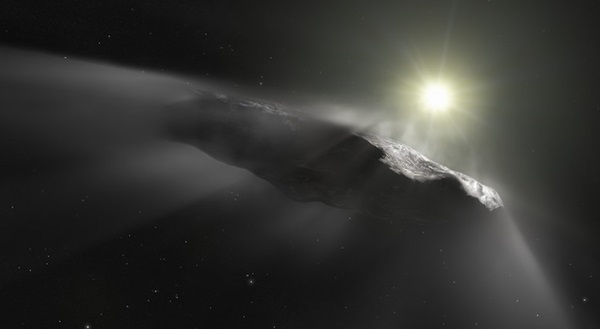
Sometime around the year 1837, a strange object passed an invisible cosmic mile marker: 1,000 astronomical units from the Sun. (One astronomical unit, or AU, is the average Earth-Sun distance.) For more than a century, it continued undetected toward our star. Finally, on Oct. 19, 2017, humans noticed the visitor.

That night, a faint, thin streak appeared in a 45-second-long image snapped by the University of Hawai’i’s Pan-STARRS1 Telescope on Maui. The next morning, postdoctoral researcher Robert Weryk spotted the streak and compared it to an image taken the day before. The object was there, too. It was moving steadily across the sky, covering about 6.2° each day.

By Oct. 22, two things were clear: The object was on a hyperbolic orbit, meaning it comes close to our Sun only once and then shoots away again, never to return. And, based on its orbit, it did not originate in our solar system at all, but instead came from another star system. It was our first known interstellar visitor. Officially named 1I/2017 U1, the object is also known as ‘Oumuamua, which means “a messenger from afar arriving first” in Hawaiian. Following its discovery, ‘Oumuamua was moving so fast that astronomers had a scant four months to observe it; after that, the object had retreated too far from the Sun, fading past our ability to track it. But in 2019, we’d meet our second interstellar visitor, Comet 2I/Borisov, and in July of 2025, the third known object from outside our solar system, 3I/ATLAS, was spotted.


Alison Klesman is senior editor of Astronomy magazine. She holds a Ph.D. in astronomy and has studied a variety of topics, from minor planets to supermassive black holes.

The Sky Today on Monday, October 19: Feast your eyes on the Southern Fish

Looking for a sky event this week? Check out our full Sky This Week column. 

October 18: Another Tethys transit

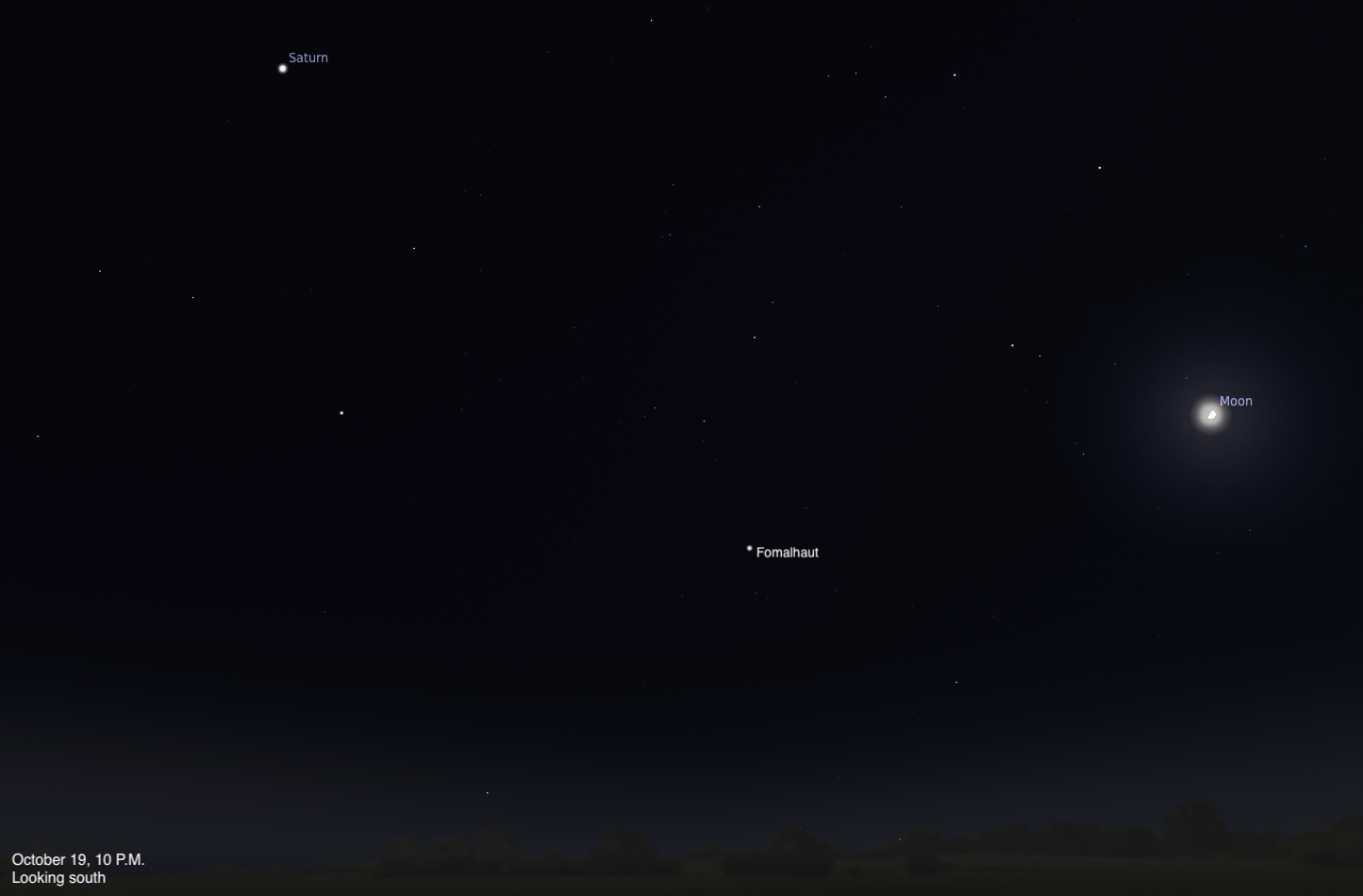
Hanging over the southern horizon this evening is the constellation Piscis Austrinus the Southern Fish. Although you might not have heard much about this particular star pattern, you’ve likely seen its luminary, the bright star Fomalhaut. Shining at magnitude 1.2, it is the 18th brightest star in the sky. It’s easy to find, too, because there aren’t many notable stars in the surrounding area: simply turn south around 10 P.M. local daylight time, and Fomalhaut is shining some 20° above the horizon. The only object that can rival it is Saturn, far to the upper left in Cetus, glowing at magnitude 0.3. To Fomalhaut’s upper right is the waxing Moon, but even our satellite can’t overpower the bright star. 

Fomalhaut is a young star, still surrounded by a disk of debris from which astronomers believe planets could form. However, the (now in)famous Fomalhaut b, which astronomers once believed was a planet and tracked for roughly a decade, is in fact a cloud of debris that is now dispersing, perhaps the result of a collision of planetlike objects in the disk. 

Piscis Austrinus comes in 60th in terms of size among the 88 official constellations, covering about 245 square degrees of sky. 

Sunrise: 7:15 A.M.
Sunset: 6:14 P.M.
Moonrise: 3:05 P.M.
Moonset: 12:07 A.M.
Moon Phase: Waxing gibbous (64%)
*Times for sunrise, sunset, moonrise, and moonset are given in local time from 40° N 90° W. The Moon’s illumination is given at 10 P.M. local time from the same location. 


Alison Klesman is senior editor of Astronomy magazine. She holds a Ph.D. in astronomy and has studied a variety of topics, from minor planets to supermassive black holes.

Oct. 18, 1977: The enigma of Chiron

On Oct. 18, 1977, Charles Kowal was at the 1.2-meter Schmidt telescope at Palomar Observatory in California – reportedly his favorite equipment at the facility to observe with – when he unwittingly discovered an entirely new class of objects.

Kowal was conducting a survey for slow-moving objects beyond the Main Belt, taking two plates of the same location a few hours apart and searching them for differences using a blink comparator. He spotted one such difference – an 18th-magnitude object moving at a rate of only 3 arcminutes per day between Saturn and Uranus that was initially designated an asteroid, 2060. (Later, Kowal would name it Chiron, after a mythological centaur who was the son of Saturn and grandson of Uranus.) Chiron was a puzzle, with an orbit and size that didn’t fit its location. It would eventually be recognized as the first in a new class of cosmic objects: Centaurs. These travelers dislodged from the Kuiper Belt are the bridge between small planetesimals and full-fledged planets, making them a valuable evolutionary link for understanding planet formation.


Elisa Neckar is senior production editor of Astronomy magazine, and the editor of the Today in the History of Astronomy feature on Astronomy.com.

The Sky Today on Sunday, October 18: Another Tethys transit

Looking for a sky event this week? Check out our full Sky This Week column. 

October 17: Watch Wild Ducks

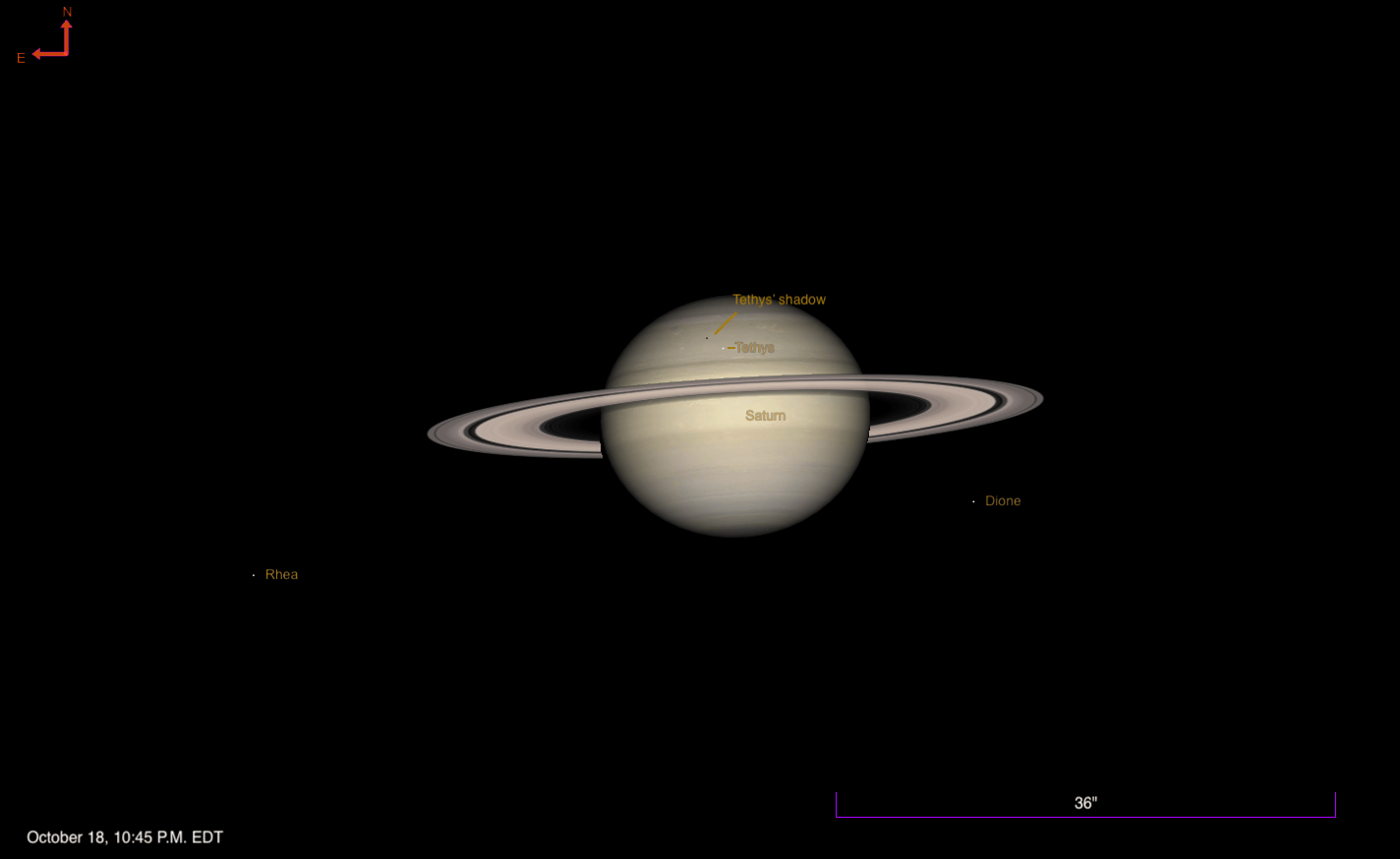
Tiny Tethys is transiting the disk of Saturn beginning around 9:35 P.M. EDT, most easily visible from the eastern half of the U.S.

Saturn is easy to locate in Cetus the Whale — it’s the brightest light in the southeast around 9 P.M. local daylight time. Through any telescope, you’ll easily see Saturn’s disk and broad rings, as well as its brightest moon, Titan, which now lies far to the planet’s east. You might also spot its three next-brightest moons, 10th-magnitude Tethys, Dione, and Rhea. Tethys is closing in on the planet’s northeastern limb, while Rhea sits southeast and Dione southwest of the planet. 

Tethys will be easy to track until the transit begins — then it grows much harder, as the tiny disk offers little contrast with Saturn’s much brighter cloud tops. The moon’s journey is followed by its equally tiny shadow, which appears just northeast of Tethys around 9:50 P.M. EDT. Both moon and shadow will only be visible to astroimagers using advanced video-capture techniques. Tethys finally leaves the northwestern limb shortly after midnight EDT. 

Even if you can’t watch Tethys’ transit, you can still admire Saturn’s stunning rings and its other visible moons. Note that Dione is moving closer to Saturn’s southeastern limb — it will disappear behind the planet in an occultation just before 12:45 A.M. EDT (the 19th in the Eastern time zone only). And once the transit is through, visual observers should be able to pick up Tethys once more as it moves away from the planet, now on the western side of the planet, north of the rings.

Sunrise: 7:14 A.M.
Sunset: 6:16 P.M.
Moonrise: 2:35 P.M.
Moonset: —
Moon Phase: Waxing gibbous (54%)
*Times for sunrise, sunset, moonrise, and moonset are given in local time from 40° N 90° W. The Moon’s illumination is given at 10 P.M. local time from the same location. 


Alison Klesman is senior editor of Astronomy magazine. She holds a Ph.D. in astronomy and has studied a variety of topics, from minor planets to supermassive black holes.

Oct. 17, 1956: Birth of Mae Jemison

Born Oct. 17, 1956, in Decatur, Alabama, and raised in Chicago, Mae Jemison showed a passion and talent for science from early in her childhood. After graduating high school by the age of 16, Jemison attended Stanford University and earned a B.S. in chemical engineering and a B.A. in African American studies. She went on to Cornell Medical College, and after completing her M.D. in 1981, worked for several years as a medical officer in the Peace Corps.

Watching Sally Ride become the first American woman in space inspired Jemison to pursue her lifelong dream of becoming an astronaut, and on June 4, 1987, she became the first Black woman admitted into NASA’s training program. On Sept. 12, 1992, she launched as a mission specialist on the Space Shuttle Endeavor, becoming the first woman of color in space. During her eight-day flight, she conducted experiments that capitalized on her background as a medical doctor, including research on motion sickness and on bone density in space. Since her return to Earth, Jemison has focused on education and technology access and integration, including teaching at Dartmouth and founding a science camp for children – and even made a guest appearance on Star Trek: The Next Generation.


Elisa Neckar is senior production editor of Astronomy magazine, and the editor of the Today in the History of Astronomy feature on Astronomy.com.