Astronomy forum Connect with fellow astronomy enthusiasts!
Get started
Skip to content
Astronomy Magazine logo
  • Login / Register
  • Logout
  • Shop
  • Subscribe

  • News
  • Science
    • Solar System
    • Exoplanets
    • Stars
    • Milky Way
    • Galaxies
    • Exotic Objects
    • Cosmology
  • Observing
    • In The Sky
    • Upcoming Events
    • The Sun
    • The Moon
    • Planets
    • Comets
    • Deep-Sky Objects
    • Observing Basics
    • Telescopes and Equipment
    • Astrophotography
    • Gear Guide
    • This Week in Astronomy
  • Space Exploration
    • What’s Launching This Week
    • Human Spaceflight
    • Robotic Spaceflight
  • The Magazine
  • Ask Astro
  • Star Products
  • Login / Register
  • Logout
  • Shop
  • Subscribe

Planets

A monochrome photograph shows a large, roundish asteroid filling the frame against a solid black space background. Strong directional lighting coming from the right illuminates a heavily pockmarked, grey surface covered in round craters and ridges. The left half of the body curves sharply into deep black shadow, creating strong contrast across the terrain.
Today in the History of Astronomy

Sept. 1, 1804: Karl Harding spots 3 Juno

A detailed, full-disk view of a celestial body fills almost the entire frame against a solid black background. The textured surface displays a patchwork of distinct colors, featuring a large, smooth, light cream-colored region in the lower center bordered by heavily cratered, deep rust-red terrain to the left and pale bluish-grey areas near the top and right. Soft lighting across the sphere highlights fine surface crevices and crater rims, creating gentle shadows near the lower-right edge.
Today in the History of Astronomy

Aug. 24, 2006: Pluto is demoted

A bright, pixelated circle of mottled yellow and green glowing hues sits centered against a dark, speckled blue-and-black background. Small red-orange spots mark the top, bottom, and center of the bright sphere, with a tiny, isolated red dot floating just off its top edge. High contrast separates the vibrant yellow-green disc from the surrounding cool-toned background.
Today in the History of Astronomy

Aug. 23, 1991: Water on Mercury

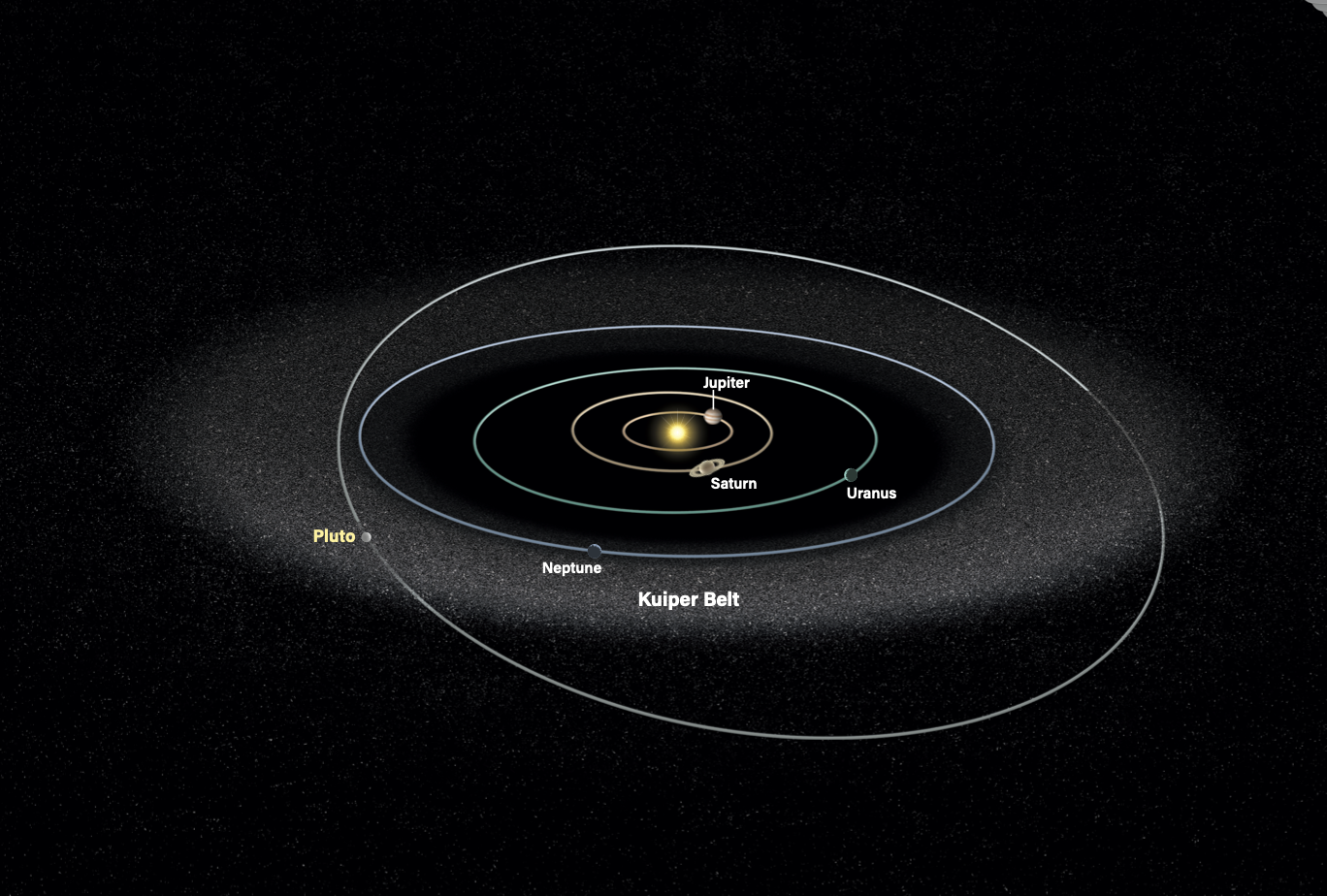
A diagram illustrating the outer solar system from an angled top-down perspective. Concentric orbital paths are shown around a central yellow Sun, with Jupiter, Saturn, Uranus, and Neptune labeled at increasing distances. Pluto is shown in yellow text outside Neptune's orbit, and the entire outer region is surrounded by a diffuse haze representing the Kuiper Belt, labeled in white text.
Solar System

How do planets clear out objects on the other side of their orbit?

A dark night sky chart transitions from a deep purple at the top to a warm orange glow along a jagged black mountain horizon at the bottom. A crescent moon and several small, white star dots are scattered across the sky, each accompanied by a white text label. In the lower-center of the frame, a single bright white dot sits next to the bold labels "SATURN" and "JUPITER" just above the date text "December 21."
Today in the History of Astronomy

June 17, 2 BCE: A conjunction between Venus and Jupiter

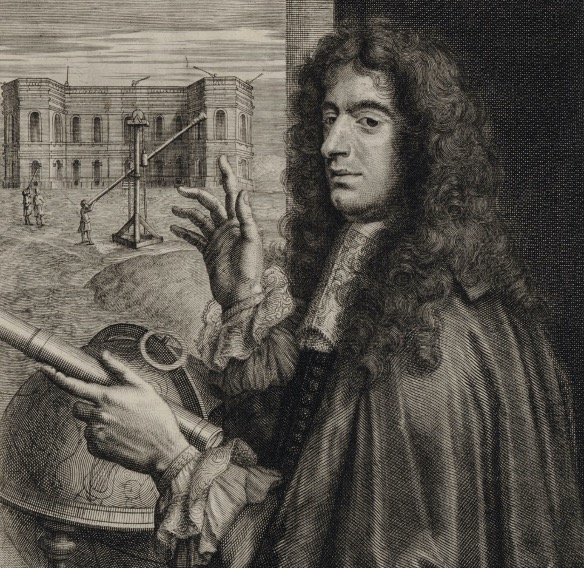
A man with long, curly dark hair is depicted from the waist up, facing left. He rests one hand on a large celestial globe while gesturing with his other hand toward an outdoor scene visible through a window behind him. The background shows a large stone building and several figures operating long telescopes on a grassy field, all rendered in detailed monochrome linework.
Today in the History of Astronomy

June 8, 1625: The birth of Giovanni Cassini

A black-and-white engraved portrait shows a balding man with a full, bushy beard and mustache, turned slightly to the right. He wears a dark suit jacket and vest over a white collared shirt and a dark bowtie. The detailed sketching sits against a stark white background that fades out softly at the bottom edge of the frame.
Today in the History of Astronomy

June 5, 1819: The birth of John C. Adams

Exoplanets, Science, Solar System

Why don’t planets fall into the stars they orbit?

DSCOVR image of Earth and Moon
Science, Solar System

How much less would you weigh on the Moon than on Earth?

Observing, The Moon, Upcoming Events

The Moon, Mars, and Jupiter meet up! This Week in Astronomy with Dave Eicher

Deep-Sky Objects, Observing, Planets

Spy two planets in the Bull: This Week in Astronomy with Dave Eicher

Observing, The Moon, Upcoming Events

The Moon, Mars, and Saturn line up: This Week in Astronomy with Dave Eicher

Posts pagination

1 2 3 … 13 Older posts

Astronomy Newsletter

Get newsletters, updates and special offers via email from Astronomy.com!

Please enter a valid email address.
Astronomy Magazine logo
  • Facebook
  • LinkedIn
  • YouTube
  • Instagram
  • Twitter
  • About Us
  • Contact Us
  • Subscribe
  • Customer Service
  • Advertising
  • Terms of Use
  • Privacy Policy
  • Do Not Sell

@ 2025 Firecrown Media. All Rights Reserved.

More Sites from Firecrown Media Publisher logo
Scroll to Top

Sign In

New User? Create an Account

Why Sign In? Subscribers can access their digital magazine issues, and registered users can participate in our Community forums and galleries.

Please enter your email.
Please enter your password.

Lost your password?

Manage My AccountCustomer Support