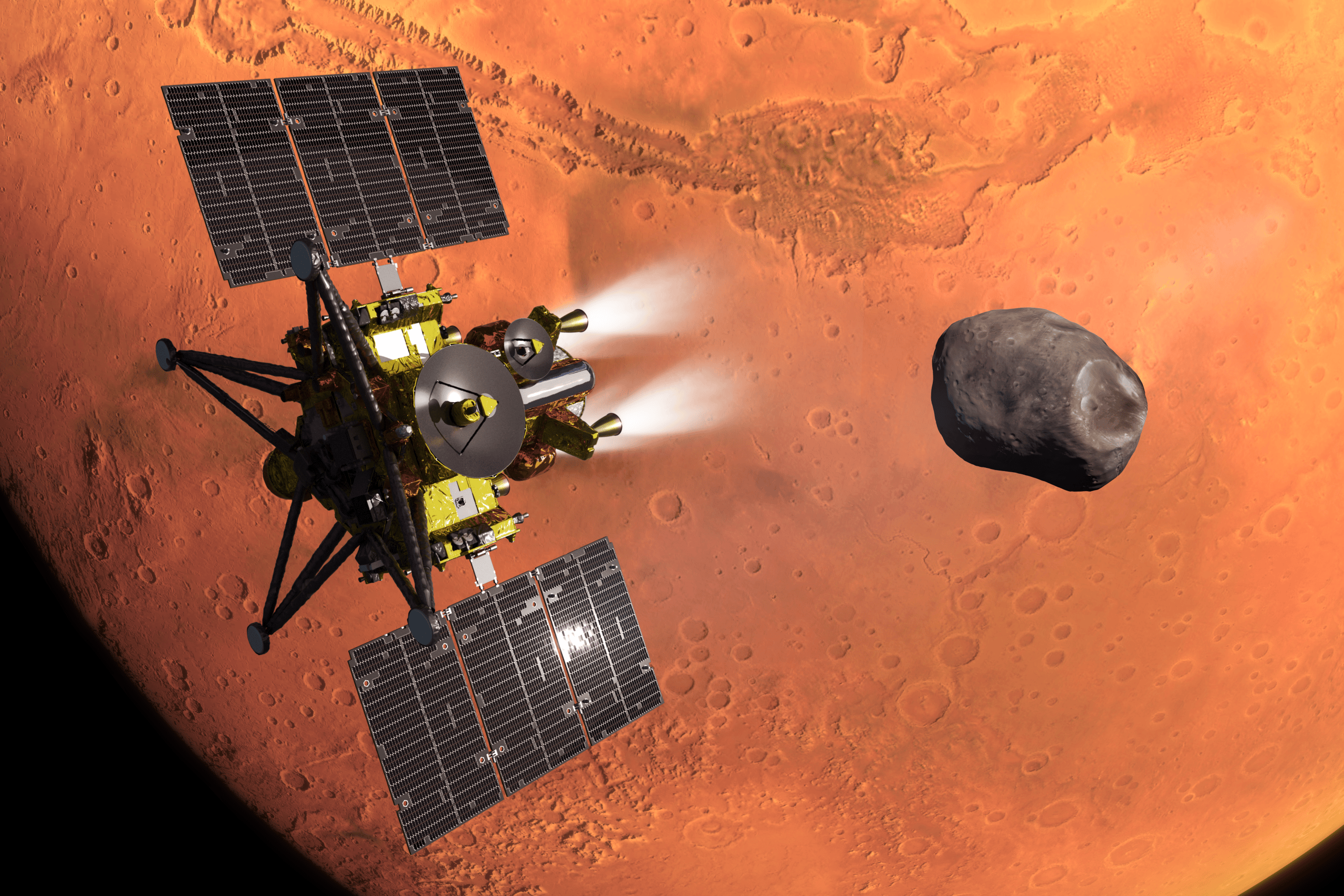
The Japan Aerospace Exploration Agency (JAXA) is targeting Oct. 19 for the launch of a first-of-its-kind sample return mission to the martian moon Phobos.
The Martian Moons eXploration (MMX) mission is set to lift off at 3:41 p.m. EDT (4:41 a.m. Oct. 20 local time) aboard an H3 rocket from Tanegashima Space Center in southern Japan. JAXA leads the mission with NASA contributing science instruments and 10 participating scientists. MMX will be the first spacecraft to both land on the Red Planet’s moon Phobos and return a sample of it to Earth for study.
“The Martian moon Phobos remains an unexplored frontier for humankind,” said MMX Project Manager Kawakatsu Yasuhiro in a statement. “By bringing home samples from Phobos, we hope to explore how the martian moons were formed, how the Mars sphere evolved, and how the water and organic materials found on the terrestrial planets originated.”
Mysterious moons
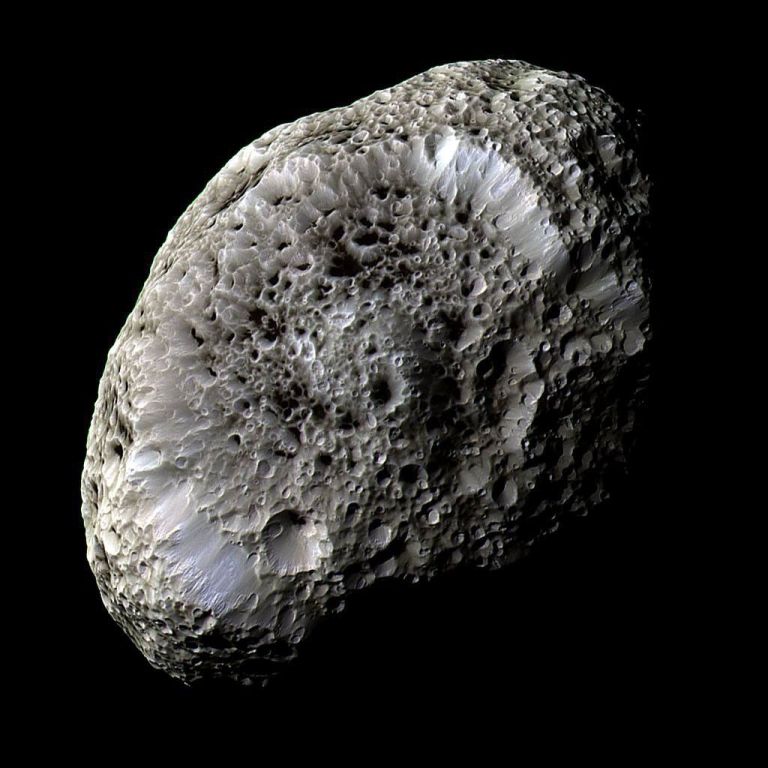
Relative to our own Moon, Mars’ satellites are tiny. Phobos measures about 17 by 14 by 11 miles (27 by 22 by 18 kilometers), and Deimos about 9 by 7 by 6.8 miles (15 by 12 by 11 km). And while our Moon has enough mass to pull itself into a sphere, Phobos and Deimos are lumpy and irregular, like asteroids (they’re often compared to potatoes). Scientists aren’t sure where the martian moons came from. It’s possible they are indeed asteroids snared by Mars’ gravity. Or they could be bits of debris flung into orbit following a large impact on Mars.
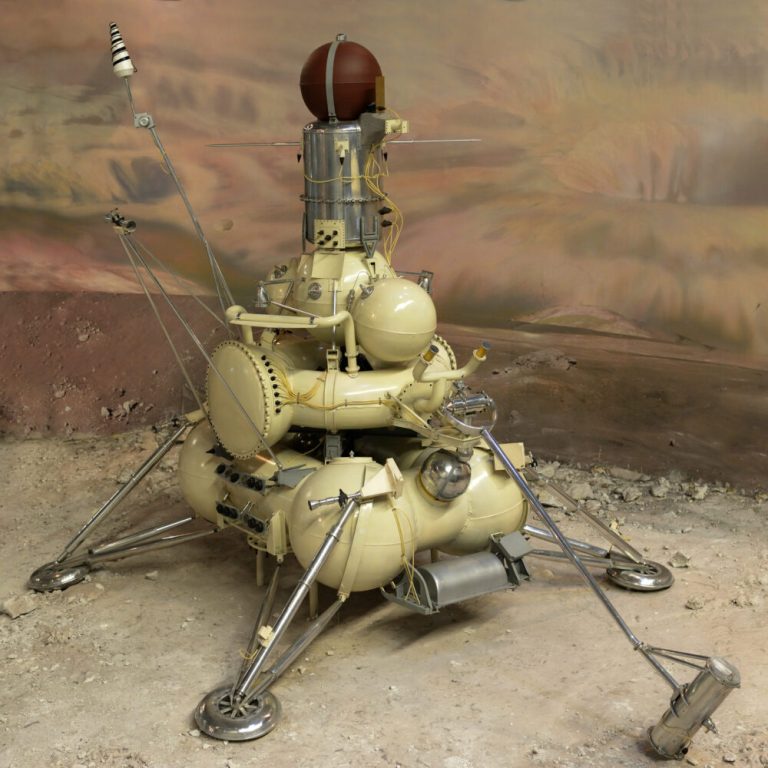
Historically, reaching them has been fraught with failure. The Soviet Union lost both of its Phobos probes before either could reach the moon in 1988 and 1989. Russia’s much later third attempt, the Phobos-Grunt sample return mission, never even escaped Earth orbit in 2011.
MMX has two main science goals: figure out how Phobos and Deimos formed; and investigate the origins of a Mars long since gone, which had a thick atmosphere and liquid water on its surface. The team believes the answers might be connected. “The key to this mystery,” Kuramoto said, “lies in the martian moons, which closely resemble carbonaceous asteroids — the very celestial bodies capable of carrying the ingredients for an atmosphere and water.”
Mission overview
JAXA calls MMX “the largest international collaborative mission in lunar and planetary exploration ever led by Japan.” The French National Centre for Space Studies (CNES) and the German Aerospace Center (DLR) built IDEFIX, a 55-pound (25 kilograms) rover that will weigh less than a few dozen paperclips on the surface of Phobos. France also supplied an infrared spectrometer, and the European Space Agency (ESA) is providing scientific and operational support.
MMX should arrive at Mars in August 2027, about a year after launch, and slip into a so-called quasi-satellite orbit a month later: While the spacecraft will appear to orbit Phobos, it will in fact be in orbit around Mars, tracking along with the motion of the moon. The 30-foot-long (9 meters) spacecraft comprises a propulsion module, exploration module, and return module. It will drop IDEFIX in early 2029. In 2030, the main spacecraft will touch down twice to collect at least 0.35 ounce (10 grams) of regolith, then pay a brief visit to Phobos’ sister moon with a quick flyby of Deimos on its way back to Earth. The return capsule is set to land in Australia in 2031.
To scout landing sites for both the rover and sample collection, MMX carries a telescopic camera that can make out features about 16 inches (40 centimeters) across, a wide-angle multicolor imager, and a laser altimeter. NASA’s Mars-moon Exploration with Gamma rays and Neutrons (MEGANE) will take a chemical inventory of Phobos from orbit. (The word megane is also Japanese for eyeglasses.) MMX also carries instruments to monitor dust along Phobos’ orbit, particles escaping from Mars’ atmosphere as well as those knocked loose from Phobos’ surface by the solar wind, and the background radiation of Phobos’ environment.
Once MMX touches down, two samplers will perform the excavation for sample collection. One is a corer on a robotic arm that will reach down nearly an inch (2.54 centimeters) into the regolith. The other is a NASA-supplied pneumatic device that blasts surface grains into a container using pressurized nitrogen — similar to how OSIRIS-REx collected its sample of Bennu. MMX also carries two ultra-high-definition cameras, built with Japan’s public television broadcaster NHK, to film Mars and its moons in 8K from its orbital point of view.
Looking back
Just as the Moon holds a record of Earth’s violent early days, Phobos may preserve clues to Mars’ ancient history. The science MMX conducts could help explain how Mars went from a world with a thick atmosphere and flowing water to the cold, dry Red Planet we see today.
“MMX promises to reveal a great deal about how the Earth — the neighbor to Mars — became a planet capable of sustaining life,” said Principal Investigator Kuramoto Kiyoshi, “and how our planet has managed to remain so.”
Brooks Mendenhall is a staff writer at Astronomy, based in Chattanooga, Tennessee, fueled by an unending curiosity about the universe. A former classroom teacher, he has a knack for breaking down complex concepts for a wide audience.