Looking for a sky event this week? Check out our full Sky This Week column.
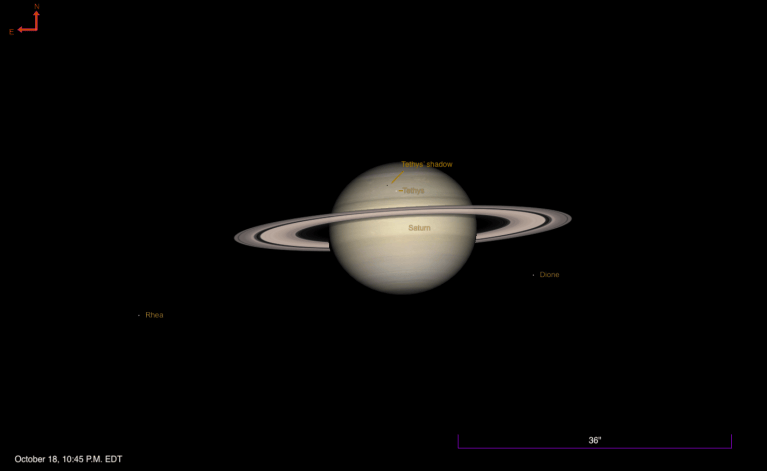
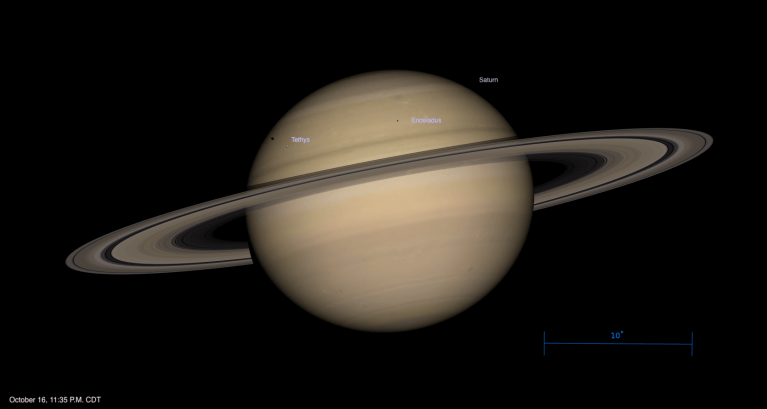
October 18: Another Tethys transit
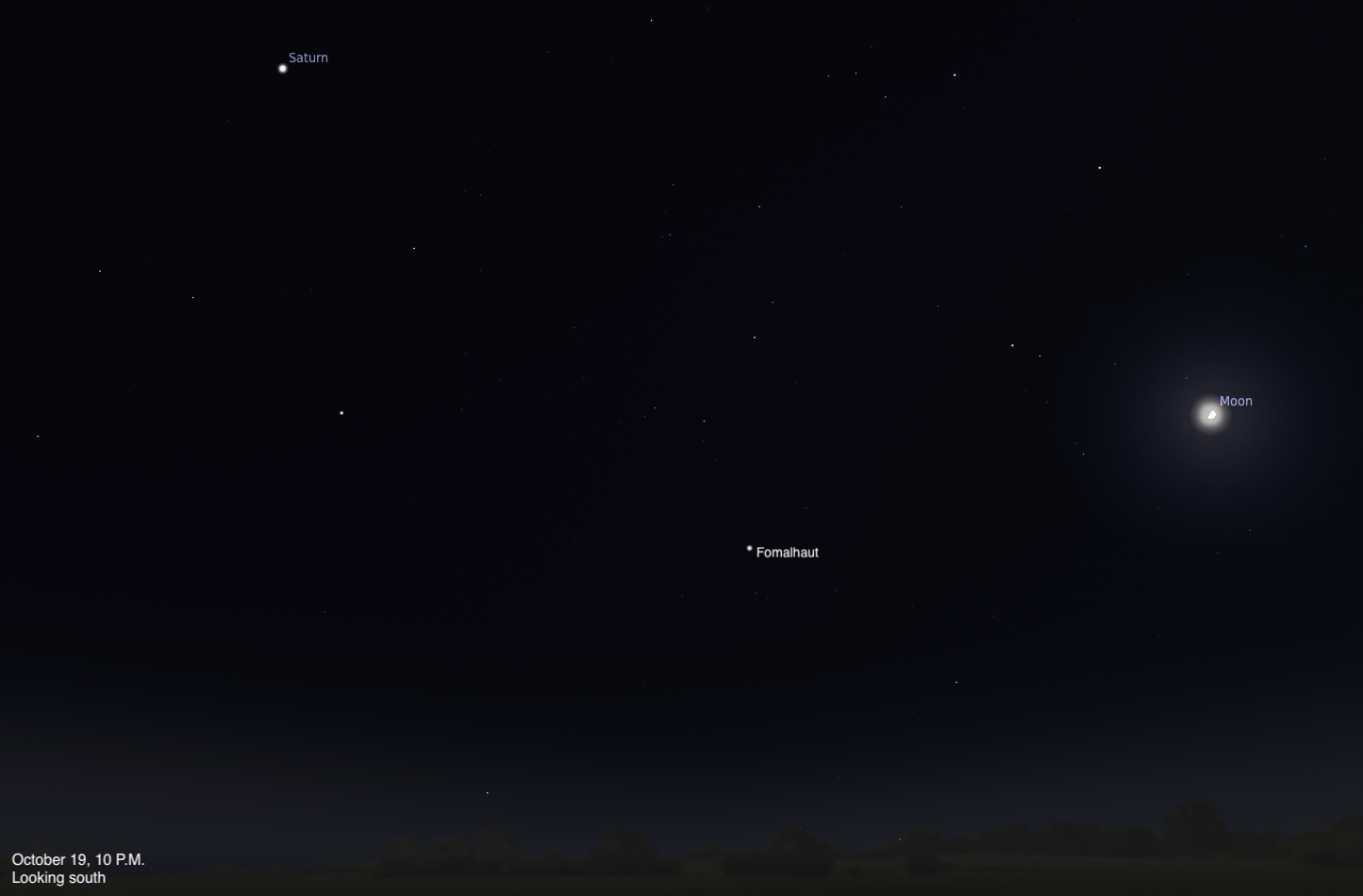
Hanging over the southern horizon this evening is the constellation Piscis Austrinus the Southern Fish. Although you might not have heard much about this particular star pattern, you’ve likely seen its luminary, the bright star Fomalhaut. Shining at magnitude 1.2, it is the 18th brightest star in the sky. It’s easy to find, too, because there aren’t many notable stars in the surrounding area: simply turn south around 10 P.M. local daylight time, and Fomalhaut is shining some 20° above the horizon. The only object that can rival it is Saturn, far to the upper left in Cetus, glowing at magnitude 0.3. To Fomalhaut’s upper right is the waxing Moon, but even our satellite can’t overpower the bright star.
Fomalhaut is a young star, still surrounded by a disk of debris from which astronomers believe planets could form. However, the (now in)famous Fomalhaut b, which astronomers once believed was a planet and tracked for roughly a decade, is in fact a cloud of debris that is now dispersing, perhaps the result of a collision of planetlike objects in the disk.
Piscis Austrinus comes in 60th in terms of size among the 88 official constellations, covering about 245 square degrees of sky.
Sunrise: 7:15 A.M.
Sunset: 6:14 P.M.
Moonrise: 3:05 P.M.
Moonset: 12:07 A.M.
Moon Phase: Waxing gibbous (64%)
*Times for sunrise, sunset, moonrise, and moonset are given in local time from 40° N 90° W. The Moon’s illumination is given at 10 P.M. local time from the same location.
Alison Klesman is senior editor of Astronomy magazine. She holds a Ph.D. in astronomy and has studied a variety of topics, from minor planets to supermassive black holes.