On Oct. 18, 1977, Charles Kowal was at the 1.2-meter Schmidt telescope at Palomar Observatory in California – reportedly his favorite equipment at the facility to observe with – when he unwittingly discovered an entirely new class of objects.
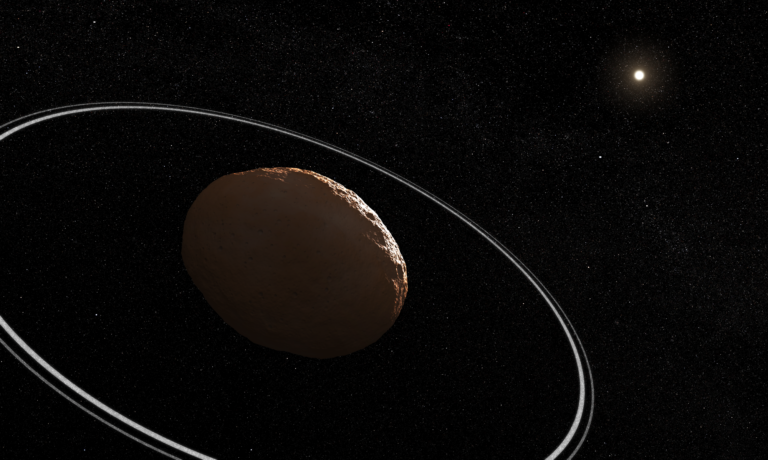
Kowal was conducting a survey for slow-moving objects beyond the Main Belt, taking two plates of the same location a few hours apart and searching them for differences using a blink comparator. He spotted one such difference – an 18th-magnitude object moving at a rate of only 3 arcminutes per day between Saturn and Uranus that was initially designated an asteroid, 2060. (Later, Kowal would name it Chiron, after a mythological centaur who was the son of Saturn and grandson of Uranus.) Chiron was a puzzle, with an orbit and size that didn’t fit its location. It would eventually be recognized as the first in a new class of cosmic objects: Centaurs. These travelers dislodged from the Kuiper Belt are the bridge between small planetesimals and full-fledged planets, making them a valuable evolutionary link for understanding planet formation.