Friday, October 16
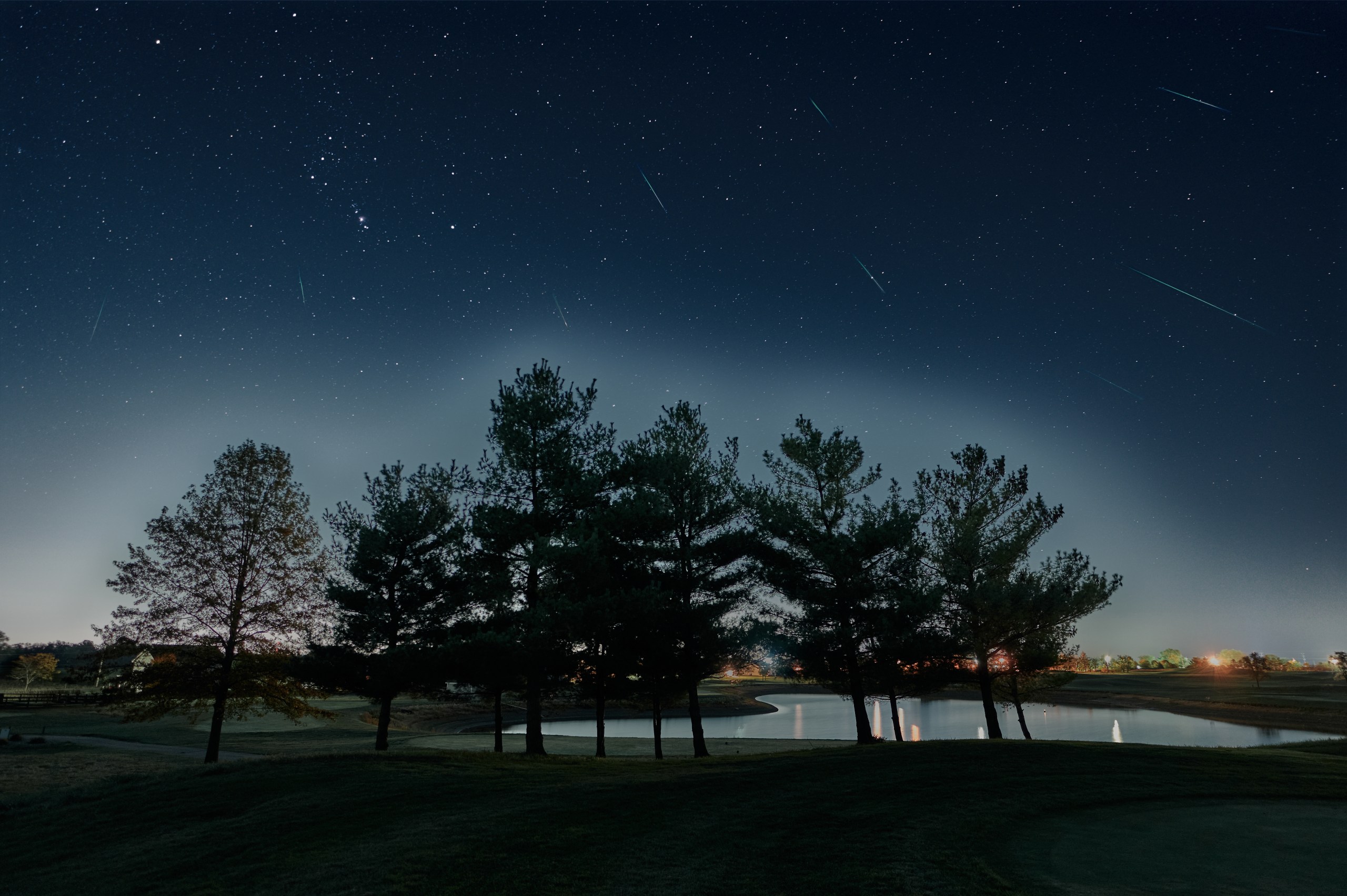
Pluto is stationary in Capricornus at 7 A.M. EDT. This evening, the Moon reaches apogee, the farthest point from Earth in its slightly elliptical orbit, at 6:56 P.M. EDT. Our satellite will then be 251,434 miles (404,644 km) away.
Although Pluto is too dim for most amateur scopes to reach, especially with the Moon relatively nearby, Capricornus holds other treasures that are much more accessible. Around 8:30 P.M. local daylight time, the Sea Goat is some 30° high in the south. The constellation’s brightest star is actually Delta (δ) Capricorni in its northeastern reaches, but Alpha (α) and Beta (β) Cap are still easy to find in the northwestern portion of this star pattern, to the upper left of the Sagittarius Teapot. Shining at magnitudes 3.6 and 3.1, respectively, these two stars appear well within the same field of view in binoculars. Using even the lowest magnification, Alpha Cap will split into two, although this is not a true binary pair but just a chance superposition of two stars at vastly different distances from Earth.
Beta Cap, however, is a binary system, comprising stars of 3rd and 6th magnitude about 330 light-years away. They circle each other at a distance of roughly ⅓ light-year. This pair also offers lovely contrasting colors of orange and blue, much like the famous bi-colored Albireo in Cygnus.
Sunrise: 7:12 A.M.
Sunset: 6:19 P.M.
Moonrise: 1:16 P.M.
Moonset: 10:05 P.M.
Moon Phase: Waxing crescent (36%)
*Times for sunrise, sunset, moonrise, and moonset are given in local time from 40° N 90° W. The Moon’s illumination is given at 10 P.M. local time from the same location.
Saturday, October 17
Still visible for several hours after sunset is the Wild Duck Cluster (M11), a young grouping of stars also cataloged as NGC 6705. Located in Scutum the Shield, the cluster is still 40° high in the south an hour after sunset and more than 30° high in the southwest an hour after that. Even with the bright waxing Moon nearby, M11’s stars will readily pop into view in binoculars or a telescope, thanks to their brightness: The cluster shines at magnitude 5.8. It lies near the rich, star- and dust-filled plane of our Milky Way, although the galactic plane will likely be difficult to make out in the moonlight tonight. Come back when there’s no Moon in the sky, however, and it may appear from a dark observing site.
Spanning roughly 14’, M11 is a lovely grouping filled with numerous young suns — at least 500 of its stars are brighter than magnitude 14. Astronomers estimate its stars are roughly 250 million years old, and it lies 6,000 light-years away. The easiest way to find M11 is to start at the tail of Aquila the Eagle nearby, which hangs below the Eagle’s brightest star, Altair. Use the curving path created by the stars Lambda (λ) and 12 Aquilae, followed by Eta (η) Scuti, to guide your way right to M11’s location.
Sunrise: 7:13 A.M.
Sunset: 6:17 P.M.
Moonrise: 1:59 P.M.
Moonset: 11:05 P.M.
Moon Phase: Waxing crescent (45%)
Sunday, October 18
First Quarter Moon occurs at 12:13 P.M. EDT.
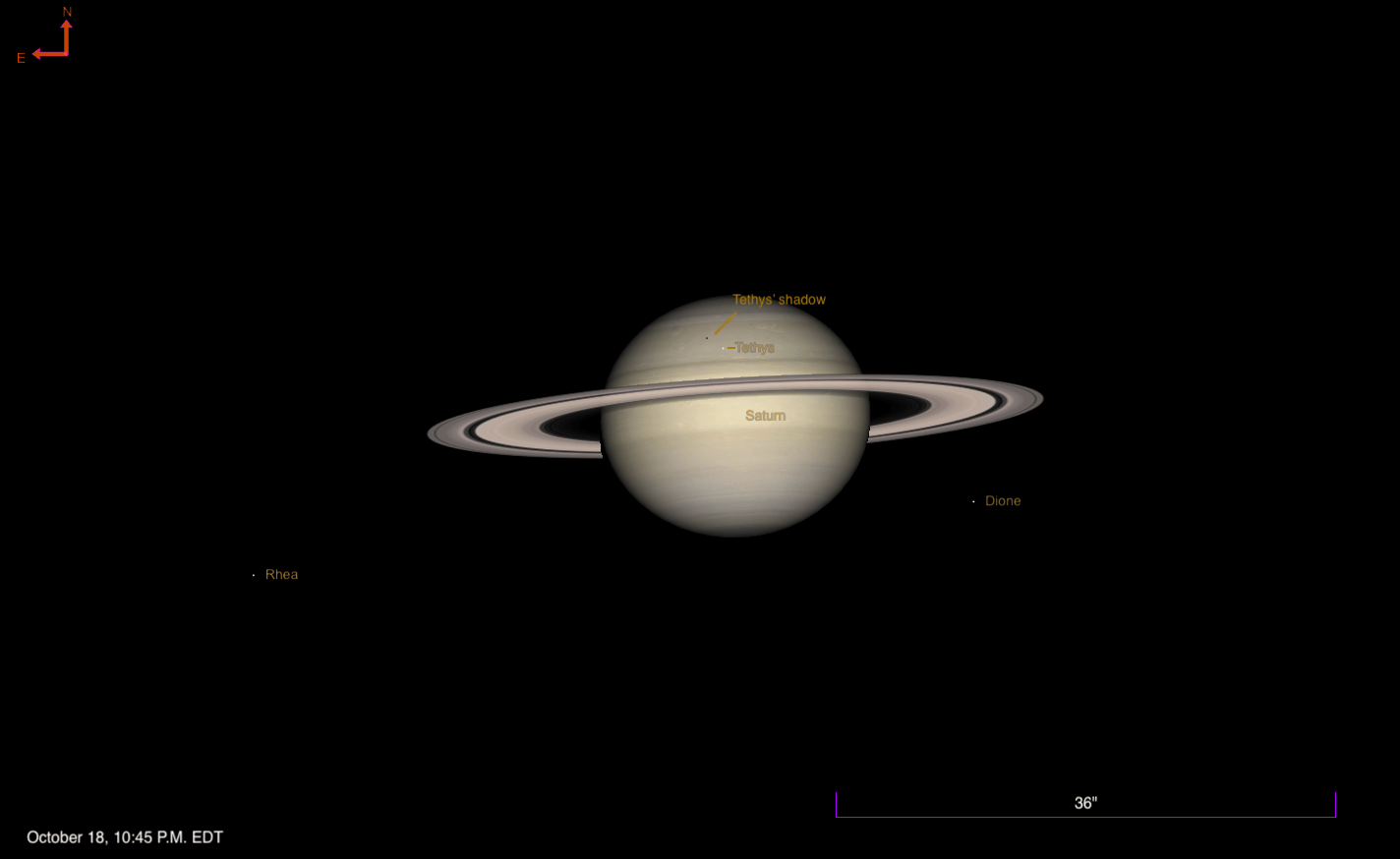
While our Moon is easy to observe, lingering in the sky all evening, another solar system satellite is ready to present a challenge tonight. Tiny Tethys is transiting the disk of Saturn beginning around 9:35 P.M. EDT, most easily visible from the eastern half of the U.S.
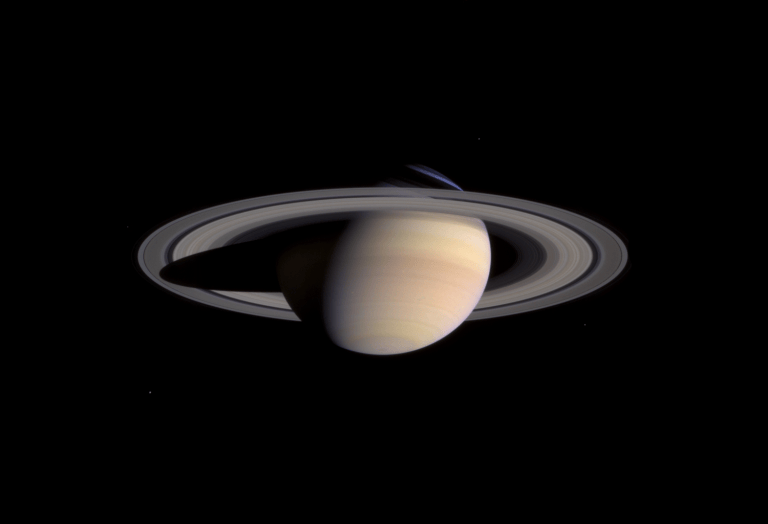
Saturn is easy to locate in Cetus the Whale — it’s the brightest light in the southeast around 9 P.M. local daylight time. Through any telescope, you’ll easily see Saturn’s disk and broad rings, as well as its brightest moon, Titan, which now lies far to the planet’s east. You might also spot its three next-brightest moons, 10th-magnitude Tethys, Dione, and Rhea. Tethys is closing in on the planet’s northeastern limb, while Rhea sits southeast and Dione southwest of the planet.
Tethys will be easy to track until the transit begins — then it grows much harder, as the tiny disk offers little contrast with Saturn’s much brighter cloud tops. The moon’s journey is followed by its equally tiny shadow, which appears just northeast of Tethys around 9:50 P.M. EDT. Both moon and shadow will only be visible to astroimagers using advanced video-capture techniques. Tethys finally leaves the northwestern limb shortly after midnight EDT.
Even if you can’t watch Tethys’ transit, you can still admire Saturn’s stunning rings and its other visible moons. Note that Dione is moving closer to Saturn’s southeastern limb — it will disappear behind the planet in an occultation just before 12:45 A.M. EDT (the 19th in the Eastern time zone only). And once the transit is through, visual observers should be able to pick up Tethys once more as it moves away from the planet, now on the western side of the planet, north of the rings.
Sunrise: 7:14 A.M.
Sunset: 6:16 P.M.
Moonrise: 2:35 P.M.
Moonset: —
Moon Phase: Waxing gibbous (54%)
Monday, October 19
Hanging over the southern horizon this evening is the constellation Piscis Austrinus the Southern Fish. Although you might not have heard much about this particular star pattern, you’ve likely seen its luminary, the bright star Fomalhaut. Shining at magnitude 1.2, it is the 18th brightest star in the sky. It’s easy to find, too, because there aren’t many notable stars in the surrounding area: simply turn south around 10 P.M. local daylight time, and Fomalhaut is shining some 20° above the horizon. The only object that can rival it is Saturn, far to the upper left in Cetus, glowing at magnitude 0.3. To Fomalhaut’s upper right is the waxing Moon, but even our satellite can’t overpower the bright star.
Fomalhaut is a young star, still surrounded by a disk of debris from which astronomers believe planets could form. However, the (now in)famous Fomalhaut b, which astronomers once believed was a planet and tracked for roughly a decade, is in fact a cloud of debris that is now dispersing, perhaps the result of a collision of planetlike objects in the disk.
Piscis Austrinus comes in 60th in terms of size among the 88 official constellations, covering about 245 square degrees of sky.
Sunrise: 7:15 A.M.
Sunset: 6:14 P.M.
Moonrise: 3:05 P.M.
Moonset: 12:07 A.M.
Moon Phase: Waxing gibbous (64%)
Tuesday, October 20
Located in northern Pegasus, NGC 7331 is a bright galaxy that is the largest in a group of five galaxies collectively known as the Deer Lick Group. It’s best viewed in early evening, standing highest around 10 P.M. local daylight time, when it is more than 80° above the southwestern horizon.
You’ll find NGC 7331 glowing at 10th magnitude just 4.4° north of 3rd-magnitude Matar (Eta [η] Pegasi). Stretching some 11’ long and 4’ wide, this lovely galaxy has a large, bright nucleus with no bar, surrounded by delicate spiral arms. Even though the galaxy is nearly edge-on, larger scopes will allow you to see exquisite detail in those arms.
We see NGC 7331 from a distance of 40 million light-years, but it’s not the only galaxy in sight. Again, a larger scope (11 inches or more) is needed, but will reveal at least three of the Deer Lick Group’s other members, collectively called the “fleas” because they appear much smaller than NGC 7331, clustering around it. But these aren’t smaller dwarf galaxies swarming a larger central body — instead, the fleas are not physically associated with NGC 7331 at all, but lie far beyond it, at distances some 290 million to 370 million light-years away.
Sunrise: 7:16 A.M.
Sunset: 6:13 P.M.
Moonrise: 3:32 P.M.
Moonset: 1:11 A.M.
Moon Phase: Waxing gibbous (73%)
Wednesday, October 21
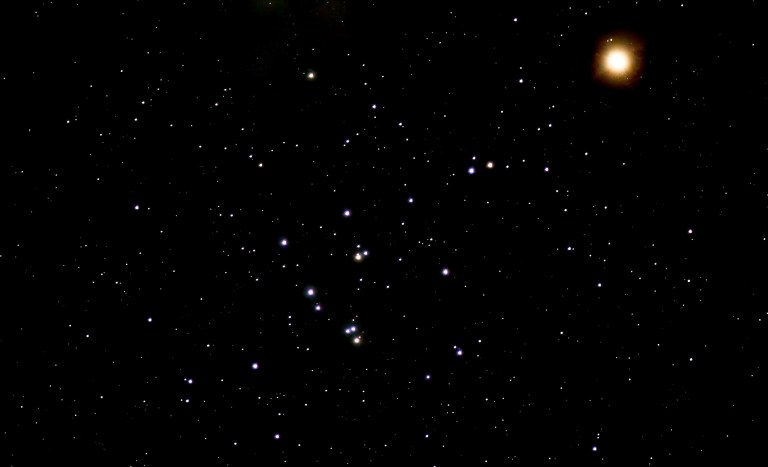
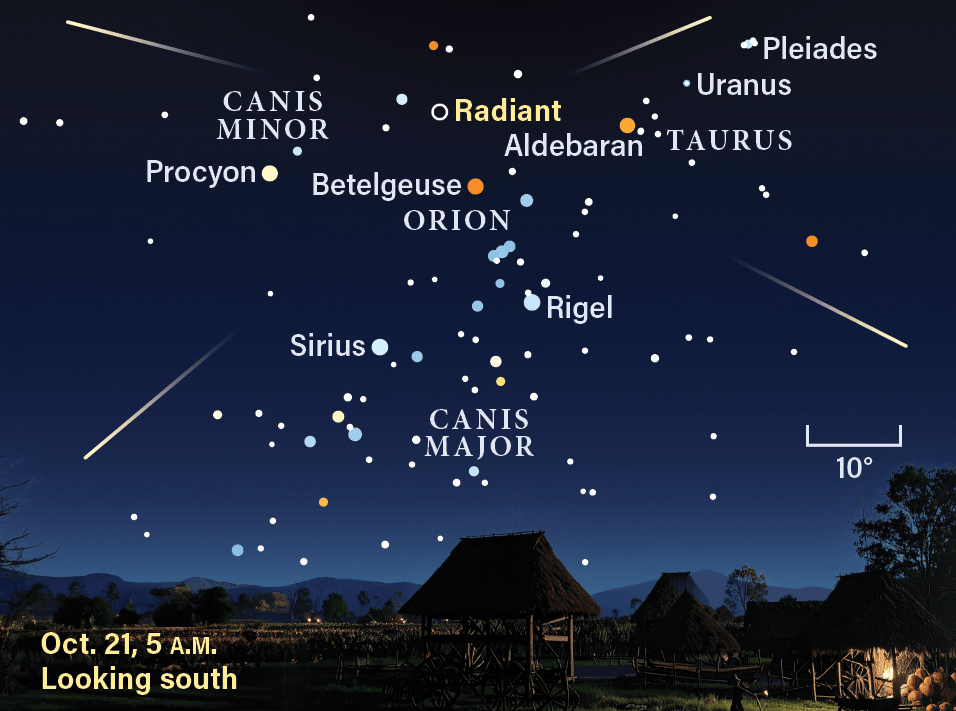
The Orionid meteor shower peaks this morning — the perfect time to watch for shooting stars, as Earth turns into the meteoroid stream of dusty debris responsible for the show.
The best time to do some meteor-watching is between 2 A.M. local daylight time and dawn, as the radiant in Orion rises higher and the Moon has already set. Around 5 A.M., the Hunter stands above the southern horizon, his famous three-star Belt easy to find. Meteors in the Orionid shower appear to originate just to the upper left (northeast) of Betelgeuse, the bright red giant that serves as one of Orion’s shoulders. Once you’ve found this star, cast your gaze some 40° to 60° to either side, away from it — that’s where you’ll see meteors with the longest trains.
This year’s shower is expected to produce some 15–18 meteors per hour in the early-morning hours. And if you aren’t able to get out in the morning, you can try again late tonight after Orion rises and overnight into tomorrow morning. Even though the peak has passed, meteor rates will still be higher than the sporadic six or so per hour that are visible even without any showers active.
Sunrise: 7:17 A.M.
Sunset: 6:11 P.M.
Moonrise: 3:56 P.M.
Moonset: 2:15 A.M.
Moon Phase: Waxing gibbous (81%)
Thursday, October 22
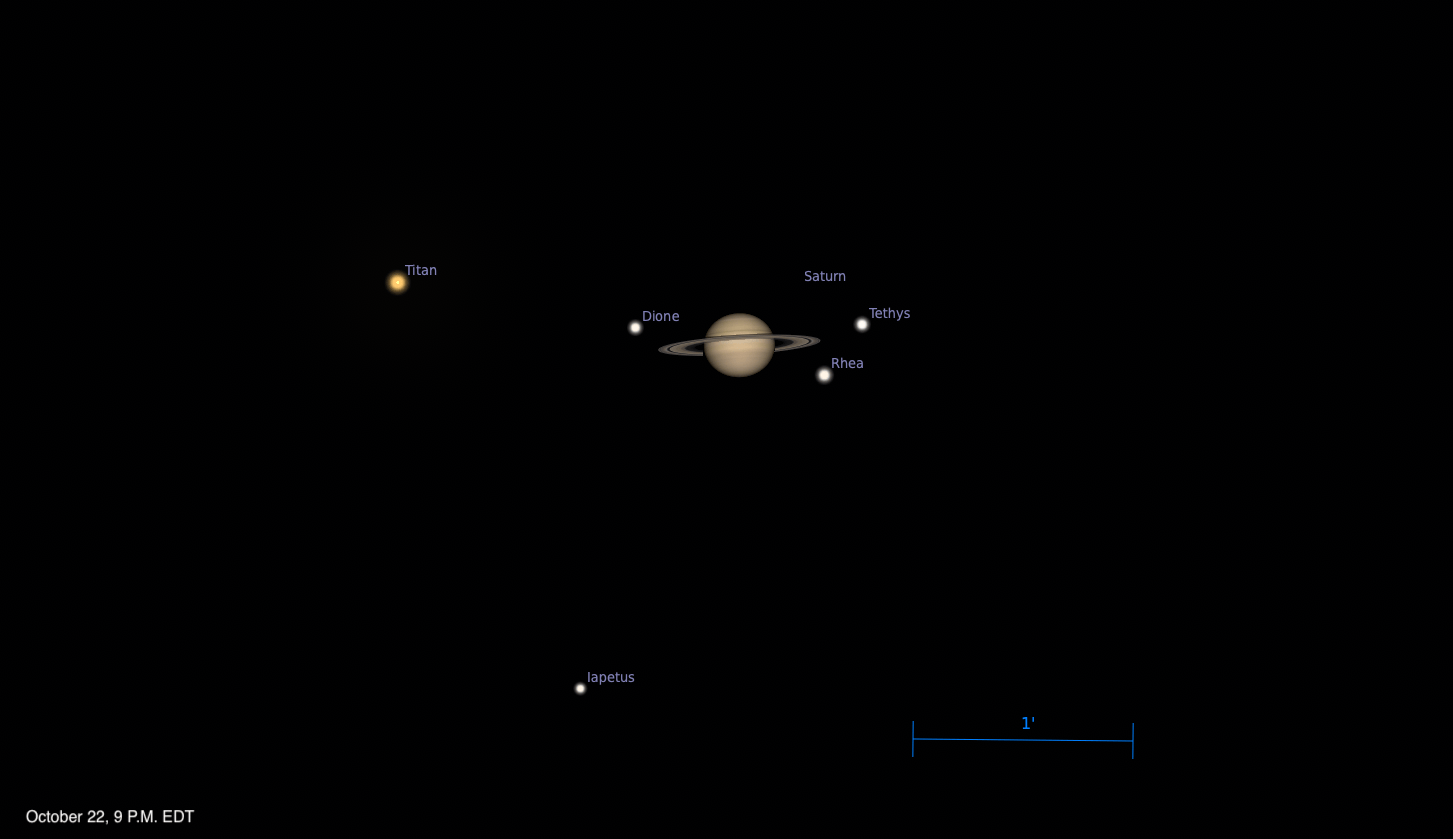
Saturn’s strange, two-faced moon Iapetus orbits on a wide path that it takes nearly 80 days to complete. During that time, it slowly rotates in synchrony with its orbit, brightening and fading by up to two magnitudes, depending on which hemisphere is facing Earth.
Tonight, Iapetus is just past superior conjunction, sitting south of Saturn and glowing at 11th magnitude. It is visible with a telescope. Saturn is already well-positioned soon after darkness falls, reaching a height of roughly 30° above the eastern horizon by 8 P.M. local daylight time. Through a telescope, you’ll easily view its lovely rings, showing off their southern side. Bright Titan, its largest moon, is just 1.6’ east of the planet, shining at mid-8th magnitude. Tethys, Rhea, and Dione shine around 10th magnitude and are closer to the ringed world. Around 8 P.M. CDT, Dione is east of Saturn and Tethys and Rhea are west of the planet.
Iapetus lies 1.7’ south-southeast of Saturn, fainter than the other four moons. Because its orbit takes it so far from the planet and because it is faint, Iapetus is easiest to find at superior and inferior conjunction, so tonight is a great time to track it down.
Sunrise: 7:18 A.M.
Sunset: 6:10 P.M.
Moonrise: 4:18 P.M.
Moonset: 3:20 A.M.
Moon Phase: Waxing gibbous (89%)
Friday, October 23
The nearly Full Moon passes 5° north of Neptune at 11 P.M. EDT, creating a celestial triangle with the ice giant and nearby gas giant Saturn. Our satellite and Neptune share the constellation Pisces, while Saturn floats in northwestern Cetus.
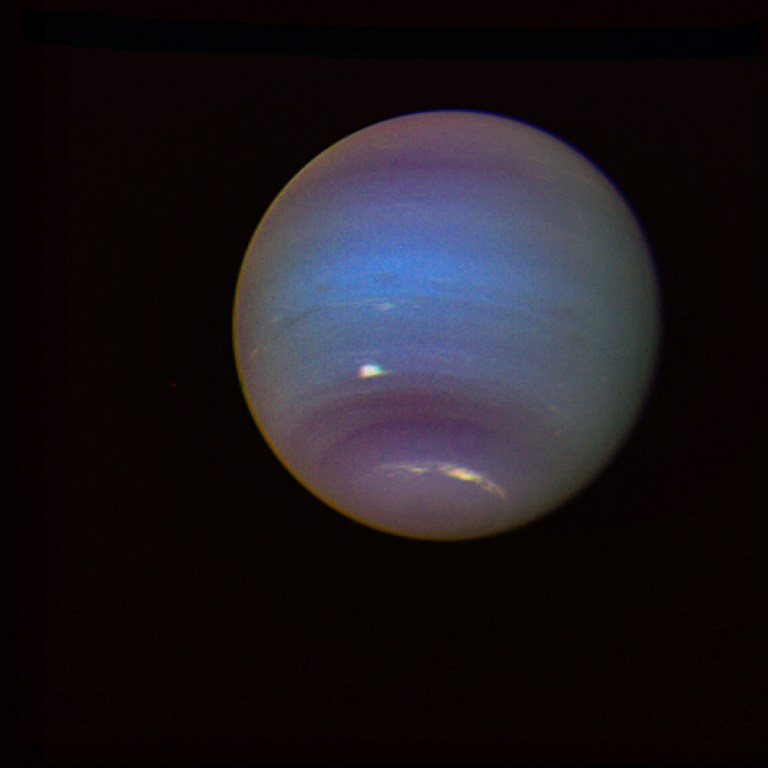
By early evening, the trio stands above the southeastern horizon, and by local midnight they are high in the south. Neptune is 4° south of (below) the Moon, while Saturn is 8° to our satellite’s southeast (left). Only the latter planet is visible to the naked eye, as Neptune requires binoculars or a telescope to view. With the bright Moon nearby, the latter is your best bet, as it offers higher magnification. Through a scope, Neptune will look like a “flat,” bluish-gray star, with a tiny disk extending 2” in diameter.
Saturn is much more impressive, with its disk 19” across and its rings some 44” from end to end. Its brightest moon, Titan, is just to the planet’s northeast, while around midnight CDT fainter Rhea and Tethys are east of the ringed world and Dione stands to its west. Iapetus, around 11th magnitude, remains relatively nearby, now about 2’ southeast of the planet. It’s still a great opportunity to catch so many of Saturn’s moons huddled close together.
Venus reaches inferior conjunction with the Sun at midnight EDT.
Sunrise: 7:19 A.M.
Sunset: 6:09 P.M.
Moonrise: 4:41 P.M.
Moonset: 4:26 A.M.
Moon Phase: Waxing gibbous (95%)
Alison Klesman is senior editor of Astronomy magazine. She holds a Ph.D. in astronomy and has studied a variety of topics, from minor planets to supermassive black holes.