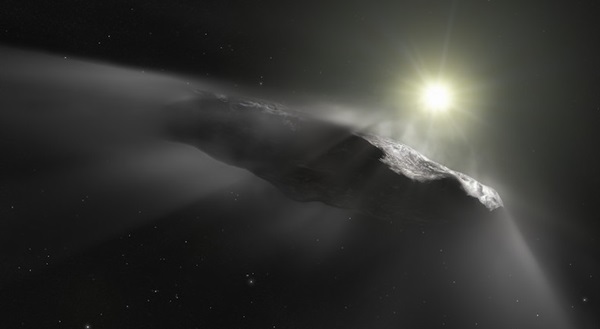
Sometime around the year 1837, a strange object passed an invisible cosmic mile marker: 1,000 astronomical units from the Sun. (One astronomical unit, or AU, is the average Earth-Sun distance.) For more than a century, it continued undetected toward our star. Finally, on Oct. 19, 2017, humans noticed the visitor.
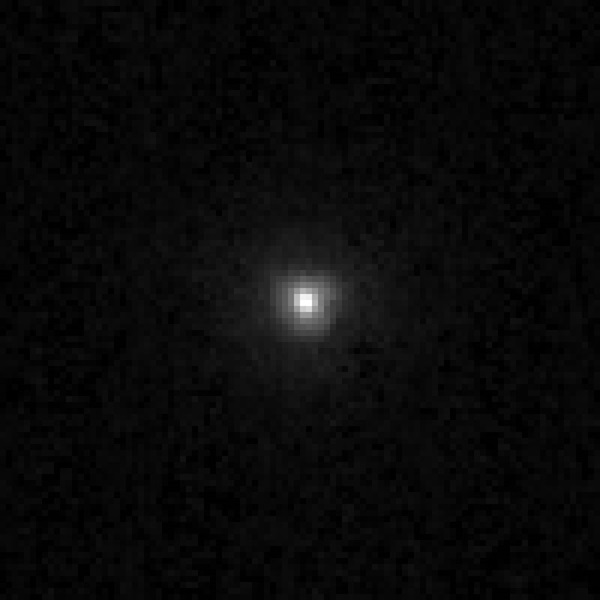
That night, a faint, thin streak appeared in a 45-second-long image snapped by the University of Hawai’i’s Pan-STARRS1 Telescope on Maui. The next morning, postdoctoral researcher Robert Weryk spotted the streak and compared it to an image taken the day before. The object was there, too. It was moving steadily across the sky, covering about 6.2° each day.
By Oct. 22, two things were clear: The object was on a hyperbolic orbit, meaning it comes close to our Sun only once and then shoots away again, never to return. And, based on its orbit, it did not originate in our solar system at all, but instead came from another star system. It was our first known interstellar visitor. Officially named 1I/2017 U1, the object is also known as ‘Oumuamua, which means “a messenger from afar arriving first” in Hawaiian. Following its discovery, ‘Oumuamua was moving so fast that astronomers had a scant four months to observe it; after that, the object had retreated too far from the Sun, fading past our ability to track it. But in 2019, we’d meet our second interstellar visitor, Comet 2I/Borisov, and in July of 2025, the third known object from outside our solar system, 3I/ATLAS, was spotted.
Alison Klesman is senior editor of Astronomy magazine. She holds a Ph.D. in astronomy and has studied a variety of topics, from minor planets to supermassive black holes.