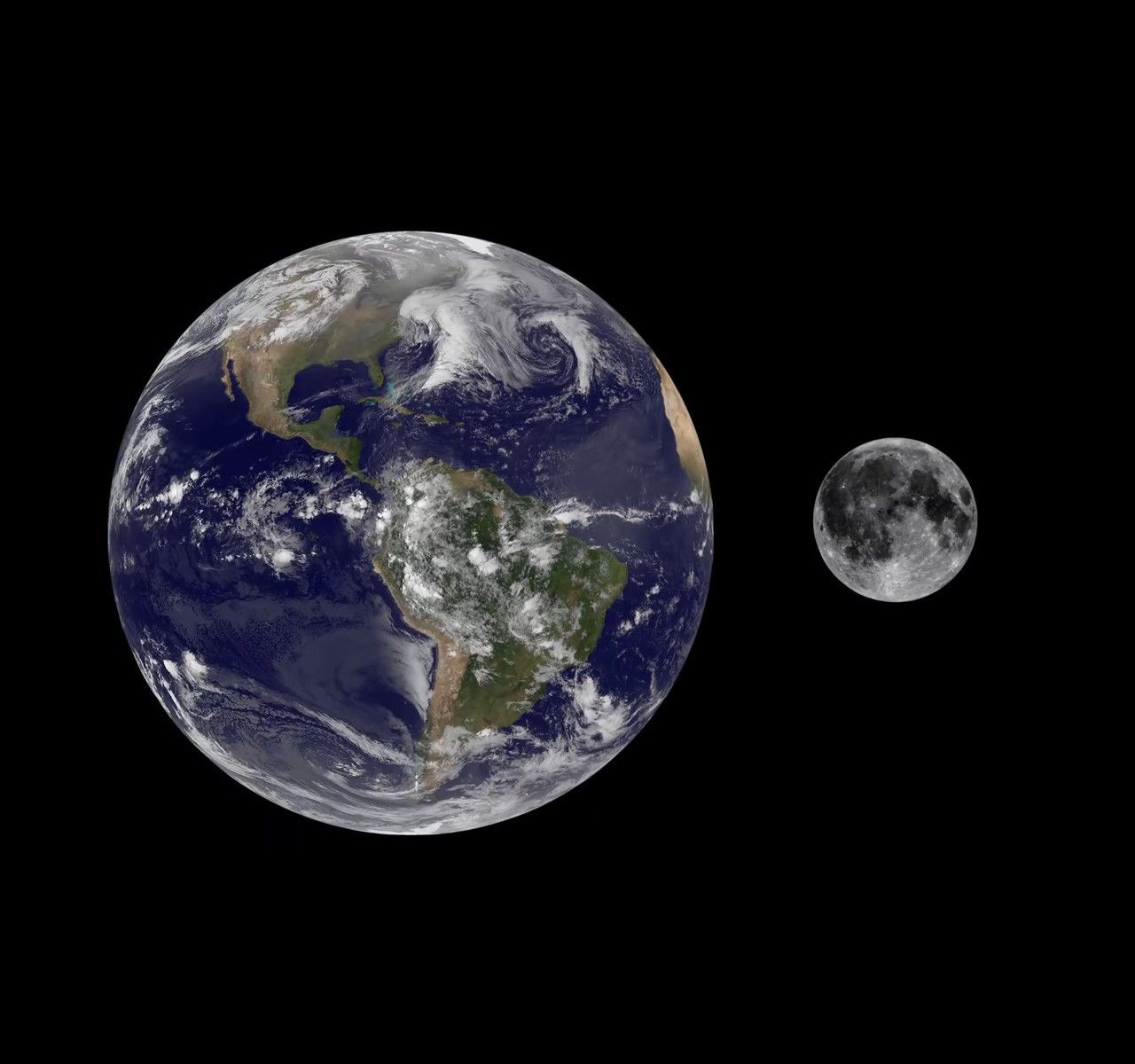
How can it be that the Moon’s mass is a little over 1 percent of Earth’s mass, while its gravity is about 17 percent of Earth’s gravity? Why aren’t the mass and gravity more closely correlated?
John Haley
Huntsville, Alabama
The answer to your question can be found in the universal law of gravitation, which states that the gravitational force exerted between two objects increases directly with the masses of both, but decreases with the square of their separation. This means that if you double the distance between yourself and another massive body, the magnitude of the gravitational force between you and that body will be reduced to one-quarter of its original value.
Imagine you’re standing on Earth. (This might not require a great deal of imagination.) You remain firmly fixed to the planet’s surface because of its gravitational pull, which is the cumulative effect of every particle comprising Earth. Literally everything on and within the planet is pulling on you: the rocks beneath your feet, the iron/nickel core, the Pacific Ocean, and the Himalaya Mountains, to name just a few. The magnitude of a given particle’s gravitational force on you is related to both its mass and its distance from you. Thus, despite the impressive mass of the Himalayas, for someone in New York City, the more modest Appalachian range is pulling on them with much more force simply because they are closer.
This means that when it comes to surface gravity, the Moon can punch above its mass: Because it is smaller than Earth, a person standing on the lunar surface is closer to every particle that makes up the Moon.
The situation would be different if the Moon suddenly became as large as Earth while retaining its current mass. In that case, the Moon’s surface gravity would be just 1.2 percent of Earth’s surface gravity — exactly the same ratio as their masses. But by virtue of the Moon’s smaller size — the Moon’s radius is just over one-quarter the radius of Earth — its surface gravity exceeds that ratio, being roughly 17 percent as strong as Earth’s.
Thus, when it comes to surface gravity, mass does matter, but so, too, does size.
Edward Herrick-Gleason
Astronomy Educator, St. John’s, Newfoundland and Labrador