If you can’t immediately conjure up the position of the constellation Lynx, I understand. It’s not an iconic star figure like Orion or Scorpius. A good, reasoned guess would place it in the winter sky (because this story is in the January issue). But, in fact, about half of Lynx lies directly north of Cancer the Crab, and the rest of the star pattern sits between the Big Dipper’s bowl and the main part of Auriga the Charioteer. So you can observe it in the springtime, too.
Of the 88 constellations that cover the sky, Lynx ranks 28th in size but only 66th in overall brightness. It contains only one of the 200 brightest stars, and that one — magnitude 3.2 Alpha (α) Lyncis — barely makes the list at number 191.
Lynx is a northern constellation, but at least part of it is visible from earthly locations north of latitude 57° south. Observers located north of latitude 28° south can see the entire constellation. Both of these numbers, however, assume a perfect horizon. In practice, move 5° north in each case to assure good visibility.
This star pattern does not come to us from antiquity. German astronomer Johannes Hevelius, best known for his studies of lunar features, included Lynx (along with six other new star figures) in a celestial atlas of 56 engraved maps that accompanied his 1690 star catalog, Firmamentum Sobiescianum, sive Uranographia, totum Coelum Stellatum.
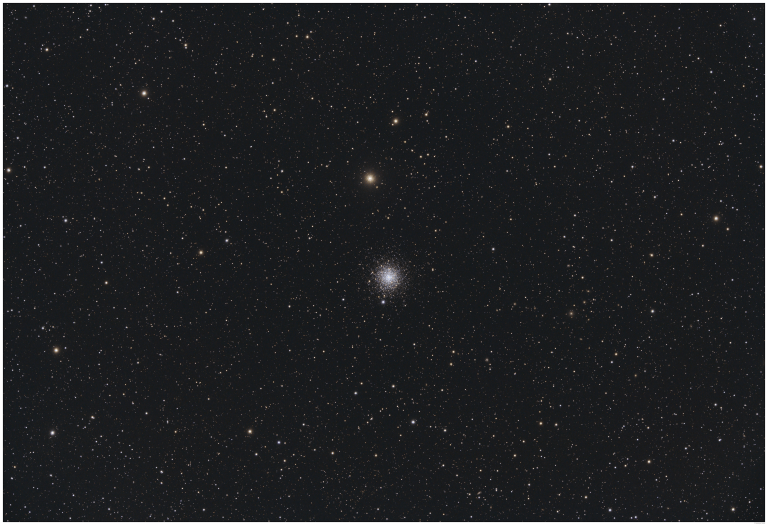
In the more than three centuries since this constellation’s birth, astronomers have found numerous deep-sky targets within its boundaries. Most are dim galaxies too numerous to count and too faint to target with amateur telescopes. But enough bright targets lurk within Lynx to fill an evening observing session.
In this story, I’ll describe 10 of my favorites, and I’ve included something for everyone. Small-scope users can enjoy a trio of nice double stars and a famous globular cluster. And large-scope owners can challenge both their optics and their sky conditions not only with individual galaxies, but also with clusters of those distant, massive star systems. In each section, the objects are in order of increasing right ascension, so the westernmost ones will rise first.
Explore Lynx
Select a target to discover the deep-sky treasures of the Lynx constellation.

Explore more of the night sky with our other interactive deep-sky tours:
Wander the Queen’s starry court
Discover deep-sky gems in Ophiuchus
Michael Bakich has spent his life immersed in astronomy, earning two degrees in the field, authoring seven books, and joining Astronomy magazine in 2003. When not writing or leading tours to eclipses and historical astronomy sites worldwide, he enjoys woodworking, science-fiction movies, and collecting rare 19th-century astronomy books from his home in Tucson.