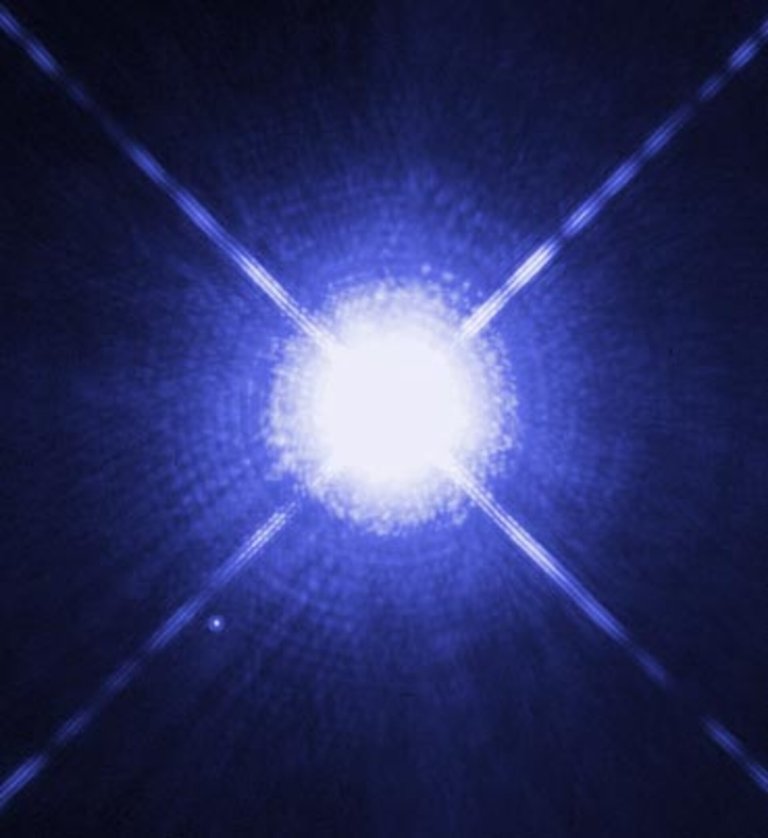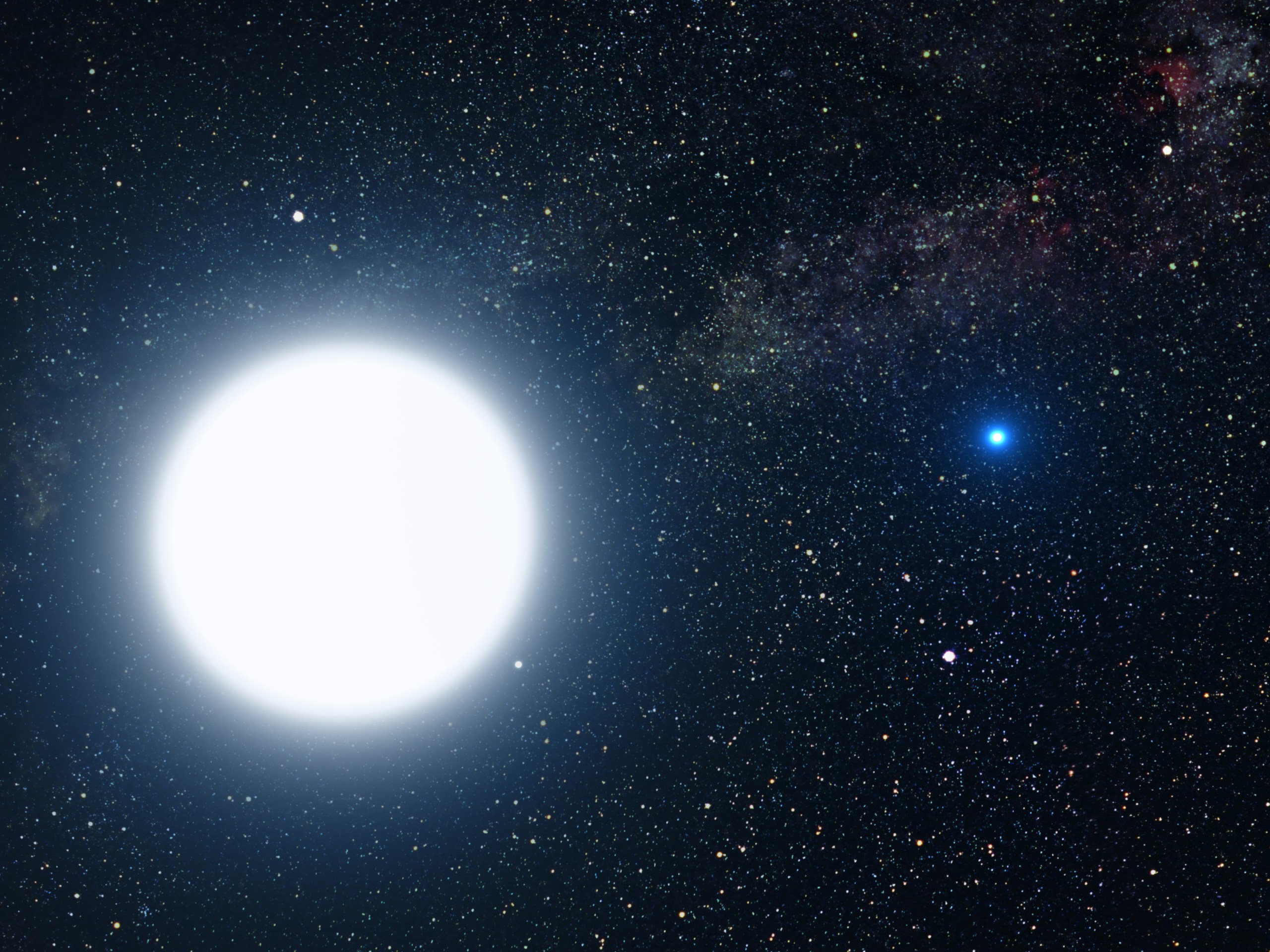
Sirius is a blue giant, which burns through its fuel quickly and lives only a relatively short period of time. Yet it has a white dwarf companion (Sirius B) and white dwarfs are the end result of stars like our Sun, which live for billions of years. How can a young blue giant have a companion star that’s billions of years older?
John Gould
Moab, Utah
This is a great question. It hinges on the fact that while we often say that white dwarfs are the remnants of Sun-like stars, the term Sun-like in this case is admittedly a bit of an oversimplification.
Generally, Sun-like means stars of similar mass, temperature, brightness, and evolutionary stage to our Sun. But when we are talking about white dwarfs, Sun-like ultimately means progenitor stars with masses such that they evolve like the Sun — or, in other words, stars that are not massive enough to end their lives as supernovae. A star’s internal workings — its pressure, temperature, and brightness — are largely determined by its mass. In turn, pressure and temperature determine the types of fuel the star can burn throughout its life, which ultimately affect its demise.
Any star with a mass less than about eight or nine times that of the Sun will leave a white dwarf behind when it dies — essentially the inert, leftover, glowing core of the star after it has blown the rest of its material away. Stars more massive than this evolve in a slightly different way; because they are more massive, their interiors are under greater pressure and thus hotter. So, they are capable of burning through more elements as fuel than lighter stars, and they can leave behind either a neutron star or a black hole (again, depending on the progenitor’s mass).
What does all this mean for Sirius A and B? Let’s start with Sirius A, the blue giant. It is classified as an A-type main sequence star (meaning it is not in a giant phase and is still burning hydrogen in its core) that shines some 25 times brighter than the Sun and has a mass about twice that of the Sun. Astronomers guess that it will live only about 1 billion years in total, as opposed to our Sun’s 10-billion-year lifespan. And it, too, will leave behind a white dwarf.
Now for Sirius B: As you say, because it has already evolved to the end of its life, it must have been more massive than Sirius A. But here’s the catch, and where “Sun-like” causes the confusion — astronomers believe the progenitor star that formed Sirius B weighed roughly 5 solar masses. At that mass, it’s still considered Sun-like in that its end stage is a white dwarf. But of course, because of its greater mass, it evolved quickly — a 2005 study finds it likely burned all its hydrogen fuel in only 100 million years or so.
In fact, the Sirius system — meaning both stars, the giant and the white dwarf — is only about 250 million years old. So while Sirius A might make it a billion years before ceasing fusion, not all stars that leave behind the same type of remnant as our Sun live even that long.
Alison Klesman
Senior Editor