The world’s first commercial space science telescope, Mauve, just sent back data from low-Earth orbit, achieving “first light” — and signaling a potential new era for low-cost observation.
Launched Nov. 28, 2025, aboard SpaceX’s Transporter-15, Mauve was created by British space company Blue Skies Space to observe stars in ultraviolet light and help astronomers study how stellar flares affect whether exoplanets can support life. The small, suitcase-sized satellite and its 5-inch-aperture (130mm) telescope were conceived, constructed, and launched over the span of just three years — a fairly rapid timeline that Blue Skies Space hopes will become the norm as commercial space science missions proliferate. Mauve transmitted its first results on Feb. 9, from a 5-second observation of the star Alkaid (Eta [η] Ursae Majoris), the star at the end of the Big Dipper’s handle, located approximately 104 light-years away.
Giovanna Tinetti, professor of physics at King’s College London and co-founder of Blue Skies Space, noted in a press release that while the November launch was an emotional experience, “[T]he real excitement comes when the data start flowing in: seeing the first spectrum from Mauve has suddenly made me realise that we’ll soon do science with the first privately funded space science mission ever!”
A new model for space science
Blue Skies Space was founded in 2014 by Tinetti and CEO Marcell Tessenyi. The company is pioneering what it calls “space science as a service” — a model in which universities worldwide buy telescope time on privately operated satellites, much as they subscribe to ground-based observatories.
Mauve rode to orbit last year as one of 140 payloads aboard SpaceX’s Transporter-15 rideshare mission, a Falcon 9 rocket that placed the satellite into a sun-synchronous low-Earth orbit at 317 miles (510 km) altitude.
The satellite itself is a CubeSat measuring roughly 9 by 9 by 18 inches and weighing just 41 pounds (18.6 kilograms). Its 5-inch Cassegrain telescope — a modified off-the-shelf commercial unit — observes visible and near-ultraviolet light, covering wavelengths from 700 to 200 nanometers. For context, Hubble’s mirror measures 2.4 meters across, and James Webb’s stretches 6.5 meters. But Blue Skies aims to complement those telescopes with unique capabilities.
Mauve will operate at UV wavelengths, which ground-based telescopes cannot see due to obstruction from the Earth’s atmosphere. It will also do what astronomers call time-domain surveys, observing the same stars over and over again to monitor the changes in their UV brightness with time. Such sustained campaigns aren’t practical for a telescope that’s in demand like Hubble — and JWST, though powerful, operates mainly at infrared wavelengths rather than UV. Both telescopes have broad applications and are shared by scientists from all over the globe. Mauve offers a more specialized observation approach, so scientists studying stellar magnetic activity, flares, and exoplanet habitability don’t have to compete for Hubble observing time.
First light
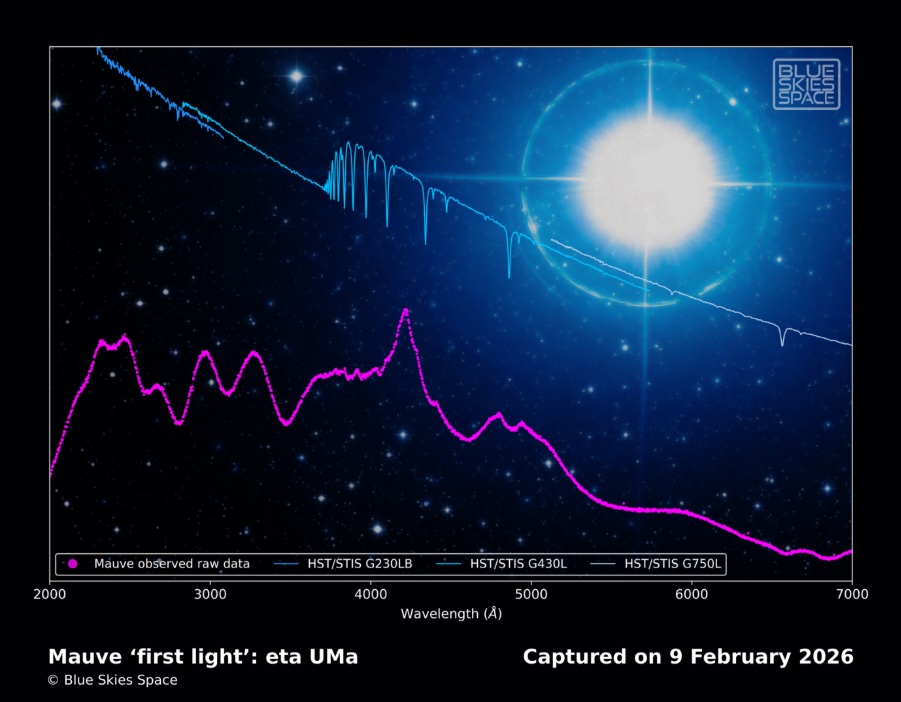
For its first target, the team chose Alkaid, a hot, blue-white B-type star extremely bright in ultraviolet light — ideal for calibrating a new ultraviolet instrument. In particular, the star displays a well-known dip in its spectrum, a so-called “Balmer jump,” caused by hydrogen absorption — a predictable feature that makes it ideal for confirming the instrument is taking accurate readings.
Blue Skies Space released the raw data from Mauve alongside archival Hubble observations of the same star, showing that Mauve’s data captures the same key spectral features — a promising sign as the team begins calibration. “Achieving first light with Mauve is a fantastic milestone,” added Ian Stotesbury, lead systems engineer at Blue Skies Space. “It’s great to see Mauve perform brilliantly in orbit. Full instrument performance will be established over the coming weeks as we continue calibration and observe progressively fainter targets.”
A paper by the Mauve Science Collaboration posted to the arXiv preprint server outlines 10 research themes for the satellite’s first year, falling into four broad areas: stellar activity and variability, host-star and exoplanet interactions, hot stars, and exotic stellar populations in binary systems.
Specific themes include monitoring M-dwarf flares and superflares on young Sun-like stars, searching for coronal mass ejections through UV dimming, and surveying candidate stars for NASA’s future Habitable Worlds Observatory. Some 5,000 observational hours have been allocated for year one among ten institutions, including Columbia University, Vanderbilt University, Kyoto University, and Rice University.
The rise of private astronomy
Mauve’s arrival comes at a moment of increasing private ambition in space-based astronomy. In January, Schmidt Sciences — the philanthropic organization of former Google CEO Eric Schmidt and his wife Wendy — announced plans for Lazuli, a 3-meter space telescope that will be larger than Hubble.
Together, they represent the two vastly different ends of the private space science spectrum — a lean CubeSat built in three years on one end, and a Hubble-class observatory backed by billionaire philanthropy on the other. The landscape long dominated by government agencies is quickly changing. More space science telescopes are on the way — and with them, more observation time, more data, and hopefully more discoveries.