A long time ago, in a galaxy far, far away, a massive star collapsed, triggering a supernova explosion so bright it could be seen across the universe. When the light reached Earth, telescopes around the world and in space quickly focused on the blast. They confirmed it took place just 730 million years after the Big Bang, less than half the age of the previous record-holder.
This timing places the supernova in the heart of the epoch of reionization, when ultraviolet light from the first generation of massive stars was clearing the hydrogen fog that had permeated space during the so-called Dark Ages. Because astronomers know little about the universe’s first billion years, any observation from this era opens a new window into cosmic evolution.
It started with gamma rays
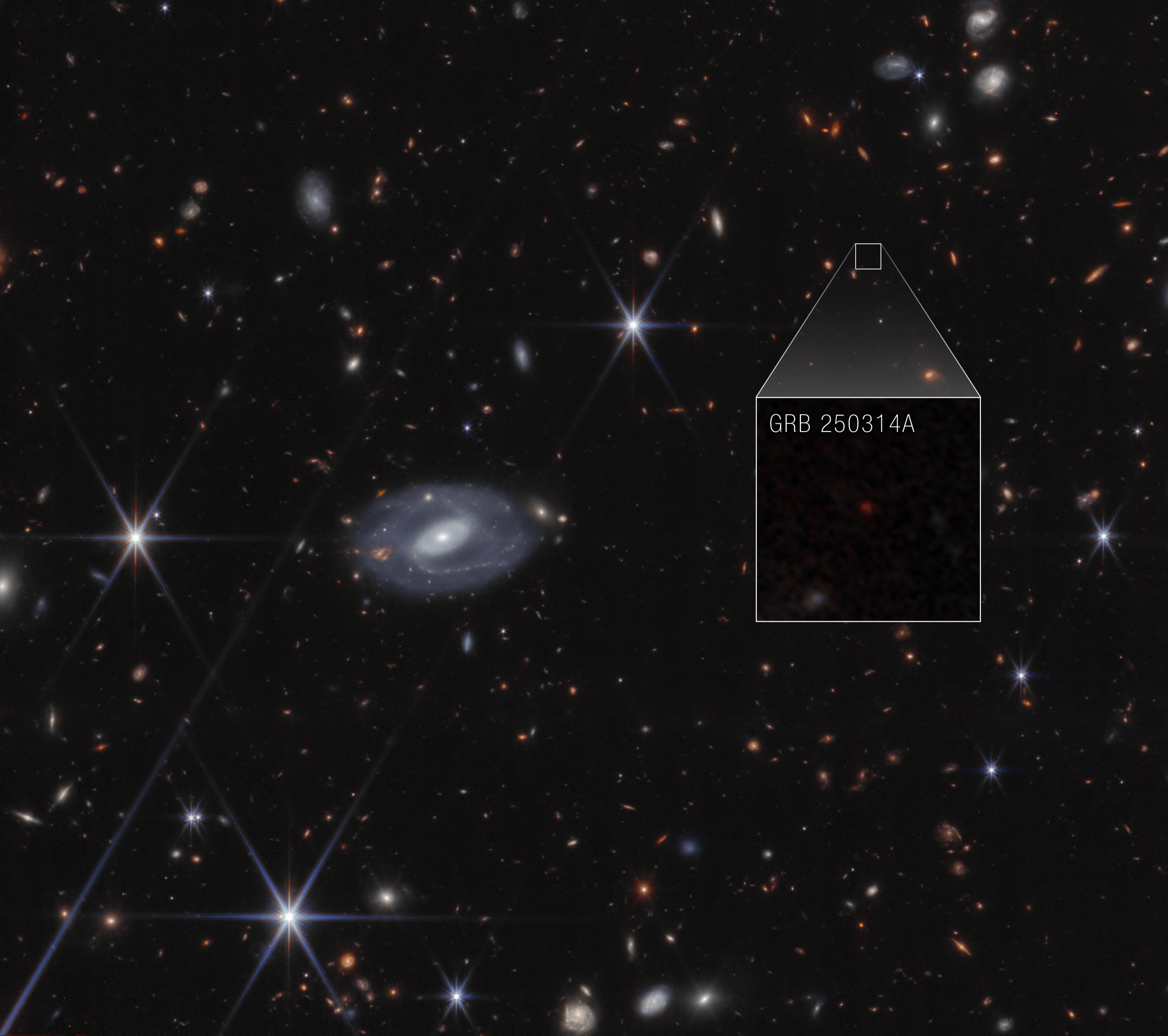
The story of the supernova’s discovery began March 14, 2025. That’s when the Space-based multiband astronomical Variable Objects Monitor (SVOM) satellite detected a 10-second-long burst of gamma rays, earning it the designation GRB 250314A.
Such long bursts — short gamma-ray bursts last no more than two seconds — typically arise when a star weighing at least 30 solar masses exhausts its nuclear fuel and collapses. This generates a shock wave that tears through the star’s outer layers and spawns a supernova. The collapsed core produces jets of particles traveling near the speed of light. When these jets pierce the stellar envelope, they emit beams of gamma rays that spread across the universe.
Scientists working on SVOM, a joint Chinese-French mission, promptly alerted their colleagues around the world. Within 1.5 hours, NASA’s Neil Gehrels Swift Observatory detected GRB 250314A’s X-ray afterglow and established its precise position. Eleven hours later, the 2.6-meter Nordic Optical Telescope on La Palma in the Canary Islands spotted the burst’s infrared afterglow. (Despite the telescope’s name, it also observes near-infrared light.)
Four hours after that, astronomers focused one of the 8-meter mirrors of Paranal Observatory’s Very Large Telescope in Chile on the spot. It captured a spectrum of the fading infrared afterglow, establishing a redshift of about 7.3 and confirming the light took some 13.1 billion years to reach us.
JWST forges the final link
And then astronomers waited. Supernovae typically reach peak brightness two to three weeks after the explosion. But Albert Einstein showed more than a century ago that events at high redshift occur in slow motion. For an object with a redshift of 7.3, actions happen 8.3 times more slowly. The same effect lengthens the wavelength of emitted light by a factor of 8.3.
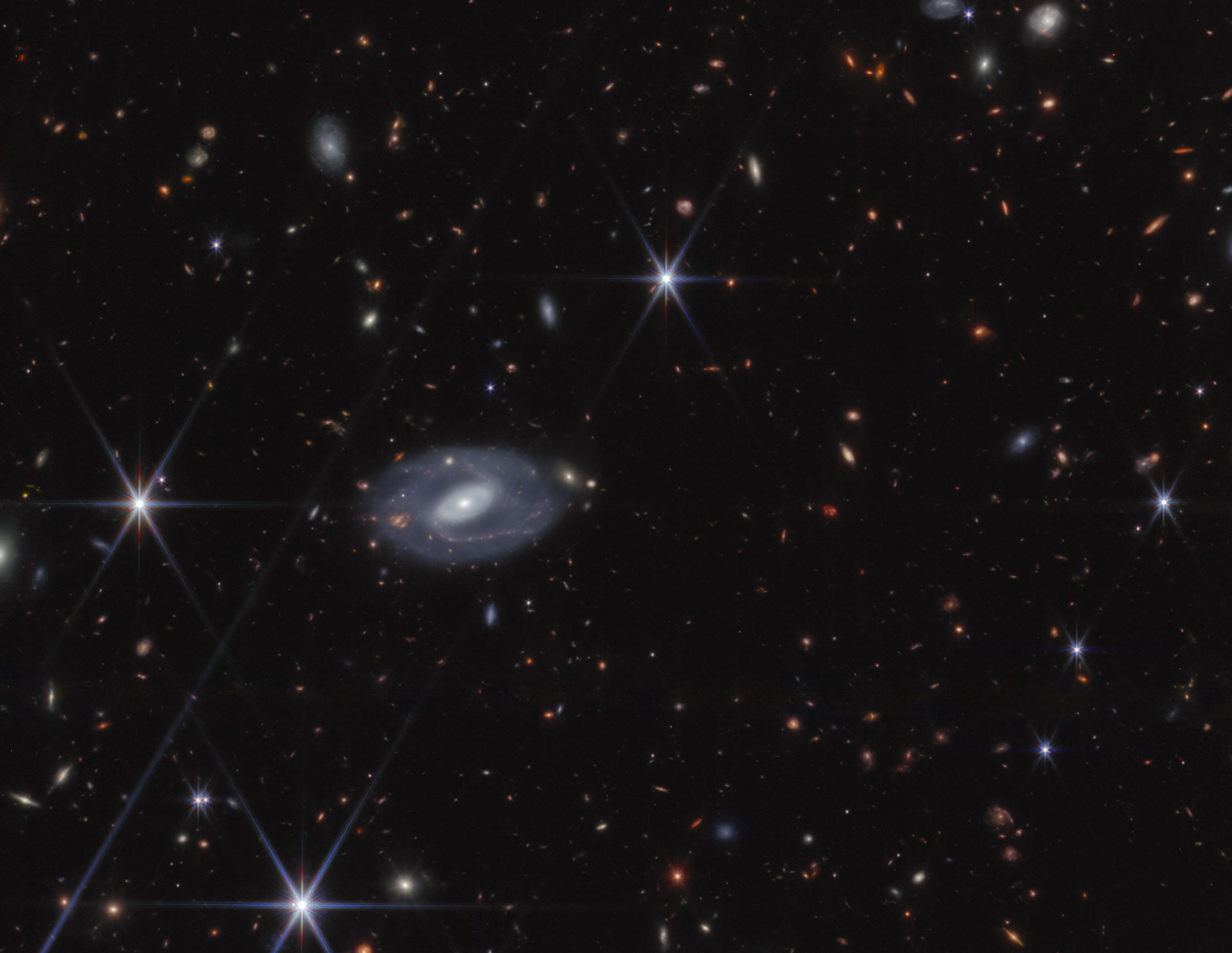
Astronomers took a 3.5-month break, until July 1, to target GRB 250314A with the infrared-sensitive James Webb Space Telescope (JWST). The observatory captured the blast’s faint glow and a hint of its host galaxy, confirming it as the earliest supernova ever observed.
“Only Webb could directly show that this light is from a supernova,” said lead researcher Andrew Levan of Radboud University in Nijmegen, Netherlands, and the University of Warwick in the United Kingdom, in a press release. The team reported its results in the December 2025 issue of Astronomy & Astrophysics Letters. “This observation also demonstrates that we can use Webb to find individual stars when the universe was only 5 percent of its current age,” he added.
Astronomers think stars in the early universe were more massive, lived shorter lives, and possessed fewer heavy elements than stars today. Would those conditions have an effect on the supernovae these behemoths produced?
“We went in with open minds,” said co-author Nial Tanvir of the University of Leicester in the U.K. “And lo and behold, Webb showed that this supernova looks exactly like modern super-novae.” Now researchers must find and scrutinize other early supernovae to look for subtle differences.
Contributing Editor Richard Talcott wrote about JWST’s observations of the star cluster Pismis 24 in the April issue.