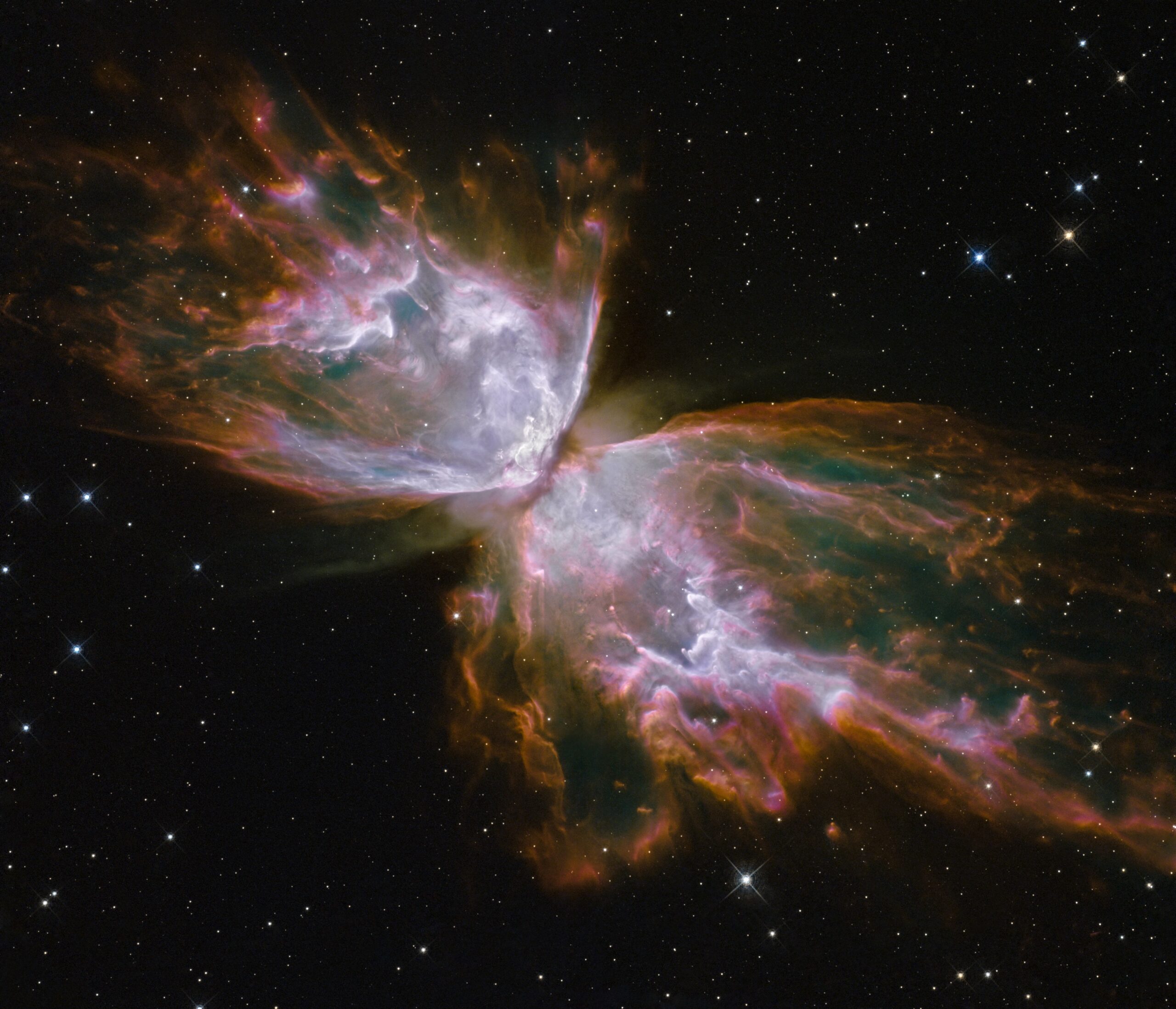
How long do planetary nebulae last on average? What are some of the controlling factors?
Doug Kaupa
Council Bluffs, Iowa
To understand how long a planetary nebula remains visible, we first need to understand why a planetary nebula is visible at all. When a solar-type star (one with a mass of 0.8 to eight times that of our Sun) reaches the end of its life cycle, it casts off its outer layers, leaving behind a hot core that emits copious amounts of high-energy ultraviolet rays. The expanding gas shell absorbs the rays, and this absorption leaves the gases in an excited state, meaning that the electrons within the atoms are elevated to higher energy levels. These electrons then emit visible light when they return to their original states. As the gas shell continues to expand, the planetary nebula will remain visible to us until the gases become too diffuse.
The duration of the visibility period will therefore depend on the amount of expelled material, which relates directly to the star’s mass; naturally, the greater the mass, the higher the amount of material expelled. The length of time that a nebula is visible also depends on its expansion rate: The faster it expands, the less time it will take for it to become too diffuse to absorb enough energy to glow. Yet another factor is metallicity, or chemical composition. Gaseous shells with a lower metal content tend to be less dense and therefore will become too rarefied to remain visible within a shorter amount of time. (Note: Astronomically speaking, a metal is defined as any element heavier than helium.)
Taking these factors into account, astronomers estimate that a planetary nebula should, on average, remain visible for 21,000 to 25,000 years before its shell is rendered invisible. Keep in mind that this value is an average. Planetary nebulae that expand very quickly and are less dense will vanish sooner, while those that expand more slowly and are of greater density will last longer.
In 2022, a team of astronomers from the University of Hong Kong and the Laboratory for Space Research discovered a planetary nebula in the star cluster M37 that they estimated to be 70,000 years old. (Astronomers can estimate a planetary nebula’s age by measuring its expansion speed and extrapolating backward.) This planetary nebula, IPHASX J055226.2+323724, is the oldest of the approximately 4,000 known planetary nebulae in our galaxy. Although it is an outlier, it illustrates the point that some planetary nebulae will last well beyond 25,000 years. It is highly unlikely that any planetary nebula would remain visible for more than 100,000 years, however.
We can conclude that the planetary nebulae we can see through our scopes (e.g., the Ring Nebula and the Helix Nebula) will remain visible for thousands of years. But compared to the stars that produce them, planetary nebulae are ephemeral entities indeed.
Edward Herrick-Gleason
Astronomy Educator, St. John’s, Newfoundland and Labrador