Looking for a sky event this week? Check out our full Sky This Week column.
November 1: The Moon in Cancer
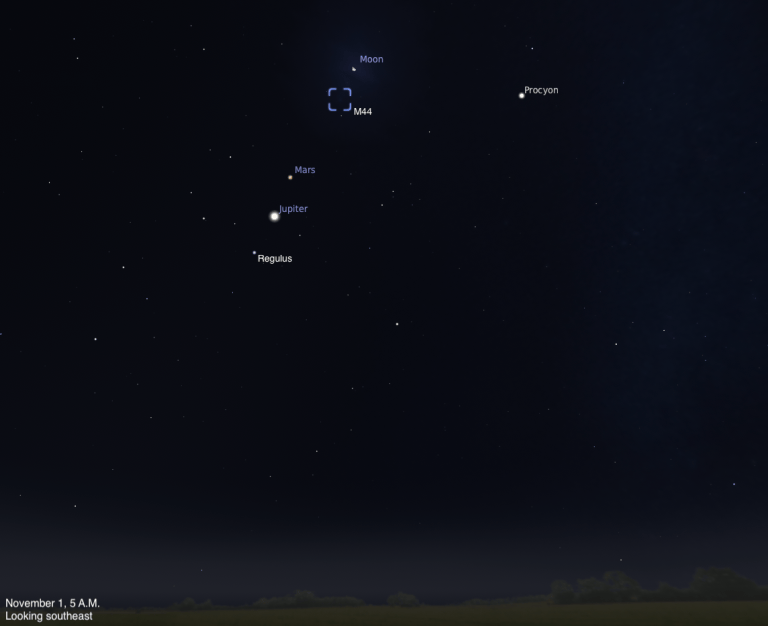
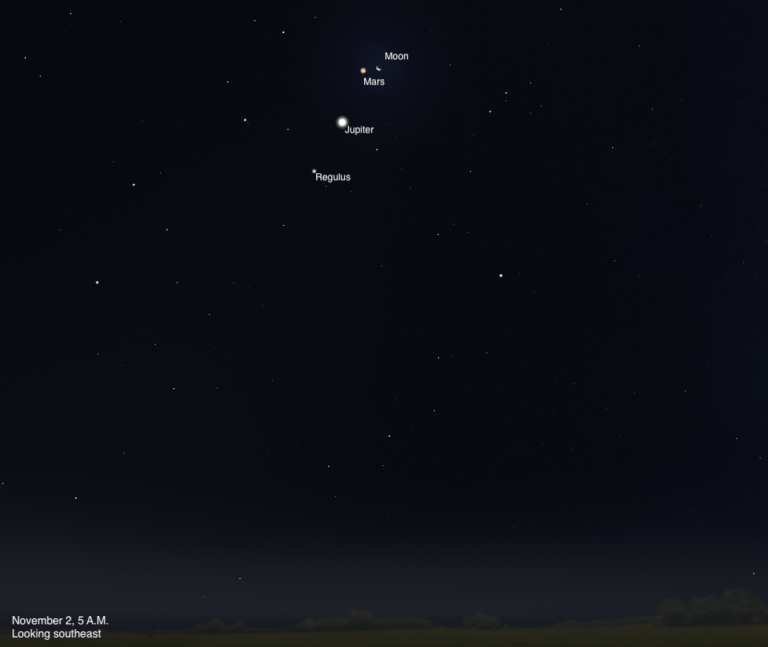
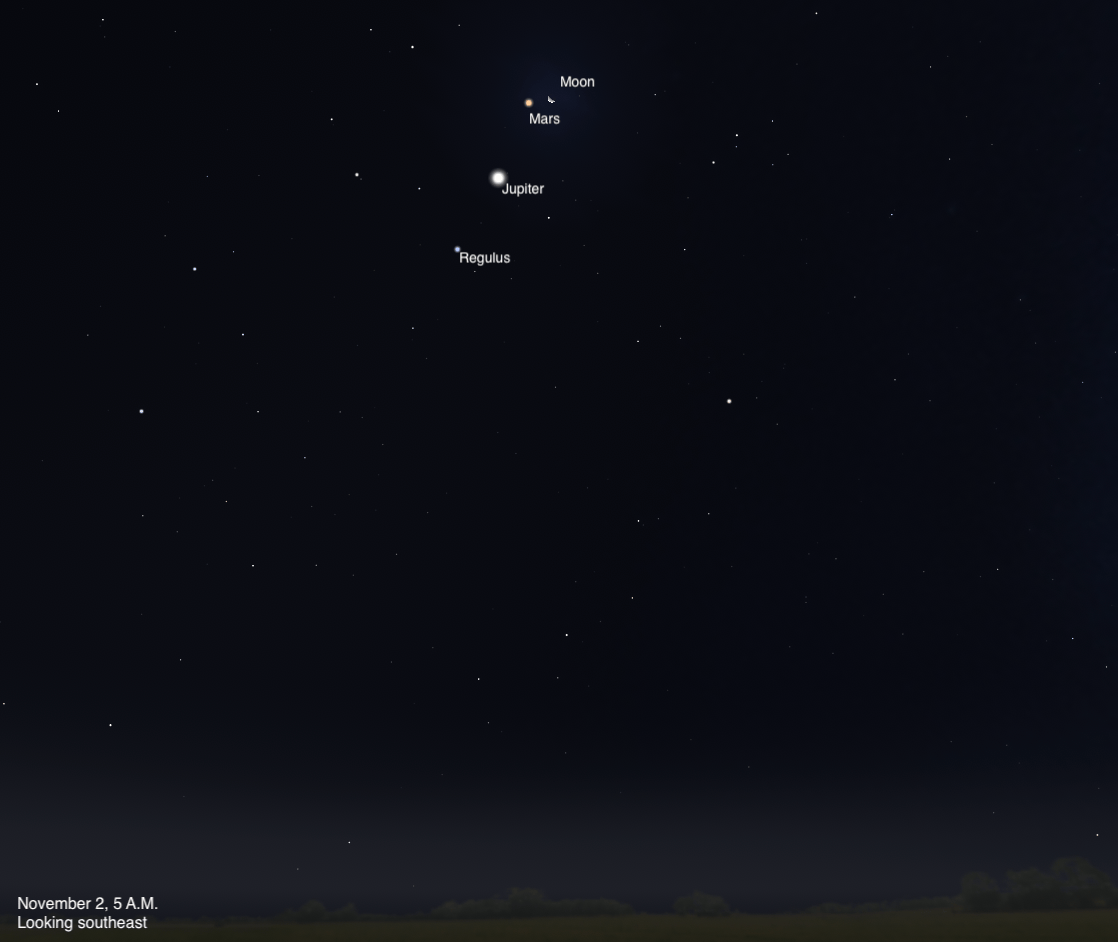
The Moon slides 1.1° south of Mars at 9 A.M. EST, then passes 0.5° south of Jupiter at 6 P.M. EST. Some parts of the world will see these planets disappear behind the Moon, although this is not visible from North America. Instead, we’ll focus on the trio’s appearance before this in the early-morning sky, where they dominate in the hours before sunrise.
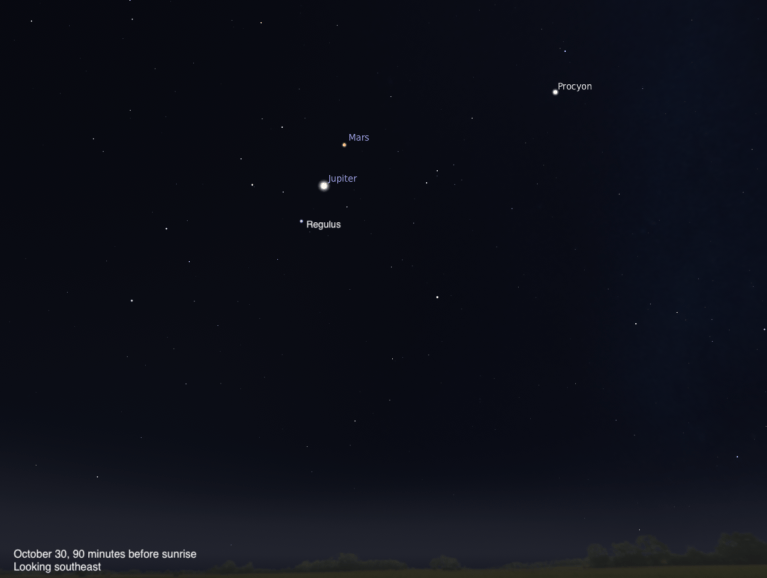
By 5 A.M. local time, western Leo is more than 50° high in the southeast. The Moon lies just to Mars’ upper right, roughly 1.5° southwest of the Red Planet’s position and 6.3° west-northwest of Jupiter. The gas giant is by far the brightest light here, shining at magnitude –2.0. This morning it lies halfway between the Moon and Regulus to its lower left (east), Leo’s alpha star and the base of the Sickle asterism.
This view offers a great opportunity to see just how far the Moon travels through our sky in a day. By tomorrow morning at the same time, Luna will have moved some 14° to the east, passing close to Regulus and standing southeast of the star in the early-morning sky at the same time. Make sure to check out the view tomorrow for comparison.
Sunrise: 6:30 A.M.
Sunset: 4:56 P.M.
Moonrise: —
Moonset: 1:41 P.M.
Moon Phase: Waning crescent (36%)
*Times for sunrise, sunset, moonrise, and moonset are given in local time from 40° N 90° W. The Moon’s illumination is given at 10 P.M. local time from the same location.
The Moon passes 0.8° south of the bright star Regulus in Leo at 4 A.M. EST on November 3. Some regions of the world will see our satellite pass in front of Regulus in an occultation, but again, the event is not visible from North America.
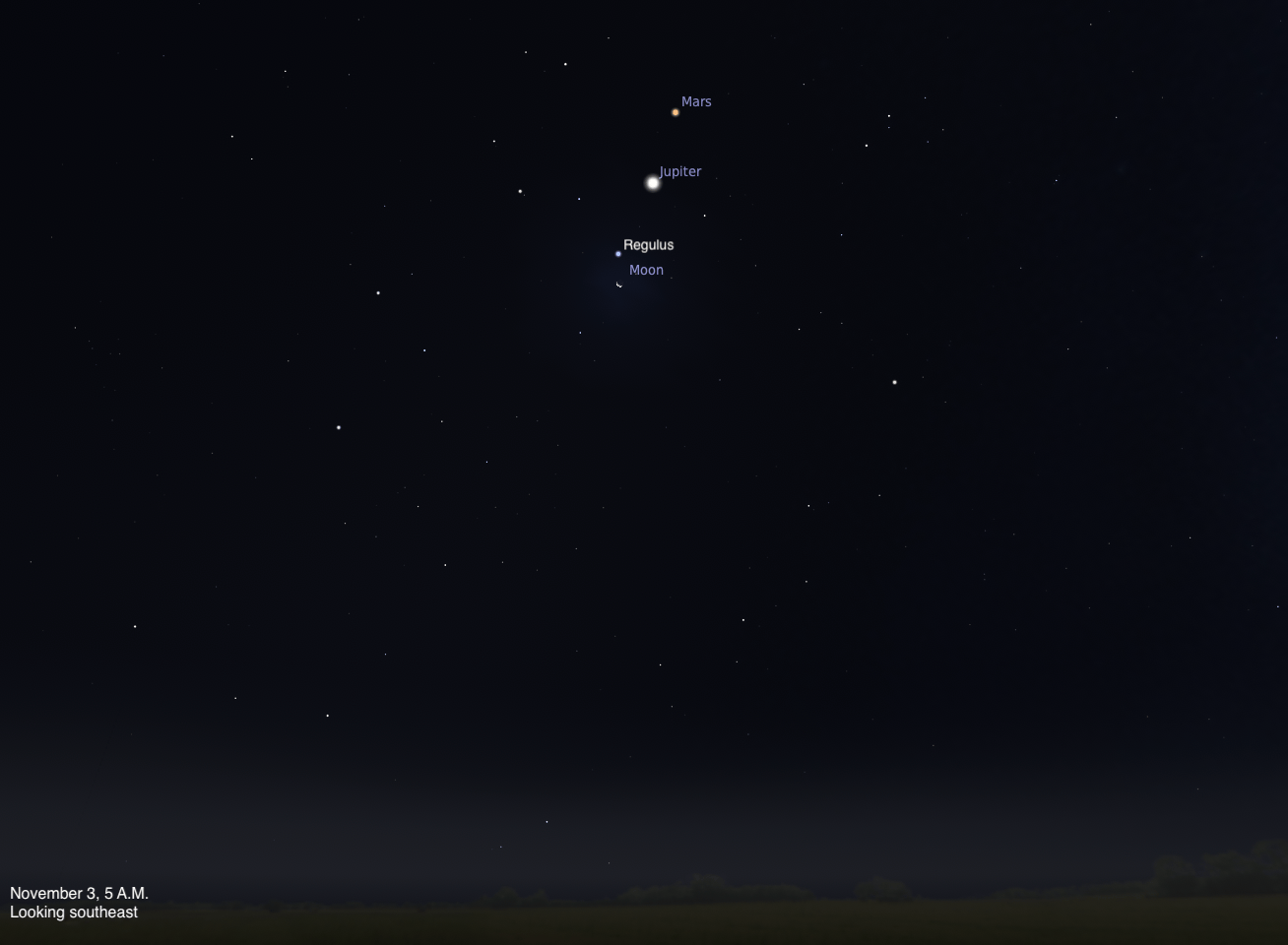
The pair rises together shortly after midnight on the 2nd, following Jupiter and Mars by roughly an hour. By 5 A.M. local time on the 3rd, the Moon-star pair is nearly 50° high in the southeast. Despite its brightness (it is ranked as the 21st brightest star in the sky), magnitude 1.4 Regulus will be the faintest object in this region, as magnitude 0.8 Mars and magnitude –2.0 Jupiter to its west (upper right) far outshine it.
The waning Moon has shrunk from roughly 43% lit yesterday morning to 33% lit today. It is just under a week from New phase, which occurs on the 9th. Between now and then, the phase will continue to diminish and the Moon will rise later in the morning each day, until it travels across the sky in tandem with the Sun when it is New.
Alison Klesman is senior editor of Astronomy magazine. She holds a Ph.D. in astronomy and has studied a variety of topics, from minor planets to supermassive black holes.