Looking for a sky event this week? Check out our full Sky This Week column.
June 20: Libra’s Ghost Cluster
The summer solstice occurs at 4:25 A.M. EDT. This is the time the Sun reaches its northernmost point in the Northern Hemisphere sky, which also means our star takes its longest path across this hemisphere’s sky on this date and provides the most hours of daylight. Today also marks the beginning of astronomical summer in the Northern Hemisphere, although meteorological summer began on the 1st of June.
First Quarter Moon occurs at 5:55 P.M. EDT. Rising around 1 P.M. local daylight time, our satellite is now in Virgo.
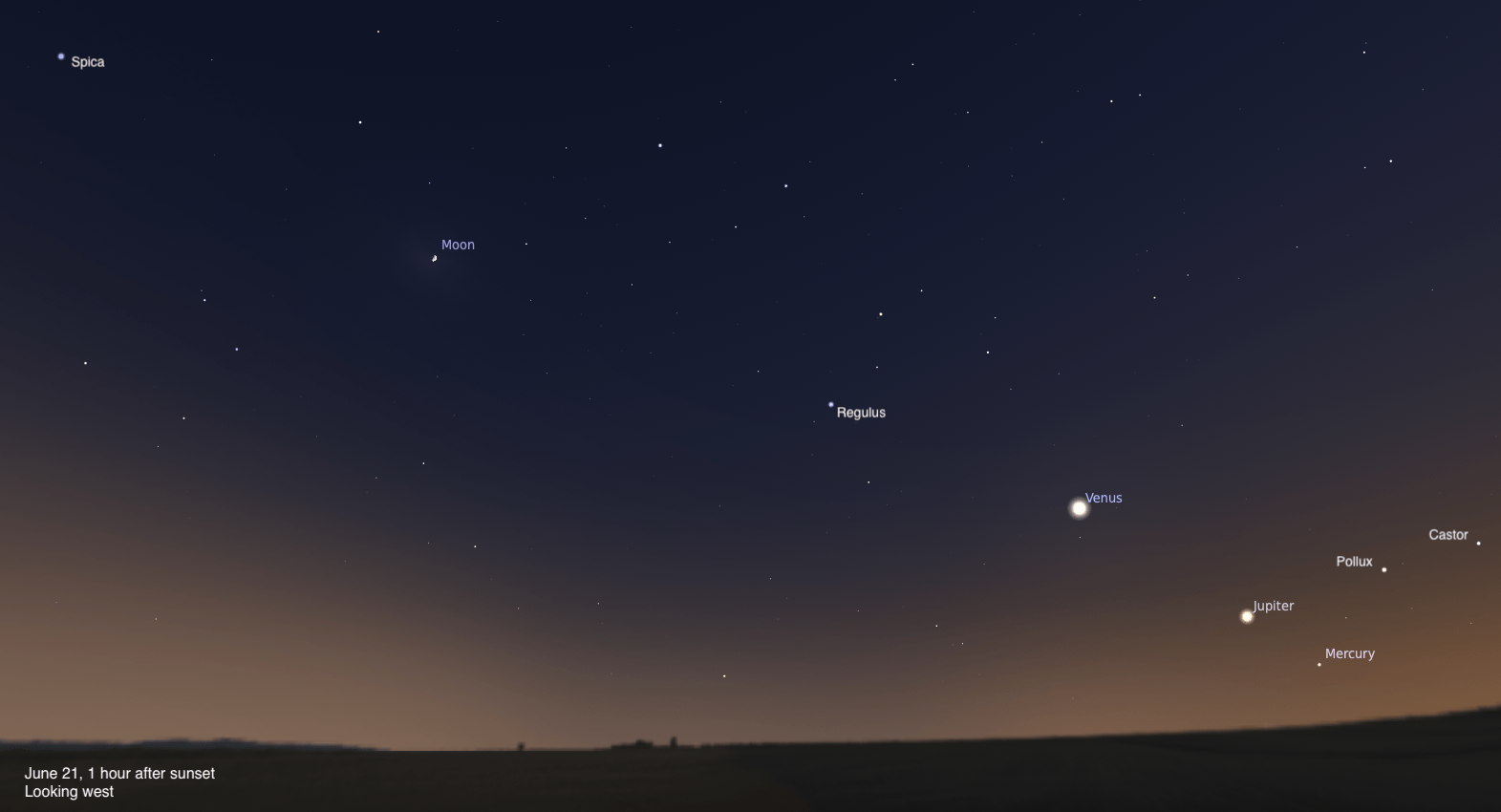
If you look west about an hour after sunset, you’ll see a long line of bright lights in the sky, starting with Mercury in Gemini, just 4° high. Stretching out to the upper left are then Jupiter, Venus, Regulus, the Moon, and Spica. The line these objects trace out is the ecliptic, the plane of the solar system where all the major planets orbit. The ecliptic is defined by the tilt of Earth’s orbit, such that Earth’s orbit is tilted 0° to this imaginary line. All the planets lie close to this plane, and even the Moon’s orbit lines up along it. Many bright stars also happen to sit near the ecliptic, and Regulus and Spica are two such stars. This is why the Moon regularly passes close to — or sometimes in front of — them.
Sunrise: 5:32 A.M.
Sunset: 8:32 P.M.
Moonrise: 12:56 P.M.
Moonset: 12:34 A.M.
Moon Phase: Waxing gibbous (52%)
*Times for sunrise, sunset, moonrise, and moonset are given in local time from 40° N 90° W. The Moon’s illumination is given at 10 P.M. local time from the same location.
Alison Klesman is senior editor of Astronomy magazine. She holds a Ph.D. in astronomy and has studied a variety of topics, from minor planets to supermassive black holes.