Looking for a sky event this week? Check out our full Sky This Week column.
June 15: Mercury at greatest eastern elongation
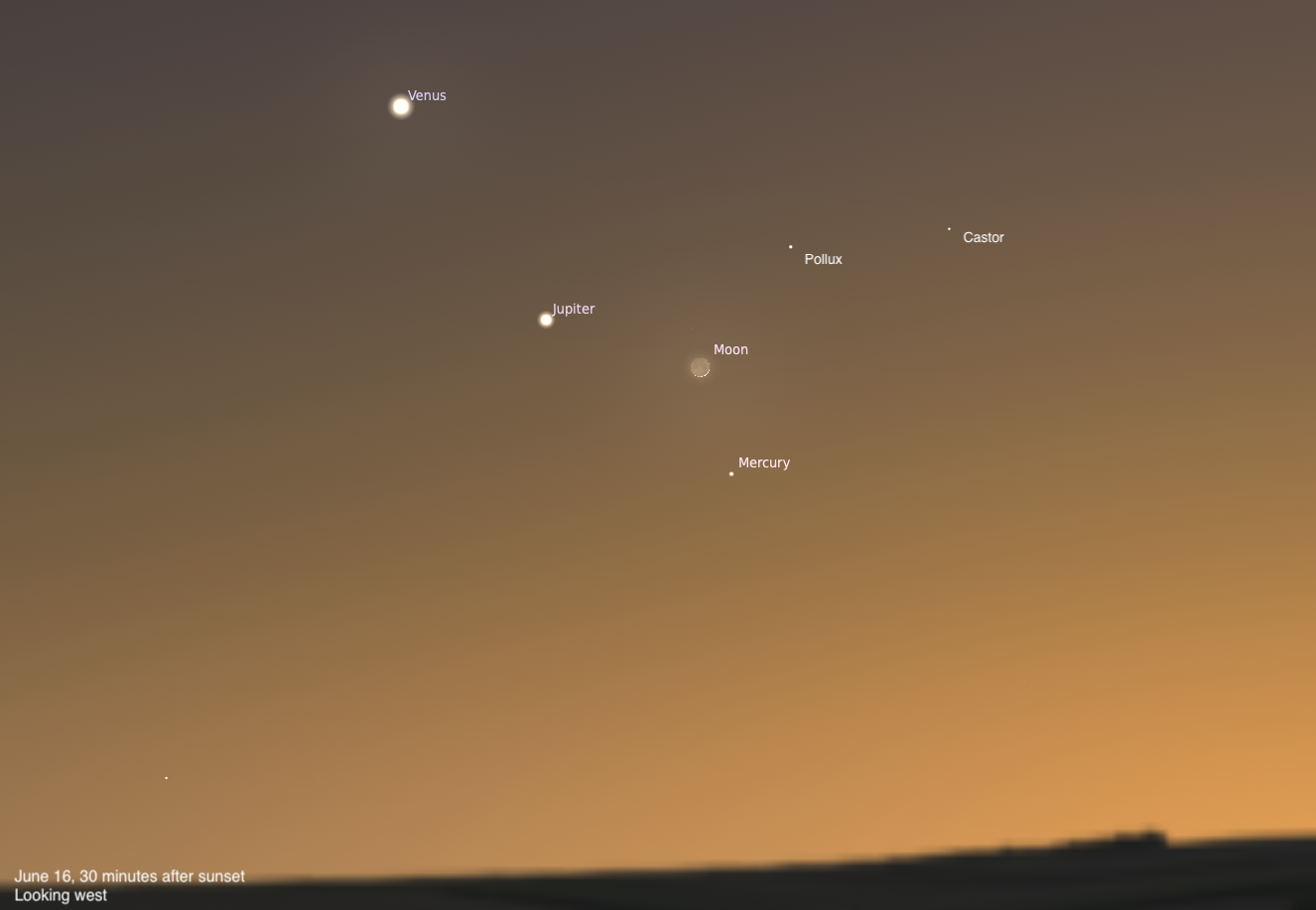
The Moon passes 3° north of Mercury at 4 P.M. EDT. Looking west again after sunset this evening, the Moon now sits above Mercury, forming a triangle with Mercury and Jupiter.
Half an hour after sunset, the trio is over 10° high; an hour after sunset, they’re still 8° above the horizon. The Moon is a slightly wider crescent, now 6% lit as dawn breaks across its surface from east to west. Just north of the Moon, to our satellite’s upper right, is the bright star Pollux in Gemini; to the right of Pollux is slightly fainter Castor. As darkness falls, these stars should be some of the first to pop out of the twilight. It’s a beautiful grouping you should be able to capture with a cellphone camera.
Additionally, Venus still lies to Jupiter’s upper left, shining brightly in Cancer the Crab. Note in particular how far the Moon seems from Venus’ position — by tomorrow afternoon, our satellite will catch up to the bright planet, passing in front of Venus in a daytime occultation. Stay tuned for details on that event in tomorrow’s entry.
Sunrise: 5:31 A.M.
Sunset: 8:31 P.M.
Moonrise: 6:50 A.M.
Moonset: 10:35 P.M.
Moon Phase: Waxing crescent (6%)
*Times for sunrise, sunset, moonrise, and moonset are given in local time from 40° N 90° W. The Moon’s illumination is given at 10 P.M. local time from the same location.
Alison Klesman is senior editor of Astronomy magazine. She holds a Ph.D. in astronomy and has studied a variety of topics, from minor planets to supermassive black holes.