Looking for a sky event this week? Check out our full Sky This Week column.
June 17: The Moon covers Venus
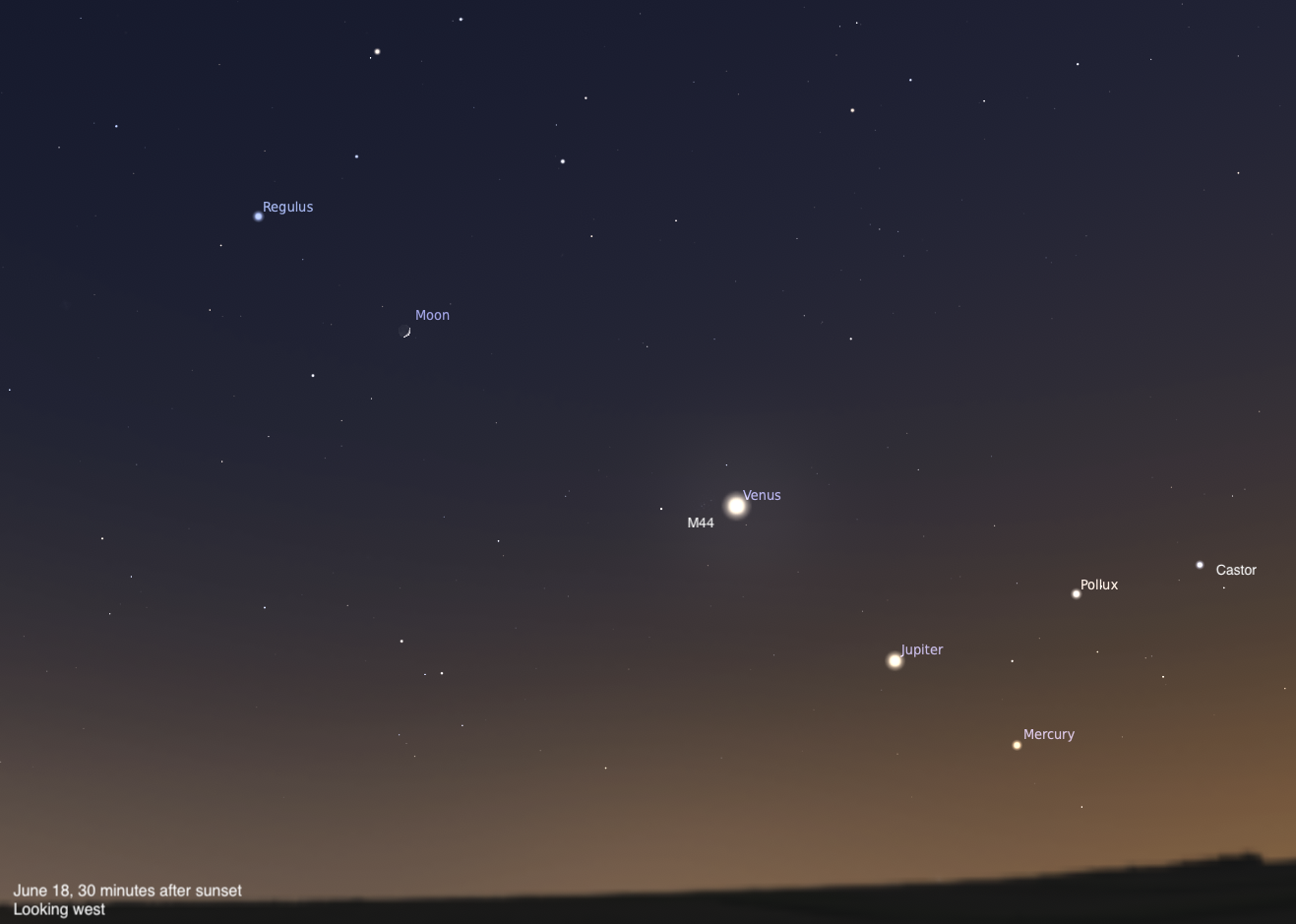
Now it’s Venus’ turn to close in on the Beehive Cluster (M44), which sparkles in central Cancer. Tonight after sunset, blazing Venus is just 1.3° from the center of this loose open cluster, which is visible to the naked eye after dark and looks fantastic in binoculars or a low-power telescope.
The Beehive Cluster is spread across nearly 100’ of sky and its members shine with a combined magnitude of 3.7. Venus is of course far brighter, a bright pinprick of light at magnitude –4.0 just to the right of the cluster in the sky. Tomorrow, Venus will have moved to stand within less than a degree of the cluster, so make sure to return and check out the view yet again.
The Moon has meanwhile moved into Leo, which sits immediately east of Cancer on the ecliptic. You will see it tonight to the lower right of the Sickle asterism, whose brightest star — marking the bottom of the Sickle’s handle — is magnitude 1.4 Regulus (Alpha [α] Leonis), the brightest star in all of Leo.
As darkness falls, the Sickle should slowly emerge into view. From Regulus, the next star (marking the top of the Sickle’s handle) is Eta (η) Leo, 4.8° due north of Regulus. The blade is outlined by magnitude 2.0 Gamma Leo, 4.3° northeast of Eta; magnitude 3.4 Zeta (ζ) Leo, 3.7° north of Gamma; magnitude 3.9 Mu (μ) Leo, 6° northwest of Zeta; and magnitude 3.0 Epsilon (ε) Leo, 2.7° southwest of Mu. Many observers think it looks like a backwards question mark.
Sunrise: 5:31 A.M.
Sunset: 8:31 P.M.
Moonrise: 9:28 A.M.
Moonset: 11:46 P.M.
Moon Phase: Waxing crescent (22%)
*Times for sunrise, sunset, moonrise, and moonset are given in local time from 40° N 90° W. The Moon’s illumination is given at 10 P.M. local time from the same location.
Saturn rules the early-morning sky, shining at 1st magnitude in otherwise dim Pisces the Fish. One of the ringed planet’s many moons, Dione, passes due north of Saturn the morning of June 19. The 10th-magnitude moon’s progress is visible if you’ve got a dark sky and a telescope.
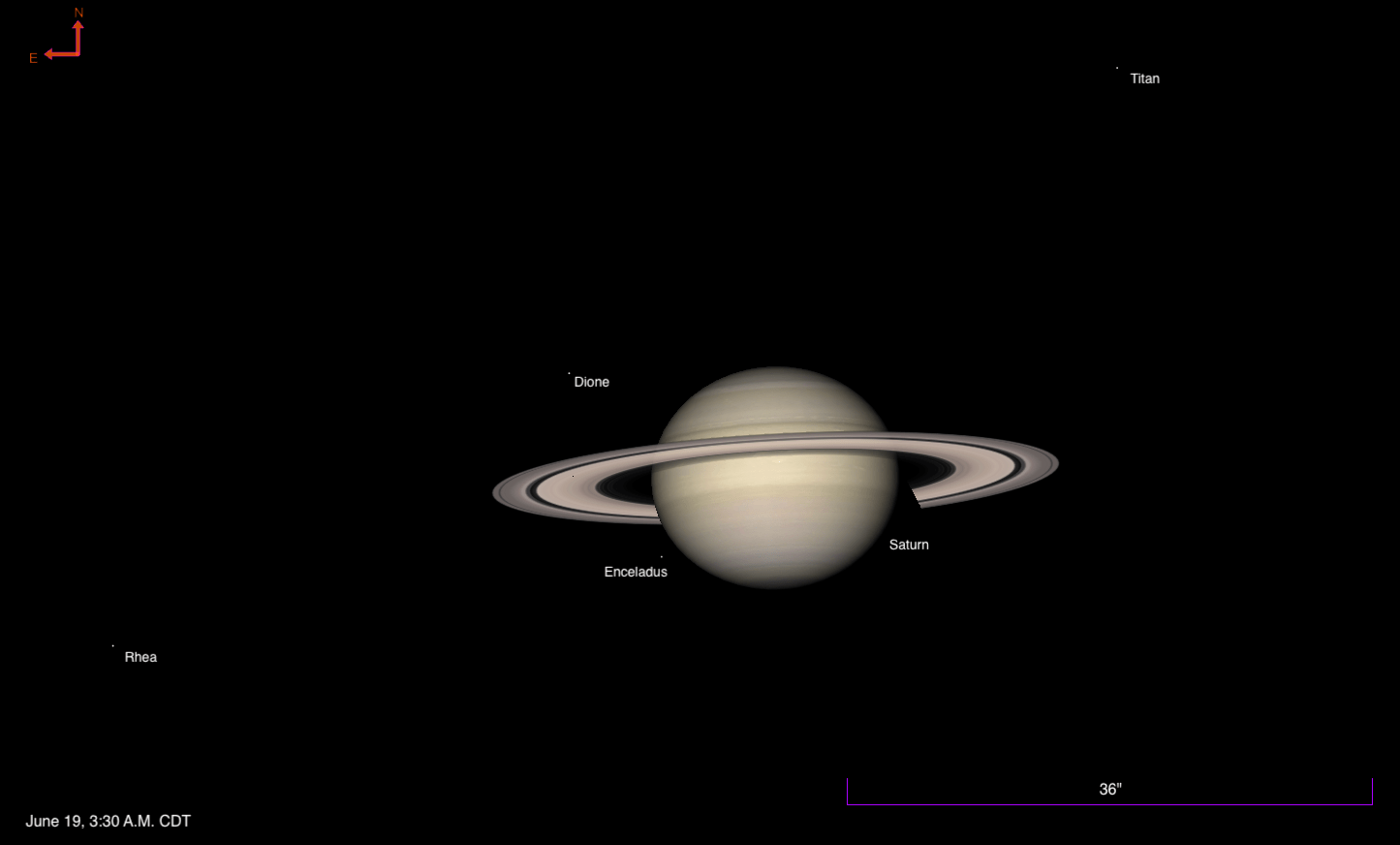
Two hours before sunrise, Saturn is nearly 20° high in the east. It’s easy to find as the brightest light in this part of the sky, skimming the border between southern Pisces and northern Cetus. Through a telescope, you’ll of course see Saturn’s stunning ring system, and should also easily pick up its largest and brightest moon, Titan, just northwest of the planet.
Dione — again, magnitude 10 — is much closer to the planet than Titan and lies northeast of Saturn. As the hours pass, it draws closer, passing due north of Saturn shortly before 4:30 A.M. PDT — note the time zone, as at this point the planet and moon will only be visible along the U.S. West Coast. The farther west you are, the better, as the sky is likely already growing light. See if you can identify Dione roughly an arcsecond above the planet’s north pole, despite the slowly brightening twilight; you might also try snapping a quick photo if you’ve got the setup, as that may show Dione’s position even if your eyes can’t find it.
Alison Klesman is senior editor of Astronomy magazine. She holds a Ph.D. in astronomy and has studied a variety of topics, from minor planets to supermassive black holes.