Looking for a sky event this week? Check out our full Sky This Week column.
June 16: The Moon meets up with Mercury and Jupiter
The Moon, moving east along the ecliptic (the plane of the solar system and the line along which the planets and Moon move on the sky), passes 3° north of Jupiter in Gemini at 3 A.M. EDT. Although the region is not visible at this time, our satellite is moving quickly into Cancer and will pass 0.3° north of Venus at 4 P.M. EDT.
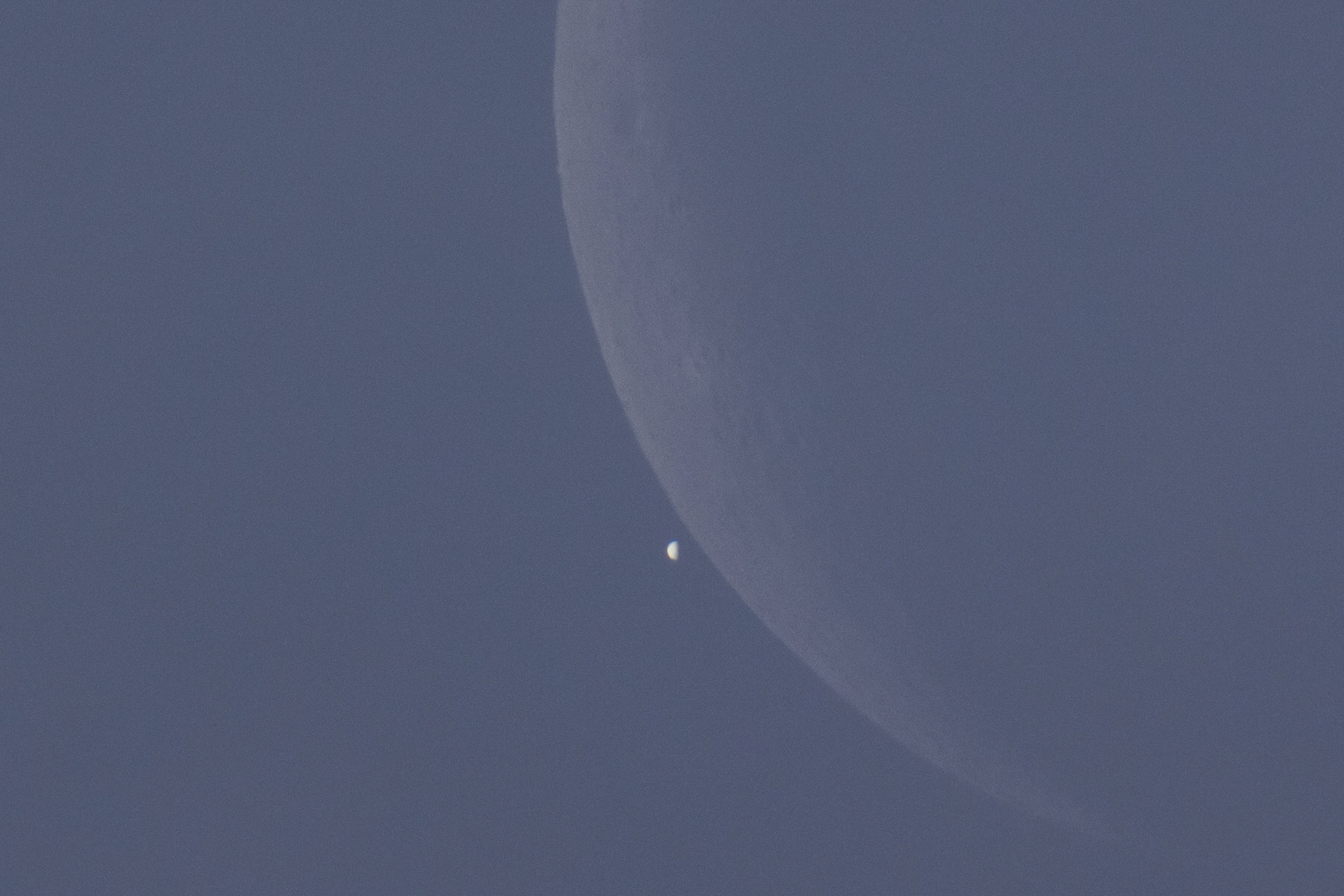
However, some observers won’t see the Moon pass north of the planet, but instead pass in front of it in an occultation. Although visible across the U.S., observing during daytime always requires extra care and caution, as pointing any optics at the Sun for even a brief instant can cause permanent eye damage. Make sure to take care if you are attempting to view using binoculars or a telescope — using the latter in particular is recommended for experienced observers only.
The timing of the event depends on your location. Along the East Coast, for example, Venus disappears behind the leading dark edge of the Moon at 3:49 P.M. EDT. In Texas, those in Austin will see it disappear at 2:24 P.M. CDT. Farther west, Denver sees the event begin at 12:55 P.M. MDT. The International Occultation Timing Association’s webpage for the event lists the times of disappearance and reappearance for numerous locations at www.lunar-occultations.com/iota/bstar/0617venus.htm. Note that dates and times are given in Universal Time and will need to be converted to your local time zone.
By evening, the Moon is crossing M44, the Beehive star cluster, in central Cancer, with Venus now some 2° to our satellite’s lower right. There are more occultations here, as the Moon passes in front of some of the cluster’s stars. This is of course safe for viewing with binoculars or a telescope as soon as the Sun sets, although the stars aren’t visible until the sky starts to darken. The show is best for those in the eastern half of the U.S., who see the stars disappear; the western half of the country will see the stars reappear from behind the Moon, but because they pop out from behind the bright limb, it’s a more challenging observation.
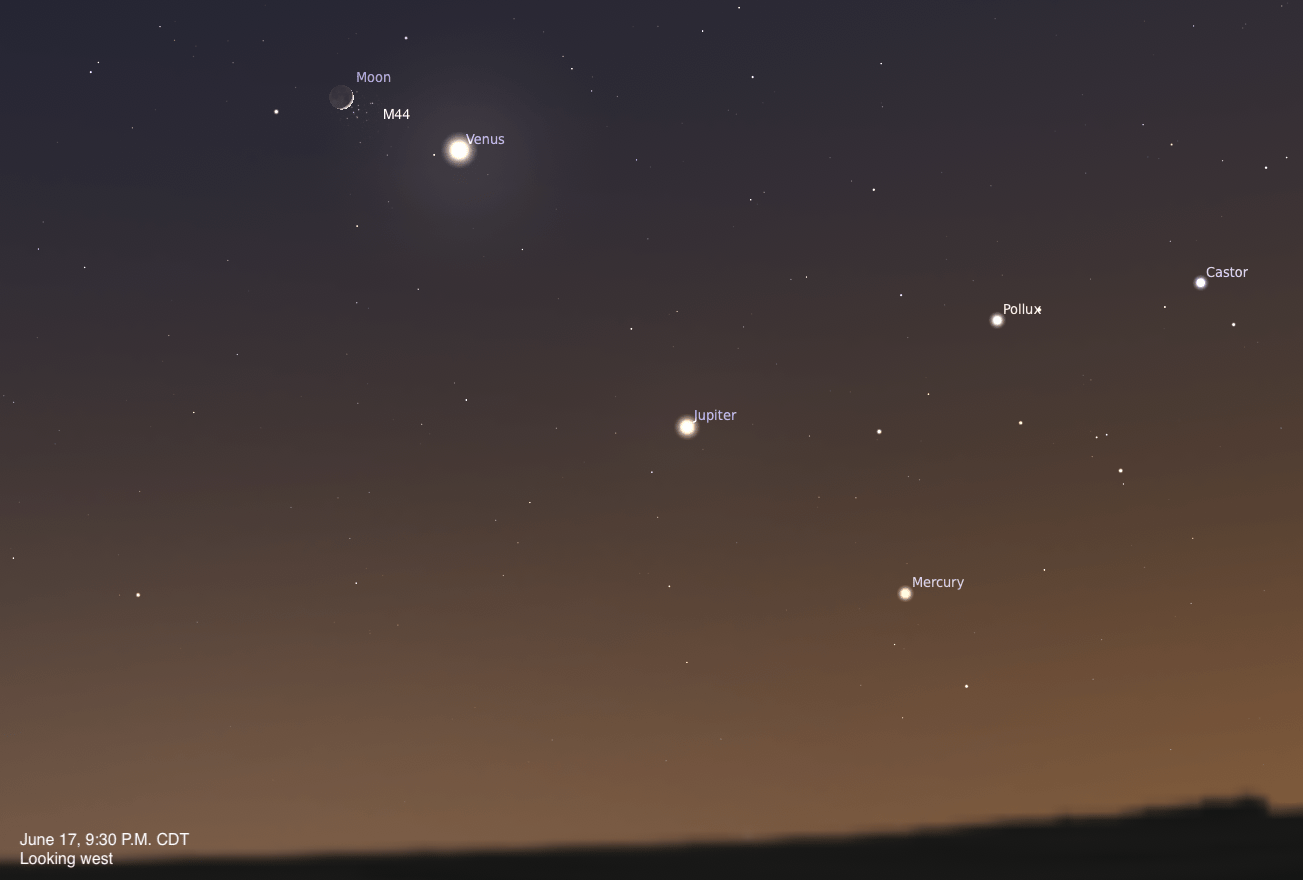
Nonetheless, everyone can enjoy the lovely juxtaposition of Moon and stars in the sky, even if observing the occultations isn’t feasible.
Sunrise: 5:31 A.M.
Sunset: 8:31 P.M.
Moonrise: 8:09 A.M.
Moonset: 11:14 P.M.
Moon Phase: Waxing crescent (13%)
*Times for sunrise, sunset, moonrise, and moonset are given in local time from 40° N 90° W. The Moon’s illumination is given at 10 P.M. local time from the same location.
Alison Klesman is senior editor of Astronomy magazine. She holds a Ph.D. in astronomy and has studied a variety of topics, from minor planets to supermassive black holes.