Friday, June 19
The Moon passes 0.3° south of Regulus at 11 A.M. EDT. By evening, our satellite has moved farther east to lie to the bright star’s upper left as they slowly set in the west after sunset.
Bright Venus is now located in central Cancer and is just 45’ north of M44, the Beehive Cluster. The lovely pairing is also visible in the west this evening, still some 15° high an hour after sunset. You’ll see magnitude –4.0 Venus first — it’s the brightest point of light in this region of the sky, and will quickly pop out of the twilight to the Moon’s lower right. To Venus’ lower right is fainter (magnitude –1.8) Jupiter, and to Jupiter’s lower right is even fainter (magnitude 0.7) Mercury. Mercury is only about 5° high at this time, so you’ll need a clear western horizon to spot it.
Look back up to Venus and pull out binoculars, which will show the sparkling stars of M44 even before you can spot them with your eyes. This cluster is visible to the naked eye, but it may be a challenge if there is light pollution to your west. Whether you need optical aid or not, it’s always a fun opportunity to see Venus veritably plowing through this scattered group of young stars.
Sunrise: 5:31 A.M.
Sunset: 8:32 P.M.
Moonrise: 10:41 A.M.
Moonset: —
Moon Phase: Waxing crescent (32%)
*Times for sunrise, sunset, moonrise, and moonset are given in local time from 40° N 90° W. The Moon’s illumination is given at 10 P.M. local time from the same location.
Saturday, June 20
Highest in the south around 10:30 P.M. local daylight time is the constellation Libra, whose brightest star is Beta (β) Librae, also called Zubeneschamali. Nearly 12° below (south) of this star at that time is the constellation’s brightest deep-sky object, globular cluster NGC 5897. If you want a closer signpost, just move about 5° northeast of 3rd-magnitude Sigma (σ) Lib.
Glowing at mid-8th-magnitude, NGC 5897 is a wonderful target for any telescope, including smaller instruments. It’s also a popular astrophotography target. NGC 5897 is rather large, spanning about 12”, and has a loosely packed center. The cluster lies some 24,000 light-years away and is sometimes called the Ghost Globular for its resemblance to brighter M5 in Serpens.
Sunrise: 5:31 A.M.
Sunset: 8:32 P.M.
Moonrise: 11:51 A.M.
Moonset: 12:11 A.M.
Moon Phase: Waxing crescent (42%)
Sunday, June 21
The summer solstice occurs at 4:25 A.M. EDT. This is the time the Sun reaches its northernmost point in the Northern Hemisphere sky, which also means our star takes its longest path across this hemisphere’s sky on this date and provides the most hours of daylight. Today also marks the beginning of astronomical summer in the Northern Hemisphere, although meteorological summer began on the 1st of June.
First Quarter Moon occurs at 5:55 P.M. EDT. Rising around 1 P.M. local daylight time, our satellite is now in Virgo.
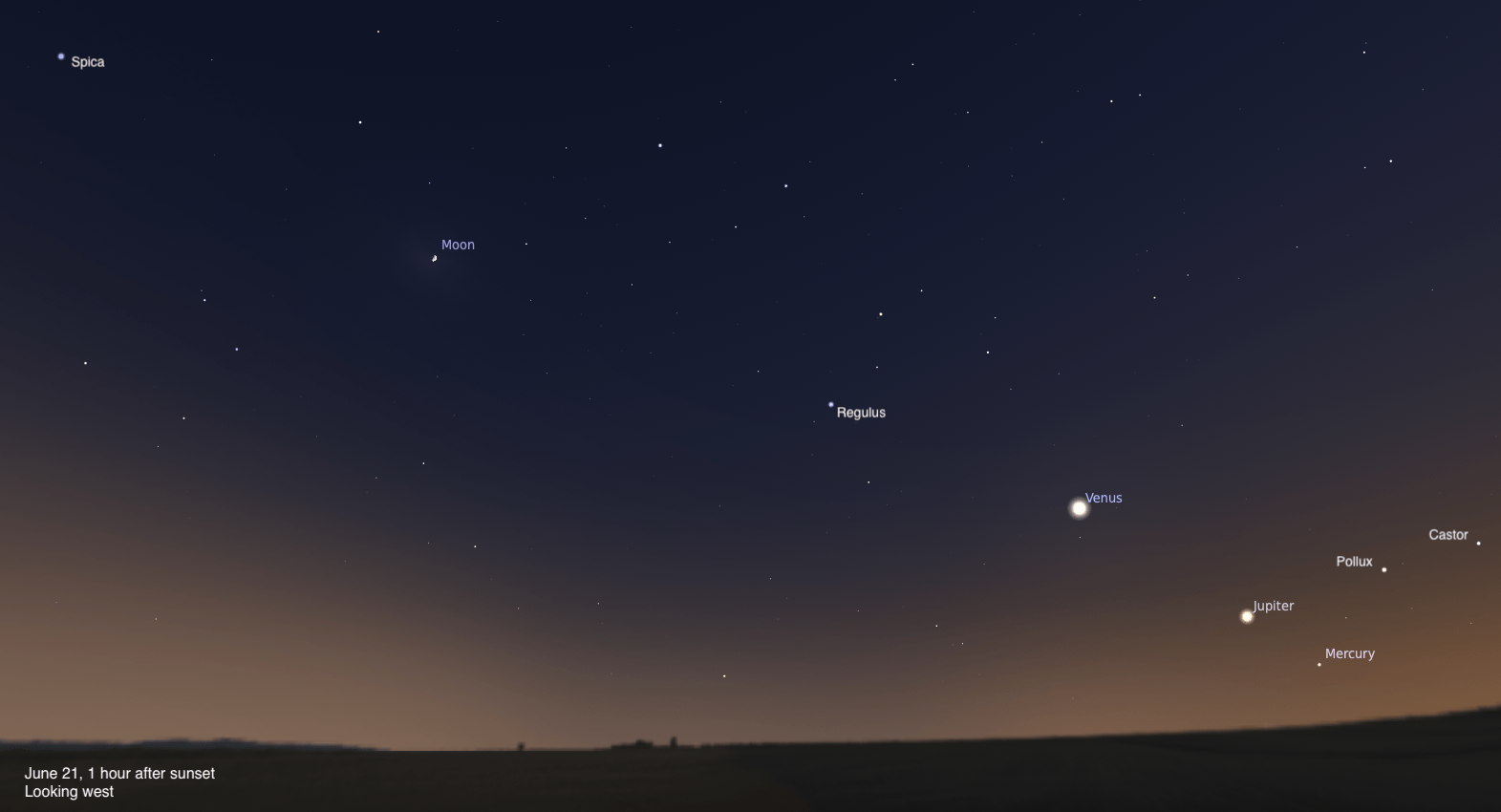
If you look west about an hour after sunset, you’ll see a long line of bright lights in the sky, starting with Mercury in Gemini, just 4° high. Stretching out to the upper left are then Jupiter, Venus, Regulus, the Moon, and Spica. The line these objects trace out is the ecliptic, the plane of the solar system where all the major planets orbit. The ecliptic is defined by the tilt of Earth’s orbit, such that Earth’s orbit is tilted 0° to this imaginary line. All the planets lie close to this plane, and even the Moon’s orbit lines up along it. Many bright stars also happen to sit near the ecliptic, and Regulus and Spica are two such stars. This is why the Moon regularly passes close to — or sometimes in front of — them.
Sunrise: 5:32 A.M.
Sunset: 8:32 P.M.
Moonrise: 12:56 P.M.
Moonset: 12:34 A.M.
Moon Phase: Waxing gibbous (52%)
Monday, June 22
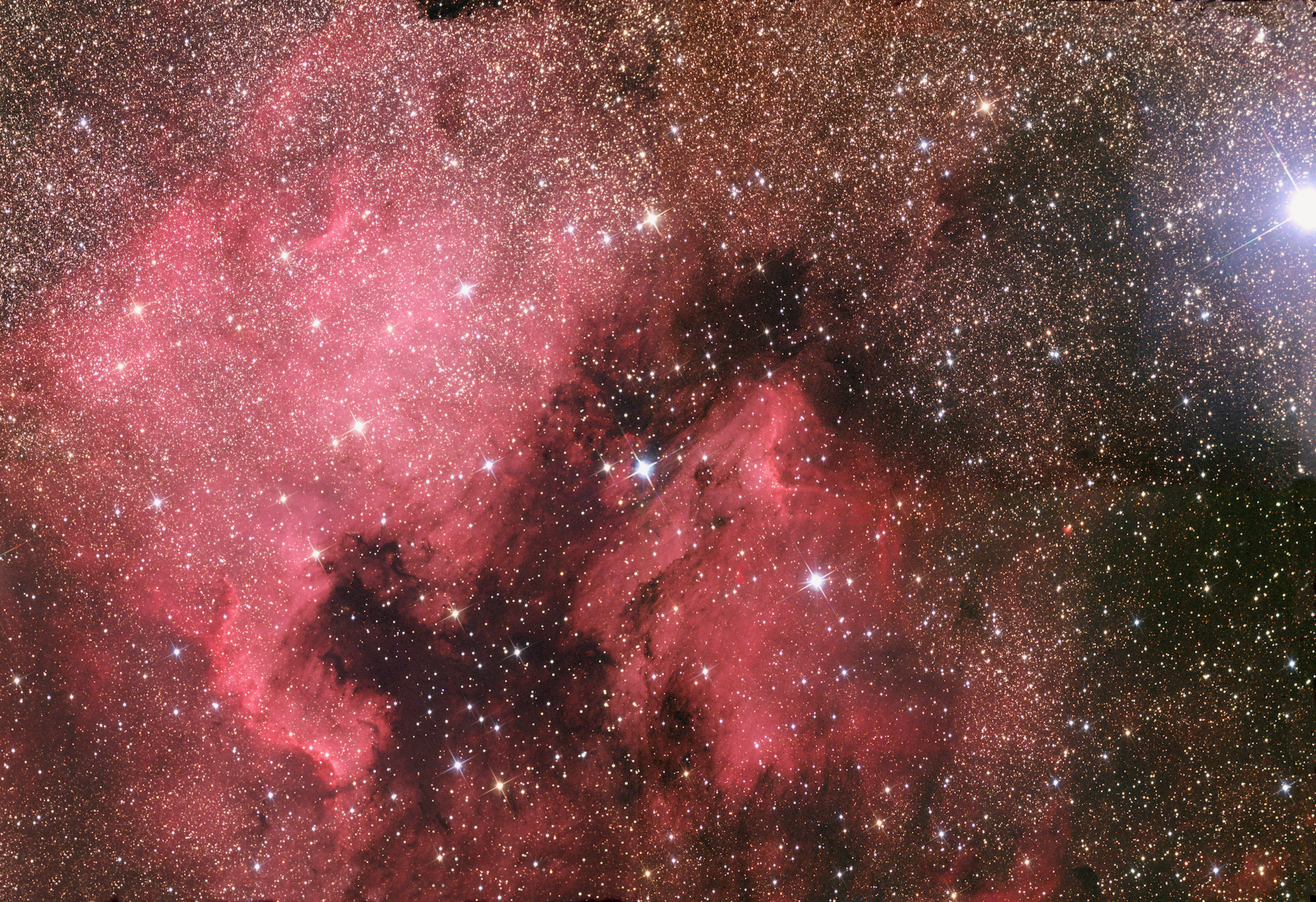
If you’re up late after midnight, you’ll have the chance to check in on a summertime favorite: NGC 7000, the North America Nebula in Cygnus. Reaching nearly 70° high in the east by 2 A.M. local daylight time, this large emission nebula sits just 3.2° east of bright Deneb, the tail of the Swan.
Stretching 2° by 1⅔°, the North America Nebula gets its name from its distinct shape, which very closely resembles the continent. Drop a wide-field eyepiece into your telescope and it will likely fill the view. Astronomy contributor Alan Goldstein recommends adding a UHC filter for the best views. You’ll likely note that the eastern and southeastern coasts are more well defined than the western coast.
NGC 7000 sits just northeast of the smaller Pelican Nebula (IC 5070); a narrow swath of darkness cataloged as L935 separates the two.
Sunrise: 5:32 A.M.
Sunset: 8:32 P.M.
Moonrise: 2:00 P.M.
Moonset: 12:56 A.M.
Moon Phase: Waxing gibbous (62%)
Tuesday, June 23
Mercury passes 7° due south of Pollux in Gemini at 3 P.M. EDT. By evening, Mercury, Jupiter, and Pollux create a skinny, tall triangle with the two planets forming the base and the star at the apex, visible in the western sky for short time after sunset.
After the sky has grown fully dark, scan over toward the southeast, where the mighty constellation Hercules is already quite high. Although best known for its globular cluster M13, the Strongman holds many other treasures as well, such as the bright planetary nebula NGC 6210, also called the Turtle Nebula. This puff of gas signaling a dying star is a great small scope target, shining at 9th magnitude and spanning a mere 14”. That’s quite small — but the size works in your favor, because it concentrates the nebula’s light and makes it easier to spot.
To find it, all you need to do is scan 4° northeast of magnitude 2.8 Kornephoros (Beta Herculis), located in western Hercules. The nebula gives off a bluish glow and appears just slightly oval-shaped if you’ve got a large scope and high magnification.
Sunrise: 5:32 A.M.
Sunset: 8:33 P.M.
Moonrise: 3:03 P.M.
Moonset: 1:18 A.M.
Moon Phase: Waxing gibbous (72%)
Wednesday, June 24
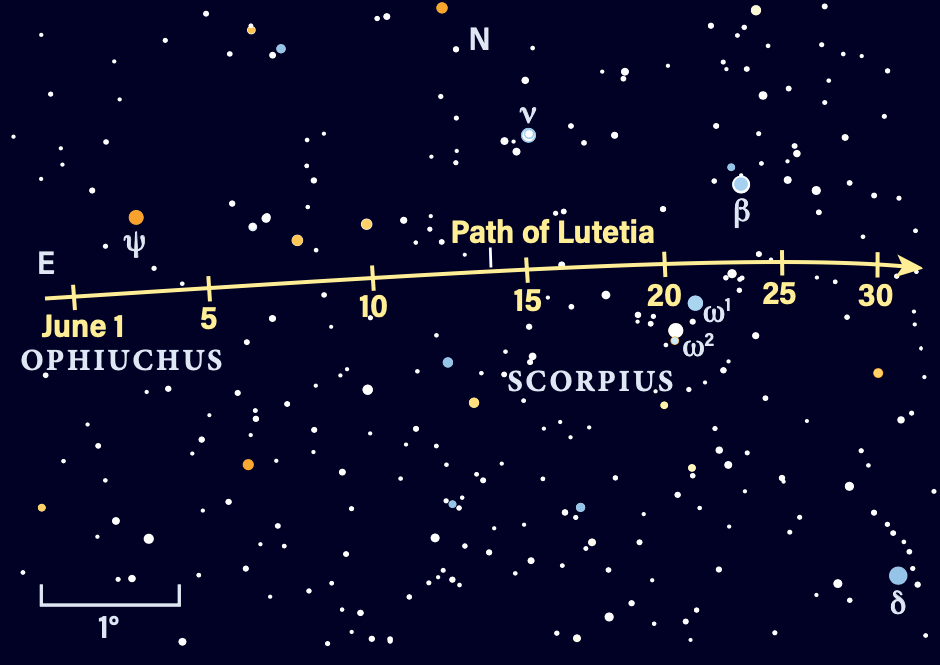
Now shining at magnitude 10.6, main-belt asteroid 21 Lutetia is sliding just south of a 9th-magnitude field star in Scorpius. The best time to observe is late in the evening in the hour or two around midnight, when this region is highest in the south. Lutetia passes just under 4’ due south of the star (HIP 78769) around 10:20 P.M. EDT, then slowly inches to its southwest as time passes.
However, it will likely be difficult to catch the asteroid’s motion in a single night. Come back tomorrow to check out this region again, and you’ll definitely note Lutetia has moved, sitting southwest of a second, fainter field star on the 25th, all three dots in a line.
While you’re here, though, your eye likely can’t help but catch on Omega1 (ω1) and Omega2 (ω2) Scorpii, about 0.7° to the southeast. This widely spaced pair of 4th-magnitude stars are lovely to look at in binoculars. And about 0.6° to Lutetia’s north is 3rd-magnitude Beta Scorpii, a double whose two components are easy to split in any telescope, standing 14” apart.
Sunrise: 5:32 A.M.
Sunset: 8:33 P.M.
Moonrise: 4:06 P.M.
Moonset: 1:41 A.M.
Moon Phase: Waxing gibbous (80%)
Thursday, June 25
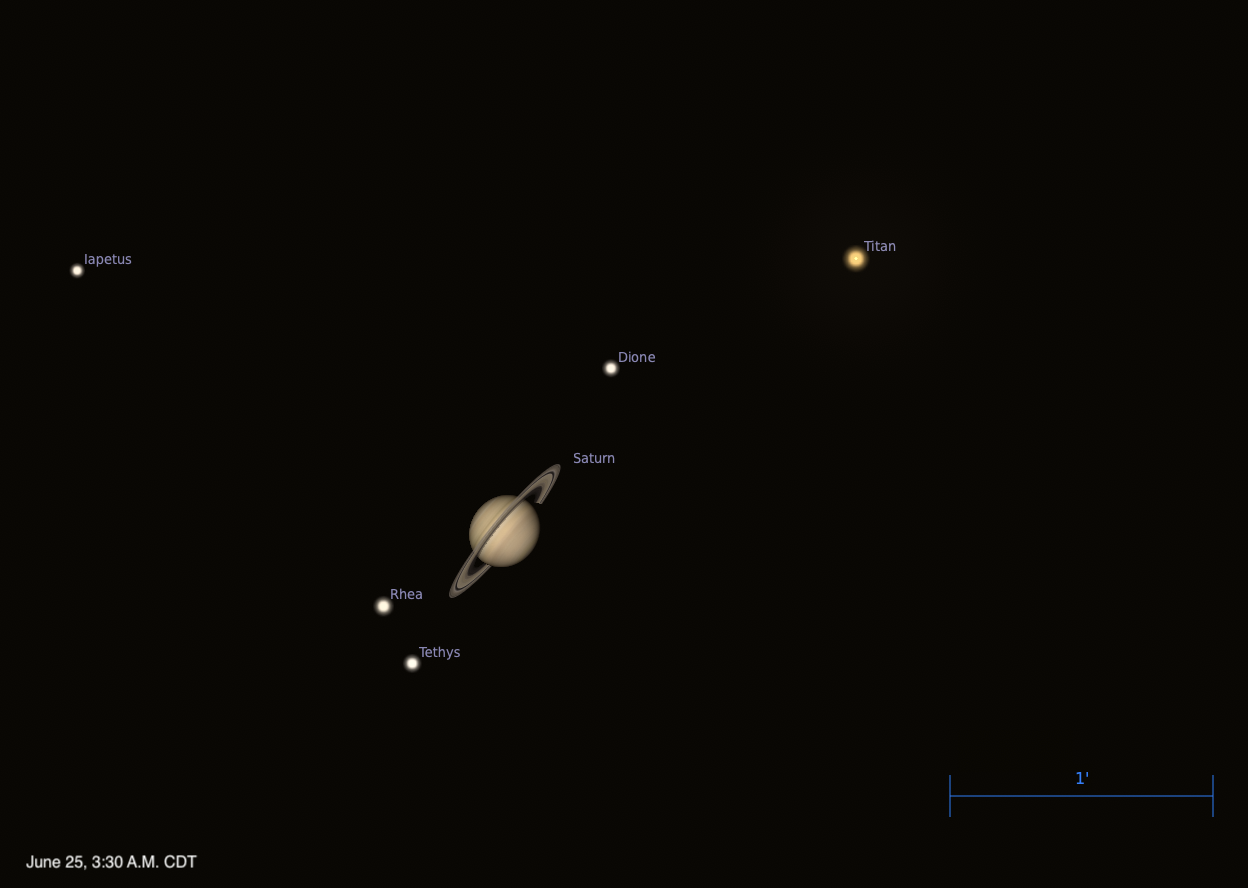
Saturn’s two-toned moon Iapetus is now halfway between its eastern and western elongations. Heading toward the latter, which it will reach in just a few weeks, the moon sits 1.9’ due north of Saturn in the early-morning sky. Shining around 11th magnitude, Iapetus has brightened roughly a magnitude from its fainter eastern elongation and will continue to brighten as it moves westward.
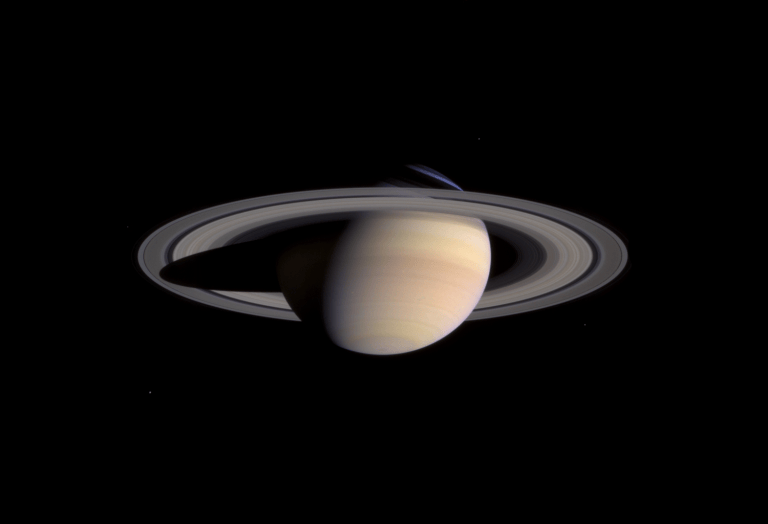
Pull out your telescope about two hours before sunrise, when Saturn has reached an altitude of 20° in the eastern sky. It’s easy to find the ringed world, as it’s the brightest object in this part of the sky. Once you home in on Saturn, you’ll of course see its stunning ring system, stretching nearly 40” across as it encircles the planet, whose angular size is 17”.
Saturn’s brightest moon, Titan, should be easy to spot some 1.7’ to the planet’s west. Tenth-magnitude Tethys, Rhea, and Dione are visible as well, clustered closer to Saturn. Dione sits west of Saturn, while Rhea and Tethys are to the planet’s east. And, again, 11th-magnitude Iapetus is north of the planet, about 1.9’ from its center.
Iapetus will remain near Saturn for the next two or three days, so if you aren’t able to catch it this morning, you can try again tomorrow or the next day.
Sunrise: 5:33 A.M.
Sunset: 8:33 P.M.
Moonrise: 5:09 P.M.
Moonset: 2:07 A.M.
Moon Phase: Waxing gibbous (87%)
Friday, June 26
Let’s close out the week back in the evening sky, checking on Mercury’s progress. The tiny planet has been moving closer to Jupiter in the west, although Mercury’s brightness has been fading day by day. This evening, Mercury shines at magnitude 1.4, standing just under 4° west of Jupiter, to the brighter planet’s lower right.
You may need binoculars or a telescope to spot Mercury, which is now just 4° high 45 minutes after sunset. Through a telescope, the rocky world appears 18% lit and spans 10”. Compare that to Jupiter, which appears fully illuminated and 32” across. You can also take in Venus to the pair’s upper left, now near the eastern border of Cancer. Venus is some 71% lit and 16” in apparent width.
Sunrise: 5:33 A.M.
Sunset: 8:33 P.M.
Moonrise: 6:11 P.M.
Moonset: 2:38 A.M.
Moon Phase: Waxing gibbous (93%)
Alison Klesman is senior editor of Astronomy magazine. She holds a Ph.D. in astronomy and has studied a variety of topics, from minor planets to supermassive black holes.