Friday, July 3
Although the Moon is still bright, there’s a short window after darkness falls and before moonrise to sneak in some deep-sky viewing. Let’s get a jump on tomorrow’s celebration of U.S. Independence Day with a look at the Fireworks Galaxy (NGC 6946) in Cygnus, which has reached an altitude of more than 40° by 10 P.M. local daylight time, an hour or so before moonrise.
To find our target, look northeast to find the cross-shaped constellation Cygnus the Swan. Its brightest star is magnitude 1.3 Deneb, which lies roughly in the center of the constellation’s domain. From this star, you’ll want to scan due north roughly 15° to find the Fireworks Galaxy, which lies near Cygnus’ border with southwestern Cepheus. The closest stellar signpost is magnitude 3.4 Eta (η) Cephei — NGC 6946 lies 2.1° southwest of this star.
You’ll want a larger scope if possible to check out the 9th-magnitude face-on spiral. This magnitude may seem pretty bright for a galaxy, but because it is face-on, that light is spread over an area with a diameter of roughly 10’. The galaxy’s central nucleus is the brightest part, but small compared to its arcing spiral arms. Take your time with this one and try for some deep astrophotography if you’ve got the experience.
NGC 6946 is called the Fireworks Galaxy because it has hosted at least 10 supernovae since 1917. Compare that to the Milky Way’s roughly one to three supernovae every century, and you’ll see why that’s significant!
Sunrise: 5:36 A.M.
Sunset: 8:32 P.M.
Moonrise: 10:57 P.M.
Moonset: 8:57 A.M.
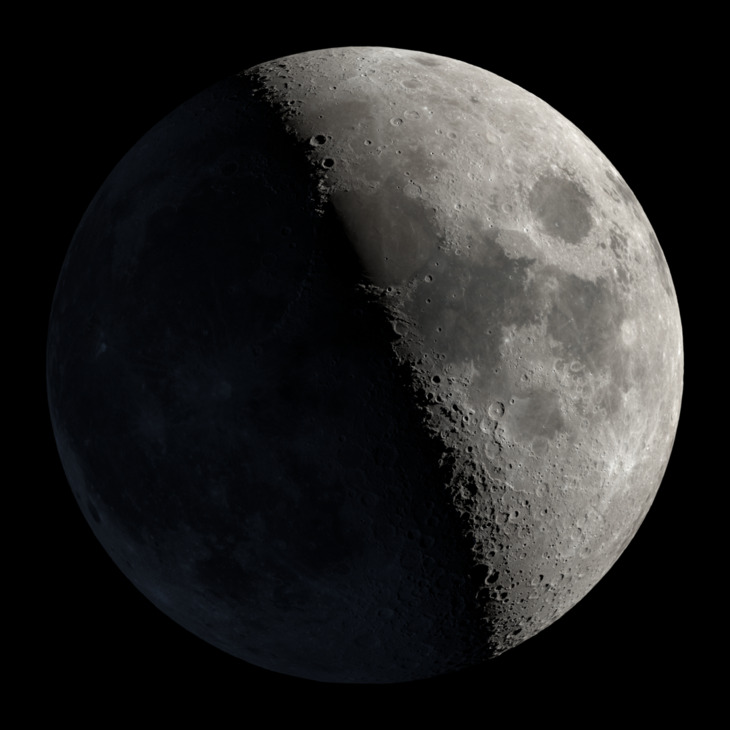
Moon Phase: Waning gibbous (85%)
*Times for sunrise, sunset, moonrise, and moonset are given in local time from 40° N 90° W. The Moon’s illumination is given at 10 P.M. local time from the same location.
Saturday, July 4
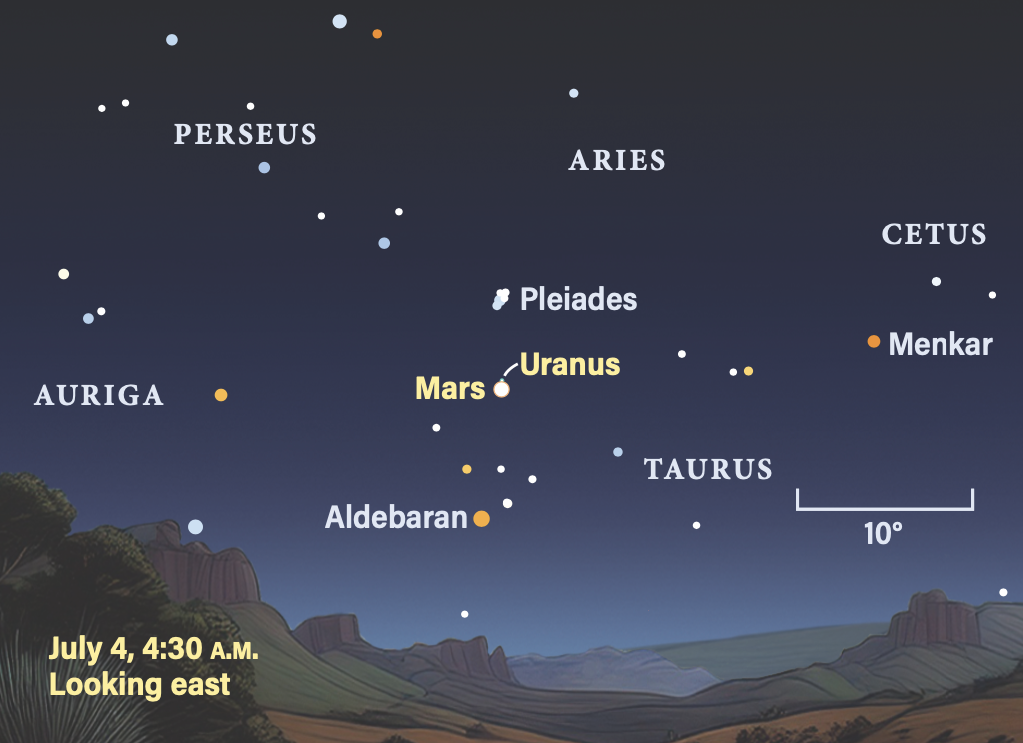
Mars passes 0.1° south of Uranus in Taurus the Bull at 1 A.M. EDT. By about an hour before sunrise, roughly 4:30 A.M. local daylight time, you’ll find both planets some 16° high in the east, between the bright star Aldebaran and the Pleiades star cluster.
Mars will be readily visible to the naked eye, a reddish-orange light glowing at magnitude 1.3 above Aldebaran. Uranus, however, will be difficult without optical aid in the slowly growing twilight — but any optics will show it, including binoculars or a small telescope. Look for it just 9′ northwest of Mars, glowing at magnitude 5.8. It should appear as a tiny, circular disk with a slight bluish-green hue. You might even spot a fainter, 8th-magnitude field star between the planets — but don’t be misled, Uranus is brighter and farther northwest of Mars than this star.
Follow the pair of planets as long as you can in the growing twilight. By tomorrow, they will have pulled farther apart, with Mars 45′ due east of Uranus — still in the same telescopic or binocular field of view, so if you can’t catch the pair today, try again tomorrow.
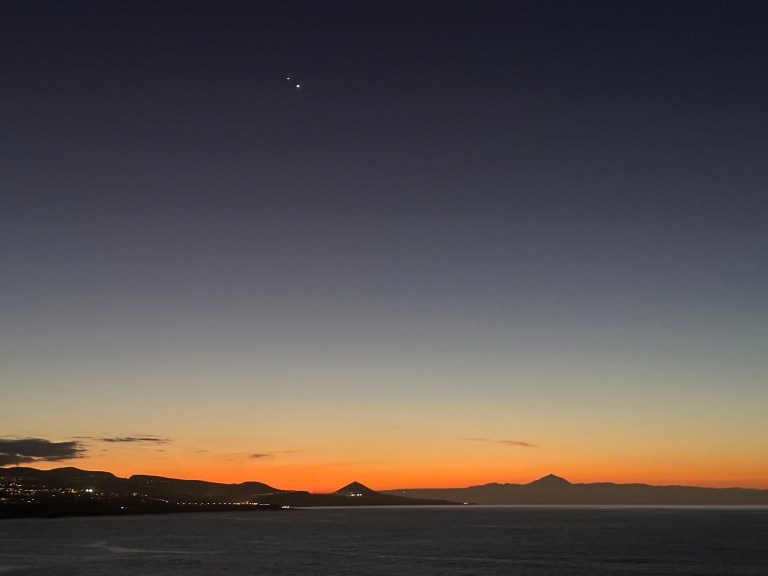
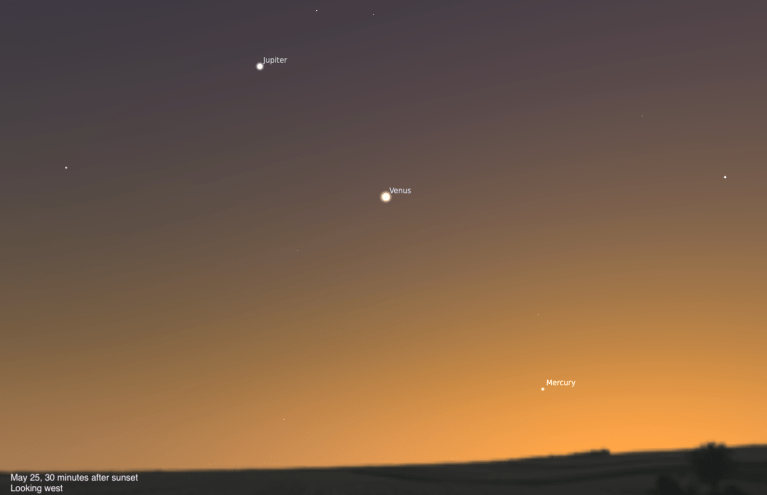
Mercury passes 10° south of Pollux at 7 A.M. EDT, but neither is visible then. Both are in the evening sky, but Mercury is now magnitude 3.0 and sets within half an hour of the Sun, making viewing the small planet a significant challenge. You may still catch Pollux, however, just barely visible some 4° above the western horizon 40 minutes after sunset, roughly even with the planet Jupiter, which shines to its left.
Sunrise: 5:37 A.M.
Sunset: 8:32 P.M.
Moonrise: 11:20 P.M.
Moonset: 10:01 A.M.
Moon Phase: Waning gibbous (77%)
Sunday, July 5
Saturn’s largest and brightest moon, Titan, lies close to its parent planet today. You can spot it — along with several of Saturn’s other moons — with a telescope in the early-morning sky.
Try between about 3 A.M. local daylight time and sunrise, when Saturn is more than 20° above the horizon. You’ll find the ringed planet in the east around 3 A.M. and in southeast after 4 A.M. Glowing at magnitude 0.7, it’s the brightest light in this region of the sky. Through a telescope, Saturn’s disk stretches some 18”, with rings that span roughly 40” from end to end. Titan, which glows at mid-8th-magnitude, is just northwest of the planet. Depending on when you look, you may catch at least three other moons: 10th-magnitude Tethys, Rhea, and Dione.
Around 3 A.M. CDT, Dione lies east of the planet, in line with the rings. Tethys is just northeast of the disk, above the rings, while Rhea is west of the planet and slightly north of the plane of the rings. Tethys is moving toward the limb and disappears behind it shortly after 4 A.M. CDT.
Iapetus, which is now approaching western elongation, shines at roughly 10th magnitude as well. Look for it some 5½’ from Saturn, far to the planet’s west.
Sunrise: 5:37 A.M.
Sunset: 8:32 P.M.
Moonrise: 11:41 P.M.
Moonset: 11:05 A.M.
Moon Phase: Waning gibbous (68%)
Monday, July 6
Earth reaches aphelion, the farthest point from the Sun in its orbit, at 1 P.M. EDT. At this time, our planet will lie 94.5 million miles (152 million kilometers) from our star.
About two hours after sunset, the constellation Coma Berenices is still some 40° above the western horizon. It’s a great time to take in the Coma Star Cluster, also called Melotte 111. Spanning 4°, this lovely open cluster is visible to the naked eye, but is also great to view with binoculars or a small scope (or your telescope’s finder scope). The cluster lies just south of magnitude 4.3 Gamma (γ) Comae Berenices. With the naked eye, you’ll see a smattering of 4th- and 5th-magnitude stars. Add some optics, and you’ll be able to pull out 40 or so suns that shine at magnitude 10 or brighter.
The Moon passes 5° north of Neptune at 11 P.M. EDT. We’ll try to catch it — along with Saturn — in the early-morning sky tomorrow before dawn.
Sunrise: 5:38 A.M.
Sunset: 8:32 P.M.
Moonrise: —
Moonset: 12:10 P.M.
Moon Phase: Waning gibbous (58%)
Tuesday, July 7
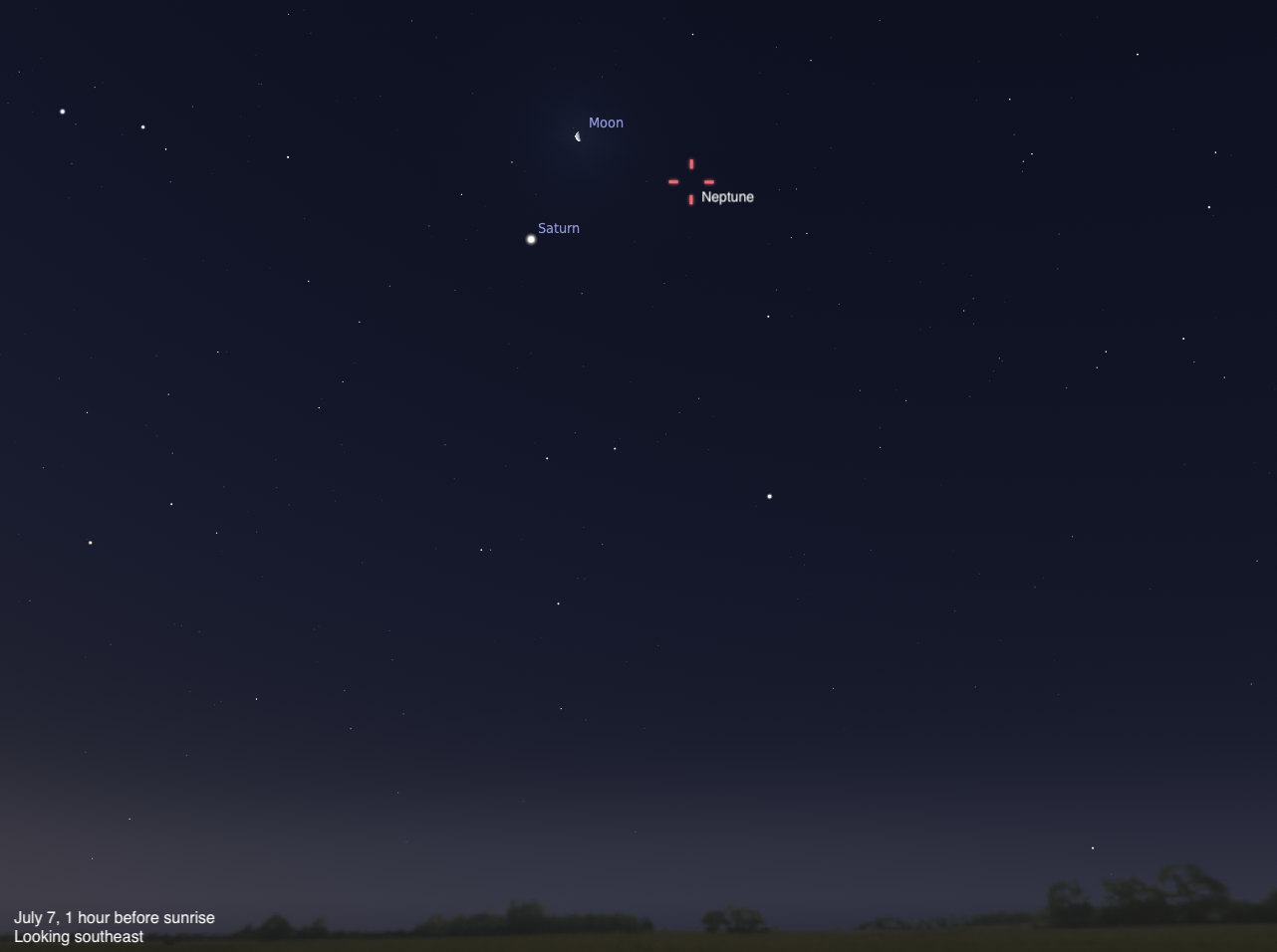
Last Quarter Moon occurs at 3:29 P.M. EDT. The Moon then passes 7° north of Saturn at 6 P.M. EDT.
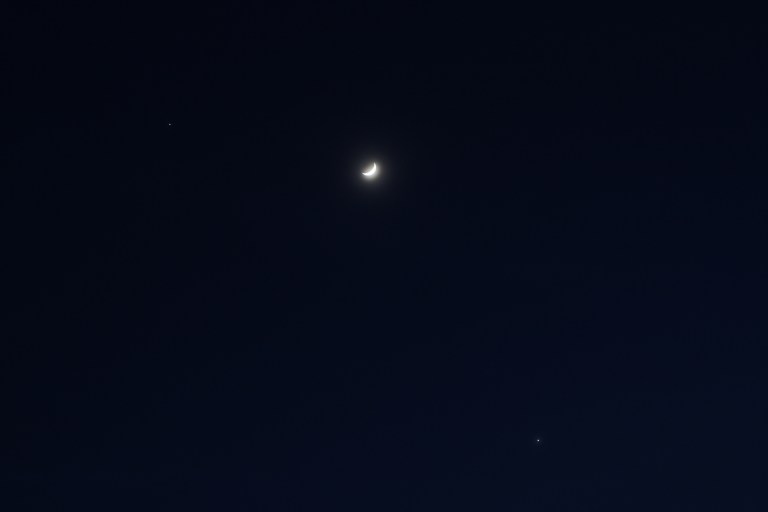
You can catch this pairing before then, visible in the early-morning sky. An hour before sunrise, the Moon stands high in the southeast, to the upper right of magnitude 0.7 Saturn. The ringed planet is easily visible to the naked eye. To the Moon’s lower right is Neptune, although this distant world is invisible without optical aid. Using binoculars or a telescope, look for Neptune about 7° southwest of the Moon, or 10° west of Saturn (the latter is the more reliable guide, as the Moon moves through our sky relatively quickly). You may need to try viewing the magnitude 7.7 ice giant even earlier in the morning, when the sky will be darker and provide better contrast for its faint light.
Neptune reaches a stationary point at midnight EDT in the constellation Pisces, bringing its eastward (prograde) motion to a halt. After today, the ice giant will turn and begin moving to the west, taking a retrograde path.
Sunrise: 5:39 A.M.
Sunset: 8:31 P.M.
Moonrise: 12:03 A.M.
Moonset: 1:18 P.M.
Moon Phase: Waning crescent (47%)
Wednesday, July 8
Asteroid 18 Melpomene reaches opposition at 4 P.M. EDT. Now visible all night long, the 9th-magnitude main-belt world is located in southeastern Aquila, near the Eagle’s border with Scutum.
To track the asteroid for yourself, swing binoculars or any telescope up above the southeastern horizon around 10:30 P.M. local daylight time. We’re looking in the region between the Sagittarius Teapot and the bright star Altair in Aquila. Between these two markers in the sky lies magnitude 3.4 Lambda (λ) Aquilae, located in the tail of Aquila. Find this star, then slide about 4.7° due south to land on Melpomene.
The asteroid lies close to a field star of similar magnitude, forming an artificial “double star.” Over the course of the night, Melpomene will move westward, pulling away from the star. You may be able to note its motion if you snap a picture and then come back a few hours later to take another.
Sunrise: 5:39 A.M.
Sunset: 8:31 P.M.
Moonrise: 12:27 A.M.
Moonset: 2:28 P.M.
Moon Phase: Waning crescent (36%)
Thursday, July 9
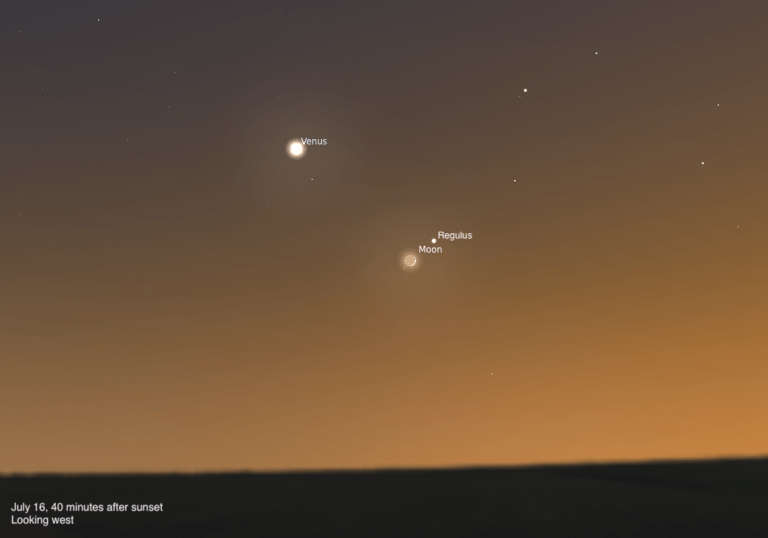
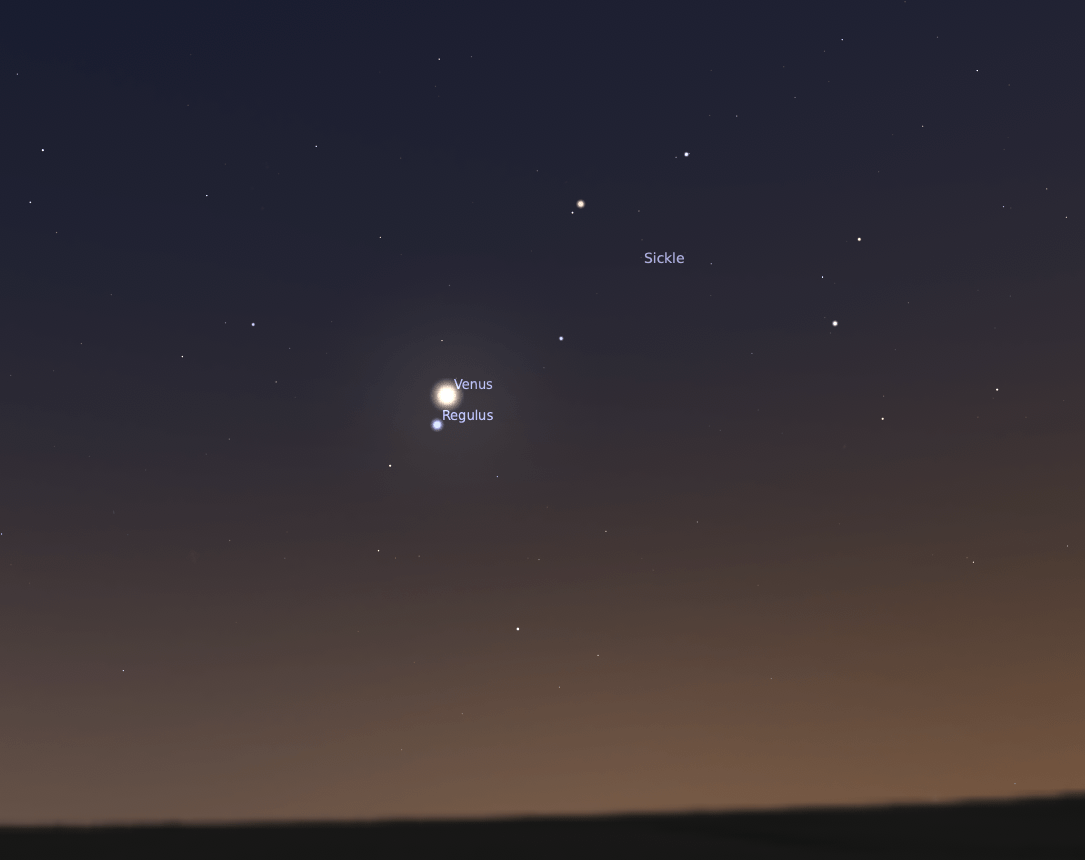
Venus passes 1.1° north of Regulus, the brightest star in Leo the Lion, at 10 A.M. EDT. The pair is visible after sunset this evening, when they are still close as they slowly set in the western sky.
An hour after sunset, both should be visible, with brighter magnitude –4.1 Venus just above magnitude 1.4 Regulus. This star not only marks the heart of Leo the Lion, but also the base of the easy-to-find Sickle asterism, which looks like its eponymous farm instrument — or, alternatively, like a backward question mark in the sky. As the sky darkens, the stars of this pattern should appear, stretching to the upper right of Regulus in the sky.
Asteroid 8 Flora reaches opposition at 6 P.M. EDT, located in Sagittarius the Archer. Like Melpomene, it’s also roughly magnitude 9 and located very close to Pi (π) Sagittarii, which lies to the upper left of the handle of Sagittarius’ Teapot asterism late tonight. Again looking southeast around 10:30 P.M. local daylight time, this time find the Teapot and then look to its upper left for 3rd-magnitude Pi Sgr. Flora is just 1.5° east-southeast of Pi, within the same field of view of a telescope or binoculars. Also like Melpomene, Flora is moving westward with time, so snap a pic every few hours to see if you can note its retrograde motion compared to the background stars.
Sunrise: 5:40 A.M.
Sunset: 8:30 P.M.
Moonrise: 12:56 A.M.
Moonset: 3:44 P.M.
Moon Phase: Waning crescent (25%)
Friday, July 10
Look north after dark tonight to spot one of the most famous asterisms in the sky: the Big Dipper. Late tonight, it lies to the lower left of the North Star, Polaris, with its cup below the curving handle.
That handle is where we’re looking tonight — specifically, the spot where the handle is kinked and changes direction, at the second star from the end. Look at this star — Mizar — closely. Do you see one star, or two? You may notice a small, faint star just to Mizar’s upper right (southeast): this is Alcor. Glowing at magnitude 4.0, Alcor is much fainter than magnitude 2.2 Mizar, but sits 11.8′ away, far enough to make out with the naked eye from a dark site and if your visual acuity is good. And because they are so widely separated, they will easily split into two in any optics, including binoculars or any size telescope.
This lovely pair is likely not physically bound, however, but is part of a loose cluster of stars all moving together through space, called the Ursa Major Moving Group. Also in that group are Merak, Phecda, and Megrez in the Big Dipper, as well as many more not part of this specific star pattern.
Sunrise: 5:41 A.M.
Sunset: 8:30 P.M.
Moonrise: 1:31 A.M.
Moonset: 5:01 P.M.
Moon Phase: Waning crescent (16%)
Alison Klesman is senior editor of Astronomy magazine. She holds a Ph.D. in astronomy and has studied a variety of topics, from minor planets to supermassive black holes.