
Sky This Week is brought to you in part by Celestron.
Friday, May 29
An hour after sunset this evening, Cancer the Crab remains some 30° above the western horizon, available for viewing for a while longer before it’s lost to the summertime sky. This large, somewhat sparse constellation is located immediately to the upper left of Gemini, which hosts four bright points of light: the stars Castor and Pollux, the heads of the Twins, as well as the planets Jupiter and Venus. We’ll definitely be coming back to this constellation later this week.
But tonight, look to the Twins’ upper left for a rough, upside-down Y-shaped pattern of stars. We’re focusing in on the base of the Y’s stem, which appears at upper right and is marked by the 4th-magnitude star Iota (ι) Cancri. Sometimes called the “springtime Albireo,” this single point of light splits easily into two in any size telescope. Because its components are bright — magnitudes 4.2 and 6.6 — and widely separated — with 30” between them — this is a great target for beginners. As an added bonus, like its namesake, this lovely double star hosts suns with different colors, appearing a contrasting gold and blue.
In space, this wide pair of stars is separated by nearly 3,000 astronomical units (1 astronomical unit, or AU, is the average Earth-Sun distance; Pluto lies an average distance of 39 AU from the Sun). It takes them some 65,000 years or more to complete a single orbit. In fact, they are so loosely bound that, according to the late stellar expert Jim Kaler, astronomers think they may eventually drift apart due to gravitational interactions with passing nearby stars and ultimately become two singleton stars.
Sunrise: 5:35 A.M.
Sunset: 8:21 P.M.
Moonrise: 7:17 P.M.
Moonset: 4:04 A.M.
Moon Phase: Waxing gibbous (98%)
*Times for sunrise, sunset, moonrise, and moonset are given in local time from 40° N 90° W. The Moon’s illumination is given at 10 P.M. local time from the same location.
Saturday, May 30
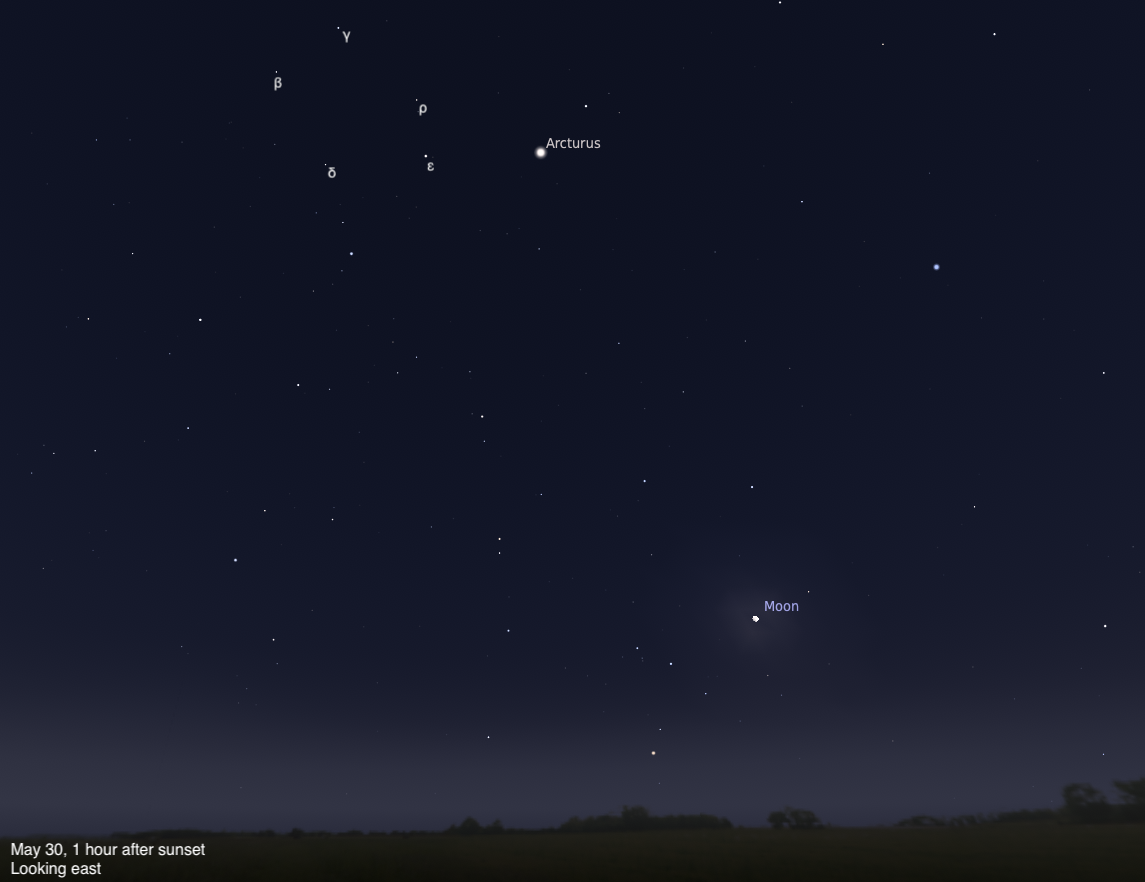
Already high in the eastern sky an hour after sunset is the constellation Boötes the Herdsman. Easy to find thanks to its brightest star, the magnitude –0.1 red giant Arcturus, the stars of this constellation form a well-known asterism called the Kite.
You don’t need any optical aid to spot this shape in the sky, either, so it’s great for beginners. Start at Arcturus, which forms the base of the Kite, and look to the upper left. In this orientation (early evening, as Boötes is still rising), the right side of the Kite is marked by magnitude 3.6 Rho (ρ) and magnitude 3.0 Gamma (γ) Boötis. Th Kite then comes to a point at the top at magnitude 3.5 Beta (β) Boo. The left side of the Kite is demarcated by magnitude 2.4 Epsilon (ε) and magnitude 3.5 Delta (δ) Boo.
Sunrise: 5:34 A.M.
Sunset: 8:21 P.M.
Moonrise: 8:18 P.M.
Moonset: 4:37 A.M.
Moon Phase: Full
Sunday, May 31
Full Moon occurs at 4:45 A.M. EDT, bringing us May’s second Full Moon and the first — and only — Blue Moon of 2026. Shortly after that, at 5 A.M. EDT, the Full Moon passes 0.4° south of Antares, as both are setting for East Coast observers. To best catch them, you’ll want to look earlier, around 3 or 4 A.M. local daylight time, when they are low but still easily visible in the southwest.
The Full Moon will be bright, but Antares is also bright, coming in at magnitude 1.1, so you should be able to make it out in the moonlit sky, just above our satellite’s position as the region sinks toward the horizon. This star, a red giant, is well known for its orangey-red hue, which is noticeable even with the naked eye. Antares marks the heart of Scorpius the Scorpion, and is named for its similar appearance to the Red Planet, Mars. The two can be easily mistaken for each other in the sky, but not today — when Mars rises around 4 A.M. local daylight time, it will be in the east, shining slightly dimmer than Antares at magnitude 1.3. The two aren’t visible together in the sky for long, as Antares is quite low in the west by the time Mars begins to rise out of the horizon haze on the opposite side of the sky, with sunrise also approaching.
By this evening, as the still-99%-lit Moon rises about an hour after sunset, it does so behind Scorpius, with Antares now far to our Moon’s upper right.
Sunrise: 5:34 A.M.
Sunset: 8:22 P.M.
Moonrise: 9:16 P.M.
Moonset: 5:16 A.M.
Moon Phase: Waning gibbous (99%)
Monday, June 1
The Moon reaches apogee, the farthest point from Earth in its slightly elliptical orbit, at 12:33 A.M. EDT. At that time, our satellite will be 252,504 miles (406,366 kilometers) away.
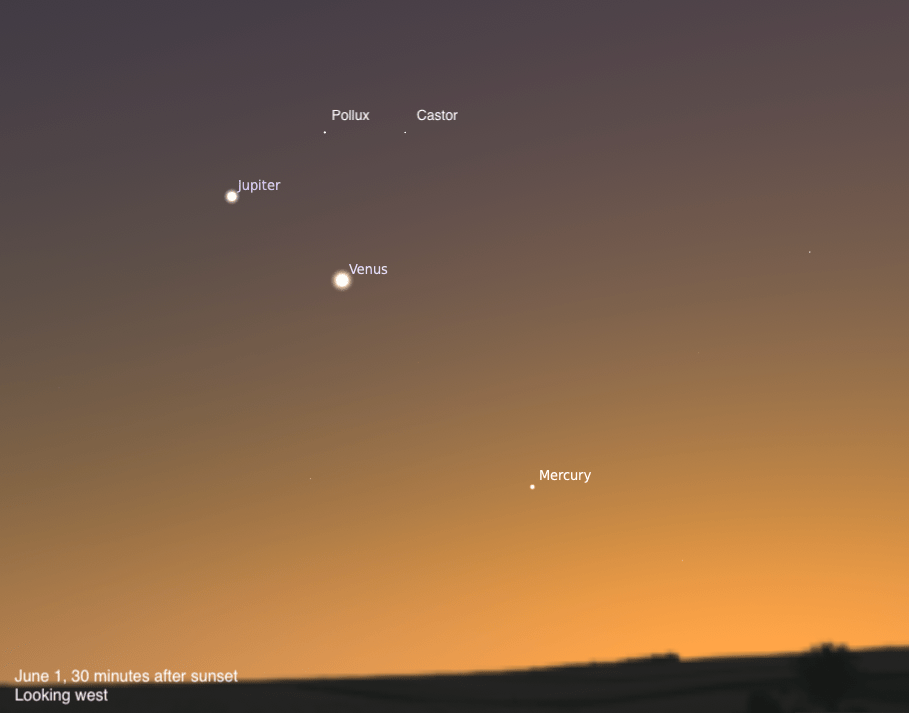
Mercury is at its best for the year. It’s now easy to spot in the evening sky, already 10° above the western horizon 30 minutes after the Sun sets. Tonight, it shines at magnitude –0.5 and sits in a line with two other bright planets: Venus and Jupiter. Together the three trace a line in the sky — that’s the ecliptic, the plane of the solar system. Just above Mercury, to its upper left, is Venus, the brightest of the three at magnitude –4.0. Then, to Venus’ upper left, sits mighty Jupiter, glowing at magnitude –1.9. Above them in the slowly darkening sky, you may also spot the two brightest stars in Gemini the Twins: Castor and Pollux. Nearly even with each other above the ground, Castor is to the right and Pollux is to the left, closer to Jupiter. The gas giant will pass due south of Pollux in just a few days.
Take a peek at Mercury through a telescope, and you’ll see the tiny planet showing off a gibbous phase, its face some 67% lit. Its disk spans 6” on the sky. Within just a few days, toward the end of the week, its width will grow to 7” across, but its phase will drop to 60% illuminated.
Sunrise: 5:33 A.M.
Sunset: 8:23 P.M.
Moonrise: 10:08 P.M.
Moonset: 6:02 A.M.
Moon Phase: Waning gibbous (97%)
Tuesday, June 2
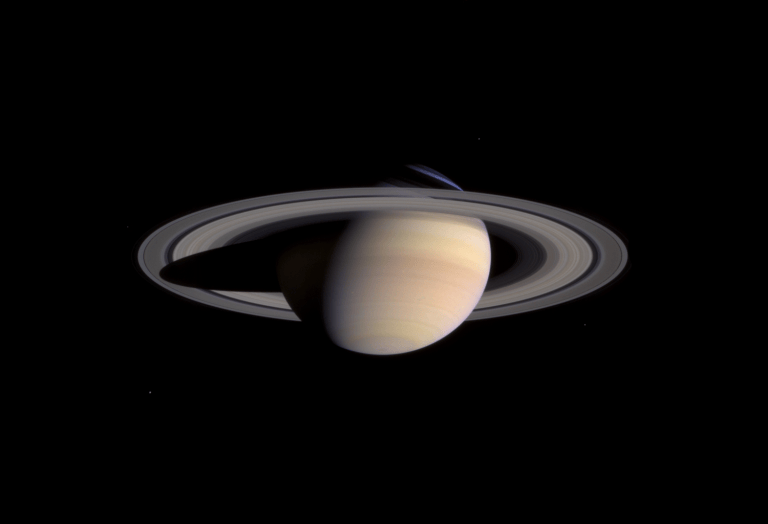
Titan, Saturn’s brightest moon, is located near its parent planet for the next two days. Visible in the early-morning sky, you’ll find Titan just northeast of Saturn this morning.
Spotting Saturn is easy — rising shortly before 3 A.M. local daylight time, it’s the brightest point of light low in the eastern sky an hour later. Through a telescope, the gas giant’s disk spans 17”, while its rings are nearly 38” from end to end. The ring system is now tilted some 8° to our line of sight, showing off its southern side as well as the planet’s southern hemisphere and pole.
Titan glows at mid-8th magnitude, and should be easy to spot in a telescope just to Saturn’s northeast this morning. Depending on when you look, some of the planet’s other moons will be visible nearby, including 10th-magnitude Rhea and Dione. Much fainter 12th-magnitude Enceladus lies just west of the ringed planet, but smaller scopes may not pick it up.
Titan passes due north of Saturn while the planet is not visible from North America, but you can come back tomorrow morning to spot the large moon sitting northwest of the planet, still nearby.
Sunrise: 5:33 A.M.
Sunset: 8:23 P.M.
Moonrise: 10:53 P.M.
Moonset: 6:55 A.M.
Moon Phase: Waning gibbous (93%)
Wednesday, June 3
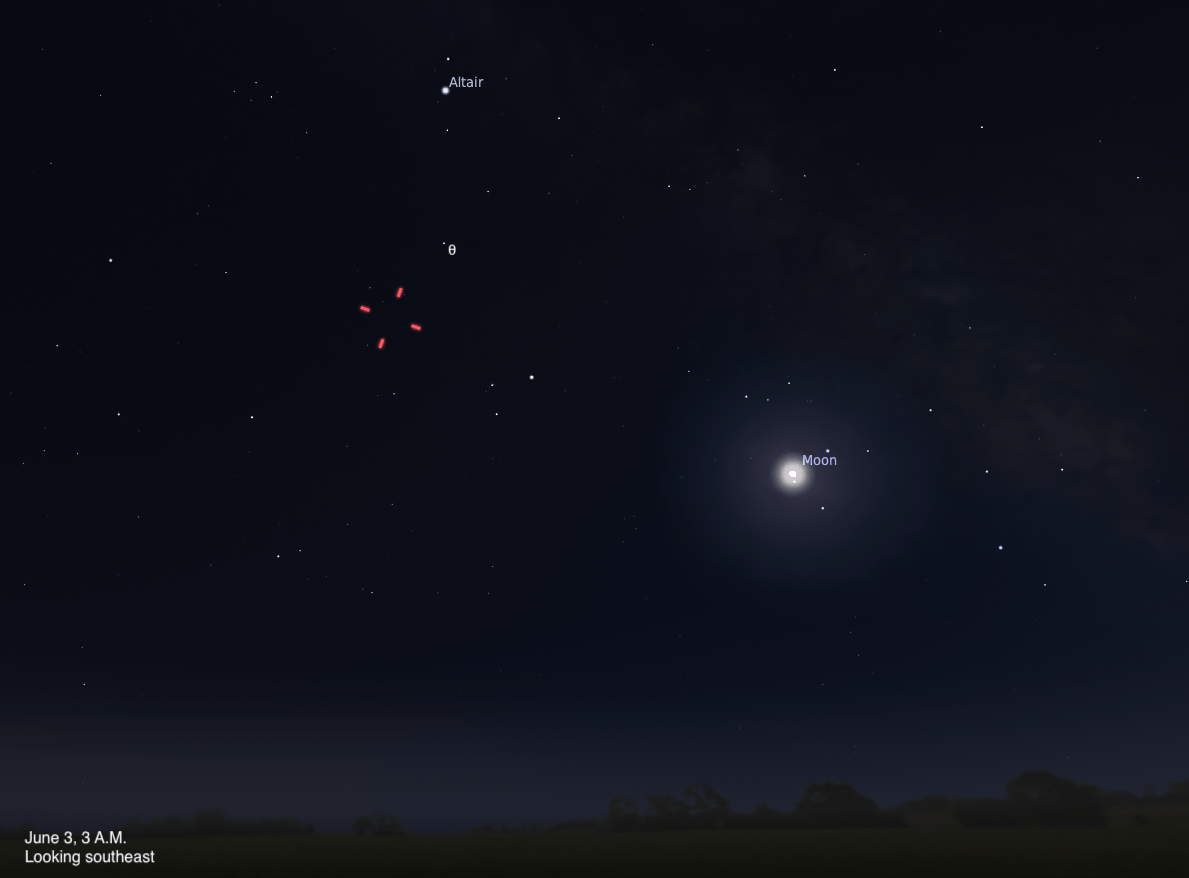
Asteroid 3 Juno is stationary at 3 P.M. EDT, standing still against the stars of Aquila the Eagle. The large main-belt world is in far eastern Aquila and doesn’t rise until an hour before midnight. The best time to catch it is overnight and into the early-morning hours; it stands highest in the sky half an hour before sunrise, but by then, the background is far too bright to capture the 10th-magnitude dot.
Instead, try around 3 A.M. local daylight time, when Juno is 40° high in the southeast. It lies just over 7° east-southeast of 3rd-magnitude Theta (θ) Aquilae. You’ll want a telescope for the best chance of spotting it this morning — the bright Moon is nearby in Sagittarius, brushing past the star Tau (τ) Sagittarii in the handle of the Teapot asterism. So, if you have trouble finding faint Juno with binoculars or a telescope, wait a few days and come back to try again. It is moving slowly north and then west against the background stars after today, swapping its motion from prograde (eastward) to retrograde (westward) after this standstill. Because it is making this turnaround, Juno remains in roughly the same spot for several more days, giving the Moon time to wane and move away.
Sunrise: 5:33 A.M.
Sunset: 8:24 P.M.
Moonrise: 11:31 P.M.
Moonset: 7:54 A.M.
Moon Phase: Waning gibbous (88%)
Thursday, June 4
Jupiter passes 6° due south of Pollux at 7 A.M. EDT, although neither object is visible in the daylit sky. Instead, check out the scene after sunset this evening, with Jupiter still south of Pollux and also still lined up nicely with Venus and Mercury. You have a while to enjoy the view as well — Mercury, which sets first, won’t disappear below the horizon until more than an hour and a half after sunset.
By the time darkness falls, there are several points of light gathered in the west. Three planets stand in line from lower right to upper left. Closest to the ground is magnitude –0.3 Mercury, while Venus — brightest at magnitude –4.0 — is in the middle. To Venus’ upper left is Jupiter, at magnitude –1.9. Castor and Pollux, the heads of Gemini the Twins, sit to the upper right (north) of Venus and Jupiter.
Another bright star, magnitude 0.4 Procyon in Canis Minor, is also visible above the horizon, now roughly level with Mercury but far to its left (southeast).
If you’ve got a telescope, take some time to compare Mercury and Venus before the former sets. Mercury is now 60% lit, its gibbous disk spanning 7” on the sky. Venus is twice as wide — 14” — and more of it also appears illuminated at 78%. However, when you look at Venus you are not seeing down to the bare surface, as with Mercury. Instead, we see sunlight bouncing off Venus’ cloud tops, as its atmosphere is too thick to allow us to view the ground.
Jupiter dwarfs them both — despite its greater distance, it is physically so much larger that it spans 33” on the sky. It is fully lit, with all four of its Galilean moons stretched out to the planet’s east.
Sunrise: 5:32 A.M.
Sunset: 8:25 P.M.
Moonrise: —
Moonset: 8:56 A.M.
Moon Phase: Waning gibbous (81%)
Friday, June 5
Now that the Red Planet is rising roughly an hour before the Sun, let’s check in on Mars in the predawn sky. The nearby world now has time to climb well above the horizon, leading to easier viewing even as the sky is growing light.
Half an hour before sunrise, Mars is 12° above the eastern horizon, shining at magnitude 1.3. If you have any trouble spotting it in the growing twilight, try for it with binoculars — but make sure to put them away at least several minutes before sunrise from your location. Brighter Saturn, shining at magnitude 0.8, lies some 30.5° west of Mars. Like the planets in the evening sky, these two worlds trace out the ecliptic in the morning sky, showing its shallower angle with respect to the horizon.
Unfortunately, peering at Mars through a telescope will show little more than the view with binoculars — the planet is just 4” across, with no surface detail visible at that size.
Sunrise: 5:32 A.M.
Sunset: 8:25 P.M.
Moonrise: 12:02 A.M.
Moonset: 10:00 A.M.
Moon Phase: Waning gibbous (73%)