Friday, June 5
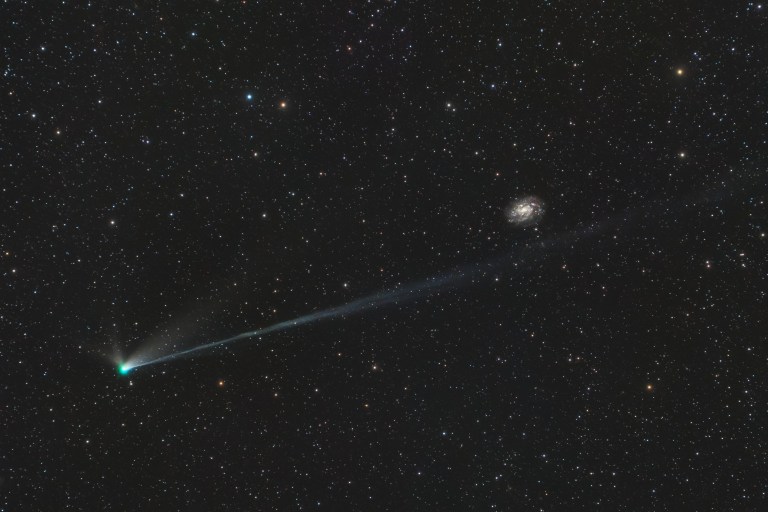
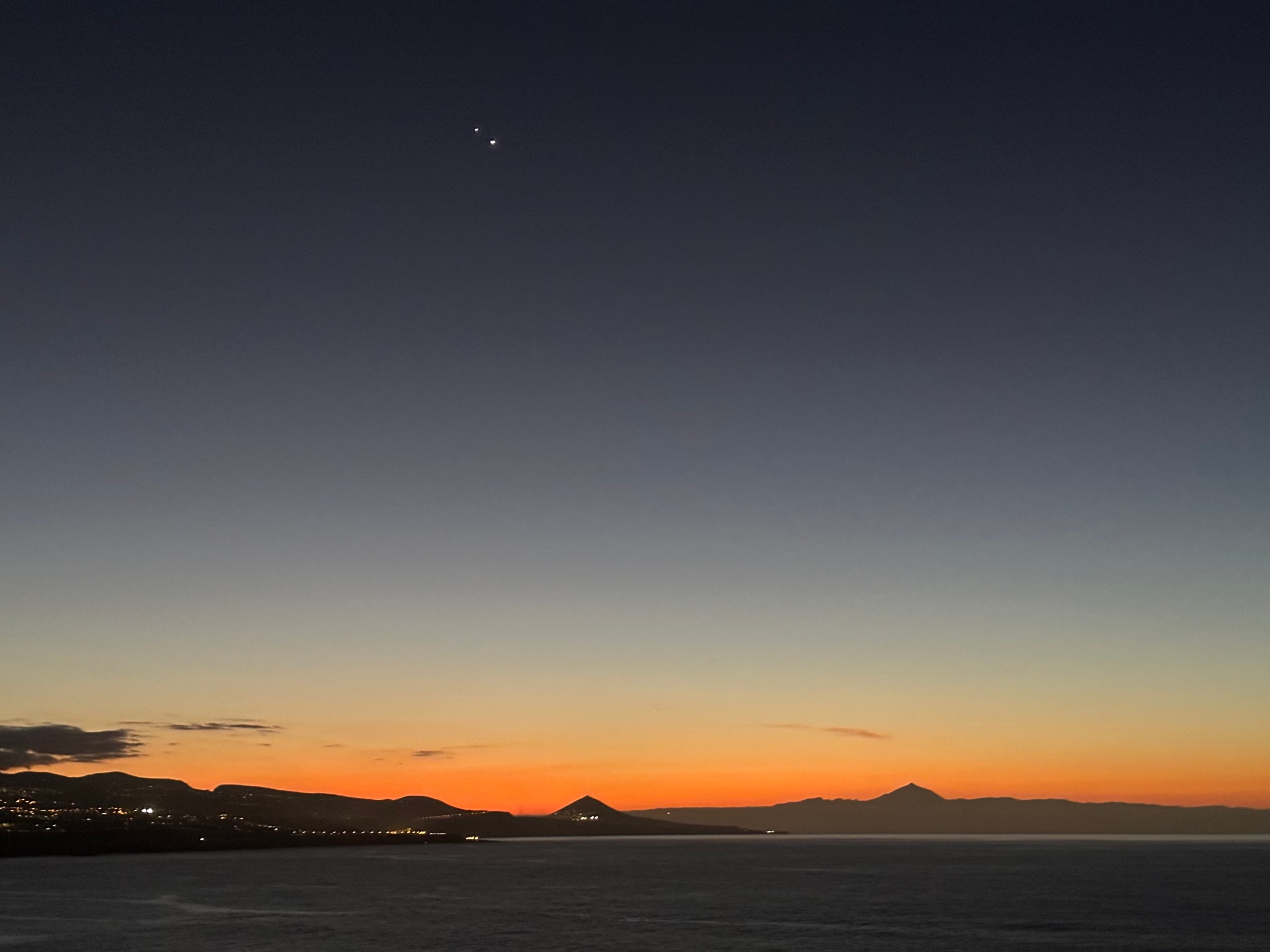
Standing some 50° high in the south by 10 P.M. local daylight time, M5 is a fabulous globular cluster well within the reach of any instrument, from binoculars to telescopes. It is even visible to some observers without optical aid at all on a clear, dark night, so if your southern horizon is free of light pollution, give it a try. You’ll find this ancient ball of stars about 11.5° north of Libra’s magnitude 2.6 beta star, Zubeneschamali.
At magnitude 5.7, M5 is the brightest globular in the Northern Hemisphere, even beating out the famous Hercules Cluster by 0.1 magnitude. It is also one of the oldest, with an age of about 13 billion years. Spanning just over 20’, M5 has a bright core that takes up about 25% of the cluster’s overall size. Its outer edges dissolve into streams of stars that are readily visible in larger scopes. It also contains more than 100 variable stars, most of which are RR Lyrae stars.
Also note: M5 lies close to a slightly brighter star, magnitude 5.0 5 Serpentis, which is just 22’ southeast of the cluster. The two are easily confused!
Sunrise: 5:32 A.M.
Sunset: 8:25 P.M.
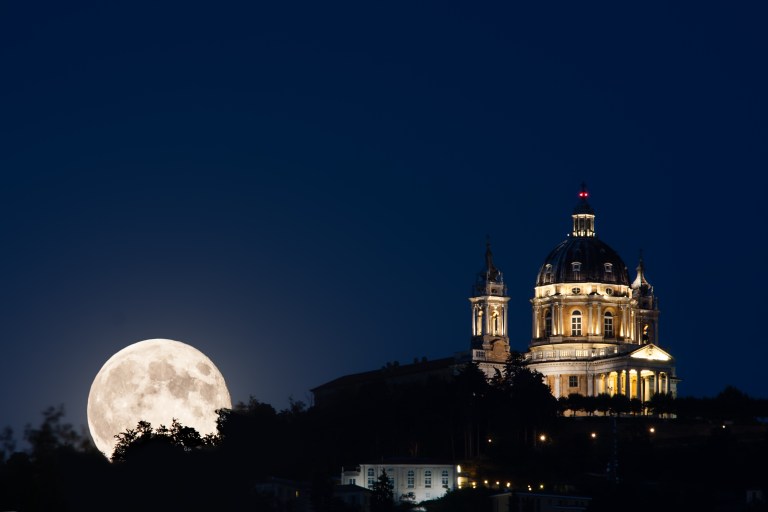
Moonrise: 12:02 A.M.
Moonset: 10:00 A.M.
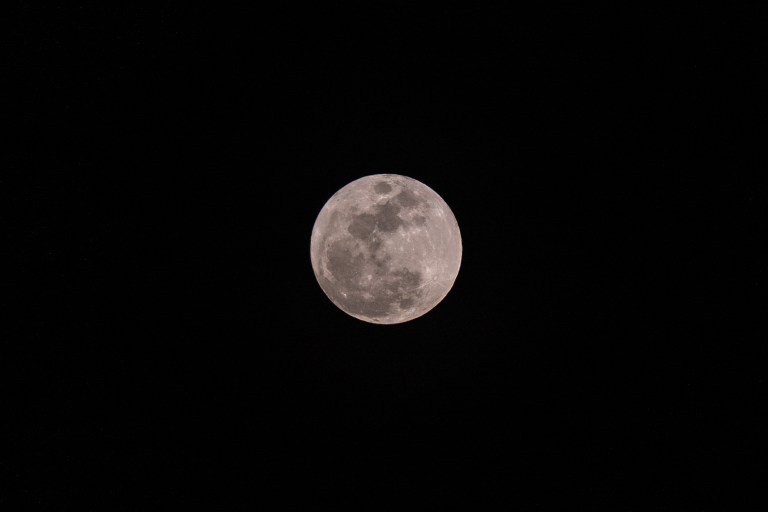
Moon Phase: Waning gibbous (73%)
*Times for sunrise, sunset, moonrise, and moonset are given in local time from 40° N 90° W. The Moon’s illumination is given at 10 P.M. local time from the same location.
Saturday, June 6
Look east around 11 P.M. local daylight time, and you’ll see three bright stars forming a triangle — this is the famous Summer Triangle asterism, which flies high overhead in the middle of short summer nights. We’re still a bit early for that, but with all three stars — and their constellations — above the horizon, it means we can now enjoy all these star patterns have to offer. Tonight, we’re after not Deneb, the tail of Cygnus the Swan, but the long-necked bird’s head to Deneb’s southwest: Albireo.
Glowing at magnitude 3.1, Albireo (also cataloged as Beta [β] Cygni) is a famous double star that is easy to split in small scopes and even well-stabilized binoculars. Its two component stars shine at magnitude 3.4 and 5.1, separated by some 34”. But what really catches the eye are their colors: the brighter star appears yellow-gold, while the fainter component shines with a much bluer light. However, no two pairs of eyes are the same. Some observers see blue and white, while others even see yellow and green (although this is a trick of the brain — there are no green stars!). What colors do you see?
Sunrise: 5:32 A.M.
Sunset: 8:26 P.M.
Moonrise: 12:28 A.M.
Moonset: 11:04 A.M.
Moon Phase: Waning gibbous (63%)
Sunday, June 7
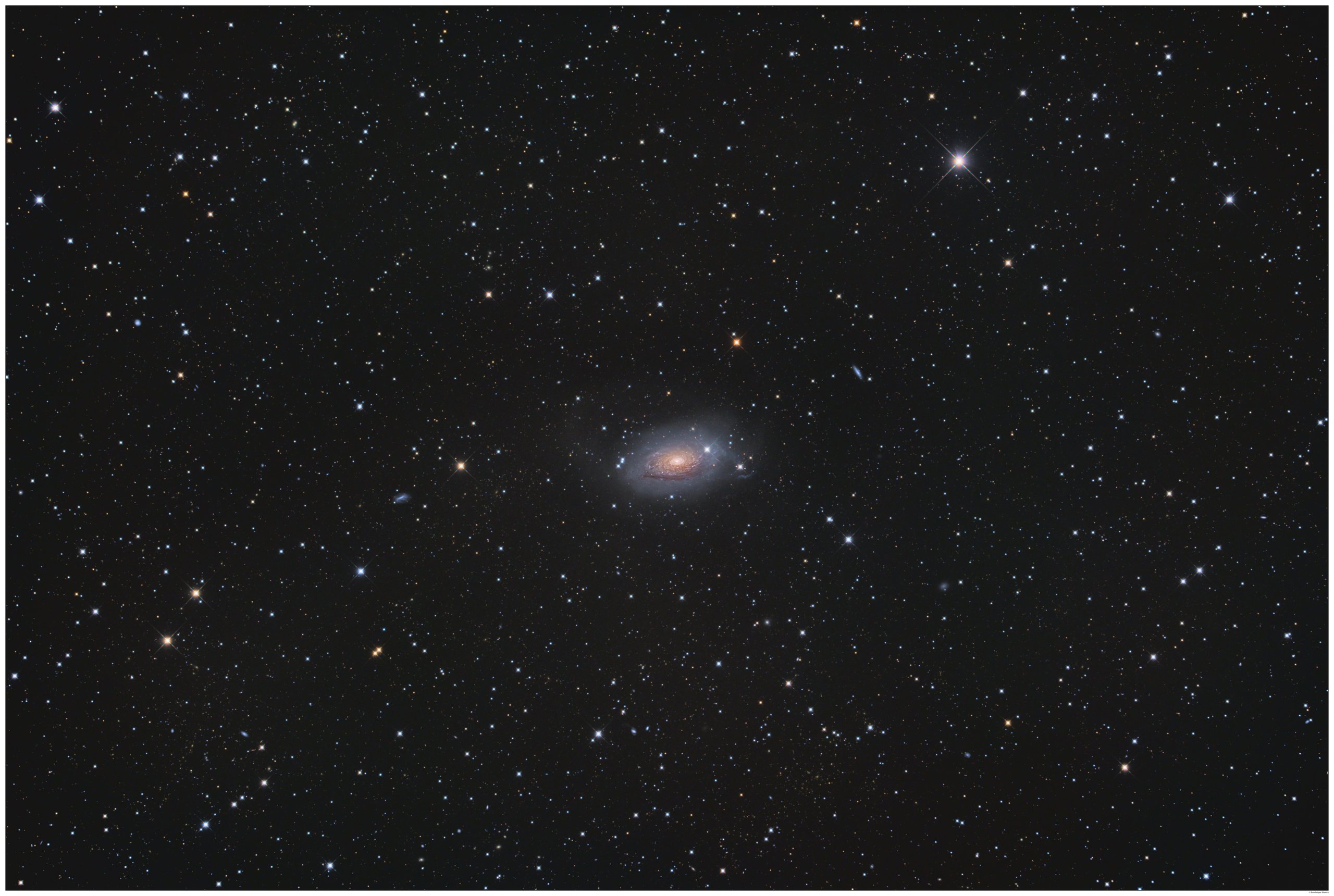
By the time the sky is dark around 10 P.M. local daylight time, the constellation Canes Venatici is still more than 70° high in the west. The Hunting Dogs hold our target for tonight: M63, also known as the Sunflower Galaxy.
A great object for small telescopes, M63 can be found 5.3° northeast of magnitude 2.9 Cor Caroli, Canes Venatici’s alpha star. It’s part of the same galaxy group as M51 (the Whirlpool Galaxy), and lies less than 6° from this object. Because they are associated in space, both lie at roughly the same distance from Earth, some 30 million light-years away.
Glowing at magnitude 8.6, M63 has a bright, compact nucleus that appears almost pointlike, surrounded by a fainter, elongated halo stretching some 3’ across. Its spiral arms are quite challenging — even in a large amateur instrument — so don’t be concerned if you don’t see them in detail. If you do spy them, they may look patchy or grainy rather than smooth and filled-out, a testament to the galaxy’s classification as a flocculent (or “fluffy”) spiral.
Sunrise: 5:32 A.M.
Sunset: 8:27 P.M.
Moonrise: 12:53 A.M.
Moonset: 12:08 P.M.
Moon Phase: Waning gibbous (53%)
Monday, June 8
Last Quarter Moon occurs at 6:01 A.M. EDT, bringing our satellite squarely into the early-morning sky.
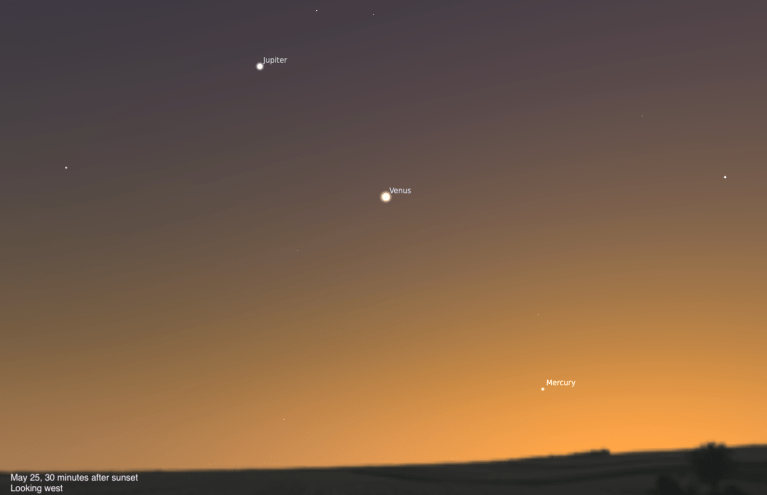
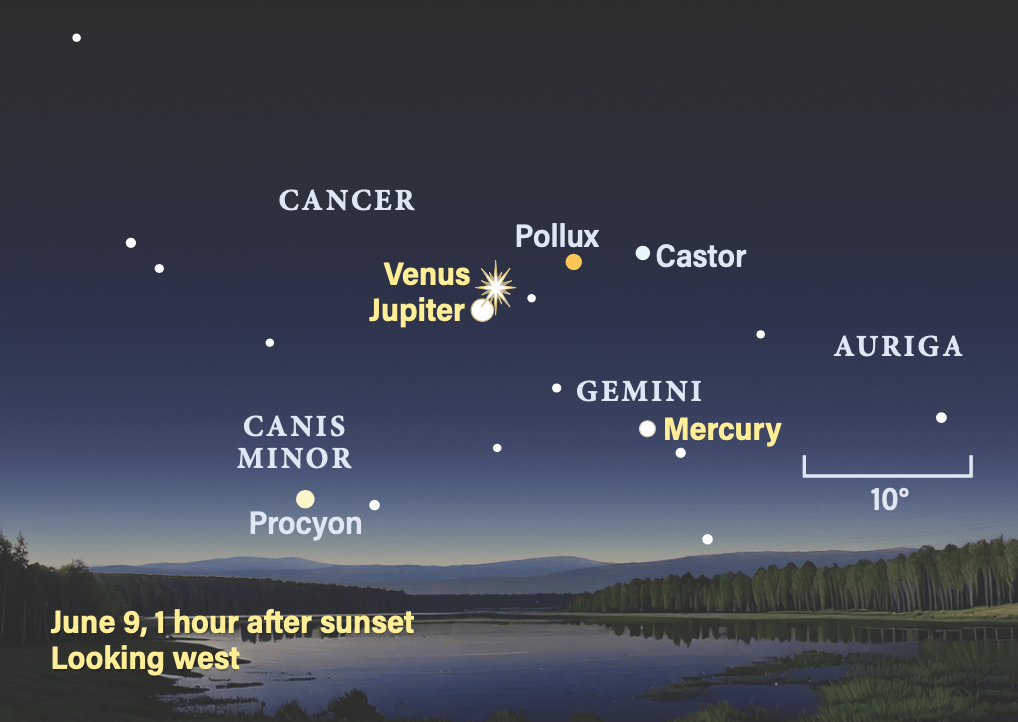
Later today, Venus passes 5° south of the star Pollux at noon EDT. You can view them after sunset in the west, as Venus and Jupiter are closing in for a conjunction. Tonight the planets are 1.7° apart, standing in line with Pollux in the evening sky. An hour after sunset, the trio is just under 20° high. Magnitude 1.2 Pollux, which lies to the left of Gemini’s alpha star, Castor, is highest in the sky. About 4.9° to Pollux’s lower left is Venus, blazing at magnitude –4.0. And less than 2° to Venus’ lower left is magnitude –1.9 Jupiter.
Compare the two planets in binoculars or a finder scope, where you can view them simultaneously. Venus appears 14″ across, showing off a gibbous disk that’s more than 75% lit. Jupiter, despite its greater distance, stretches more than twice that width — 33” — and appears fully illuminated. East Coast and Midwest observers using a telescope may be able to catch the Galilean moon Io transiting the jovian disk with its shadow; only those in the Central time zone will see Io’s transit end, shortly after 10 P.M. CDT. The shadow continues its journey for nearly another hour.
You may also spot magnitude 0.0 Mercury, much closer to the horizon and hanging some 12.2° below Castor. The small planet lies close to the 3rd-magnitude star Epsilon (ε) Geminorum, which may not appear until the sky grows darker.
Sunrise: 5:31 A.M.
Sunset: 8:27 P.M.
Moonrise: 1:15 A.M.
Moonset: 1:14 P.M.
Moon Phase: Waning crescent (43%)
Tuesday, June 9
Venus and Jupiter have now inched closer together and stand 1.6° apart in the evening sky; the former officially passed due north of the latter at 8 A.M. EDT this morning.
Compare the view this evening with that from yesterday. Note how Venus has moved slightly east of its previous position, while Jupiter appears to sit in the same place. That’s because Venus is much closer to Earth and thus appears to move faster across our sky. Closer to the horizon, Mercury has also moved slightly east of where it sat yesterday, pulling farther away from Epsilon Gem.
Once again, Venus and Jupiter are visible in the same field of view with binoculars or a finder scope. Using a telescope at higher magnification will allow you to zoom in on each planet separately to compare their sizes, showing that massive Jupiter appears more than twice as wide as Venus, despite the latter’s proximity to Earth.
Early in the evening, the shadows of both Callisto and Europa are visible crossing the jovian cloud tops. Callisto’s shadow lags behind Europa’s as they move from east to west; the latter’s shadow is also larger. Europa’s shadow transit ends around 10:15 CDT, with Jupiter starting to sink low in the Midwest and after the planet has set along the East Coast. Callisto’s shadow continues to cross for nearly three hours more, and remains visible as the planet sets across the western U.S. Callisto and Europa themselves lie west of Jupiter, while Io lies alone to the east. Ganymede spends the evening crossing behind the large planet, then trekking through its long shadow, remaining invisible until after the planet has set even for West Coast observers.
The Moon passes 4° north of Neptune at 3 P.M. EDT, although neither is visible at that time. They can be found tomorrow morning in the predawn sky, when the Moon stands closer to Saturn, which is just under 9° east of Neptune.
Sunrise: 5:31 A.M.
Sunset: 8:28 P.M.
Moonrise: 1:37 A.M.
Moonset: 2:21 P.M.
Moon Phase: Waning crescent (32%)
Wednesday, June 10
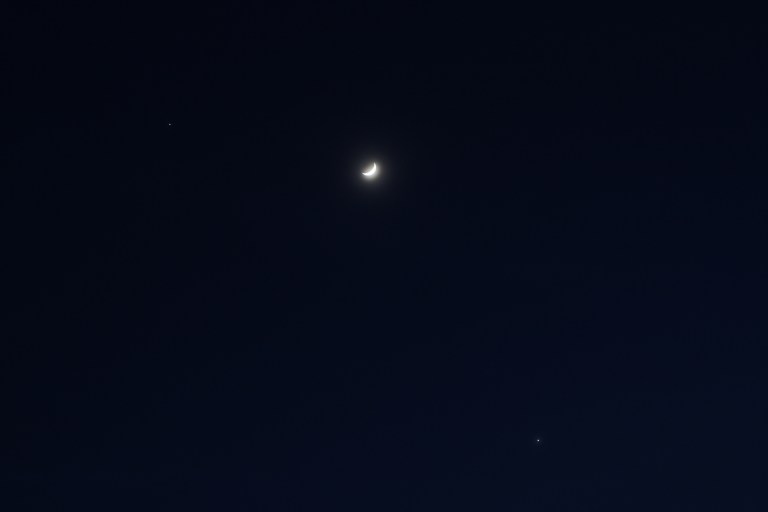
The Moon passes 6° due north of Saturn at 8 A.M. EDT; an hour before dawn, the pair is high in the eastern sky, perfect for early risers to enjoy.
Saturn is the brightest point of light in this region of the sky, sitting close to the southern border of Pisces. Glowing at magnitude 0.8, it should be easily visible even with the crescent Moon nearby. Mars lies far to the pair’s lower left, glowing at magnitude 1.3. It’s already nearly 10° high an hour before dawn, so you should be able to spot it as well.
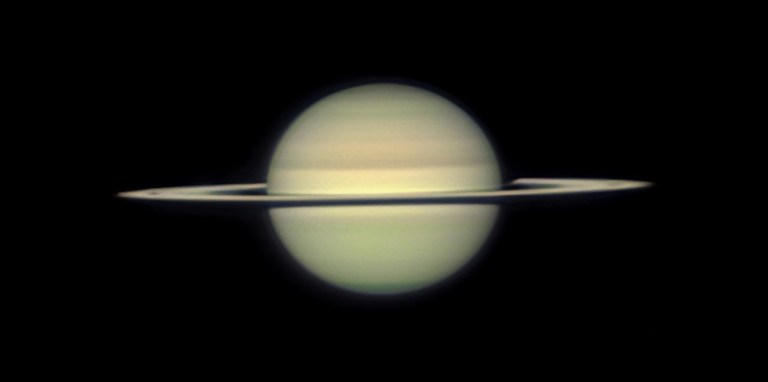
Turn a telescope on Saturn and you’ll be greeted by a view of its lovely rings, stretching some 38” from end to end. They are tilted some 8.5° to our line of sight, showing off their southern face. You may also spot Titan, Saturn’s largest moon, some 40” southwest of the planet and glowing around magnitude 8.5. Fainter 10th-magnitude Tethys, Rhea, and Dione all lie east of the ringed world, but may be more difficult to spot, particularly as the sky brightens. If you want to catch them, try looking an hour or two earlier, while the sky is still well and truly dark.
Zooming back out, Cetus the Whale lies to the lower right of the Moon and Saturn. You may be able to make out a few of the large constellation’s brighter stars, particularly 2nd-magnitude Beta Ceti, also called Diphda or Deneb Kaitos. Although its designation as Beta indicates it comes in second, Diphda actually outshines Cetus’ alpha star, magnitude 2.5 Menkar. Additionally, Menkar lies in far northeastern Cetus, where it doesn’t rise until very shortly before the Sun, rendering it invisible in the brightening sky.
Sunrise: 5:31 A.M.
Sunset: 8:28 P.M.
Moonrise: 2:01 A.M.
Moonset: 3:32 P.M.
Moon Phase: Waning crescent (22%)
Thursday, June 11
Look north after dark this evening to find the Little Dipper standing on its handle, its cup high over the horizon. The star at the end of that handle is Polaris, the North Star, marking the North Celestial Pole. Just beneath Polaris, about 4° to its southeast, is NGC 188, also known as the Polarissima Cluster, named for its proximity to the pole.
Spanning some 14’ on the sky, this 8th-magnitude group of stars is an open cluster that is several billion years old — making it one of the oldest open clusters in the Milky Way. Astronomers can’t quite agree on its age, with estimates ranging from 5 billion to 24 billion years old. Regardless of its age, scientists do agree it has likely survived so long thanks to its position high above the plane of the galaxy.
NGC 188 lies some 5,000 light-years away and is also cataloged as Caldwell 1, the first entry in Sir Patrick Moore’s Caldwell catalog of bright deep-sky objects. It looks lovely through most instruments, while larger scopes will resolve more of its glow into individual stars than smaller ones.
Sunrise: 5:31 A.M.
Sunset: 8:29 P.M.
Moonrise: 2:27 A.M.
Moonset: 4:47 P.M.
Moon Phase: Waning crescent (13%)
Friday, June 12
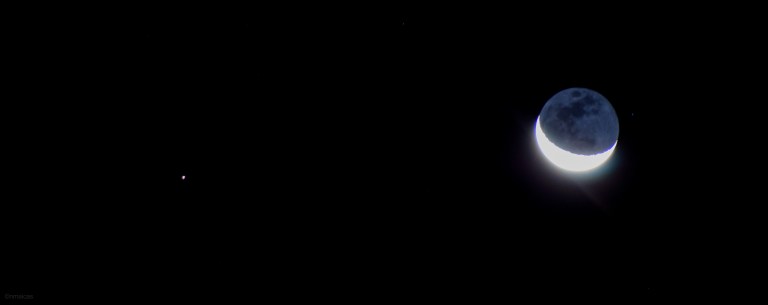
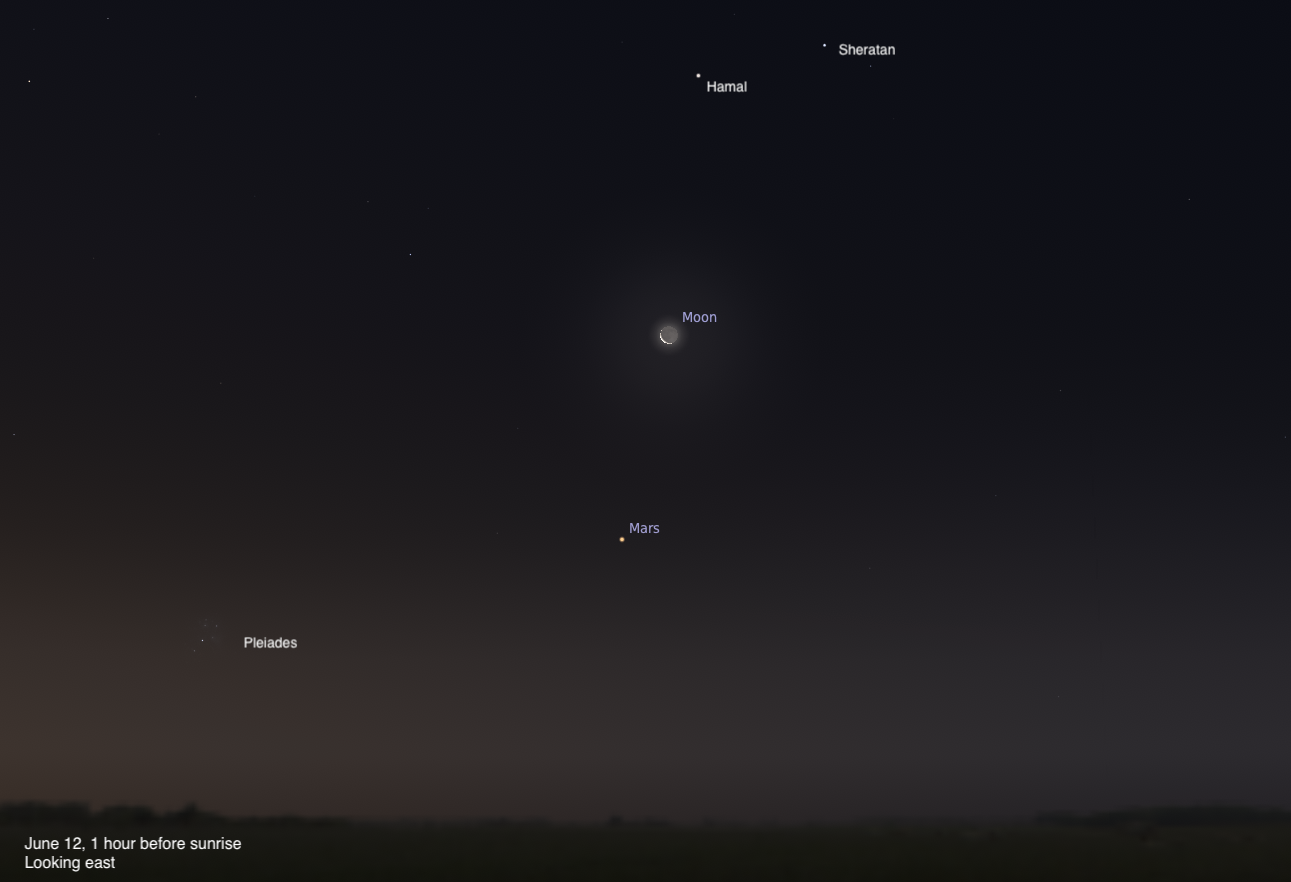
We’re back in the early-morning sky today as the waning crescent Moon joins up with Mars in Aries. Now just 11% lit, the Moon sits almost directly above the Red Planet as they rise. Above both are the two bright stars of the Ram, Hamal and Sheratan. You may also be able to spot the Pleiades star cluster (M45) in Taurus, which lies to the lower left of Mars. These stars will quickly disappear as twilight grows, but you should be able to capture them early on through binoculars or even a telescope’s finder scope. This young cluster of stars sprawls across more than 100’ of sky, making it impossible to capture all its stars with high magnification.
And even high magnification will not net you any detail on Mars. The Red Planet currently lies some 201 million miles (323 million kilometers) from Earth and its disk appears only 4” across in the sky — too small to visually make out any surface features. The planet is still half a year away from its next opposition, which won’t occur until February 2027. For now, simply enjoy its noticeably orange-red hue, which comes through even when observing with the naked eye.
The Moon will pass 6° north of Mars later today at 5 P.M. EDT.
Sunrise: 5:31 A.M.
Sunset: 8:29 P.M.
Moonrise: 2:59 A.M.
Moonset: 6:06 P.M.
Moon Phase: Waning crescent (6%)