Friday, June 12
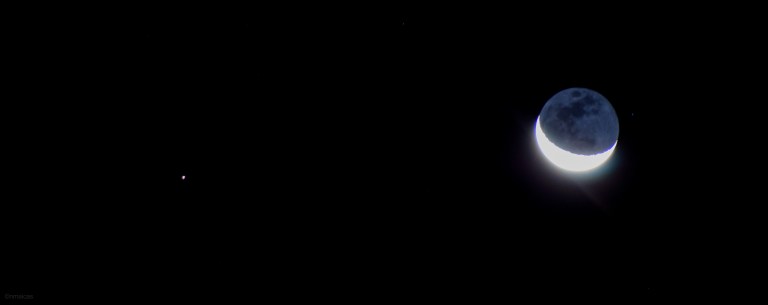
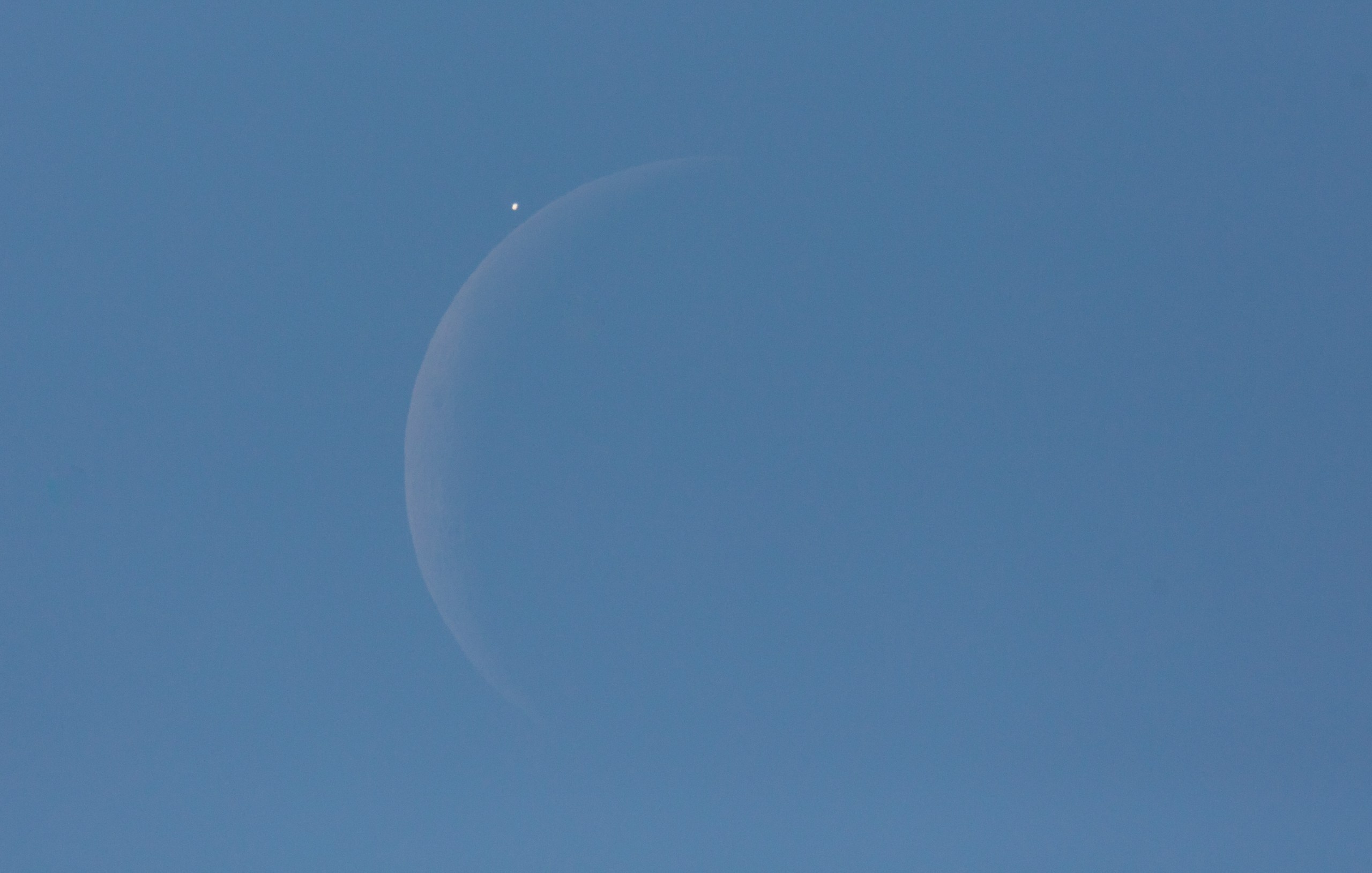
The Moon passes 6° north of Mars at 5 P.M. EDT. You can catch the pair in the early-morning sky today (see The Sky Today on Friday, June 12) or tomorrow (June 13) before dawn, when they will stand about 8° above the eastern horizon an hour before sunrise, with the Moon to the far left of Mars.
The constellation Vulpecula the Fox reaches an altitude of 30° above the eastern horizon by late evening. This star pattern is home to the famous Dumbbell Nebula (M27), a planetary nebula created by a dying Sun-like star. You’ll find the Dumbbell glowing at magnitude 7.4, some 3.2° north of magnitude 3.5 Gamma (γ) Sagittae.
The Dumbbell measures some 8’ by 5.7’, making it just slightly longer than it is wide. True to its name, to visual observers it appears to have two lobes like a dumbbell or hourglass, with a thinner center connecting them. In deep images, more detail is visible and the nebula appears more spherical, though still with a roughly sketched bi-lobed shape.
In addition to its glowing gas wowing observers, the central star generating the nebula is relatively bright at magnitude 13.5. Now a white dwarf, this is the slowly cooling core left by its progenitor star. See if you can spot it in a larger scope.
Sunrise: 5:31 A.M.
Sunset: 8:29 P.M.
Moonrise: 2:59 A.M.
Moonset: 6:06 P.M.
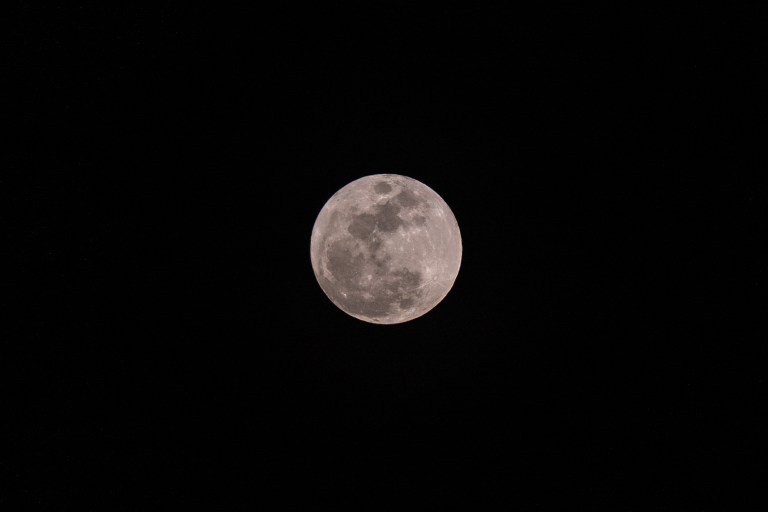
Moon Phase: Waning crescent (6%)
*Times for sunrise, sunset, moonrise, and moonset are given in local time from 40° N 90° W. The Moon’s illumination is given at 10 P.M. local time from the same location.
Saturday, June 13
The Moon passes 5° north of Uranus at 3 P.M. EDT. Rising just over an hour before the Sun, the faint, distant planet is only just now becoming visible in the morning sky, but remains a significant challenge. We’ll try chasing it down in a few weeks, when prospects are better.
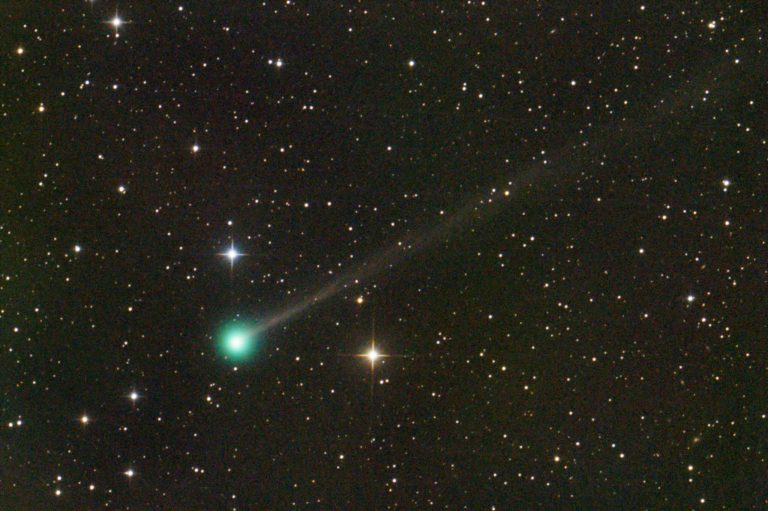
Instead, turn your telescope toward southern Pisces, where Saturn outshines any of the stars in this part of the sky. This is where Comet 220P/McNaught recently underwent an outburst, quickly brightening from 18th magnitude to nearly magnitude 8 in a single day! It has now begun to slowly fade, yet remains brighter than before the jump, recently recorded around 12th magnitude.
This morning, you can find Comet McNaught 4.7° west of Saturn’s position, so take advantage of its location near the bright planet to find it. Look some two hours before dawn, when the comet is nearly 20° high in the east. The region will continue to rise as the sky brightens.
Comet McNaught, which has a period of roughly 5½ years, officially reaches perihelion (the closest point to the Sun in its orbit) tomorrow, June 14. It is expected to continue fading, but we could always see another surprise outburst, so stay tuned! And even as this comet fades, another — 10P/Tempel — is inbound for a late summer perihelion, and is becoming more favorable for viewing.
Sunrise: 5:31 A.M.
Sunset: 8:30 P.M.
Moonrise: 3:40 A.M.
Moonset: 7:27 P.M.
Moon Phase: Waning crescent (2%)
Sunday, June 14
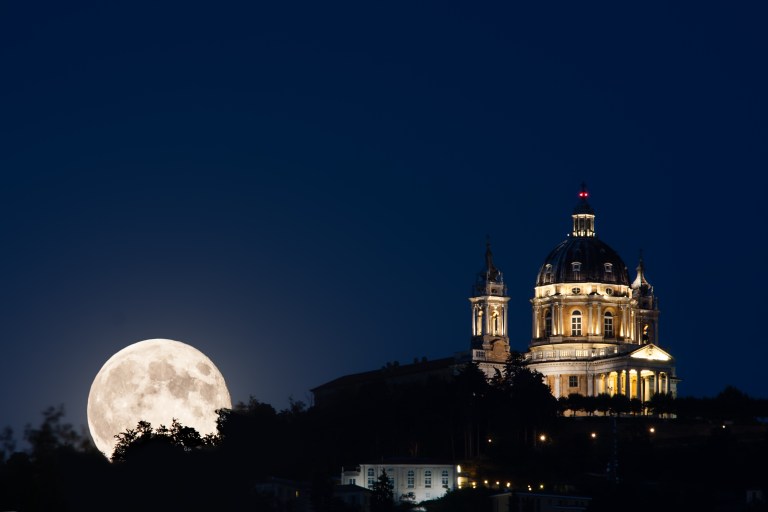
The Moon reaches perigee, the closest point to Earth in its orbit, at 7:20 P.M. EDT. At that time, it will be 221,952 miles (357,197 kilometers) away.
New Moon then occurs at 10:54 P.M. EDT.
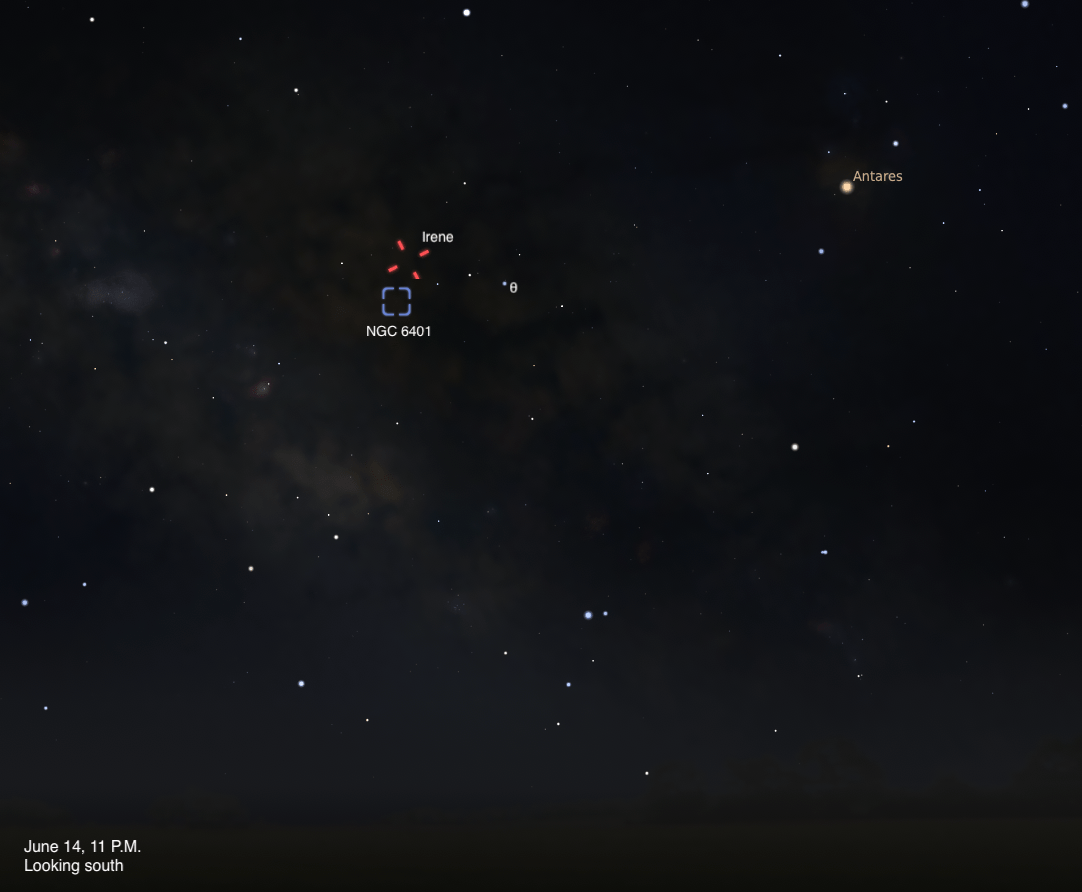
Asteroid 14 Irene reaches opposition at 6 A.M. EDT tomorrow morning, making now a great time to catch it. Glowing at mid-9th-magnitude, Irene is already 20° high in the south an hour before midnight and stands highest around 1 A.M. local daylight time. It’s located in Ophiuchus, near the plane of our galaxy, where you’ll also find rich clusters and numerous nebulae. It’s about 3.6° northeast of 3rd-magnitude Theta (θ) Ophiuchi. If you can spot bright orange-red Antares, look to the region left of this standout star.
Related: Discover deep-sky gems in Ophiuchus
Not far from Irene’s position is the compact globular cluster NGC 6401, which glows at roughly the same magnitude as the asteroid. You’ll find it just 1.6° southeast of Irene’s position, or 3.9° east-northeast of Theta Oph. Even if you have trouble spotting Irene against the crowded background stars, you should be able to pick up the globular much more easily.
Sunrise: 5:31 A.M.
Sunset: 8:30 P.M.
Moonrise: 4:31 A.M.
Moonset: 8:41 P.M.
Moon Phase: New
Monday, June 15
Asteroid 14 Irene officially reaches opposition at 6 A.M. EDT.
This afternoon, Mercury reaches greatest eastern elongation at 4 P.M. EDT, standing 25° from the Sun. You’ll find the solar system’s smallest planet in the evening sky, now shining at magnitude 0.5.
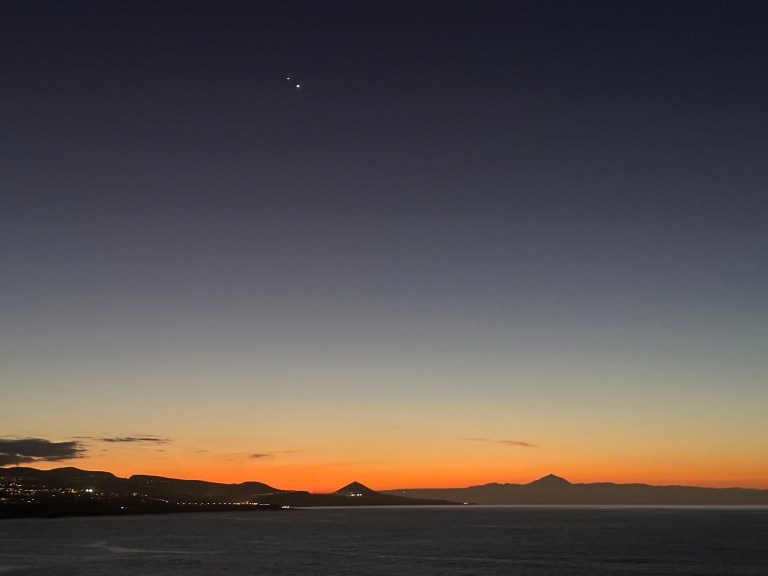
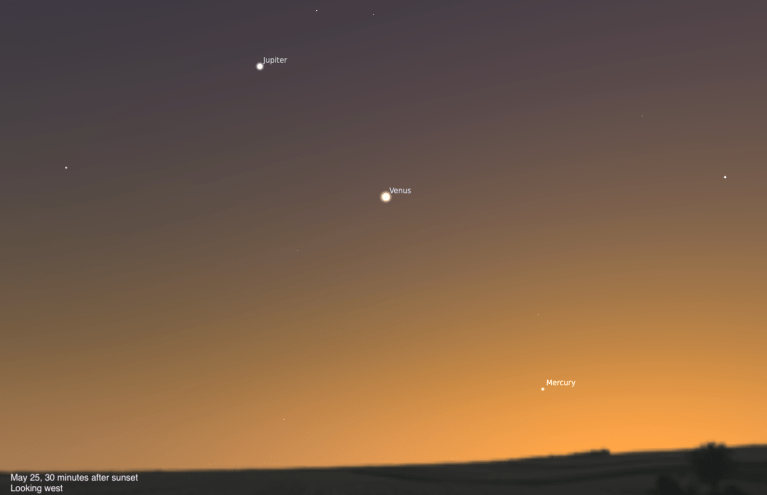
Half an hour after sunset, a delicate waxing crescent Moon — just 2% lit — is setting, just 5° above the western horizon. Mercury will pop out to the Moon’s upper left, sitting in the middle of Gemini the Twins. To Mercury’s upper left are brighter Jupiter and then Venus, shining at magnitudes –1.8 and –4.0, respectively.
After moonset, Mercury is the first planet to disappear, sinking below the horizon shortly after 10 P.M. local daylight time. Jupiter and Venus remain visible for at least half an hour more, with the latter staying aloft the longest, setting around 11 P.M. local daylight time.
Through a telescope, Mercury’s disk appears some 38% lit and spans 8” on the sky. Compare that first with Venus, which is 75% illuminated and 14” across. Jupiter dwarfs them both, its fully illuminated disk stretching 32” across. You may catch sight of the gas giant’s four Galilean moons — additionally, Io begins a transit around 9:50 P.M. CDT, with its shadow becoming visible on the cloud tops a little under an hour later, visible from the western half of the U.S.
Sunrise: 5:31 A.M.
Sunset: 8:30 P.M.
Moonrise: 5:36 A.M.
Moonset: 9:45 P.M.
Moon Phase: Waxing crescent (2%)
Tuesday, June 16
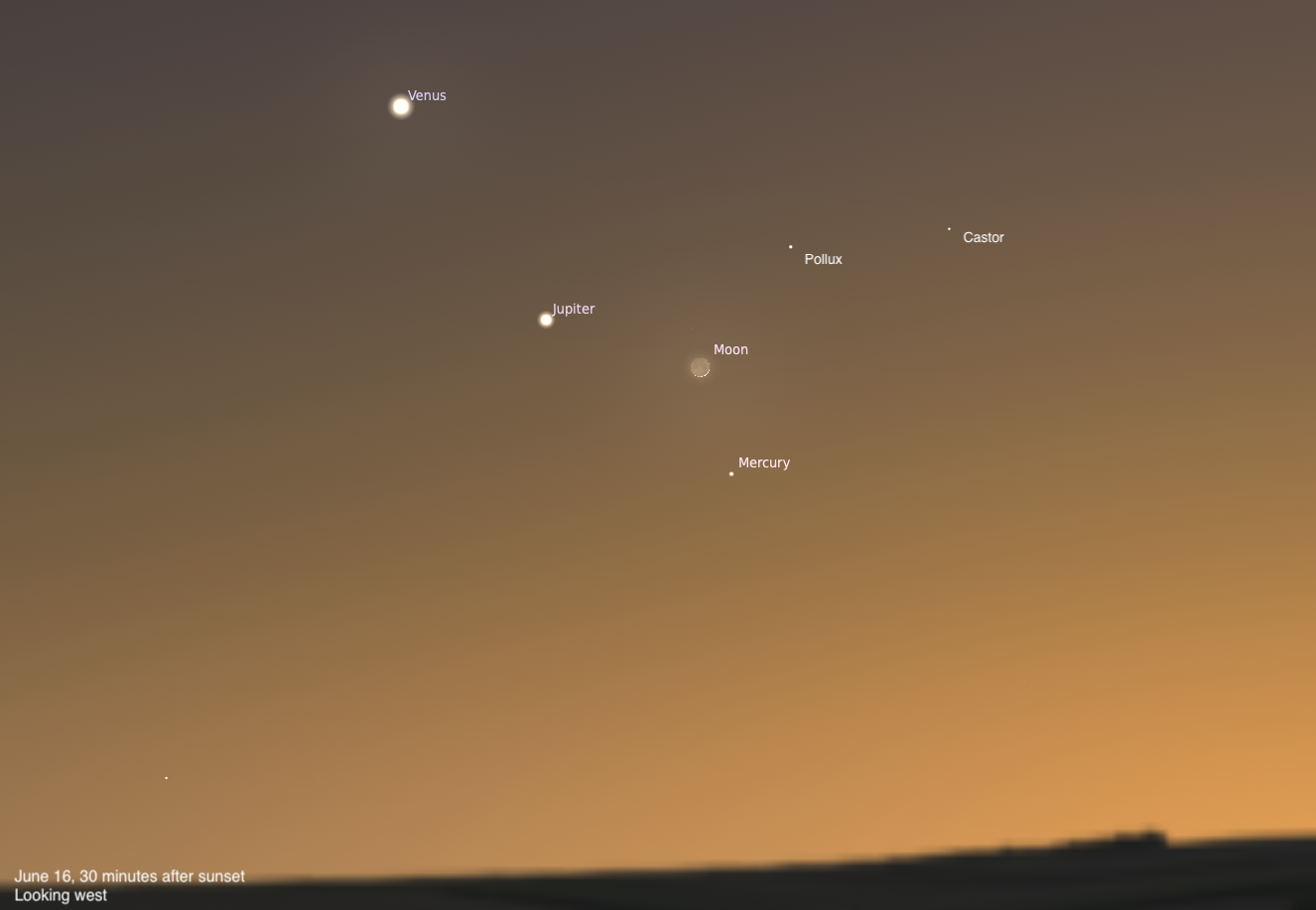
The Moon passes 3° north of Mercury at 4 P.M. EDT. Looking west again after sunset this evening, the Moon now sits above Mercury, forming a triangle with Mercury and Jupiter.
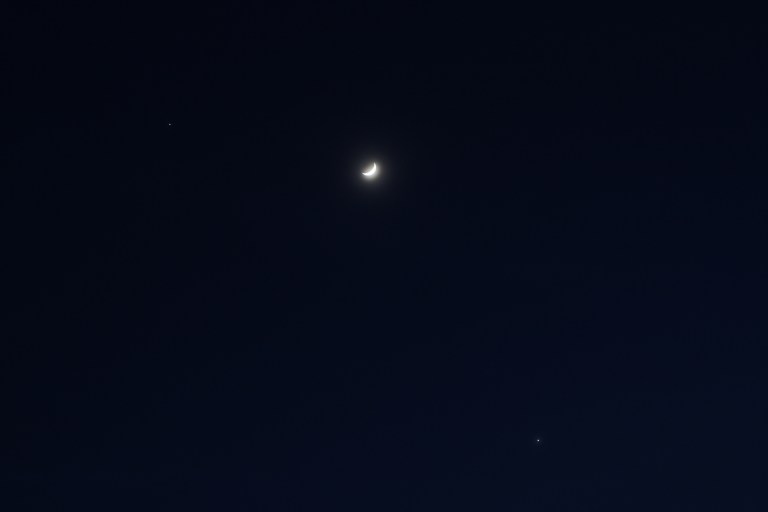
Half an hour after sunset, the trio is over 10° high; an hour after sunset, they’re still 8° above the horizon. The Moon is a slightly wider crescent, now 6% lit as dawn breaks across its surface from east to west. Just north of the Moon, to our satellite’s upper right, is the bright star Pollux in Gemini; to the right of Pollux is slightly fainter Castor. As darkness falls, these stars should be some of the first to pop out of the twilight. It’s a beautiful grouping you should be able to capture with a cellphone camera.
Additionally, Venus still lies to Jupiter’s upper left, shining brightly in Cancer the Crab. Note in particular how far the Moon seems from Venus’ position — by tomorrow afternoon, our satellite will catch up to the bright planet, passing in front of Venus in a daytime occultation. Stay tuned for details on that event in tomorrow’s entry.
Sunrise: 5:31 A.M.
Sunset: 8:31 P.M.
Moonrise: 6:50 A.M.
Moonset: 10:35 P.M.
Moon Phase: Waxing crescent (6%)
Wednesday, June 17
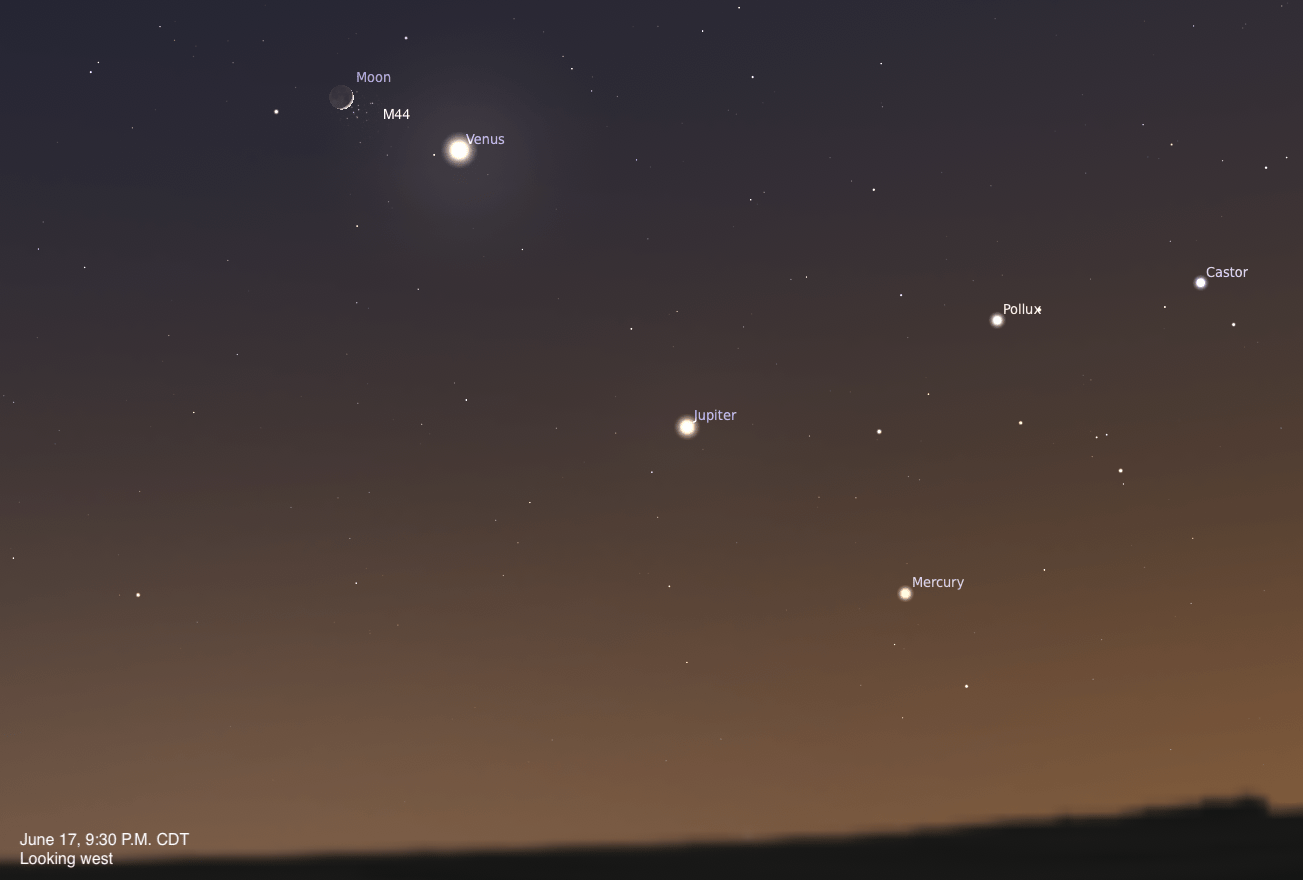
The Moon, moving east along the ecliptic (the plane of the solar system and the line along which the planets and Moon move on the sky), passes 3° north of Jupiter in Gemini at 3 A.M. EDT. Although the region is not visible at this time, our satellite is moving quickly into Cancer and will pass 0.3° north of Venus at 4 P.M. EDT.
However, some observers won’t see the Moon pass north of Venus, but instead pass in front of it in an occultation. Although visible across the U.S., observing during daytime always requires extra care and caution, as pointing any optics at the Sun for even a brief instant can cause permanent eye damage. Make sure to take care if you are attempting to view using binoculars or a telescope — using the latter in particular is recommended for experienced observers only.
The timing of the event depends on your location. Along the East Coast, for example, Venus disappears behind the leading dark edge of the Moon at 3:49 P.M. EDT. In Texas, those in Austin will see it disappear at 2:24 P.M. CDT. Farther west, Denver sees the event begin at 12:55 P.M. MDT. The International Occultation Timing Association’s webpage for the event lists the times of disappearance and reappearance for numerous locations at www.lunar-occultations.com/iota/bstar/0617venus.htm. Note that dates and times are given in Universal Time and will need to be converted to your local time zone.
By evening, the Moon is crossing M44, the Beehive star cluster, in central Cancer, with Venus now some 2° to our satellite’s lower right. There are more occultations here, as the Moon passes in front of some of the cluster’s stars. This is of course safe for viewing with binoculars or a telescope as soon as the Sun sets, although the stars aren’t visible until the sky starts to darken. The show is best for those in the eastern half of the U.S., who see the stars disappear; the western half of the country will see the stars reappear from behind the Moon, but because they pop out from behind the bright limb, it’s a more challenging observation.
Nonetheless, everyone can enjoy the lovely juxtaposition of Moon and stars in the sky, even if observing the occultations isn’t feasible.
Sunrise: 5:31 A.M.
Sunset: 8:31 P.M.
Moonrise: 8:09 A.M.
Moonset: 11:14 P.M.
Moon Phase: Waxing crescent (13%)
Thursday, June 18
Now it’s Venus’ turn to close in on the Beehive Cluster (M44), which sparkles in central Cancer. Tonight after sunset, blazing Venus is just 1.3° from the center of this loose open cluster, which is visible to the naked eye after dark and looks fantastic in binoculars or a low-power telescope.
The Beehive Cluster is spread across nearly 100’ of sky and its members shine with a combined magnitude of 3.7. Venus is of course far brighter, a bright pinprick of light at magnitude –4.0 just to the right of the cluster in the sky. Tomorrow, Venus will have moved to stand within less than a degree of the cluster, so make sure to return and check out the view yet again.
The Moon has meanwhile moved into Leo, which sits immediately east of Cancer on the ecliptic. You will see it tonight to the lower right of the Sickle asterism, whose brightest star — marking the bottom of the Sickle’s handle — is magnitude 1.4 Regulus (Alpha [α] Leonis), the brightest star in all of Leo.
As darkness falls, the Sickle should slowly emerge into view. From Regulus, the next star (marking the top of the Sickle’s handle) is Eta (η) Leo, 4.8° due north of Regulus. The blade is outlined by magnitude 2.0 Gamma Leo, 4.3° northeast of Eta; magnitude 3.4 Zeta (ζ) Leo, 3.7° north of Gamma; magnitude 3.9 Mu (μ) Leo, 6° northwest of Zeta; and magnitude 3.0 Epsilon (ε) Leo, 2.7° southwest of Mu. Many observers think it looks like a backwards question mark.
Sunrise: 5:31 A.M.
Sunset: 8:31 P.M.
Moonrise: 9:28 A.M.
Moonset: 11:46 P.M.
Moon Phase: Waxing crescent (22%)
Friday, June 19
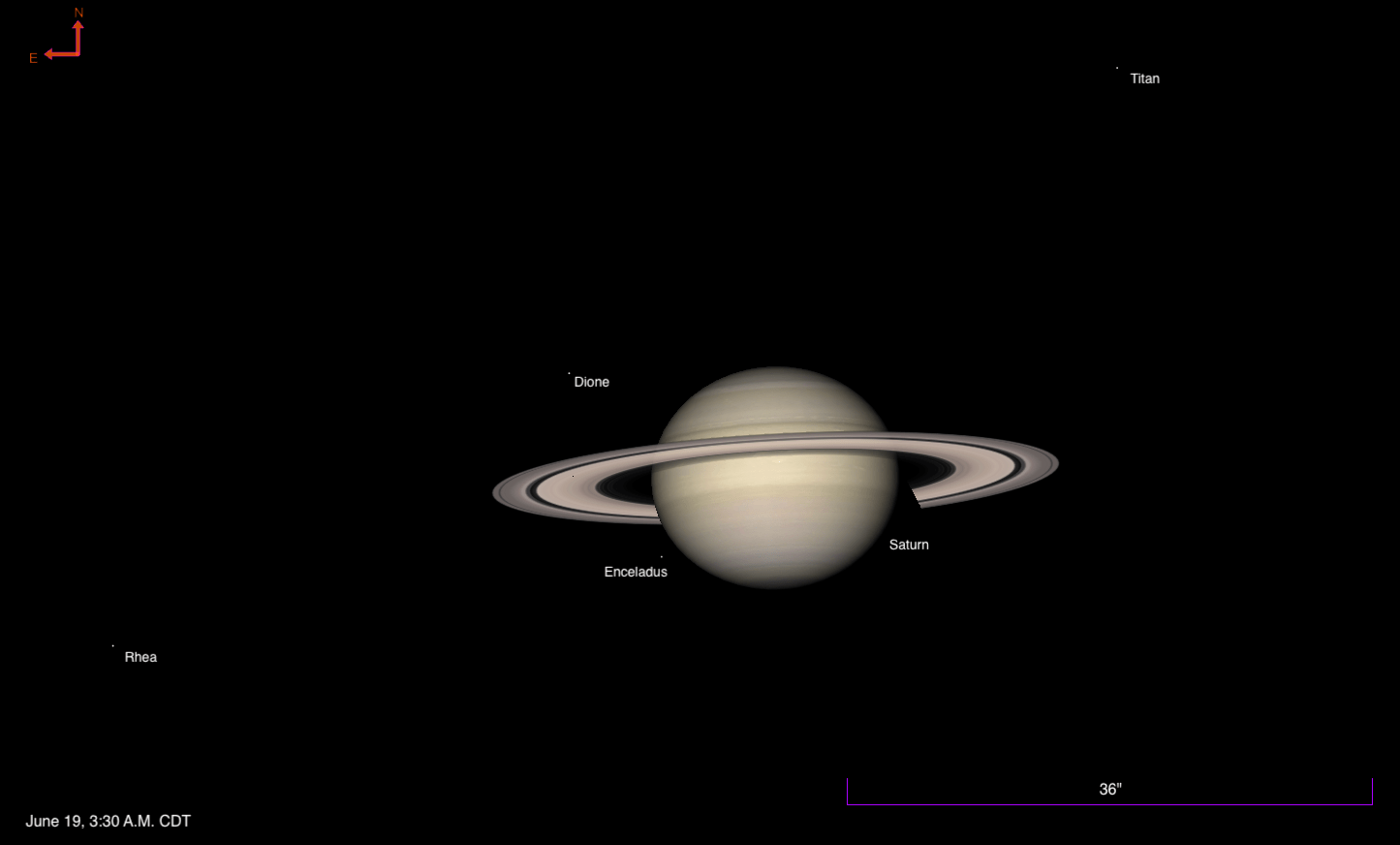
Saturn rules the early-morning sky, shining at 1st magnitude in otherwise dim Pisces the Fish. One of the ringed planet’s many moons, Dione, passes due north of Saturn this morning. The 10th-magnitude moon’s progress is visible if you’ve got a dark sky and a telescope.
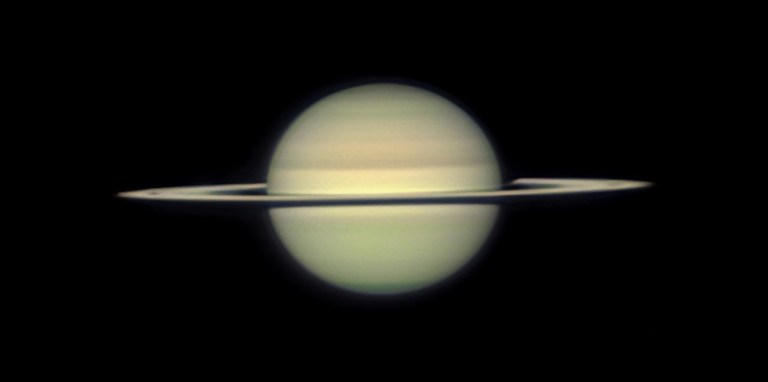
Two hours before sunrise, Saturn is nearly 20° high in the east. It’s easy to find as the brightest light in this part of the sky, skimming the border between southern Pisces and northern Cetus. Through a telescope, you’ll of course see Saturn’s stunning ring system, and should also easily pick up its largest and brightest moon, Titan, just northwest of the planet.
Dione — again, magnitude 10 — is much closer to the planet than Titan and lies northeast of Saturn. As the hours pass, it draws closer, passing due north of Saturn shortly before 4:30 A.M. PDT — note the time zone, as at this point the planet and moon will only be visible along the U.S. West Coast. The farther west you are, the better, as the sky is likely already growing light. See if you can identify Dione roughly an arcsecond above the planet’s north pole, despite the slowly brightening twilight; you might also try snapping a quick photo if you’ve got the setup, as that may show Dione’s position even if your eyes can’t find it.
The Moon passes 0.3° south of Regulus in Leo at 11 A.M. EDT. By this evening, our satellite will sit to the upper left of this bright star in the west after sunset.
Sunrise: 5:31 A.M.
Sunset: 8:32 P.M.
Moonrise: 10:41 A.M.
Moonset: —
Moon Phase: Waxing crescent (32%)
Alison Klesman is senior editor of Astronomy magazine. She holds a Ph.D. in astronomy and has studied a variety of topics, from minor planets to supermassive black holes.