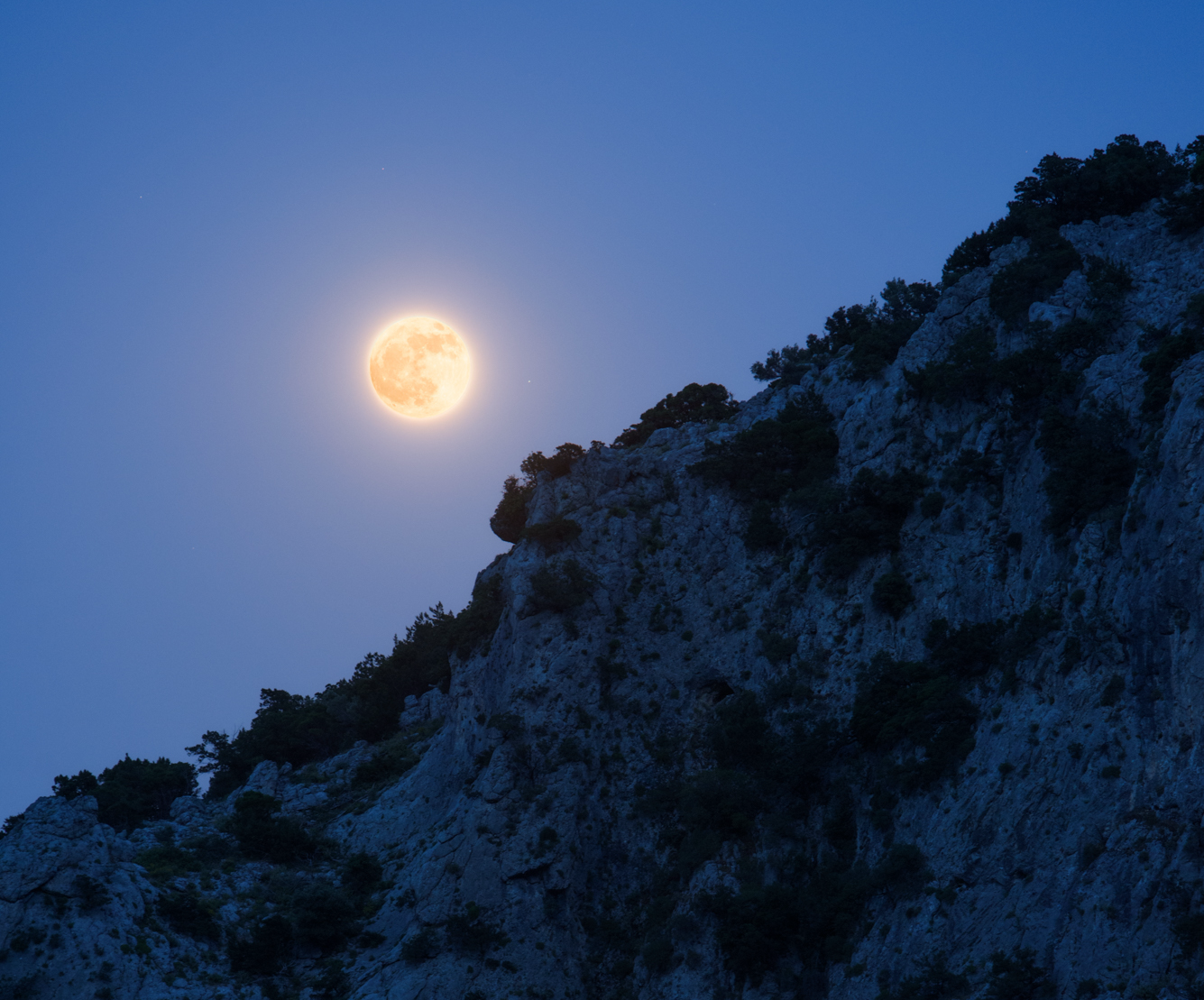
Friday, June 26
Even with a bright waxing Moon up most of the night, there are still plenty of targets for your telescope. One of those targets is the Wild Duck Cluster (M11), an open cluster in Scutum that’s located near the tail of Aquila the Eagle.
Wait until about 11 P.M. local daylight time, when this region has risen to some 30° above the southeastern horizon, to the far left of where the Moon is located in Scorpius. On a dark night, M11 can be visible to the naked eye, but tonight, the Moon’s light will wash it out. But never fear, binoculars or any small telescope will still show the cluster’s bright stars.
Located in the northeastern corner of Scutum, M11 is easy to find by following a line of three naked-eye stars. Starting at 3rd-magnitude Lambda (λ) Aquilae, slide your gaze southwest toward 4th-magnitude 12 Aql, then continue to 5th-magnitude Eta (η) Scuti. From there, simply follow the curve of this three-star pattern to reach M11, some 2.7° west-southwest of Eta Sct. The cluster lies just 1° southeast of the famous variable star R Scuti.
Glowing collectively at magnitude 5.8, the young suns of M11 spread across roughly 14’ of sky and lie some 6,000 light-years away. The cluster looks to some like a flock of birds in flight — particularly 19th-century astronomer Admiral William Smyth, who coined its common name. What pattern do you see through your optics?
Sunrise: 5:33 A.M.
Sunset: 8:33 P.M.
Moonrise: 6:11 P.M.
Moonset: 2:38 A.M.
Moon Phase: Waxing gibbous (93%)
*Times for sunrise, sunset, moonrise, and moonset are given in local time from 40° N 90° W. The Moon’s illumination is given at 10 P.M. local time from the same location.
Saturday, June 27
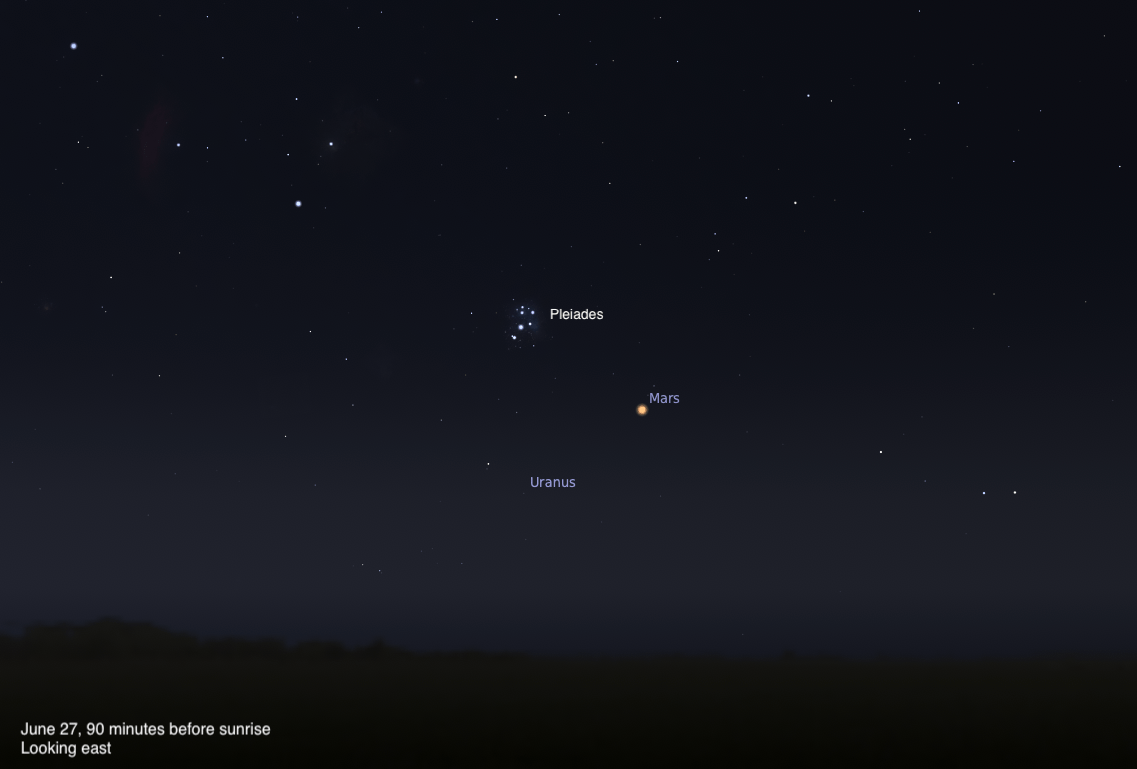
Mars now lies in Taurus, visible in the early-morning sky before sunrise. Today, the Red Planet is less than 5° from the famous Pleiades star cluster (M45). If you happen to be up roughly an hour and a half before sunrise, you can try to catch them, low in the eastern sky.
By 4 A.M. local daylight time, Mars has reached an altitude of about 8°. Glowing at magnitude 1.3, it’s a relatively bright point of light low in the east. To its upper left is the Pleiades, a young open cluster of stars and one of the most recognizable naked-eye deep-sky objects, even among beginners. Together with Mars, the Pleiades will slowly rise higher in the east as time passes, but the sky will also grow lighter, washing them out as sunrise approaches.
The Moon passes 0.4° south of Antares in Scorpius at 11 A.M. EDT, while neither is visible. By this evening, our satellite has moved from Scorpius into Ophiuchus, lying near the border of these two constellations.
Sunrise: 5:33 A.M.
Sunset: 8:33 P.M.
Moonrise: 7:10 P.M.
Moonset: 3:15 A.M.
Moon Phase: Waxing gibbous (97%)
Sunday, June 28
The Moon reaches apogee, the farthest point from Earth in its orbit, at 3:11 A.M. EDT. At that time, our satellite will be 252,441 miles (406,264 kilometers) away.
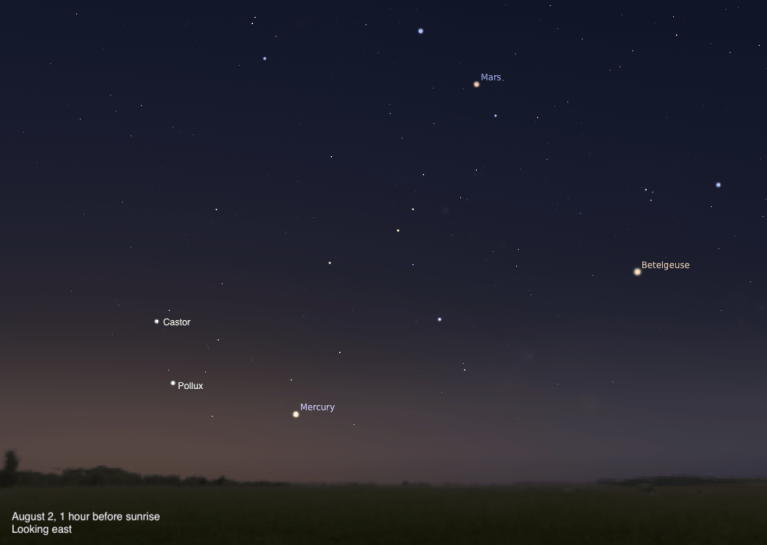
The planet Mercury stands stationary tonight at 10 P.M. EDT. Mercury was previously moving eastward, or prograde, against the background stars. After today, it will begin retrograde motion, moving westward.
Located in far eastern Gemini, the tiny planet isn’t far from mighty Jupiter, which lies to the east in Cancer. Shining at magnitude 1.7, Mercury sets soon after the Sun. If you want to catch it, you’ll want to be ready with binoculars or a telescope at sunset, but take care not to use these instruments until the Sun has fully disappeared from view.
By 30 minutes after sunset, Venus should be visible, a bright point of light in the western sky. You may also spot Jupiter, fainter but still bright in the falling twilight and far to Venus’ lower right. Mercury lies about 4.3° southwest of Jupiter, below and a little to its right. If you can’t spot it by eye, try with your optics. Mercury is just 4.7° high at this time, so you’ll need a clear western horizon. If you can get to a location above your surroundings, that will also help.
If you’re able to capture Mercury in a telescope, note how its disk is only a slender crescent. It is now just 15% lit and spans 11”. Compare that to Venus, higher in the sky, which spans 16” and is some 70% lit.
You might also notice the stars Castor and Pollux, the heads of Gemini the Twins, peeking out to Jupiter’s right as the sky starts to darken.
Sunrise: 5:34 A.M.
Sunset: 8:33 P.M.
Moonrise: 8:04 P.M.
Moonset: 3:58 A.M.
Moon Phase: Waxing gibbous (99%)
Monday, June 29
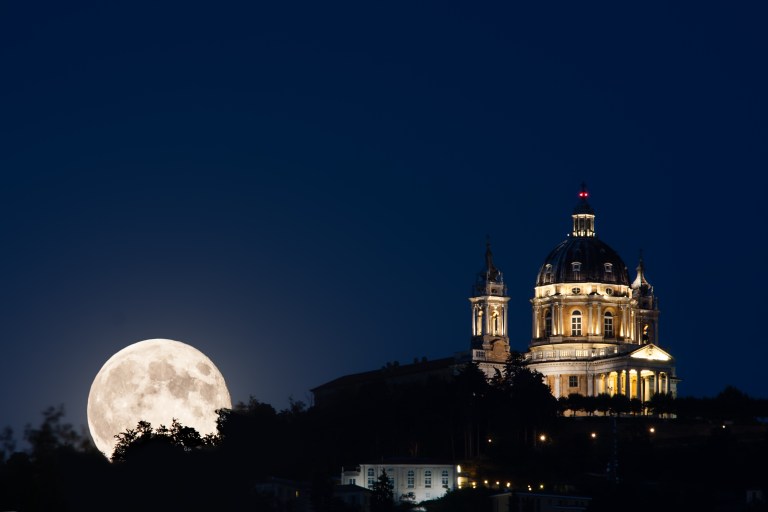
Full Moon occurs this evening at 7:57 P.M. EDT. The June Full Moon is also called the Strawberry Moon. According to NASA, this name comes from the Native American Algonquin tribes.
Rising shortly after sunset, the Full Moon will light the night from roughly dusk until dawn, dominating the constellation Sagittarius from within the Teapot asterism. It passes close to the 3rd-magnitude star Phi (φ) Sagittarii, which marks where the top of the Teapot’s handle joins with the body. From some parts of the world — South America and New Zealand — our satellite will occult nearby Nunki (Sigma [σ] Sgr), passing in front of the star and temporarily blocking it from view.
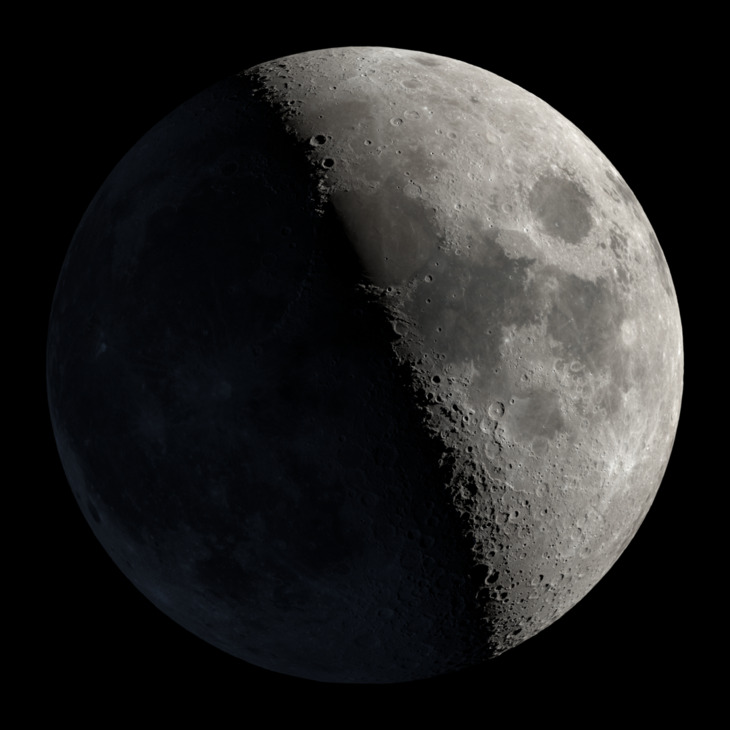
While the Full Moon is up, it can be hard to observe any deep-sky objects, so tonight concentrate your view on our satellite. Its nearside is mottled light and dark — those dark regions are old lava plains called maria, Latin for seas. In the lunar south, Tycho Crater is extremely prominent, with long rays of ejected material that was flung out when the crater was formed arcing across the nearside. These rays reach as far from the crater as Mare Serenitatis in the northern hemisphere, whose dark landscape is bisected by a bright white streak of ejecta.
Sunrise: 5:34 A.M.
Sunset: 8:33 P.M.
Moonrise: 8:51 P.M.
Moonset: 4:49 A.M.
Moon Phase: Full
Tuesday, June 30
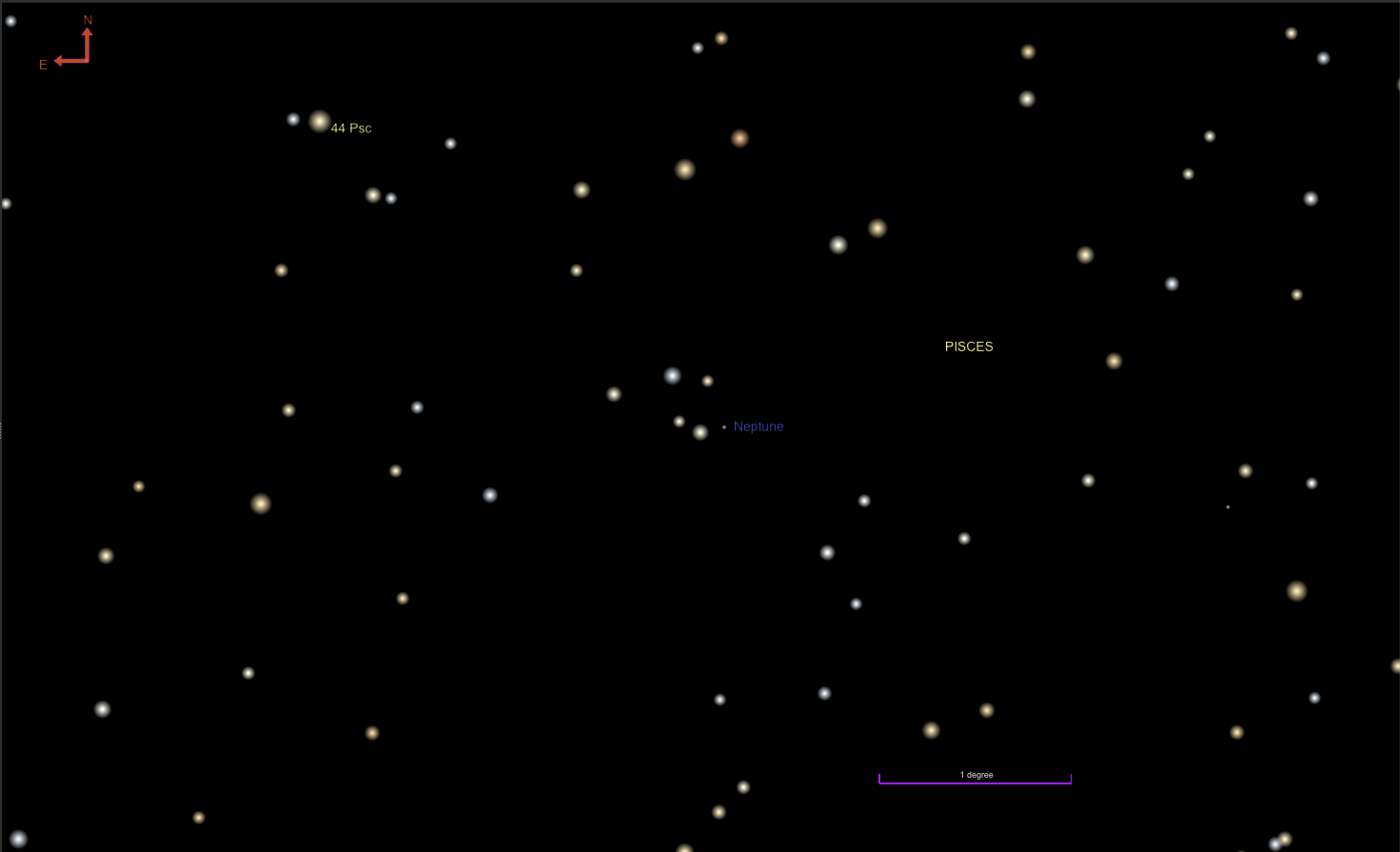
Rising around 12:30 A.M. local daylight time, the distant planet Neptune lies in the constellation Pisces, not far from Saturn. By 3:30 A.M., the ice giant has reached an altitude of some 30° in the southeast, offering excellent views in a still-dark sky.
First, find Saturn, the brightest point of light in this region. From there, slide your gaze (through binoculars or a telescope, needed to see Neptune) about 7.4° west, which will land you on the 6th-magnitude star 44 Piscium. Then look about 2° southwest of this star, which will bring a group of some five stars into view, shaped like a carat pointing east. The brightest of the group is a 7th-magnitude sun; this morning Neptune is located some 20’ southwest of this star, and about 8’ from a fainter, 8th-magnitude field star. Shining at magnitude 7.8, Neptune fits right in with this grouping, but lies farther west than any of the stars. Its tiny disk spans 2” and glows a grayish-blue — see if you can separate it from the pinprick lights of the stars.
Sunrise: 5:35 A.M.
Sunset: 8:33 P.M.
Moonrise: 9:31 P.M.
Moonset: 5:47 A.M.
Moon Phase: Waning gibbous (99%)
Wednesday, July 1
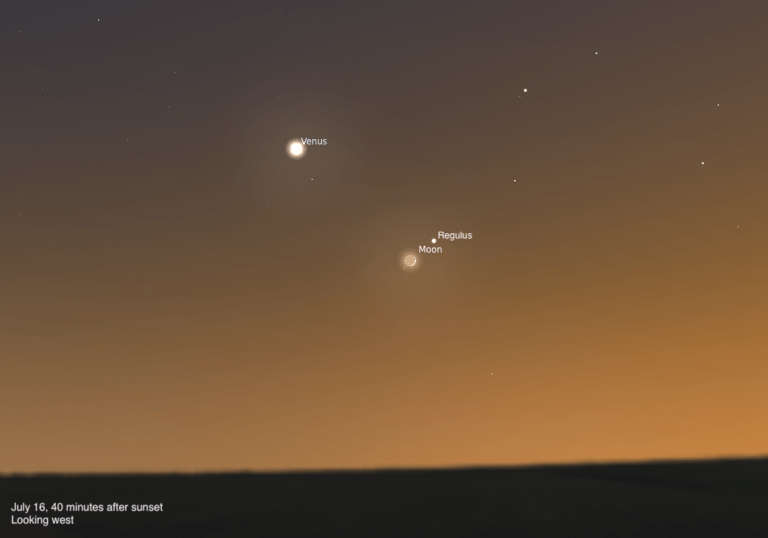
Now shining at magnitude –4.1, Venus continues to dominate the western sky after sunset. Still some 15° high an hour after the Sun has disappeared, the bright planet sits beneath the backwards question mark-shaped Sickle of Leo the Lion, a star pattern that outlines the head of the great cat as it sits in profile, facing down toward the horizon.
At this time, Jupiter is already disappearing behind any trees or buildings that might stand on your western horizon, though you might spot it as a bright point of light low in the sky. But your attention should be on Venus, which is now less than 9° west of Regulus, the brightest star in Leo and the base of the Sickle asterism. Venus will continue east over the next several days, approaching to within 2° of Regulus by July 8, when star and planet will stand close for two nights.
Through a telescope, Venus’ disk stretches 16” across and appears nearly 70% lit. Its phase is now shrinking, and it will lose several percent by the time it passes north of Regulus next week.
Sunrise: 5:35 A.M.
Sunset: 8:33 P.M.
Moonrise: 10:04 P.M.
Moonset: 6:49 A.M.
Moon Phase: Waning gibbous (96%)
Thursday, July 2
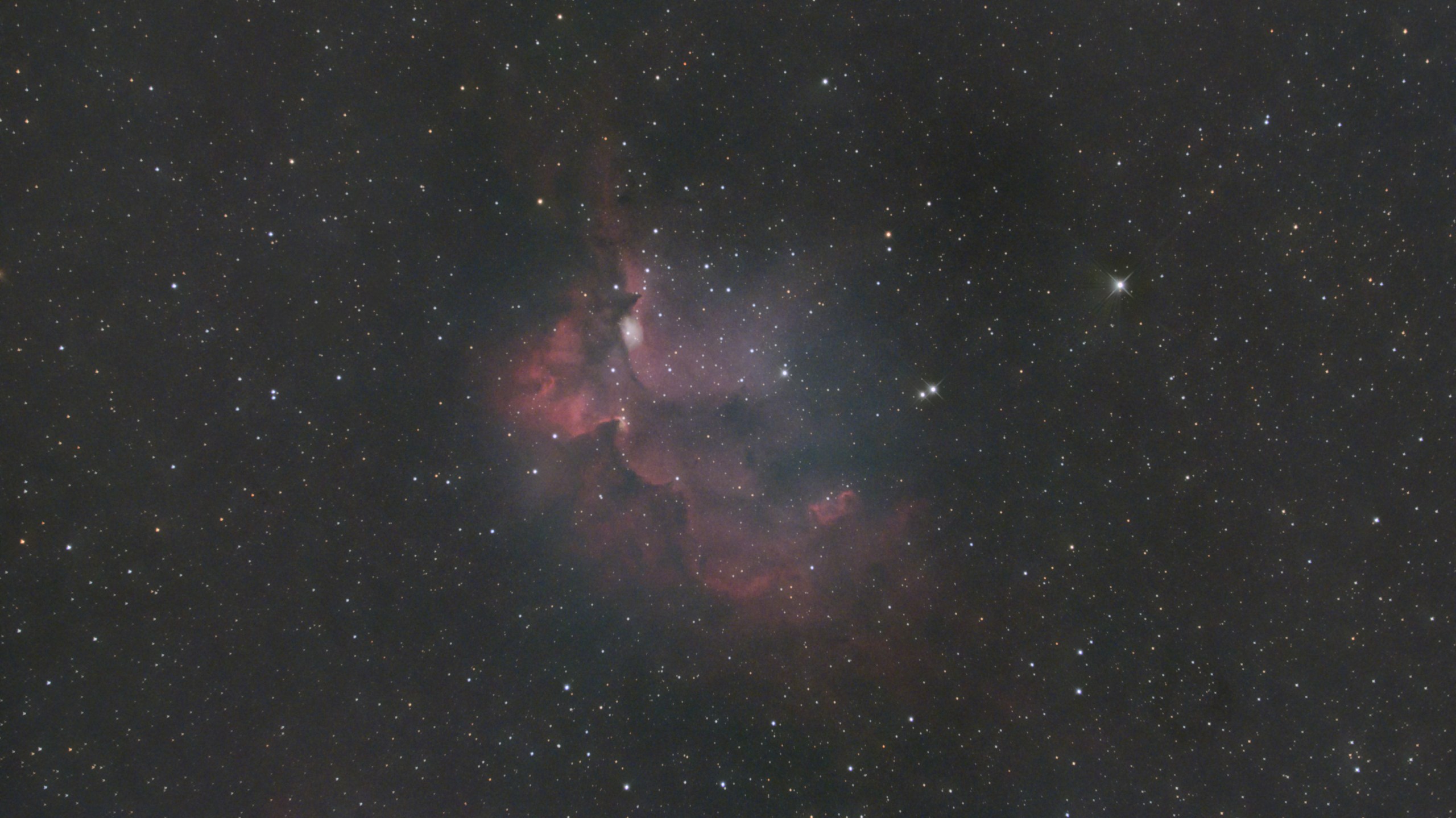
High in the north late tonight, standing to the right of the North Star Polaris, is the realm of Cepheus the King. This house-shaped constellation holds several deep-sky objects, including NGC 7380, also called the Wizard Nebula. Although the nebula itself is challenging to see visually, it cradles a lovely open star cluster that glows at 7th magnitude.
To find this object, you’ll need to search in southeastern Cepheus, to the upper right of the rightmost point in the W of Cassiopeia. Locate magnitude 3.4 Zeta (ζ) Cephei, which marks the lower lefthand corner of Cepheus’ house shape if the star pattern were set on its base. From here, drop down toward the horizon (east on the sky) about 4.8° to land on NGC 7380. You’ll easily spot the concentration of young stars at the heart of the nebula, but the gas cloud itself (cataloged as Sharpless 2-142) may remain invisible to your eye. It’s a great object for astrophotographers, however, and if you’re a relative beginner looking to up your imaging game, give this object a try.
Sunrise: 5:36 A.M.
Sunset: 8:32 P.M.
Moonrise: 10:32 P.M.
Moonset: 7:53 A.M.
Moon Phase: Waning gibbous (91%)
Friday, July 3
Have you ever wondered where the center of the Milky Way is located in the sky? You can spot it late tonight, when it stands above the southern horizon.
Shortly before midnight, face south and look for the bright orange-red star Antares, which marks the heart of Scorpius the Scorpion. To its left is the Teapot asterism in Sagittarius, with its spout facing to the right and handle to the left. Find the tip of the spout — marked by the 3rd-magnitude star Alnasl (Gamma [γ] Sagittarii) — and glance about 4.5° to its upper right (northwest). That’s the location of Sagittarius A*, the supermassive black hole at the center of our galaxy.
If you’ve got a dark sky and dark-adapted eyes, you may be able to pick out the soft glow of the Milky Way’s plane, which consists of numerous stars whose light combines to create a stripe of diffuse light reaching up from the horizon from lower right to upper left. You may also notice a dark swath cutting through it — this is dust along the plane of our galaxy, which blocks the light of the many stars behind it. Because the Milky Way is a relatively flattened disk-shaped spiral, we see its plane as a stripe across our sky. Imagine turning a plate on its side and seeing only the edge — that’s what you’re seeing here.
Sunrise: 5:36 A.M.
Sunset: 8:32 P.M.
Moonrise: 10:57 P.M.
Moonset: 8:57 A.M.
Moon Phase: Waning gibbous (85%)
Alison Klesman is senior editor of Astronomy magazine. She holds a Ph.D. in astronomy and has studied a variety of topics, from minor planets to supermassive black holes.