Looking for a sky event this week? Check out our full Sky This Week column.
May 31: Blue Moon, red star
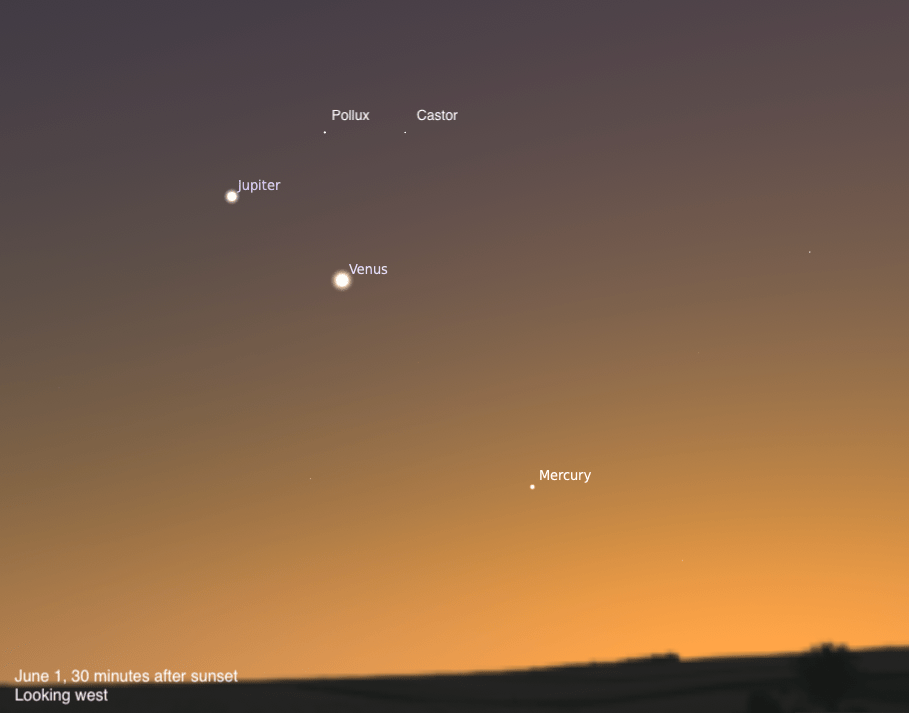
Mercury is at its best for the year. It’s now easy to spot in the evening sky, already 10° above the western horizon 30 minutes after the Sun sets. Tonight, it shines at magnitude –0.5 and sits in a line with two other bright planets: Venus and Jupiter. Together the three trace a line in the sky — that’s the ecliptic, the plane of the solar system. Just above Mercury, to its upper left, is Venus, the brightest of the three at magnitude –4.0. Then, to Venus’ upper left, sits mighty Jupiter, glowing at magnitude –1.9. Above them in the slowly darkening sky, you may also spot the two brightest stars in Gemini the Twins: Castor and Pollux. Nearly even with each other above the ground, Castor is to the right and Pollux is to the left, closer to Jupiter. The gas giant will pass due south of Pollux in just a few days.
Take a peek at Mercury through a telescope, and you’ll see the tiny planet showing off a gibbous phase, its face some 67% lit. Its disk spans 6” on the sky. Within just a few days, toward the end of the week, its width will grow to 7” across, but its phase will drop to 60% illuminated.
Sunrise: 5:33 A.M.
Sunset: 8:23 P.M.
Moonrise: 10:08 P.M.
Moonset: 6:02 A.M.
Moon Phase: Waning gibbous (97%)
*Times for sunrise, sunset, moonrise, and moonset are given in local time from 40° N 90° W. The Moon’s illumination is given at 10 P.M. local time from the same location.
Titan, Saturn’s brightest moon, is located near its parent planet in the early-morning sky of June 2.
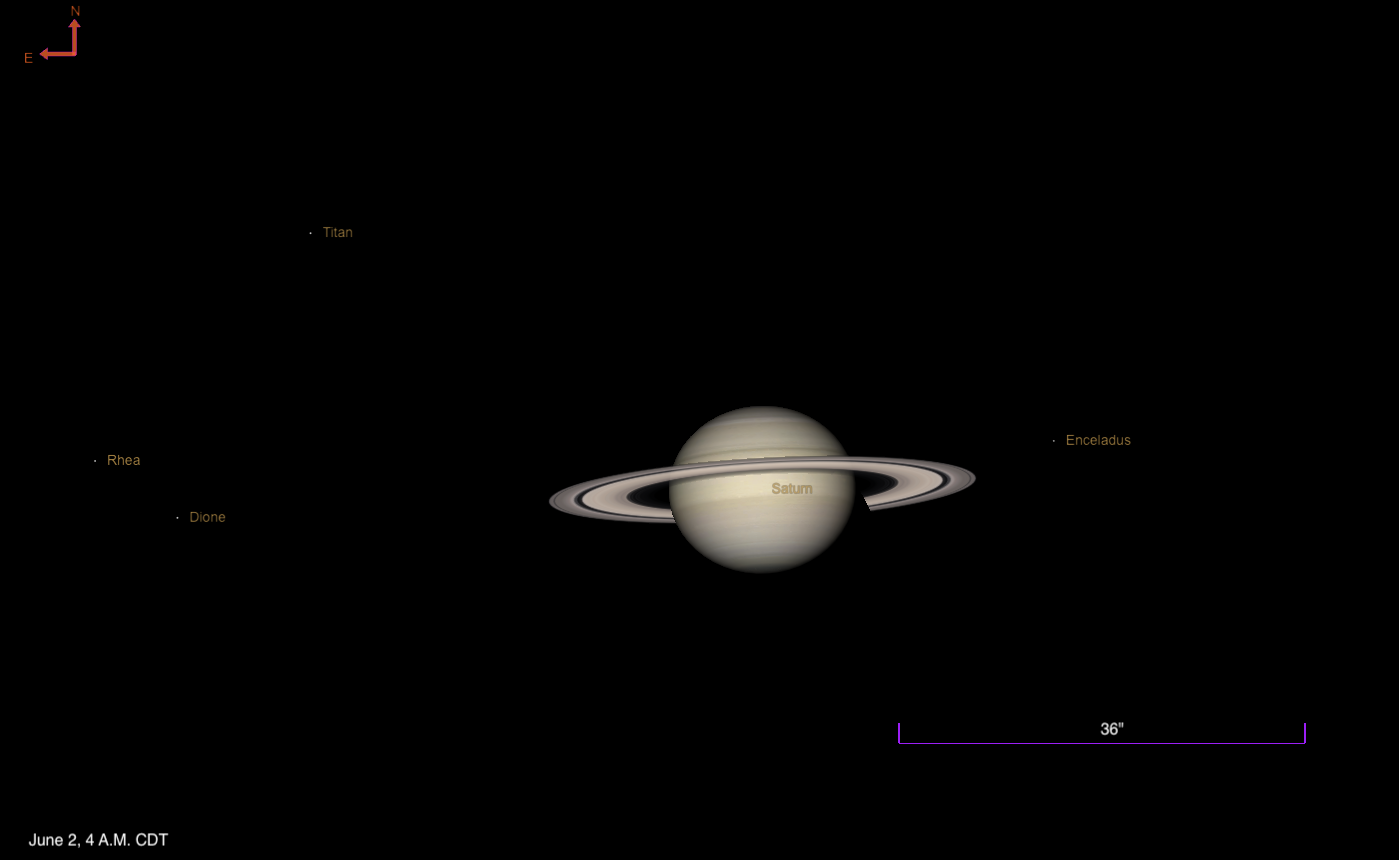
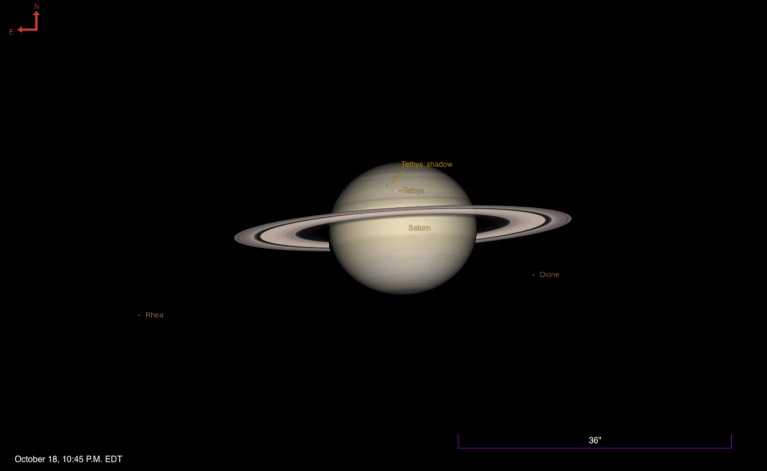
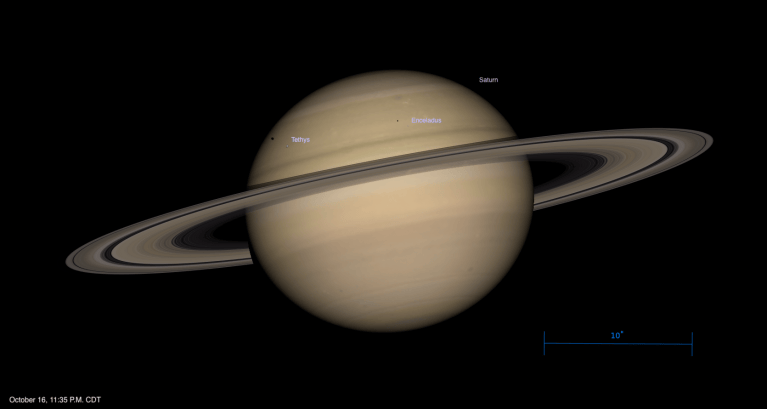
Spotting Saturn is easy — rising shortly before 3 A.M. local daylight time, it’s the brightest point of light low in the eastern sky an hour later. Through a telescope, the gas giant’s disk spans 17”, while its rings are nearly 38” from end to end. The ring system is now tilted some 8° to our line of sight, showing off its southern side as well as the planet’s southern hemisphere and pole.
Titan glows at mid-8th magnitude, and should be easy to spot in a telescope just to Saturn’s northeast this morning. Depending on when you look, some of the planet’s other moons will be visible nearby, including 10th-magnitude Rhea and Dione. Much fainter 12th-magnitude Enceladus lies just west of the ringed planet, but smaller scopes may not pick it up.