Astronomy forum Connect with fellow astronomy enthusiasts!
Get started
Skip to content
Astronomy Magazine logo
  • Login / Register
  • Logout
  • Shop
  • Subscribe

  • News
  • Science
    • Solar System
    • Exoplanets
    • Stars
    • Milky Way
    • Galaxies
    • Exotic Objects
    • Cosmology
  • Observing
    • In The Sky
    • Upcoming Events
    • The Sun
    • The Moon
    • Planets
    • Comets
    • Deep-Sky Objects
    • Observing Basics
    • Telescopes and Equipment
    • Astrophotography
    • Gear Guide
    • This Week in Astronomy
  • Space Exploration
    • What’s Launching This Week
    • Human Spaceflight
    • Robotic Spaceflight
  • The Magazine
  • Ask Astro
  • Star Products
  • News
  • Science
    • Solar System
    • Exoplanets
    • Stars
    • Milky Way
    • Galaxies
    • Exotic Objects
    • Cosmology
  • Observing
    • In The Sky
    • Upcoming Events
    • The Sun
    • The Moon
    • Planets
    • Comets
    • Deep-Sky Objects
    • Observing Basics
    • Telescopes and Equipment
    • Astrophotography
    • Gear Guide
    • This Week in Astronomy
  • Space Exploration
    • What’s Launching This Week
    • Human Spaceflight
    • Robotic Spaceflight
  • The Magazine
  • Ask Astro
  • Star Products
  • Login / Register
  • Logout
  • Shop
  • Subscribe

Observing

A telescopic simulation of Saturn and four of its moons on August 22, 2026, at 4 A.M. CDT, shown against a black background. Saturn is shown in the center with its rings visible at a shallow angle. Titan appears as a large golden point to the upper right, while Tethys and Dione are visible as smaller white points to the right of the planet, and Rhea is positioned farther to the left.
Observing

The Sky Today on Saturday, August 22: Titan northwest of Saturn

Astrophotography, The Sun

Our favorite reader images of the 2026 total eclipse

Astrophotography

Geminid melodies

A telescopic simulation of Saturn on August 21, 2026, at 5 A.M. EDT, showing the planet with its rings tilted at a shallow angle against a black background. Four labeled moons are visible: Titan as a large golden point in the upper left, and Dione, Tethys, and Rhea as smaller white points scattered to the left of the planet. A scale bar indicates 30 arcseconds.
Observing

The Sky Today on Friday, August 21: Titan nears Saturn as Dione skims past

A photograph of a total lunar eclipse showing the Moon glowing in deep red and crimson hues — a blood moon — against a black sky. The Moon's surface features, including its darker maria regions, are still faintly visible through the red coloration. A thin sliver of brighter bluish-white light is visible along the upper edge, suggesting the Moon is just beginning to exit or enter Earth's umbral shadow.
Sky This Week, The Sky This Week

The Sky This Week from August 21 to 28: Eclipsed Sturgeon Moon 

A black-and-white image of the Moon, showing northeastern Mare Imbrium with Plato and Vallis Alpes labeled. North is up and east is left.
Observing

The Sky Today on Thursday, August 20: Dark, flat Plato

A telescopic photograph of the Helix Nebula (NGC 7293), a large planetary nebula appearing as a circular ring of glowing teal-green gas surrounded by a diffuse red outer halo, set against a black sky scattered with orange and white foreground stars.
Observing

The Sky Today on Wednesday, August 19: The Helix Nebula

A telescopic photograph showing two objects side by side against a dense, colorful star field: NGC 6939, a rich open star cluster with a mix of blue-white and orange stars in the upper left, and NGC 6946, the Fireworks Galaxy, a face-on spiral galaxy with a golden core and pink-tinged spiral arms visible in the lower right.
Observing

The Sky Today on Tuesday, August 18: Stars and sparklers

A sky chart showing the eastern sky on August 17, 2026, at 5 A.M. Mars glows orange near the top center, with the stars eta (η) and mu (μ) Geminorum labeled just below it. Castor and Pollux are visible to the left, Betelgeuse glows orange to the right, and the stars of Orion's belt are faintly visible at the far right edge. The sky fades to a soft twilight glow near the horizon.
Observing

The Sky Today on Monday, August 17: Mars at Gemini’s feet

A sky chart showing the western sky on August 16, 2026, one hour after sunset. The crescent Moon and Venus are shown close together and brightly glowing low in the warm twilight sky, with the star Spica labeled just above and to the left of the Moon. The sky transitions from deep blue-black above to a warm brown-orange near the dark horizon silhouette.
Observing

The Sky Today on Sunday, August 16: The Moon hangs with Venus

The sky on August 15, 2026, 40 minutes before sunrise, looking east
Observing

The Sky Today on Saturday, August 15: A conjunction of Mercury and Jupiter

A sky chart showing the eastern sky on August 14, 2026, at 4:45 A.M. Mars glows as a warm orange point near the upper center, with the Greek letter stars eta (η) and mu (μ) Geminorum labeled just below it. Castor and Pollux are visible to the left, and Betelgeuse glows orange to the right, with the stars of Orion's belt faintly visible further right. The sky fades to a subtle twilight glow near the dark horizon.
Observing

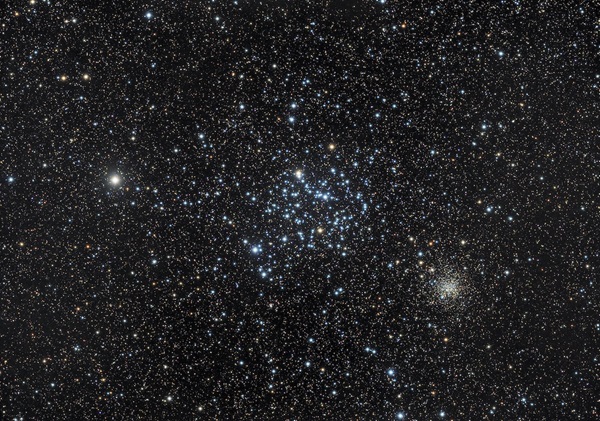
The Sky Today on Friday, August 14: Mars meets M35

Posts pagination

Newer posts 1 2 3 4 5 … 141 Older posts

Astronomy Newsletter

Get newsletters, updates and special offers via email from Astronomy.com!

Please enter a valid email address.
Astronomy Magazine logo
  • Facebook
  • LinkedIn
  • YouTube
  • Instagram
  • Twitter
  • About Us
  • Contact Us
  • Subscribe
  • Customer Service
  • Advertising
  • Terms of Use
  • Privacy Policy
  • Do Not Sell

@ 2025 Firecrown Media. All Rights Reserved.

More Sites from Firecrown Media Publisher logo
Scroll to Top

Sign In

New User? Create an Account

Why Sign In? Subscribers can access their digital magazine issues, and registered users can participate in our Community forums and galleries.

Please enter your email.
Please enter your password.

Lost your password?

Manage My AccountCustomer Support