When processing galaxy images, we astrophotographers labor to display their many beautiful features, like bright nuclei, spiral arms, star clouds, emission nebulae, dust lanes, and tidal tails. Yet most of us are oblivious to another component of galaxies we may have captured in some images: their globular star clusters.
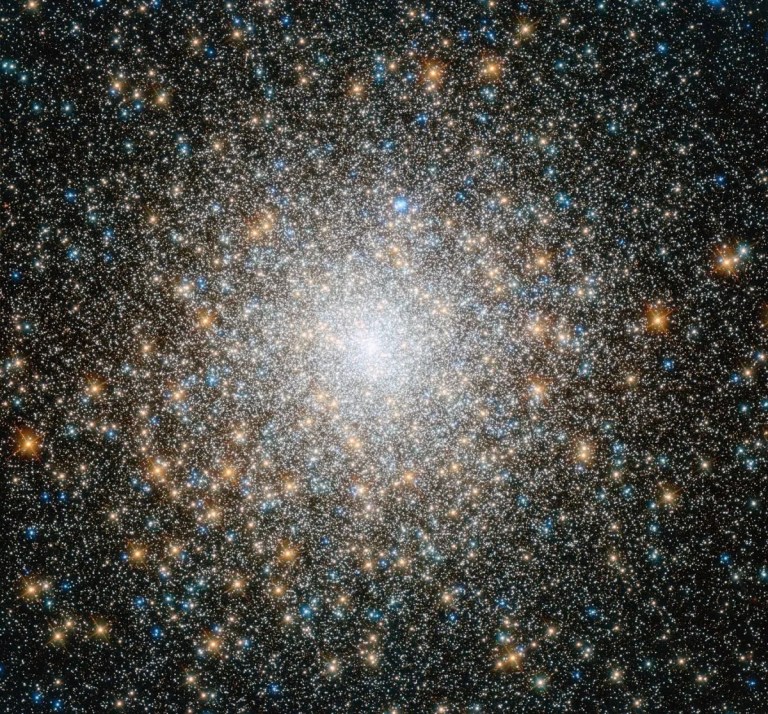
Globulars are vast, ancient clusters that can be filled with millions of stars and span hundreds of light-years. They are larger, more densely packed, and typically more spherical in appearance than open clusters, which contain young stars. Some globulars, like M54 and Omega Centauri, are the stripped cores of dwarf galaxies cannibalized long ago by our Milky Way. In all, the Milky Way is home to more than 150 globular clusters, and when you view them, you’re bearing witness to the history of our galaxy.
Amazingly, globular clusters orbiting other galaxies can be imaged using amateur equipment. And they may be lurking in your galaxy images, just waiting to be found.
A love of globulars
I love globular clusters. My first go-to telescope was a Celestron Compustar C14, which could be programmed to take me on user-defined sky tours. Every few months, I programmed it to show me all the globulars in its database then visible in my sky. Eventually, I’d observed every globular visible with a 14-inch scope from my latitude. I subsequently shot images of scores of my favorites, many of which have been published in Astronomy.
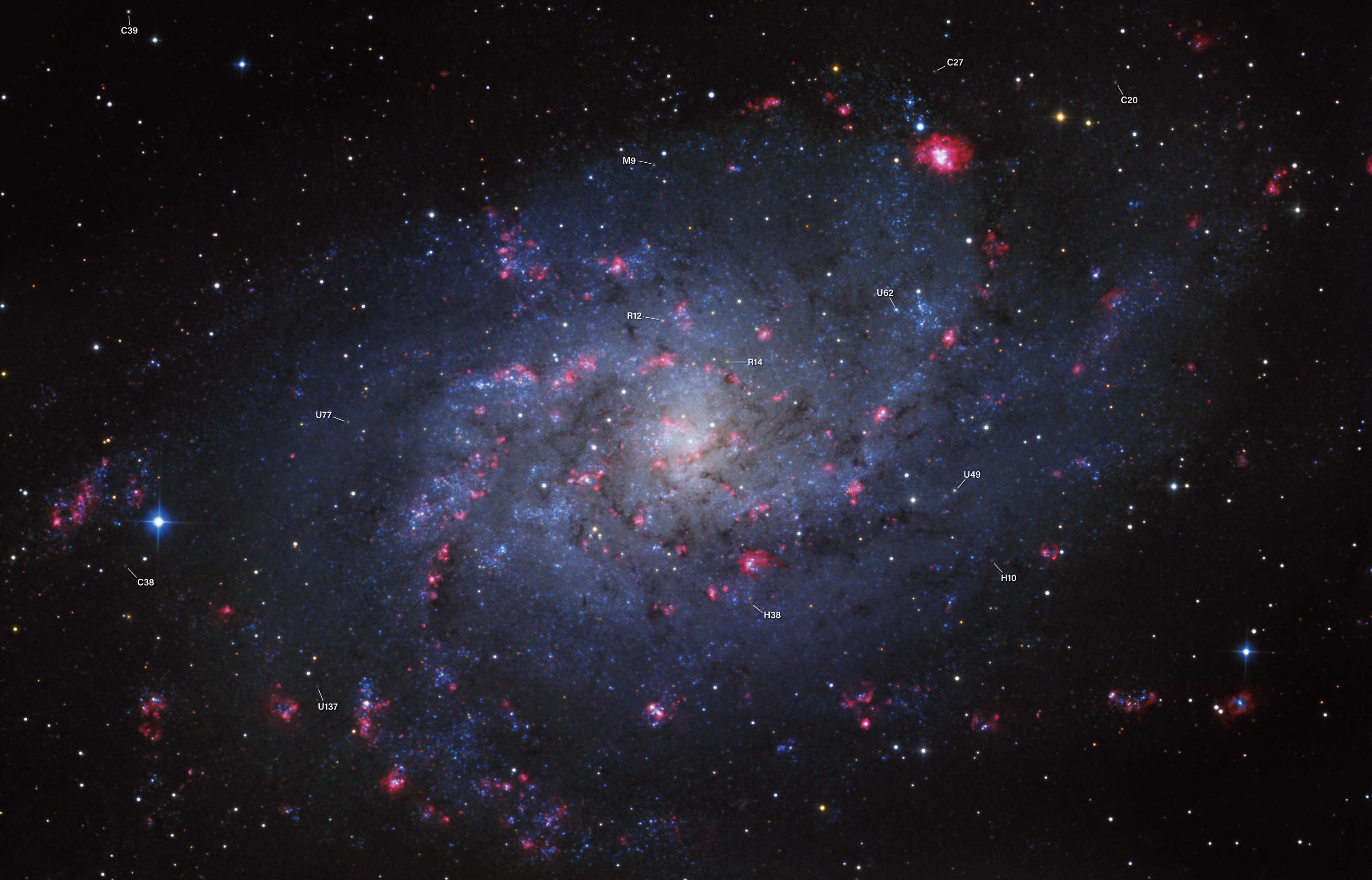
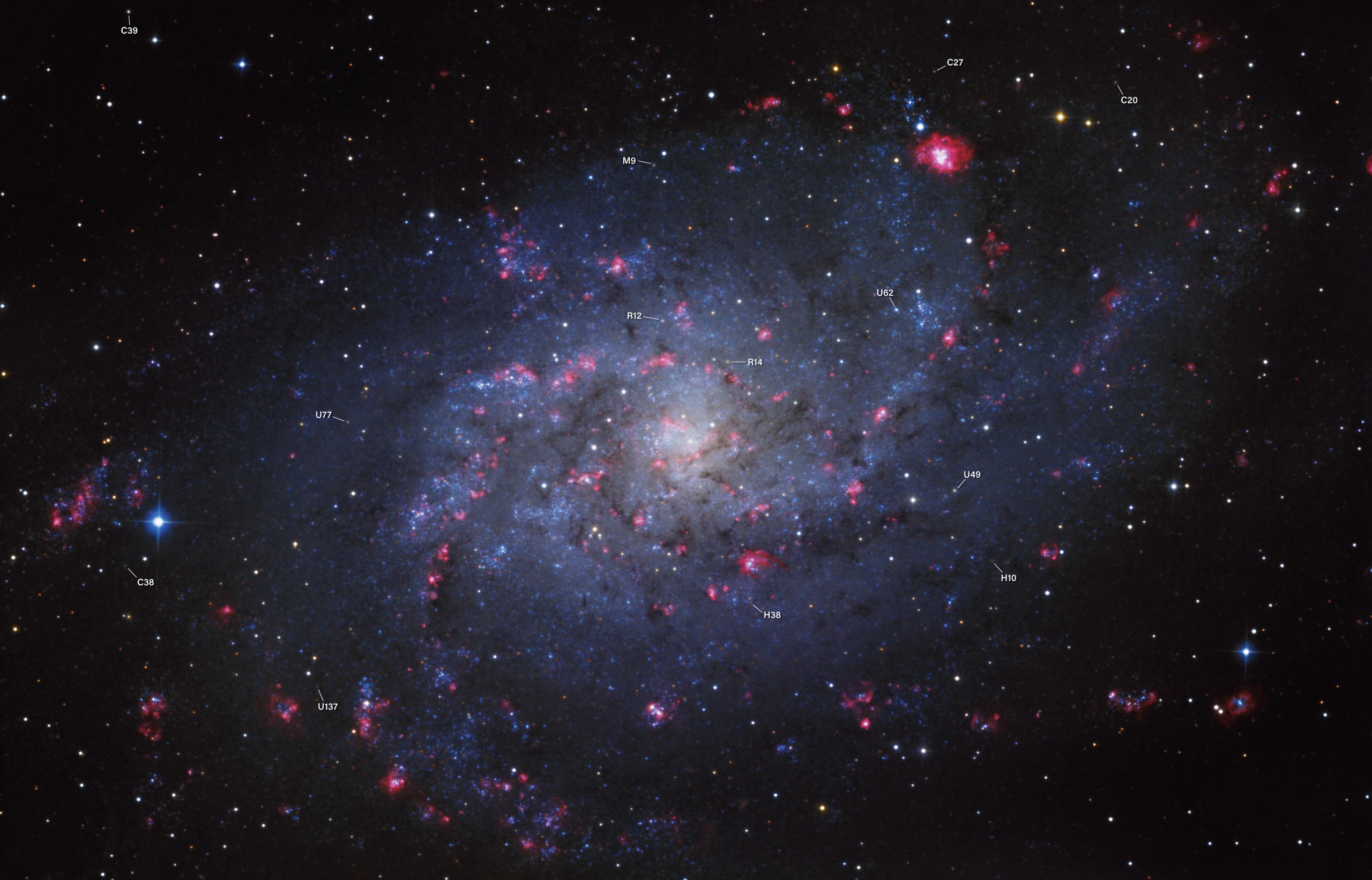
Even years later, once I’d become a seasoned deep-sky observer, I still knew of just one observable extragalactic globular. It was C39, located 22′ southeast of M33’s core, well outside its disk. It is an enormous globular that would appear far more impressive through a telescope than the Milky Way’s own M13 if viewed from the same distance. I successfully observed it visually as a 16th-magnitude “fuzzy star” and was overjoyed when I found it on my images of M33. I subsequently posed it as an observing challenge in my article “Secrets of the Pinwheel Galaxy” in the November 2014 issue.
I regarded C39 as my crowning achievement in observing and photographing globular clusters, naively thinking it the only extragalactic globular large enough, bright enough, and close enough to be seen or photographed by amateurs.
But wait, there’s more
I was wrong. Several years ago, I found an image of M33 acquired at a major observatory. Three “stars” were labeled in the image. One was C39, right where I knew it should be. But contrary to my expectations, the other two were neither foreground Milky Way stars nor suns resolved within M33’s spiral arms. Rather, they were labeled as two more of M33’s globulars. I noted they were brighter than stars resolved within M33’s arms. And I knew I had resolved those stars in my own images of M33. Was it possible I had also captured those globulars? Sure enough, when I scrutinized my images, both globulars were there.
Questions flooded my mind. Had I captured still more globulars in M33 without realizing it? Had I captured globulars in my images of other nearby galaxies, like M31 and M81? Could I image globulars in more distant galaxies? If so, how many millions of light-years away could I capture them? These questions would take my globular imaging to a whole new level.
The quest begins
For answers, I sought resources that identify globulars orbiting other galaxies. I scoured astronomical journals, Paul W. Hodge’s Atlas of the Andromeda Galaxy, the Aladin Sky Atlas, the SIMBAD astronomical database, the Hubble Space Telescope archives, and The Carnegie Atlas of Galaxies. I carefully checked my galaxy images against those references. After many hours of research, I found additional globulars in my images of M33 and dozens in my images of M31, and was amazed to discover I’d even captured globulars in my images of galaxies as far away as 55 million light-years.
Along the way, I also learned a lot about how astronomers identify these clusters. Extragalactic globular clusters appear in astrophotographs as mere pinpoints of light, resembling foreground Milky Way stars. But that’s only the beginning of the difficulties astronomers face when trying to identify them. Researchers must also distinguish globulars from bright stars, open star clusters, and planetary nebulae within that galaxy. And globular clusters must be distinguished from distant background galaxies, which can appear visually similar to compact clusters.
Astronomers begin by identifying globular candidates and analyzing them photometrically with blue (B), red (R), and visual (V) filters, followed by spectroscopy. Because globulars contain very old stars, they should appear reddish, devoid of massive blue-hot stars that burn out quickly. A B–V color index — simply the number obtained by subtracting their visual magnitude in the V filter from that in the B filter — greater than or equal to 0.6 strongly supports identification as a globular. Finding a V–R index (again, by subtracting R magnitude from V magnitude) similar to that of Milky Way globulars provides additional support. If an object’s redshift (a proxy for distance) is similar to that of its parent galaxy, that rules it out as a distant galaxy. And, again because globulars contain very old stars, a spectrum showing a low ratio of iron to hydrogen (a value astronomers call metallicity) provides final confirmation, as older stars are less rich in heavy elements than younger ones.
The problem for amateurs is that images, charts, and tables identifying extragalactic globulars are widely scattered throughout the astronomical literature and other resources. This makes it hard to track down all the objects you might have captured. Furthermore, only a fraction of the globulars found by major observatories can be imaged with amateur equipment. It would be useful for amateurs to have these data gathered into a single resource that is also filtered for globulars they could possibly image.
To solve this problem, I have created a set of my images of M31, M33, M81, M104, and M87 in which I have labeled the globular clusters I have identified within them. If you are a fellow astrophotographer, I invite you to compare your images of these galaxies if you have them (or shoot them if you don’t) to see if you have captured some of these globulars.
My images were acquired with a 17-inch f/6.8 CDK telescope, which is capable of picking up very faint extragalactic globulars even under my Bortle 7 sky. Your results will vary based on your aperture, sky conditions, and exposure times, but some of the brightest globulars can be captured by scopes with apertures of 3 to 5 inches. And if you are not an astrophotographer, you can still join in the fun by trying to find the globulars indicated here in other images of these galaxies online, or in books and magazines.
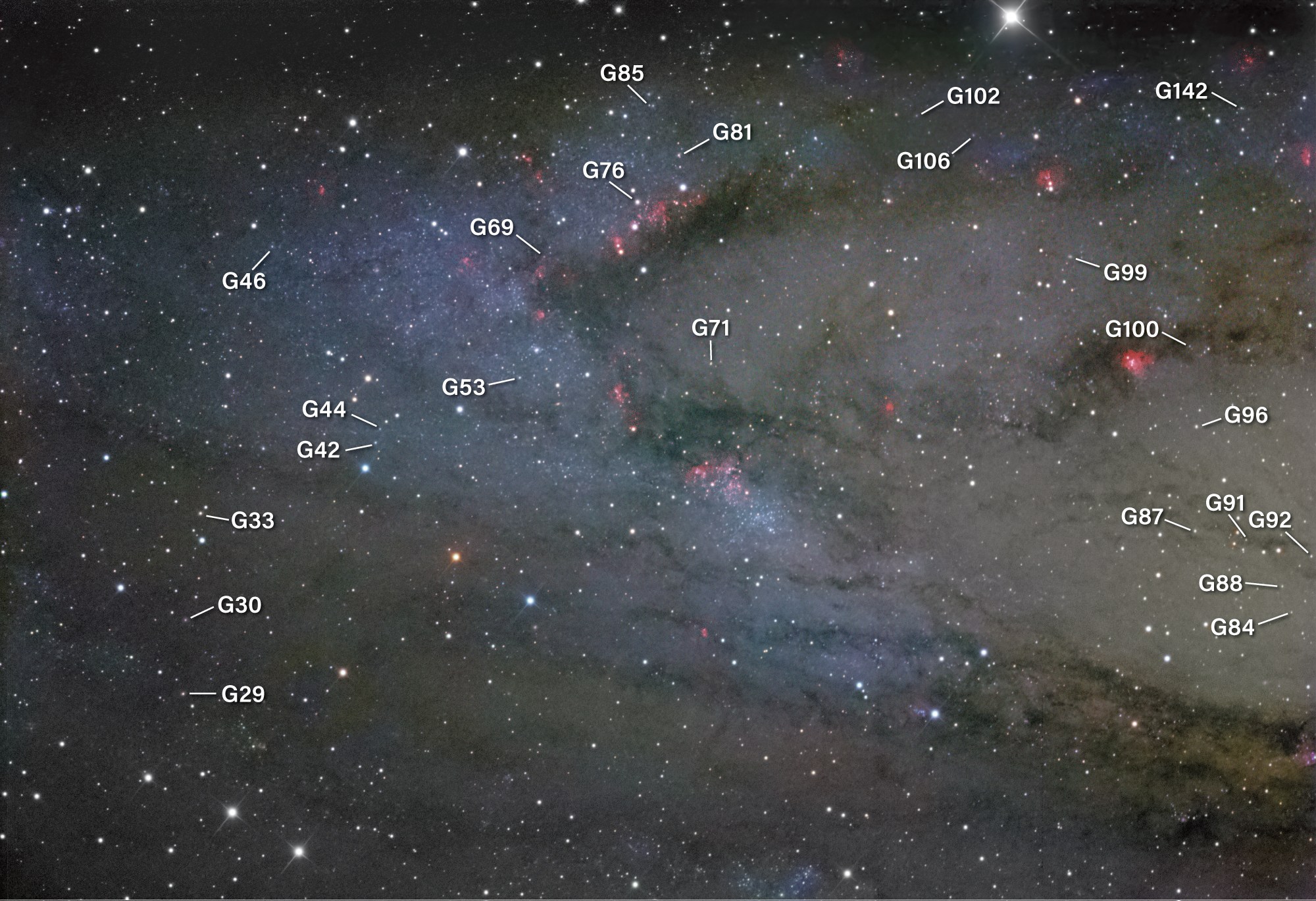
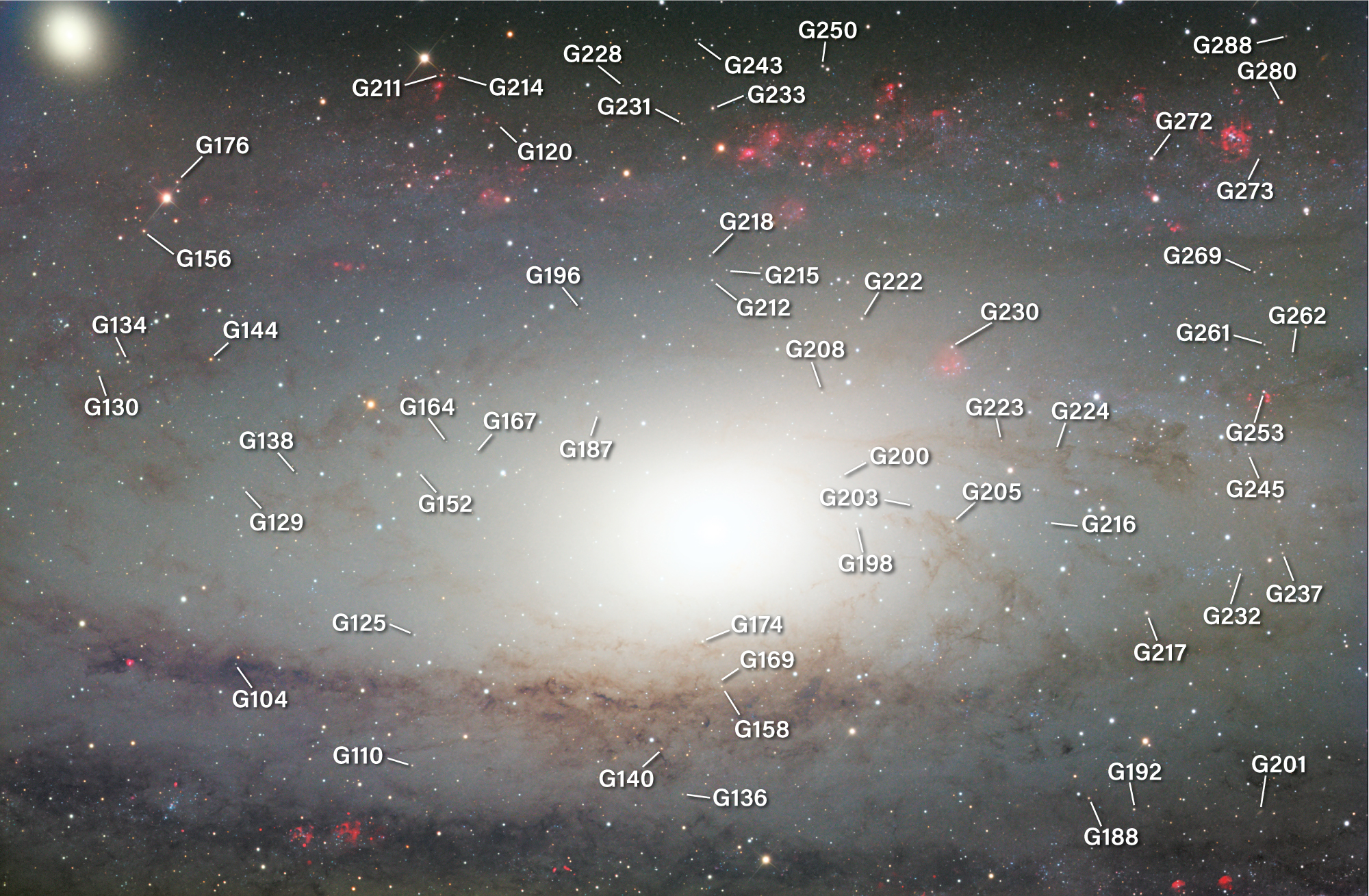
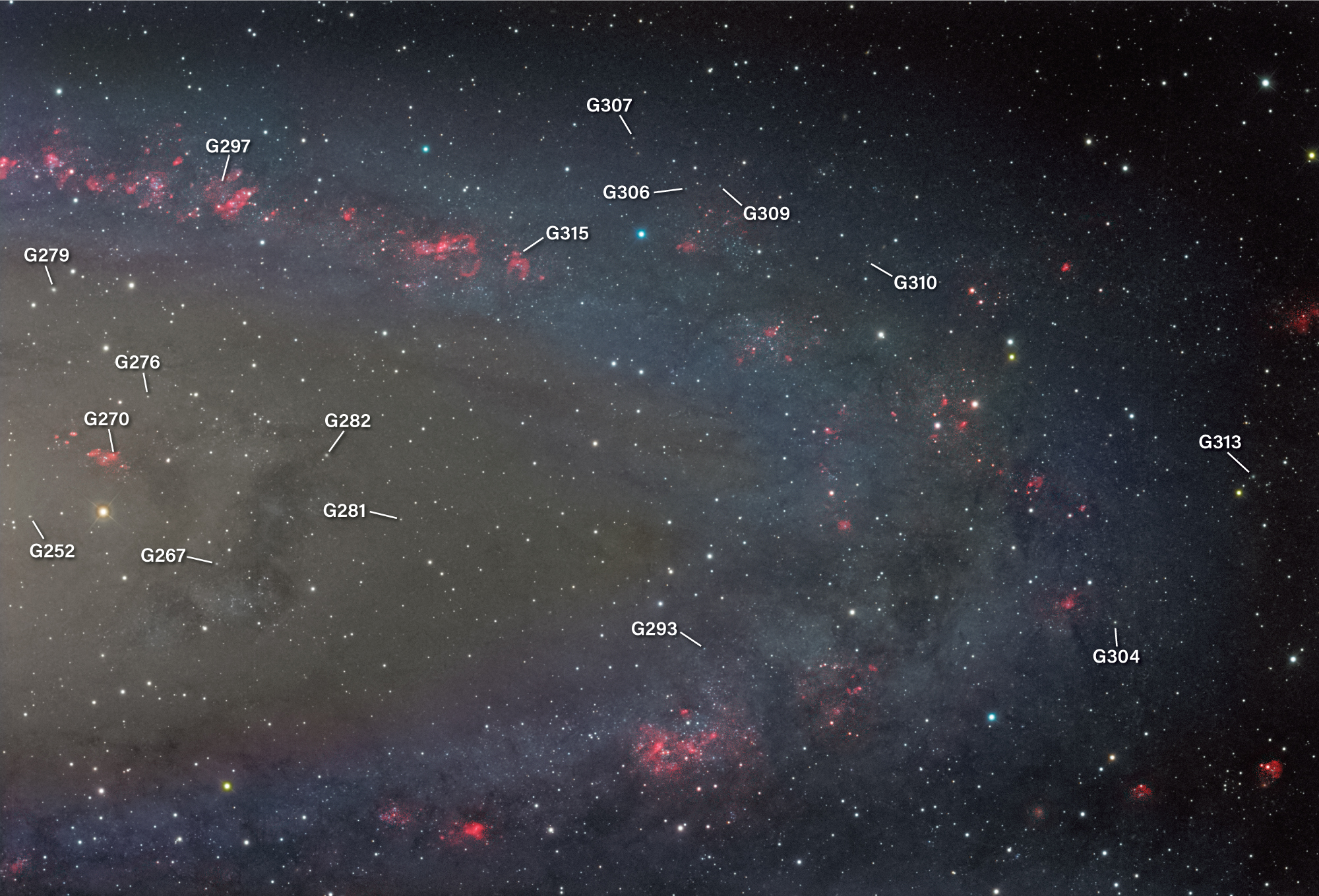
M31 lies 2.5 million light-years from Earth, and dozens of its globular clusters can be captured with amateur equipment. From left to right, these three images show the northern, central, and southern portions of the galaxy, with its globular clusters annotated. Brighter globulars include G76 in the northern portion, located above the giant star cloud NGC 206 (which lies just below G71), and G279 in the upper left corner of the southern image. G76 can be imaged with a 3-inch telescope. Southeast is up. Credit: Rod Pommier
M31
Your greatest chances of success lie with M31, which is 2.5 million light-years from Earth, a distance measurement I recently reproduced with my own observations (see “The star that changed the cosmos” in the August 2022 issue). Edwin Hubble first detected globulars around M31 in 1932 using Mount Wilson’s 100-inch Hooker telescope. M31 has approximately 400 globulars, and scores of them can be imaged by amateurs. M31’s apparent size is so large that, with my scope’s focal length, I had to divide it into three separate full-frame images of its northern, central, and southern regions. Dozens of M31’s globulars are annotated in these images. One of the brightest is G76, which can be found just above the giant star cloud NGC 206 in the image of M31’s northern region. It can be imaged with a 3-inch scope. Another bright one is G279 in the southern region.
M33
M33 lies at a distance of some 2.8 million light-years — not much farther than M31 — so your chances of success with its globulars are also good. Studies indicate it has more than 500 star cluster candidates in total, but only a fraction are confirmed as globulars. My full-frame image calls out 13 confirmed globulars. C39, in the upper left corner, can be captured with a 3-inch scope. Other bright globulars are U49, R12, and R14, but they may require larger apertures to be resolved against the background spiral arms.
M81
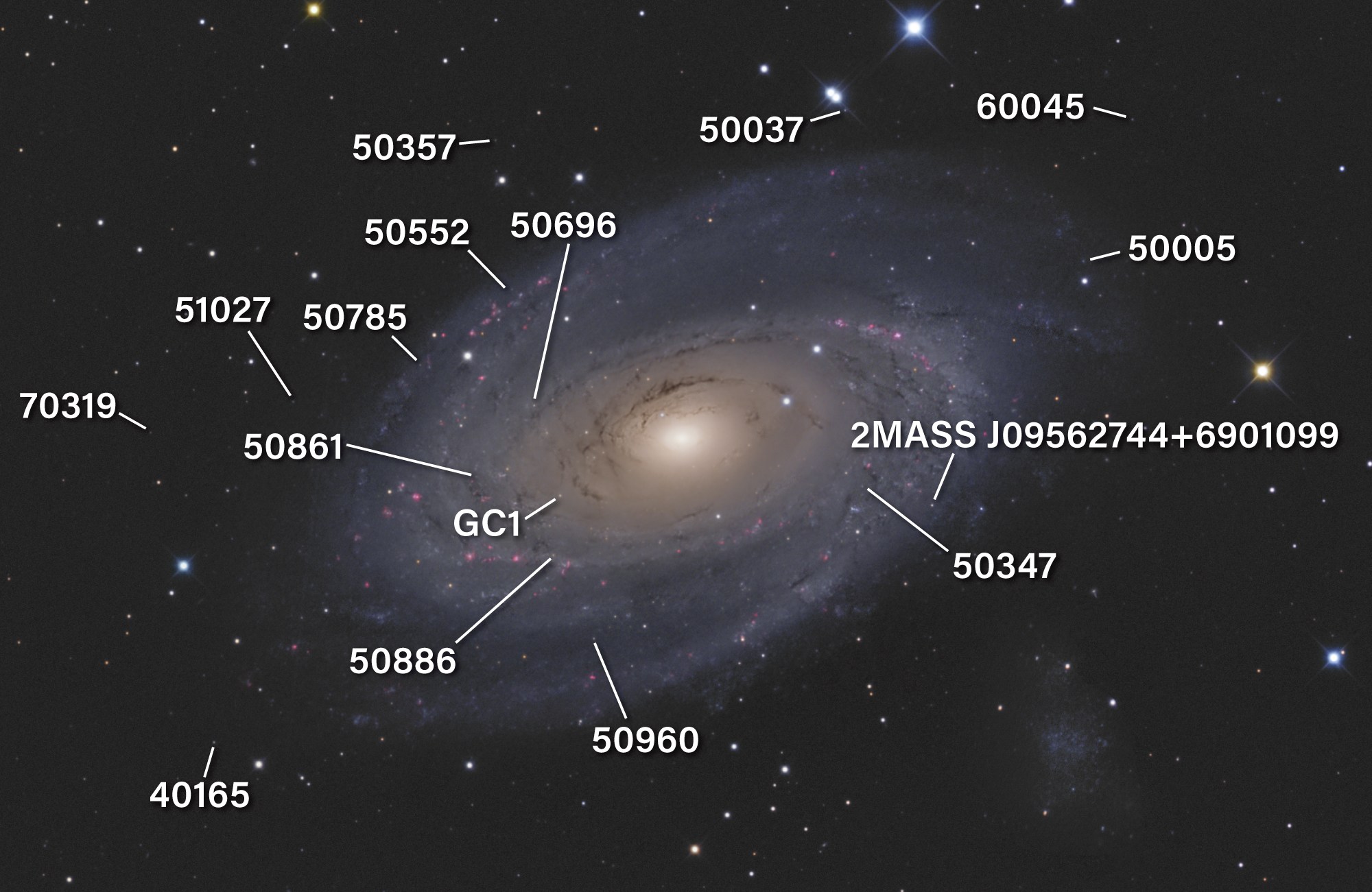
M81 is nearly 12 million light-years from Earth, so its globulars are more difficult to capture than those in M31 or M33. Astronomers estimate M81 has about 450 globulars, and while my full-frame image also captures many of M81’s peripheral halo globulars, I cropped the image here to provide enough detail to see its more plentiful central globulars. GC1 is the brightest, superimposed on the galaxy’s disk 2.9′ north-northwest of the galaxy’s nucleus. It can be imaged with a 5-inch scope.
![Annotated astrophotograph of the Sombrero Galaxy (M104), seen edge-on as a thin bright disk with a dark dust lane across a glowing central bulge, surrounded by a faint halo and a field of scattered stars. White leader lines point to globular clusters labeled [BAZ97] 1-8, GCl 2038, GCl 2084, GCl 2289, GCl 2307, GCl 2491, GCl 3284, GCl 3320, GCl 3680, GCl 3745, GCl 3987, and [BAZ97] 1-17.](https://www.astronomy.com/wp-content/uploads/2026/10/M104.jpg?w=2560)
M104
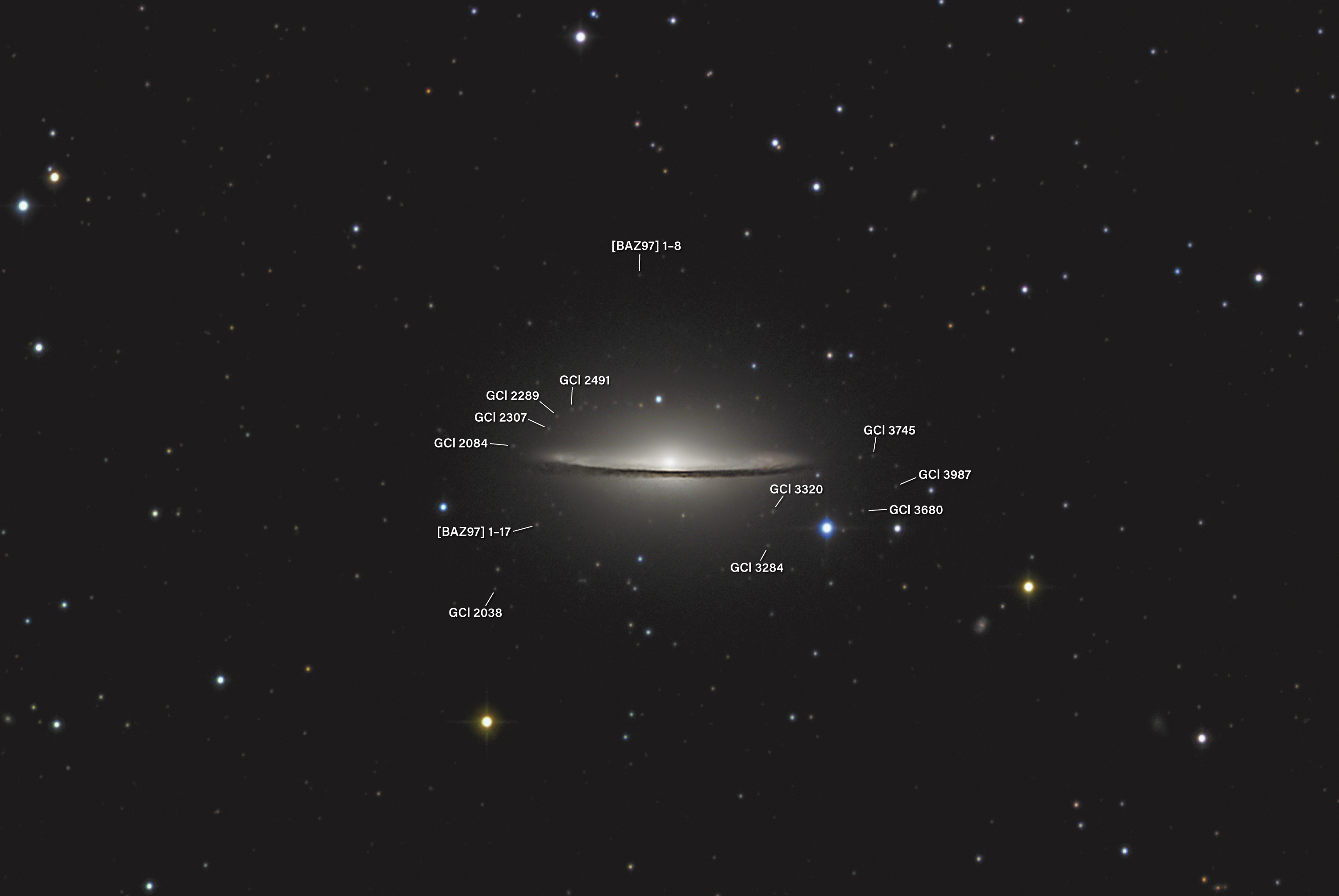
Some galaxies have thousands of globulars: M104, lying at a distance of some 30 million light-years, has approximately 2,000. Despite its considerably greater distance, several of its globulars can be imaged with medium-aperture telescopes. My image of M104 is very zoomed-in and cropped to better display them. Some of the unlabeled objects within the galaxy’s halo that you might think are globulars are actually planetary nebulae. (Yes, we can image those in other galaxies too, but that’s another story.)
![Annotated astrophotograph of the giant elliptical galaxy M87, a large, faint, round yellowish glow at center with a small blue jet streaking from its core. A few small galaxies and stars appear in the surrounding dark field. White leader lines point to two objects labeled [SRB2011] H48518 above the galaxy and [JPB2009] 187.7343775+12.3780347 below and to the left.](https://www.astronomy.com/wp-content/uploads/2026/10/M87.jpg?w=2000)
M87
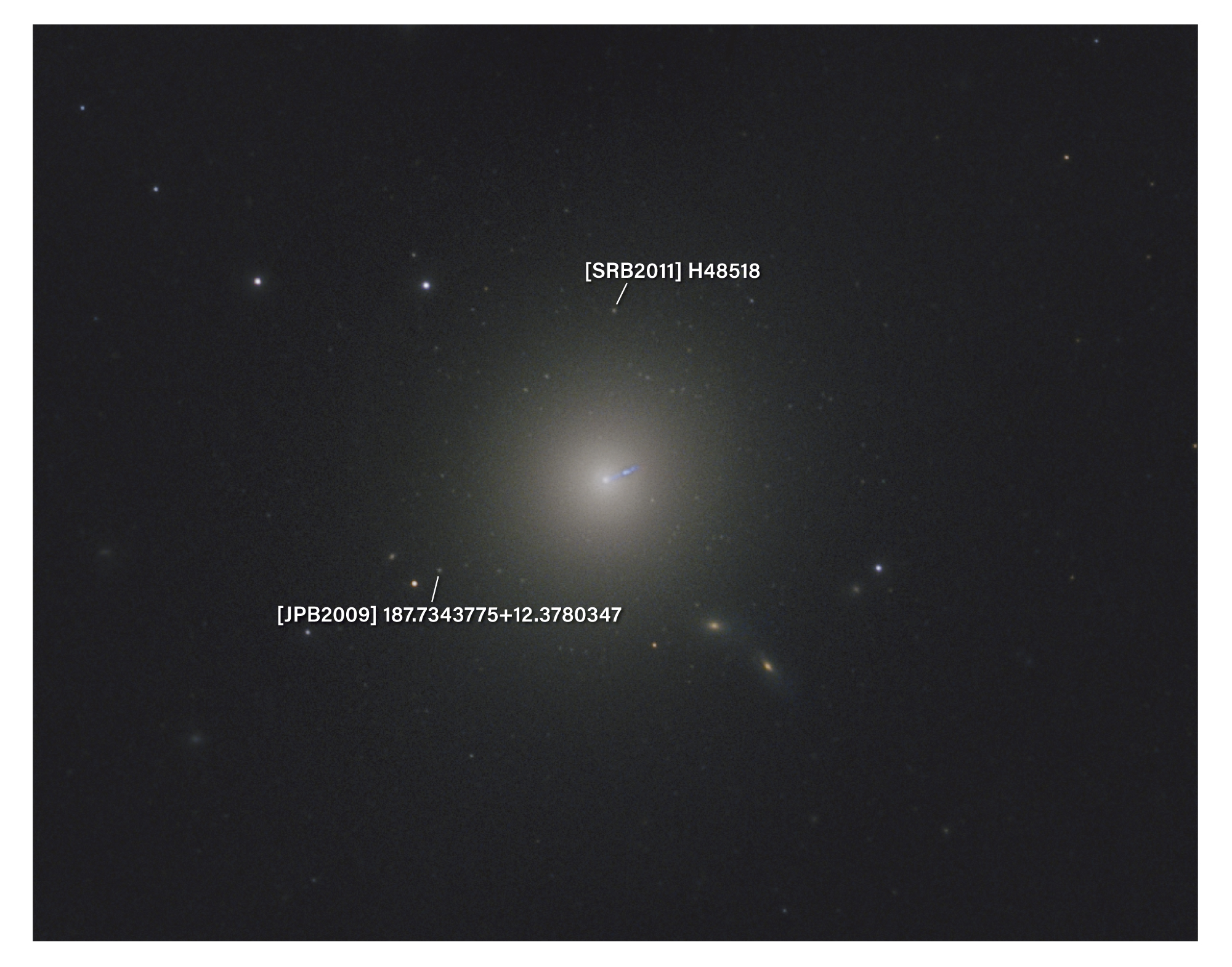
M87 is a giant elliptical galaxy lying 55 million light-years from Earth. It is among the record-holders for globular clusters, with approximately 15,000. Whereas dwarf galaxies in other regions of the sky usually have some globulars, those within some 130,000 light-years of M87 have few to none, suggesting M87 has stripped them of their globulars during previous gravitational encounters. Hubble wrote in 1926 that elliptical galaxies showed no resolution into individual stars through a telescope, but he thought perhaps M87 was an exception because the best photographic plates obtained with a 100-inch telescope showed numerous faint dots, presumably stars, around its periphery. By the 1960s, astronomers including William Baum and Allan Sandage had identified them as likely globular clusters.
My image of M87 is also very zoomed-in to better display detail, and strongly resembles Hubble’s glass plate images. In addition to showing the blue relativistic jet being ejected from M87’s supermassive black hole, I have counted more than 150 starlike objects in the galaxy’s halo. Nearly all are globulars, while a few are planetary nebulae. They are too numerous to label in such a small space, so I have labeled two of the brightest confirmed globulars, hoping you can find them and others in your images.
To infinity and beyond
Imaging globular clusters in our galaxy is a rewarding experience — but imaging them in other galaxies is thrilling. While I’ve imaged globulars in galaxies closer than M87 that are not shown here, I continue to enjoy the thrill of the hunt for them in my images of ever-more-distant galaxies. Who knows how far out into our beautiful universe the adventure will take me.
Rod Pommier is a surgeon and astroimager whose photos are often featured in Astronomy.