Looking for a sky event this week? Check out our full Sky This Week column.
October 3: Dione transits Saturn
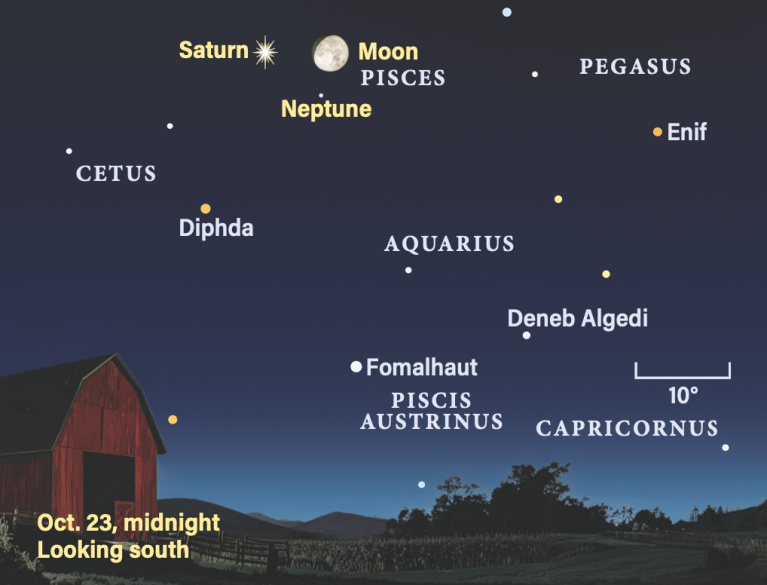
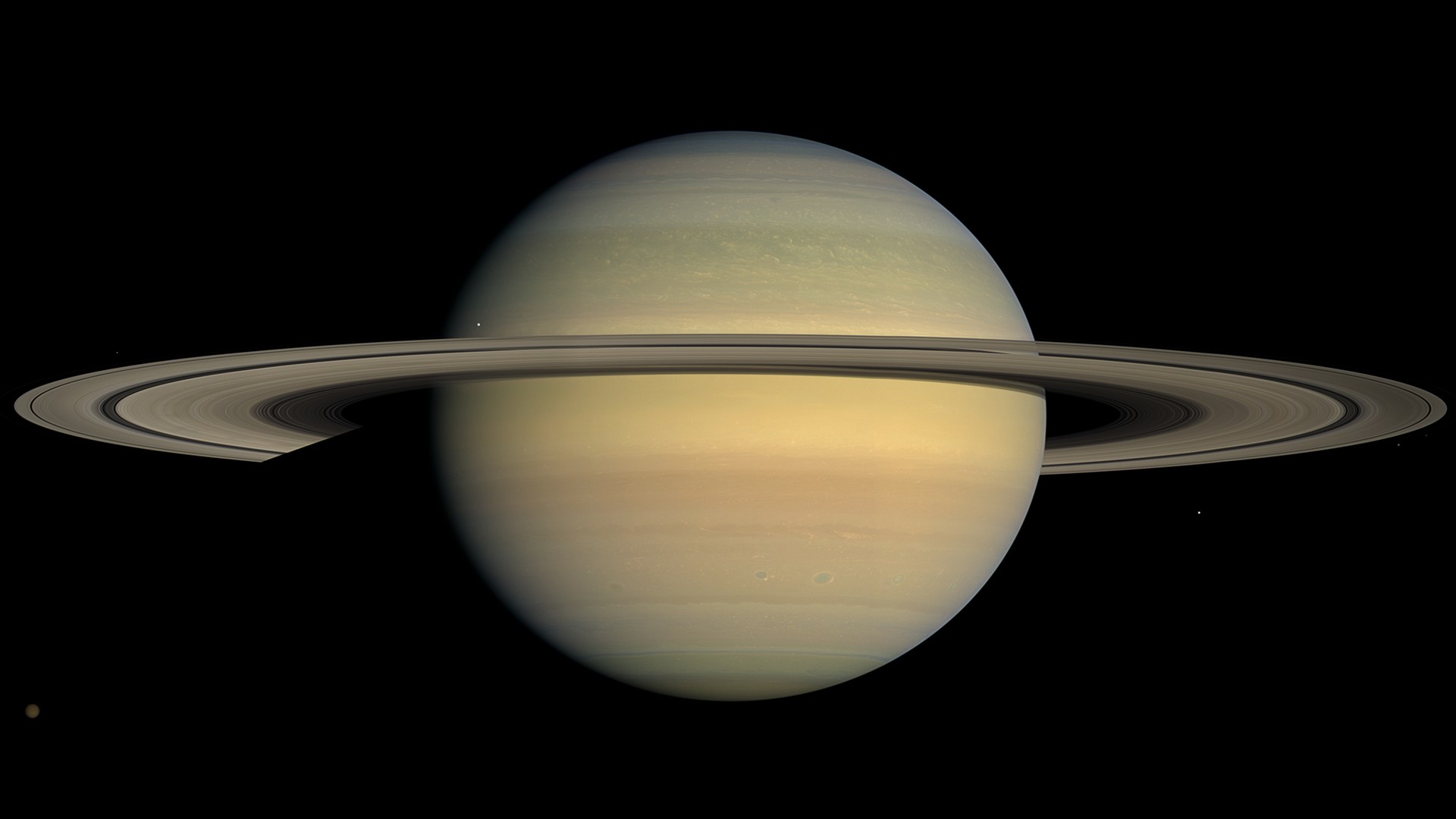
We’re back at Saturn this evening with the planet as the main attraction as the ringed world reaches opposition today at 8 A.M. EDT. Rising around sunset and setting around sunrise, it is visible all night in the constellation Cetus, located near the Whale’s northern border with Pisces.
Glowing at magnitude 0.3, Saturn is the brightest point of light in this region of the sky. It rises in the east beneath the Great Square of Pegasus and sits to the far upper left of Fomalhaut in Piscis Austrinus around midnight, the hour when the planet is highest, standing above the southern horizon.
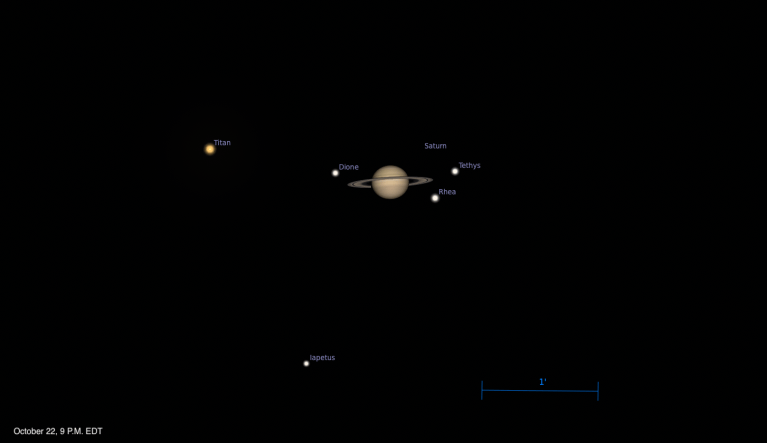
Always a treat in a telescope, Saturn’s disk now spans 20”, while its rings are nearly 45” from end to end. Their southern side is visible, along with the planet’s south pole, as the world is tilted some 7° to our line of sight. Titan, the planet’s brightest moon at mid-8th magnitude, still lies east of the ringed world. Tethys, Rhea, and Dione are closer in, all around 10th magnitude. Their positions will depend on when you observe the planet: Early on the evening of the 4th, only Dione and Rhea are visible to Saturn’s west, as Tethys is passing behind the disk in an occultation. Tethys reappears around 8:20 PM EDT, popping out from behind the southeastern limb. It pulls away from Saturn to the east over time, while Rhea approaches and crosses south of the planet (although it does not pass in front of or behind the disk) between about 1 A.M. and 3 A.M. EDT (now the 5th for most U.S. observers).
Dione also approaches the planet from the southwest, disappearing in an occultation around 6:40 A.M. MDT, shortly before sunrise in this time zone. The event is best viewed from the West Coast, where skies are still likely to be dark.
Sunrise: 6:59 A.M.
Sunset: 6:37 P.M.
Moonrise: 12:02 A.M.
Moonset: 3:34 P.M.
Moon Phase: Waning crescent (33%)
*Times for sunrise, sunset, moonrise, and moonset are given in local time from 40° N 90° W. The Moon’s illumination is given at 10 P.M. local time from the same location.
The Moon passes 1.2° north of Mars at 2 A.M. EDT on October 5. The pair shares Cancer early this morning, rising around 1:15 A.M. local daylight time and remaining visible until sunrise.
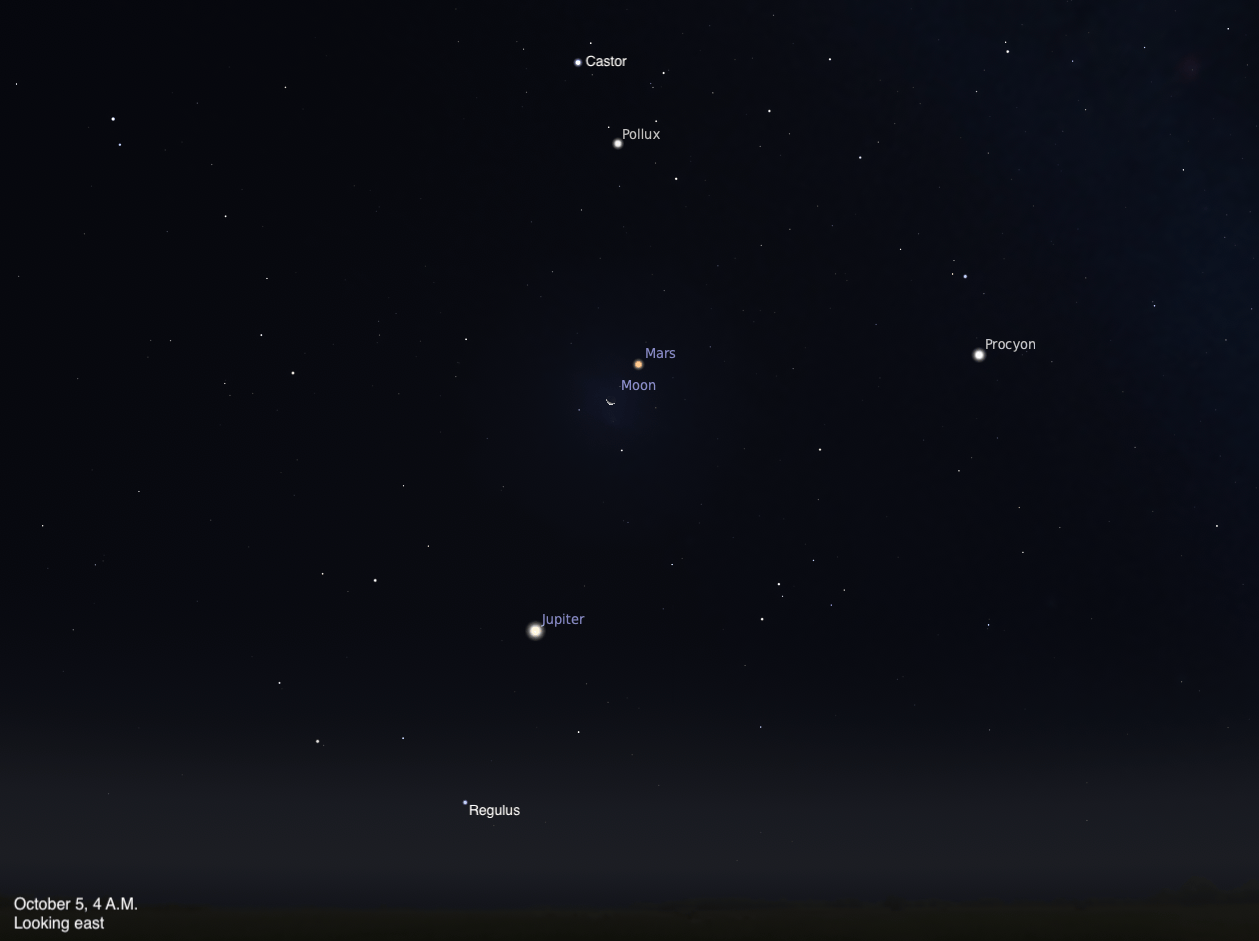
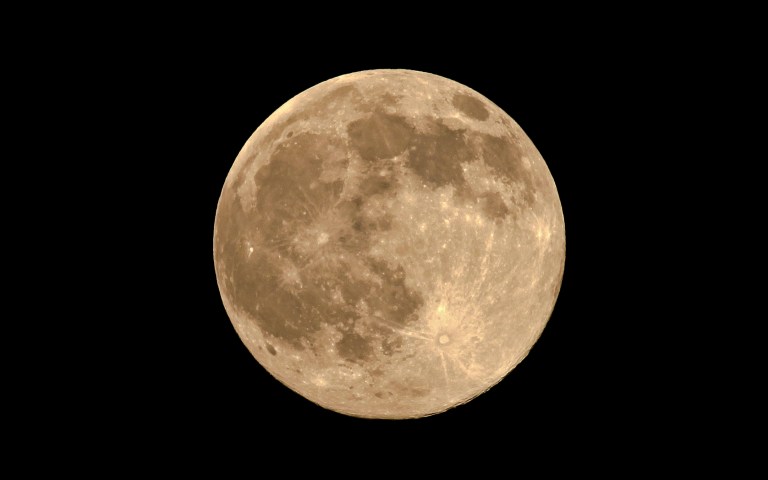
Mars is now magnitude 1.1, a bright point of light in central Cancer, hanging between Castor and Pollux above it and Regulus and Jupiter below, once Leo rises. The waning Moon is located to Mars’ lower left, passing close to the scattered stars of the Beehive open cluster (M44) and occulting some of them, depending on your location. Our satellite first begins plowing through the northern part of the cluster around 5 A.M. EDT, and takes about four hours to cross through. Stars will disappear at the bright western limb of our satellite and reappear at the darkened eastern limb — the latter will be easier to catch, best watched through binoculars or a telescope.
Alison Klesman is senior editor of Astronomy magazine. She holds a Ph.D. in astronomy and has studied a variety of topics, from minor planets to supermassive black holes.