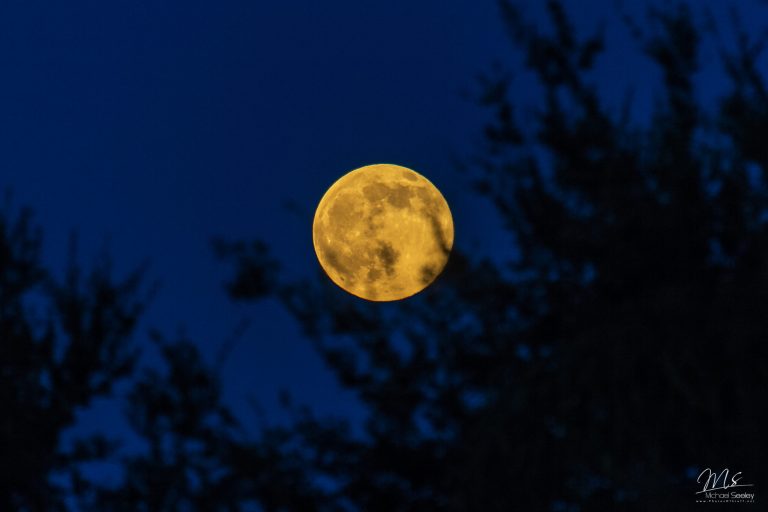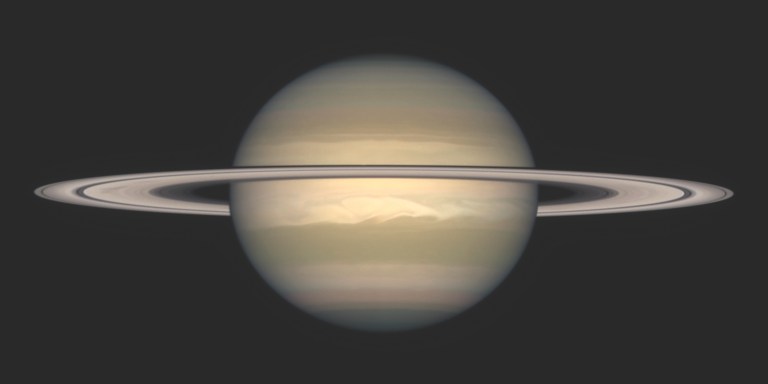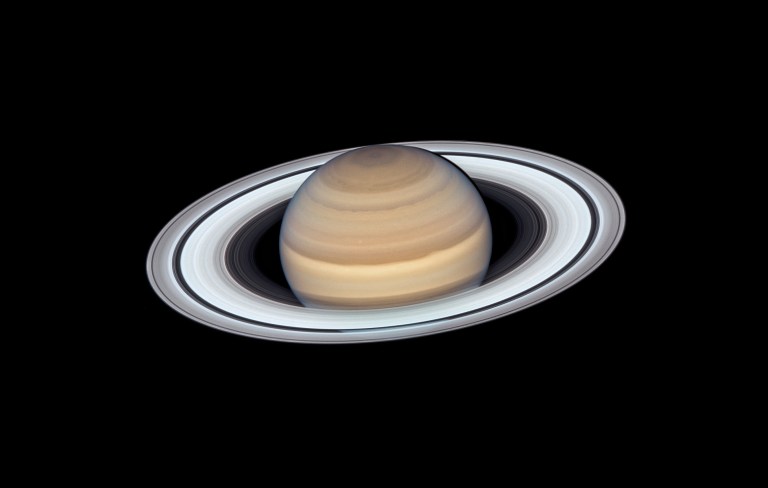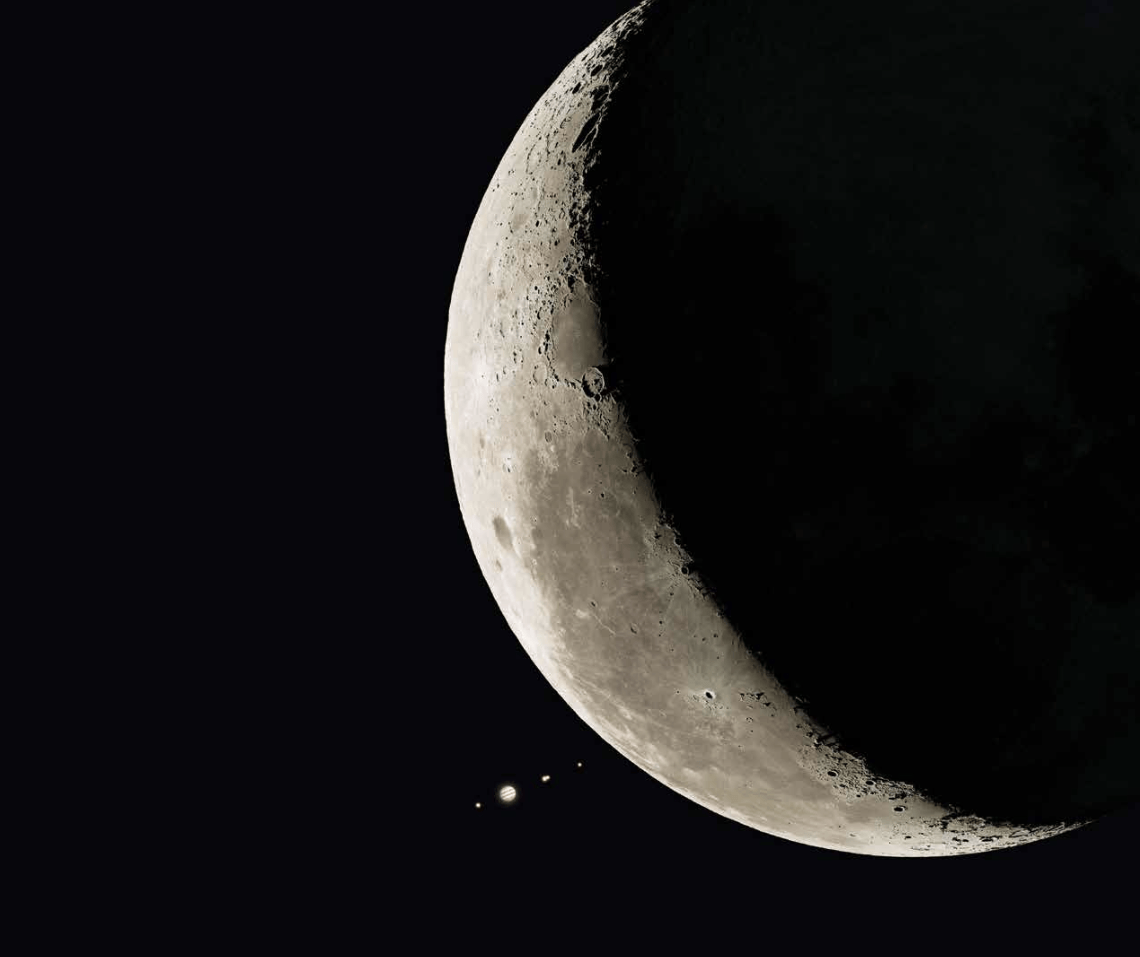
Make sure to set your alarm clock early on the morning of Tuesday, Oct. 6, so that you won’t miss a rare and spectacular celestial event. The brilliant planet Jupiter and its retinue of Galilean satellites will pass behind the waning Moon, a 20%-illuminated crescent just 4¼ days before New. Astronomers call this phenomenon an occultation, taken from the Latin word occultāre, meaning “to conceal.” This eye-catching sight will be visible in complete darkness across the eastern and much of the central U.S. as well as adjacent southern Canada, making it the best Jupiter occultation for North America since 2004.
On this special morning, the slender crescent Moon will rise in the east at around 2:30 a.m. local daylight time with Jupiter shining close by its sunlit side. As the pair rises higher in the sky, the Moon will slowly draw closer to the planet. Observers in the eastern and central U.S. will then see Jupiter disappear behind the Moon’s bright limb. The planet will reappear from behind the Moon’s dark — albeit dimly Earth-lit — eastern limb approximately an hour later.
Where the event is visible
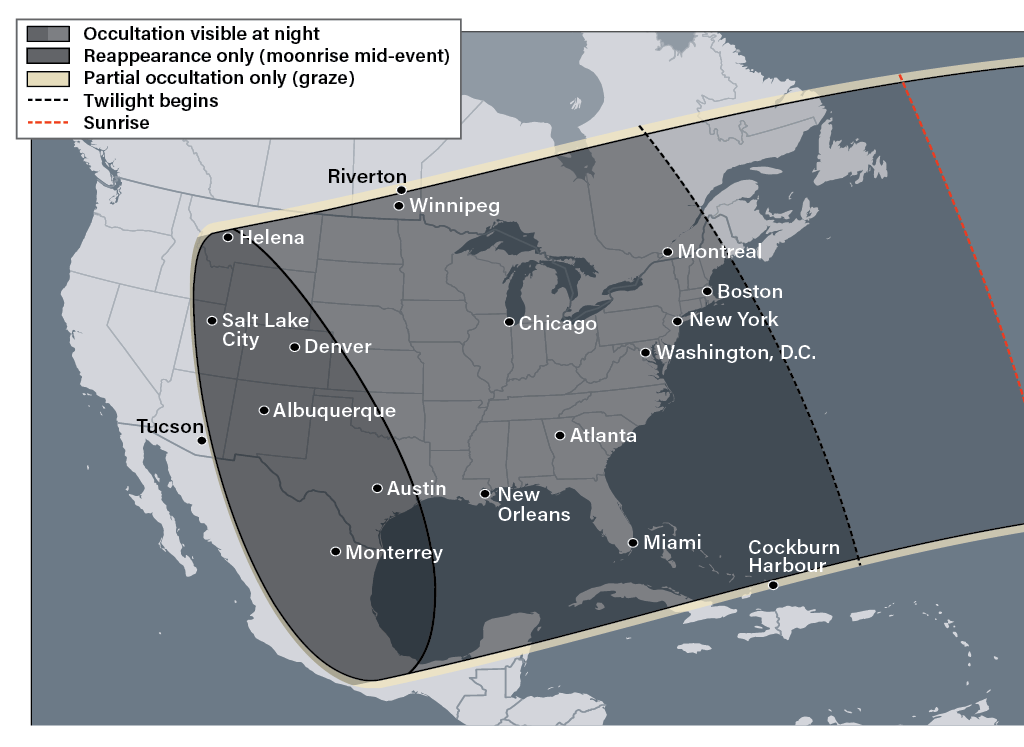
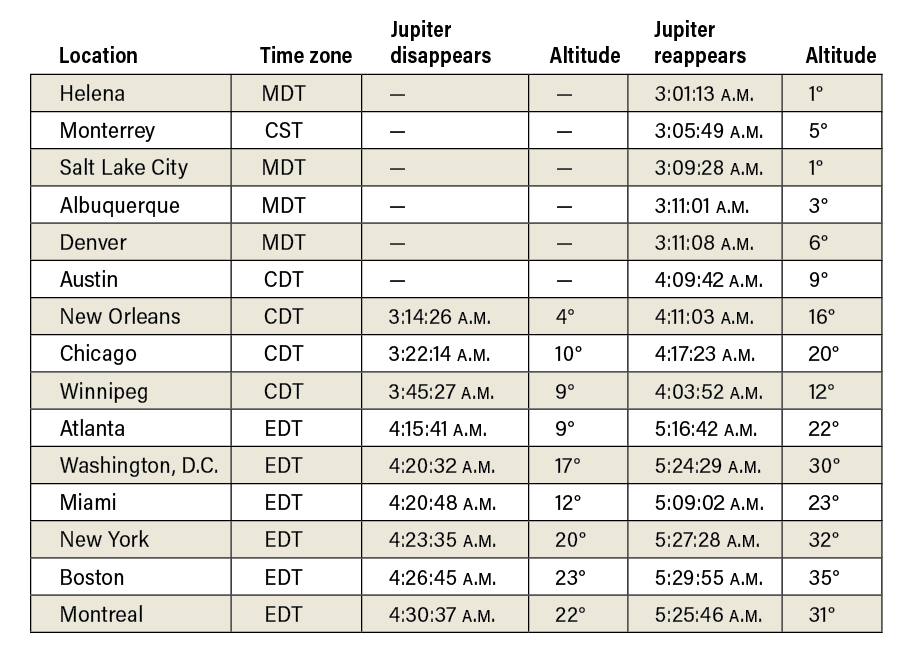
Because the Moon and Jupiter will have such a wide separation (53°) from the Sun, this occultation takes place for most observers before dawn twilight brightens the eastern sky. Eastern New York State, New England, and Atlantic Canada will be particularly favored with the Moon around 20° high when it covers Jupiter. (Your clenched fist held at arm’s length spans about 10°.) The Moon will have risen to 30° above the eastern horizon by the time Jupiter begins to reappear.
The Moon’s altitude gradually diminishes as you move south and west. Across the western Great Lakes, the eastern Great Plains, and down into the central Gulf Coast, for example, the emergence of Jupiter occurs with the Moon about 15° to 20° high.
Along a line from approximately central Montana down into southeastern Texas, Jupiter’s disappearance will roughly coincide with moonrise, but when Jupiter is ready to emerge, the Moon will have climbed to an altitude of 5° to 10°.
West of this line, viewers will only be able to see Jupiter’s reappearance, with the Moon quite low; prospective observers in this region might want to scout out an observing site in advance that has a clear view toward the east. Along a line running just west of Helena, Montana, and Salt Lake City, down to east of Tucson, Arizona, Jupiter’s emergence occurs at moonrise. Farther west, unfortunately, no occultation will be visible. But even there, Jupiter hovering just above the lunar crescent as they rise into full view will still make for a very striking sight.
What to expect
As Jupiter has a discernible disk, as seen in telescopes and even binoculars, it will not disappear or reappear in an instant like the pinpoint light of a star, but rather it will take a longer interval of time to fully disappear or reappear. In most cases, Jupiter’s disappearance and reappearance will each take about a minute, while the Moon’s edge advances across the planet’s 34″-wide face.
The sunlit lunar crescent is nearly 400 times brighter than Jupiter (magnitude –1.9), so you’re likely going to need binoculars or a telescope to watch the planet’s disappearance next to the Moon’s bright daylit landscape. In contrast, the gradual reappearance of Jupiter from behind the Moon’s dark limb will be easily visible to the naked eye, brightening against the Moon’s dark limb. That will likely be the most memorable part of this sky show — and binoculars or a telescope will provide an even more impressive view.
If you are observing with a telescope, just prior to Jupiter’s disappearance you might be struck by its relatively dim surface brightness compared to that of the sunlit portion of the Moon. Jupiter, of course, is perpetually covered by clouds possessing an average albedo, or reflectivity, of 52% compared to the Moon’s dark gray surface with a much smaller albedo of just 12%. But Jupiter is more than five times farther from the Sun compared to the Moon and consequently is illuminated by sunlight that’s only about 1/27 as intense.
The amount of time that Jupiter will be completely hidden behind the Moon depends on your location, but will reach just over an hour at the high end.
Some will see a partial occultation
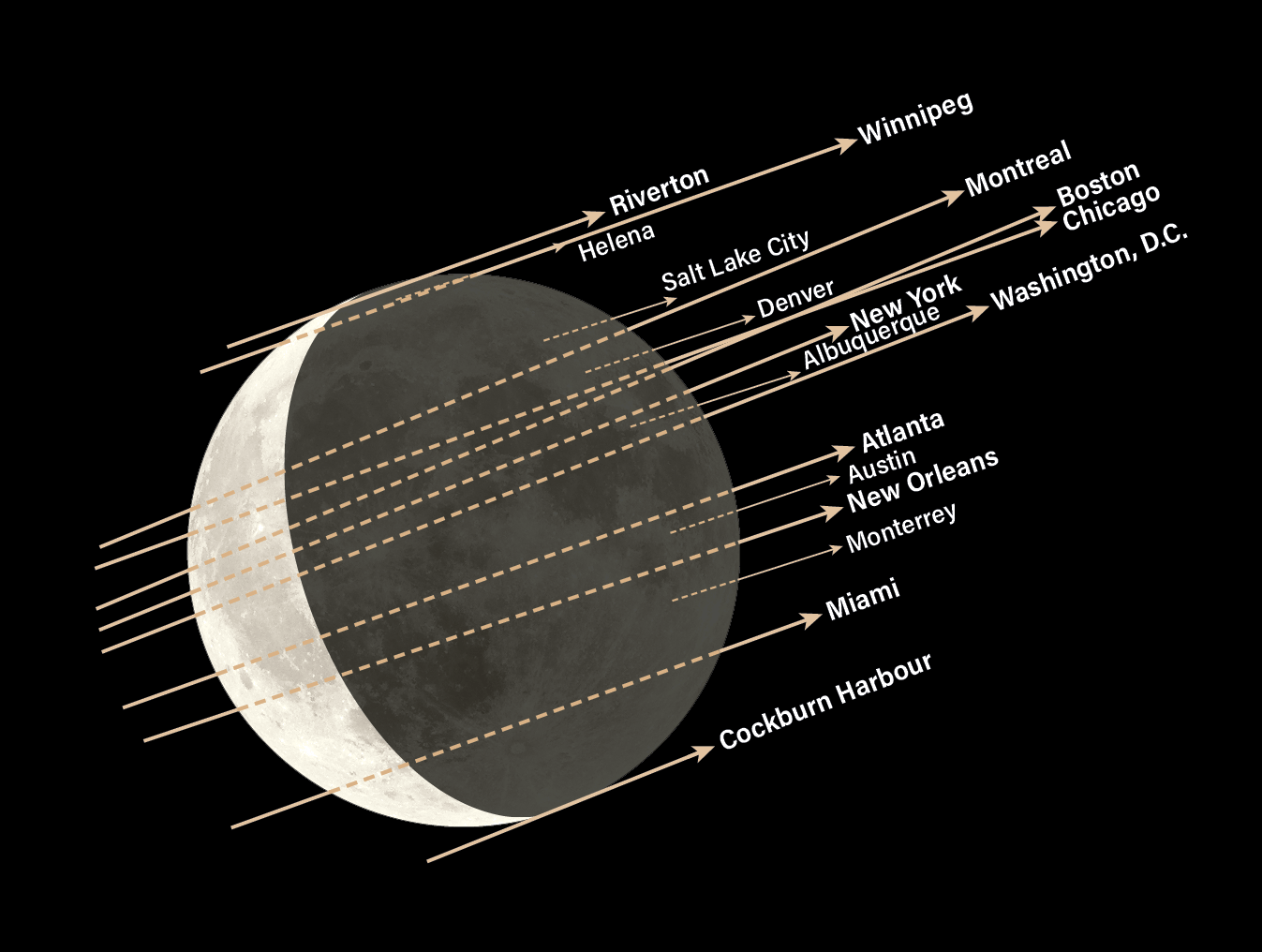
A most interesting sight will be seen from two 35-mile-wide (56 kilometers) strips at the northern and southern limits of the occultation’s visibility. The northern strip stretches northeast from northern Montana into lightly settled southern Canada and up through northern central and northeastern Canada. The southern edge crosses from southern Mexico northeast through the Yucatán Peninsula and across south-central Cuba and the Greater Antilles, including Inagua, Turks, and Caicos Islands.
Within these zones the Moon’s mountainous edge will be silhouetted against Jupiter for several minutes or more, but the planet will never be completely covered. This is called a grazing occultation. Along the northern limit, a spectacular graze will take place along the Moon’s dark limb near the crescent’s northern cusp. Riverton, Manitoba (population 475), located 68 miles (110 km) north of Winnipeg, will see Jupiter partially covered from 3:50 a.m. to 4:01 a.m. CDT.
Along the southern limit, as seen from Cockburn Harbour (population 811) on South Caicos Island, the graze will take place along the Moon’s dark limb very close to the crescent’s southern cusp, with Jupiter partially covered from 4:46 a.m. to 4:58 a.m. EDT. Farther west, across Mexico and Cuba, the graze occurs along the crescent’s bright southern limb.
Local circumstances of the Oct. 6, 2026, occultation of Jupiter
The data in the table below is based on predictions made by Rob Robinson of the International Occultation Timing Association. Over a large metropolitan area, times may differ by half a minute or more from the listed times. Dashes indicate where Jupiter’s disappearance behind the Moon occurs prior to moonrise; hence, the time and altitude data are omitted.
For more detailed information, go to http://www.lunar-occultations.com/iota/bstar/1006jupiter.htm.
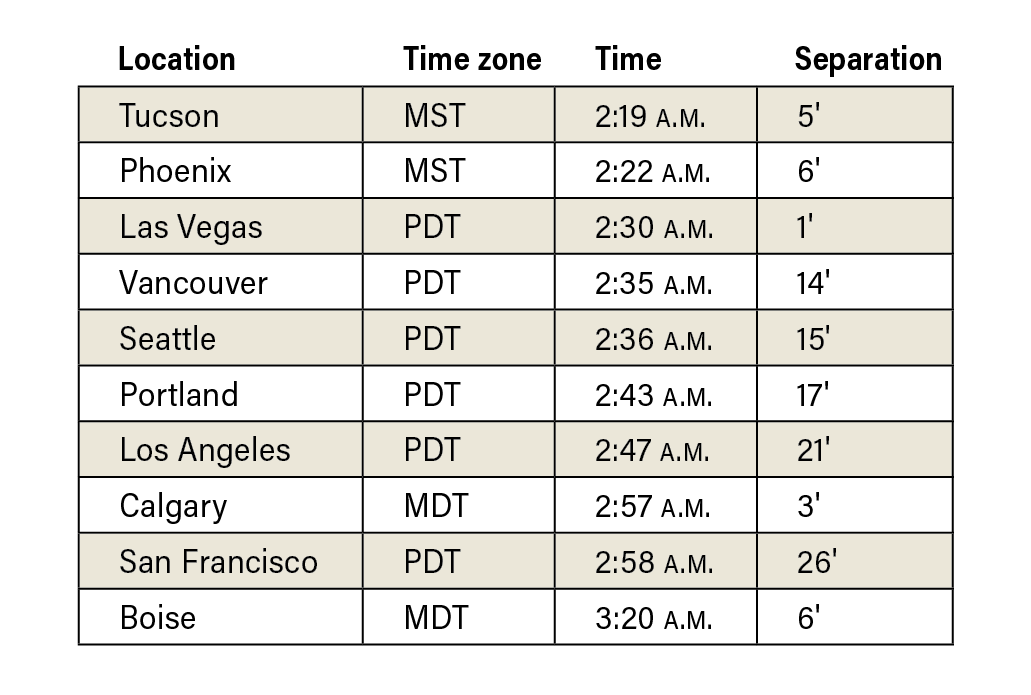
A swath of the western U.S. and Canada lies outside of the occultation zone but, as a consolation prize, will be treated to the rare sight of the planet passing very closely above the upper edge of the lunar disk — not an occultation but still a head-turning celestial tableau.
The suggested viewing times in the table below are several minutes after local moonrise; the listed separation is of Jupiter relative to the Moon’s upper edge given in arcminutes for the listed times. Make sure you have a clear and unobstructed view toward the eastern horizon. As the Moon and Jupiter ascend, the gap between them will slowly widen, with the Moon receding from Jupiter at approximately one lunar diameter per hour.
Keep in mind that the apparent diameter of the Moon is 32′, so (as an example) a separation of 4′ is equivalent to only one-eighth the Moon’s diameter.
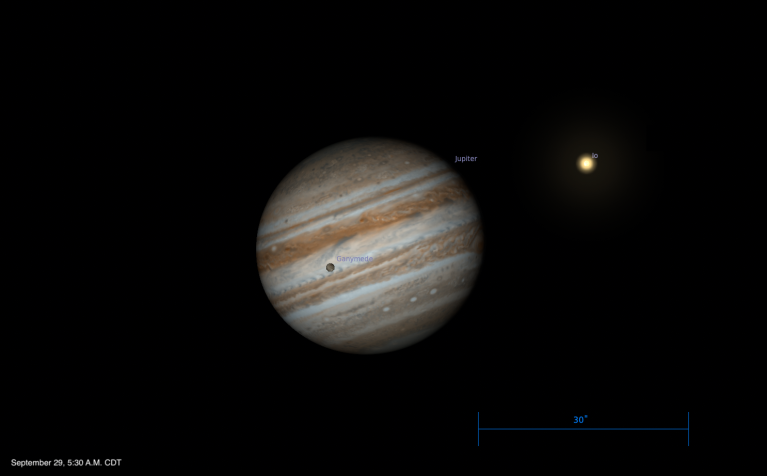
The positions of Jupiter’s moons
In addition to Jupiter, occultations of the four bright Galilean satellites will also be seen. Except for in large telescopes, they might be lost in the glare of the bright lunar crescent just prior to disappearing behind the Moon, but their emergence from behind the Moon’s dark limb should be especially dramatic.
Going in, Europa (magnitude 6.1) will be occulted about five minutes before Jupiter. It will be followed by Callisto (magnitude 6.7) and then Io (magnitude 6.0) about three minutes before Jupiter, and about 15 seconds apart. Then, about two minutes after Jupiter itself disappears, Ganymede (magnitude 5.5) will disappear.
Coming out, Europa will be first, about five minutes before Jupiter, followed by Callisto about two minutes later, accompanied roughly 45 seconds later by Io. Since Io revolves around Jupiter in only 1.8 days while Callisto takes nearly 17 days, the gap between it and Callisto will have noticeably widened even during the short time span of the occultation. Finally, two minutes after Jupiter fully returns to view, Ganymede will emerge.
Since the satellites each measure about 1″ in apparent diameter, they will all gradually brighten as they reappear from behind the Moon. Unlike stars, which when occulted instantaneously pop back into view, it will take perhaps one to three seconds on average for each satellite to fully emerge.
How rare are lunar occultations of Jupiter?
Lunar occultations of Jupiter are rather rare. Simulations turn up 123 occultations of this giant world visible anywhere on the globe between 1980 and 2040. But if we confine our search to a specific location and only include those instances when the Sun is below the horizon, such an event occurs on average once about every 13 years.
Still, there are occasional quirks: In 2037, as seen from Portland, Oregon, the Moon will occult Jupiter on Nov. 27, the morning after Thanksgiving. Portland’s next dark-sky occultation of Jupiter will come less than a month later, near the break of dawn on Christmas Eve, Dec. 24.
Conversely, prior to this year, New York City’s last dark-sky occultation of Jupiter occurred nearly 22 years ago, on Dec. 7, 2004. Incredibly, before that date we must go back 115 years, to the late 19th century — Sept. 3, 1889 — for the previous time a dark-sky occultation of Jupiter was visible from the five boroughs!
Make the most of this opportunity
As Jupiter and the Moon are both well-characterized, this occultation is not rich in scientific value. However, it certainly will be an unusual observing project for skywatchers as well as a memorable eye-catching spectacle wherever it can be seen.
The next good dark-sky occultation of Jupiter will be visible from the western half of North America on Sept. 28, 2034, and most of the continent will be able to partake of the occultation in November 2037.
Good luck, and make the most of this upcoming opportunity!
Joe Rao is an instructor and guest lecturer at New York City’s Hayden Planetarium. He writes about astronomy for Space.com, Natural History magazine, The Old Farmer’s Almanac, and other publications. In July 2023, the International Astronomical Union named 2.3-mile-wide asteroid 200009 Joerao in his honor.