Looking for a sky event this week? Check out our full Sky This Week column.
October 1: Perseus’ Double Cluster
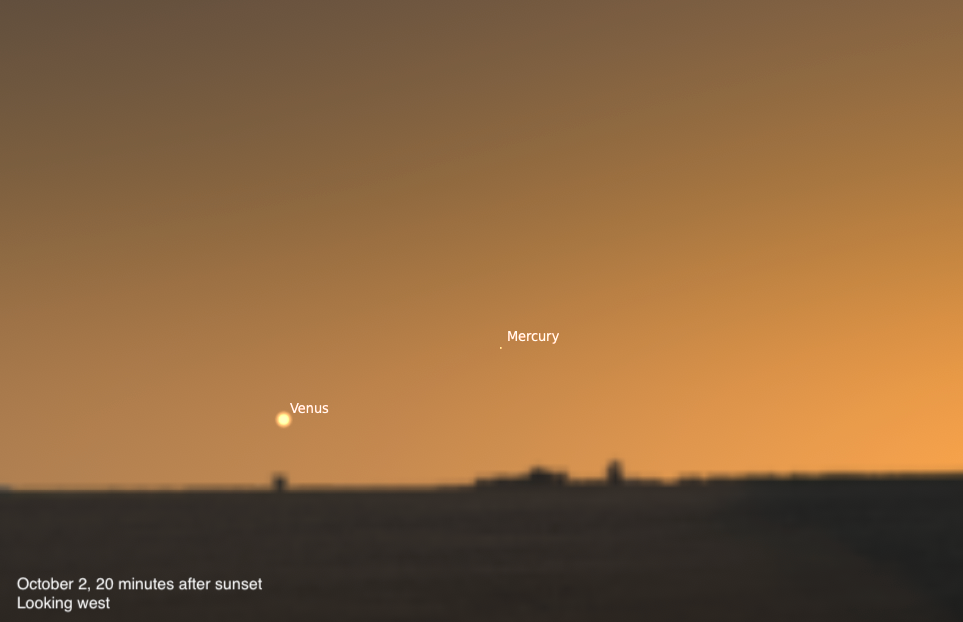
The brilliant planet Venus stands stationary against the background stars of Virgo at 10 A.M. EDT. Together with Mercury, Venus is visible for a short time in the western sky after sunset, but you’ll want a clear horizon to make sure you catch them.
Just 20 minutes after sunset, Venus is only 2° high; Mercury is about 4° high, located to Venus’ upper right. Venus is by far the brighter of the pair, blazing at magnitude –4.8 — its brilliance should help you find it, even close to the horizon. Mercury is several magnitudes fainter, but still quite bright at magnitude –0.1. You might need binoculars to help you pick it out of the slowly darkening sky, so once you find Venus, scan around for Mercury’s position based on the chart above. Make sure not to begin using binoculars or a telescope until the Sun has fully set from your location. Venus sets about 30 minutes after the Sun, and Mercury is gone 15 minutes after that.
Today’s standstill brings Venus’ prograde (eastward) motion to an end. After today, Venus will be in retrograde, appearing to move westward against the background stars. While tonight it sits in the southeastern corner of Virgo, near that constellation’s border with Libra, Venus’ retrograde motion will carry it away from Libra and back into Virgo after this date.
Sunrise: 6:57 A.M.
Sunset: 6:40 P.M.
Moonrise: 10:50 P.M.
Moonset: 1:56 P.M.
Moon Phase: Waning gibbous (55%)
*Times for sunrise, sunset, moonrise, and moonset are given in local time from 40° N 90° W. The Moon’s illumination is given at 10 P.M. local time from the same location.
Alison Klesman is senior editor of Astronomy magazine. She holds a Ph.D. in astronomy and has studied a variety of topics, from minor planets to supermassive black holes.