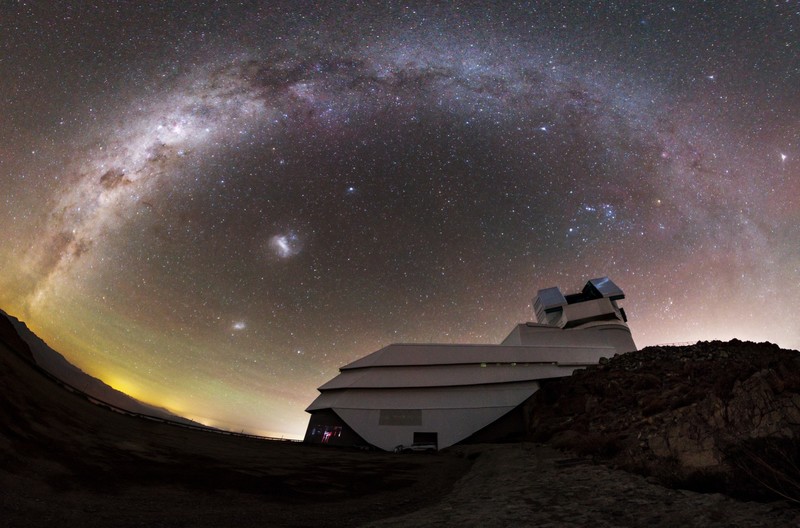
The wait is almost over. The Vera C. Rubin Observatory is just weeks, maybe even just days, away from officially beginning its landmark 10-year sky survey, according to officials at the 248th American Astronomical Society (AAS) meeting in Pasadena this week.
“A lot of people in the community are waiting for that moment for the survey really to turn on,” Chris Smith, section head of the U.S. National Science Foundation (NSF) Directorate for Mathematical and Physical Sciences (MPS) said Tuesday. “We’ve been collecting data — so it’s not that operations haven’t been happening. But there’s this important point where we declare the survey starts. That’s days to weeks away from what I’ve been told.” That survey — the Legacy Survey of Space and Time (LSST), a 10-year, whole-sky census — is the primary mission Rubin was built to carry out.
Jeff Carlin, NOIRLab community scientist, put it more simply: the survey could start “any day now.” The past year, he tells Astronomy, has been about getting the telescope ready to deliver on its promises. “We’ve spent the past year refining things — refining the workflow so the operation is more efficient, as well as making minor tweaks to improve the image quality — so that we are confident that we can start the survey in the very near future and achieve the science goals.”
When that moment arrives, it will mark the formal start of one of the most ambitious programs in the history of astronomy. The observatory is named for Vera Rubin, the astronomer whose observations in the 1970s provided the first convincing evidence for dark matter. Its 8.4-meter Telescope carries the largest digital camera ever constructed, a 3,200-megapixel instrument so detailed that a single image would require 400 high-definition television screens to display at full size.
Construction wrapped last September, and the formal handover from construction to operations took place in Chile in October 2025. “This was a big moment for us,” Smith said. “A moment that some of us waited and worked on for three decades.” First light images, released publicly in June 2025, showcased the camera’s extraordinary reach: sweeping views of the Trifid and Lagoon nebulae, thousands of galaxies in the Virgo Cluster, rendered at unprecedented resolution and depth.
Although the survey hasn’t formally started yet — a review board must recommend the go-ahead to the observatory’s director before the LSST officially begins — the telescope has been far from idle. Since February, Rubin has been streaming roughly 100,000 automated alerts per night to astronomers worldwide, flagging anything in the sky that has moved, brightened, faded, or changed since the last observation. Already, those alerts have helped confirm new supernovae and led to the discovery of more than 11,000 previously uncatalogued solar system objects. Smith noted that in full operations, that alert rate is expected to climb into the millions per night — with a global network of brokers and follow-up telescopes ready to respond.
The public is invited, too. “Rubin is ramping up on the citizen science side,” Smith said. “This was always part of the Rubin plan: engage the broader public.” One active project, Comet Catchers, invites volunteers to help identify comets in Rubin data through NASA’s citizen science program.
Once the LSST officially begins, the telescope will sweep the entire visible southern sky every three to four nights for a decade, imaging every accessible section of sky roughly 800 times and generating around 20 terabytes of data per night. The science targets are sweeping: dark matter mapping, near-Earth asteroid tracking, real-time supernova detection, and phenomena astronomers haven’t yet anticipated.
A first data preview is already available to researchers. Those data were collected using a smaller commissioning camera — a nine-sensor prototype used to test the telescope’s systems before the full 3,200-megapixel LSST Camera was installed. A second preview, drawn from roughly 30,000 science visits made with the full camera and closer to what LSST operations will actually look like, is due out this summer.