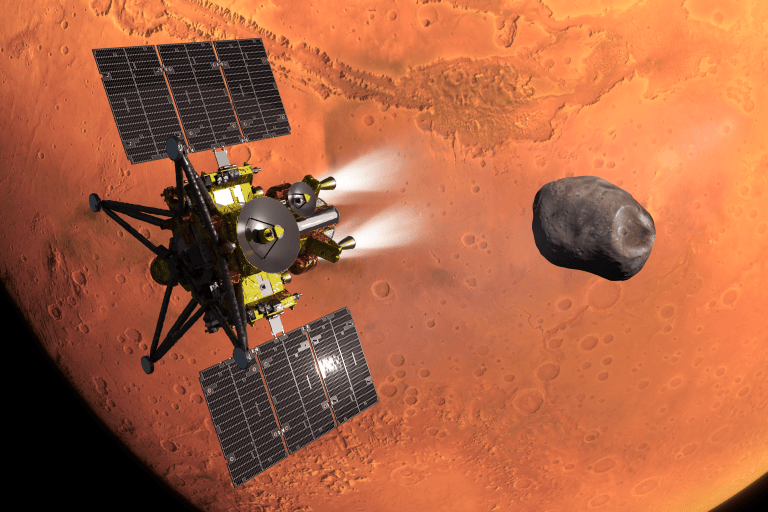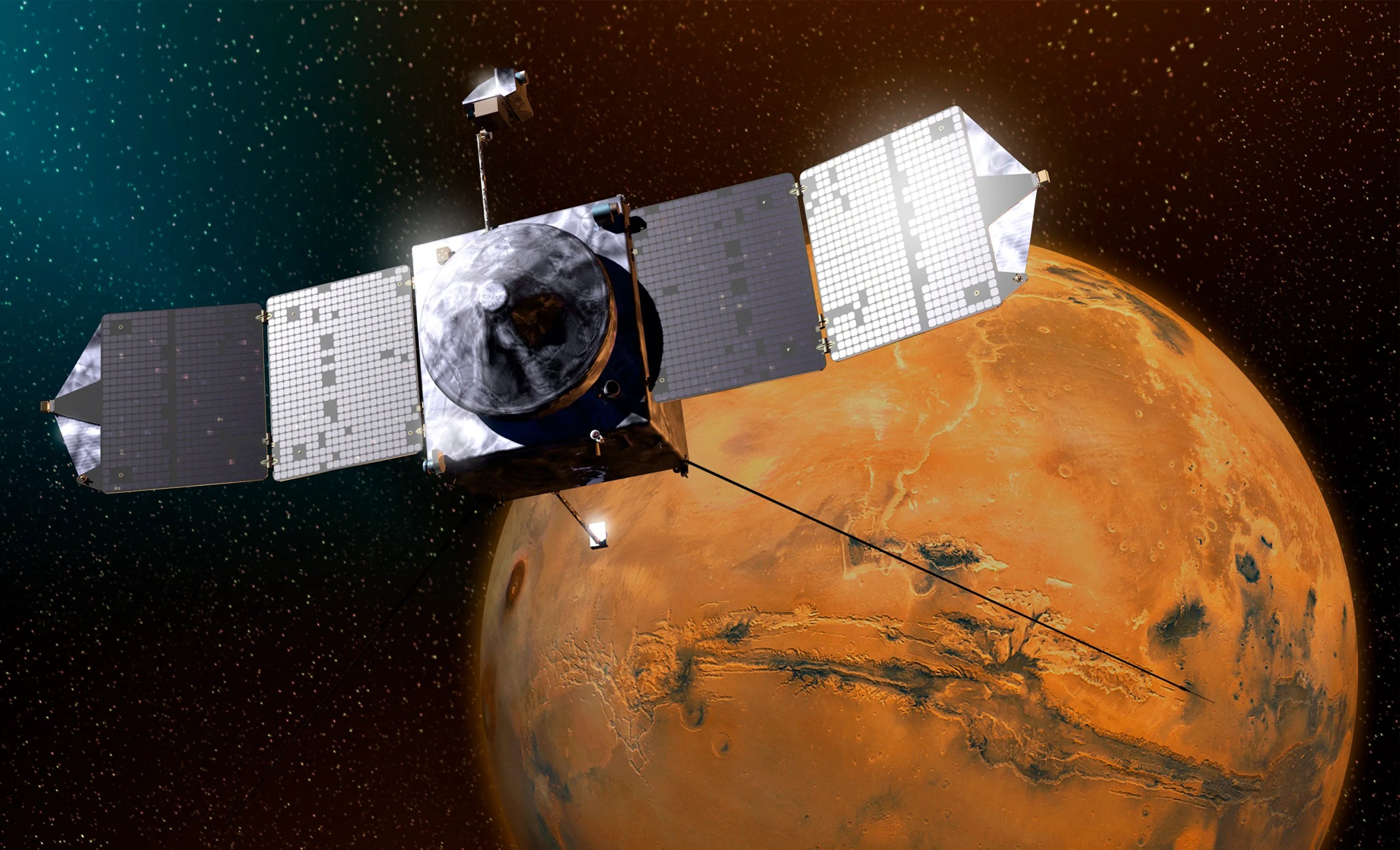
NASA has ended its attempts to reconnect with the Mars Atmosphere and Volatile EvolutioN (MAVEN) spacecraft and begun decommissioning the orbiter, closing the book on a mission that spent over a decade studying how Mars lost its atmosphere.
At a June 3 media conference, NASA officials announced that an anomaly review board — which was assembled in February after several failed attempts to recontact the spacecraft following a loss of signal on Dec. 6, 2025 — has determined that MAVEN cannot be recovered. The spacecraft, which had been operating in martian orbit since 2014, is now being formally decommissioned. Its data will be archived for future research.
Mars’s biggest question
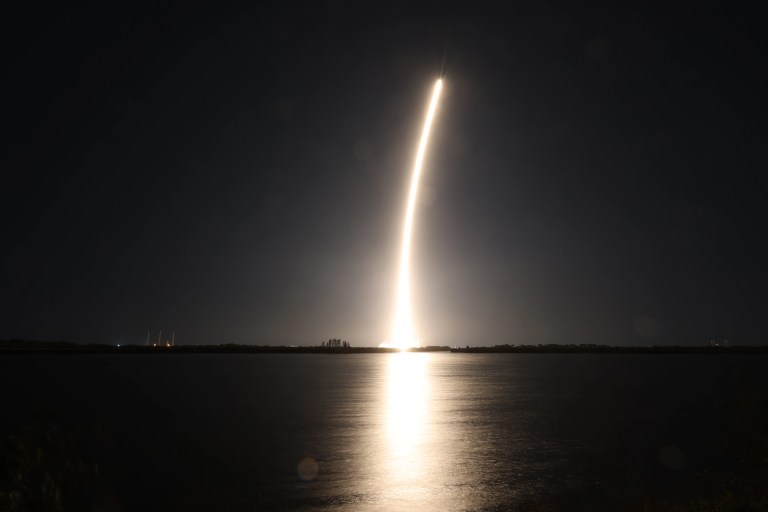
Launched in November 2013 and operational since September 2014, the spacecraft completed a one-year primary mission in 2015 and continued operating through five extended missions over the following decade. MAVEN was the first NASA mission designed explicitly to study the martian atmosphere. Its central goal was to help scientists understand one of planetary science’s biggest mysteries: How did Mars, once seemingly warm and wet, become the cold, dry world it is today? Throughout the mission, the science team behind MAVEN produced more than 800 publications, with more on their way.
A decade of discovery
Over 11 years at Mars, MAVEN rewrote the field. “The MAVEN mission has truly advanced our understanding of the martian atmosphere and evolution,” said Shannon Curry, MAVEN principal investigator and professor at the University of Colorado Boulder’s Laboratory for Atmospheric and Space Physics, in a press release. “Our science team is exceptionally proud of all of these amazing discoveries.”
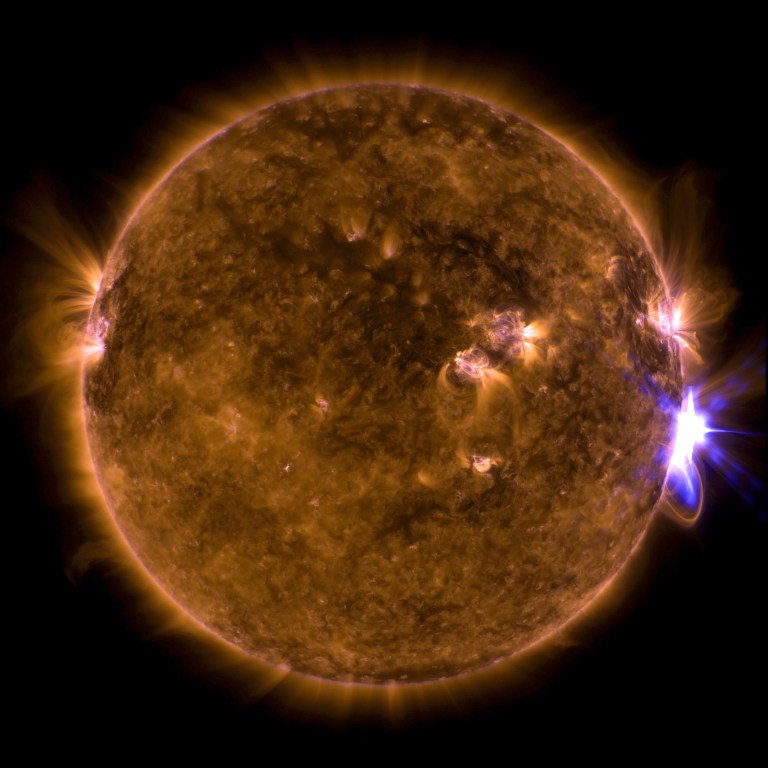
In 2015, MAVEN allowed scientists to measure atmospheric escape rates (the pace at which gas in the atmosphere is lost to space), revealing that they spike dramatically during solar storms. Then in 2025, MAVEN was the first spacecraft anywhere to directly observe so-called “atmospheric sputtering” — a specific atmospheric escape process by which energetic ions slam into a planet’s upper atmosphere and knock gas molecules into space. Using 11 years of argon data to confirm it, the team showed the process has been slowly bleeding Mars dry for billions of years. MAVEN also documented new types of aurora unique to Mars and collaborated with Perseverance to record the first visible-light aurora ever seen from the planet’s surface.
MAVEN also contributed heavily to the Mars Relay Network, the web of orbiters that shuttles data between surface rovers and Earth. According to NASA, MAVEN handled roughly 8 percent of all relay sessions planned by the rover teams over its lifetime but delivered nearly 18 percent of all the data those missions sent home — punching far above its weight. “In fact, the top 161 most productive relay sessions all belong to MAVEN. It’s … really amazing,” Tiffany Morgan, deputy director of the NASA Mars Exploration Program, an ongoing effort since 1993 to explore the potential for life on Mars and study the planet’s climate, said.
The signal goes dark
MAVEN’s last contact with Earth came on Dec. 6, 2025, midway through what should have been a routine pass behind Mars. Going in, every system on the spacecraft was reading normal. Coming out, silence — NASA’s Deep Space Network picked up nothing.
Ground teams spent the following weeks sending blind commands in hopes of triggering a reboot. By late December they had to pause: Mars had moved between Earth and the Sun (a periodic blackout period called solar conjunction), making radio contact with anything at Mars temporarily impossible.
Contact attempts resumed in January 2026, with both the Deep Space Network and the National Science Foundation’s 100-meter Green Bank telescope in West Virginia scanning for any trace of a signal. Neither found one. In February, NASA convened the anomaly review board to assess what had been tried, gauge the spacecraft’s likely condition, and decide whether recovery was still on the table.
What the data showed
The board caught a lucky break. As part of a radio science experiment already running on Dec. 6, ground receivers had been recording MAVEN’s transmissions. JPL engineers went back to those recordings and managed to extract scattered bits of usable telemetry data.
What those bits showed was alarming. When MAVEN came back around from behind Mars, it was spinning at roughly 2.7 revolutions per minute. According to Mike Moreau, the MAVEN project manager at NASA’s Goddard Space Flight Center, “That’s faster than the spacecraft is expected to rotate and … that indicates a problem that the spacecraft probably couldn’t recover from.”
From there, the board pieced together what likely happened: The uncontrolled spin kept the solar panels from charging the batteries, which drained over several hours until the radio system lost power entirely. Why the spacecraft started spinning in the first place remains unknown. The board’s full root-cause report is expected later this year.
Looking ahead
Four orbiters remain in the Mars Relay Network — Mars Odyssey, the Mars Reconnaissance Orbiter, and the European Space Agency’s Mars Express and Trace Gas Orbiter — and mission managers say they’ve absorbed MAVEN’s absence without major disruption for now.
But the fleet is aging. In May the agency issued a request for proposals for the Mars Telecom Network, a purpose-built communications infrastructure meant to serve the next generation of robotic and eventually crewed missions at the Red Planet — the kind of dedicated backbone MAVEN was never designed to be but ended up becoming anyway. Industry responses are due June 15. Whatever comes next will be built on lessons learned from MAVEN right up until it went quiet.
Curry had a ready answer when a reporter asked what she’d put on MAVEN’s tombstone: “Best Mars mission ever.”
Brooks Mendenhall is a staff writer for Astronomy and is based in Chattanooga, Tennessee.