Why does one side of the Moon have a lot of craters, while the other side does not?
Stephen Loges
Brooksville, Florida
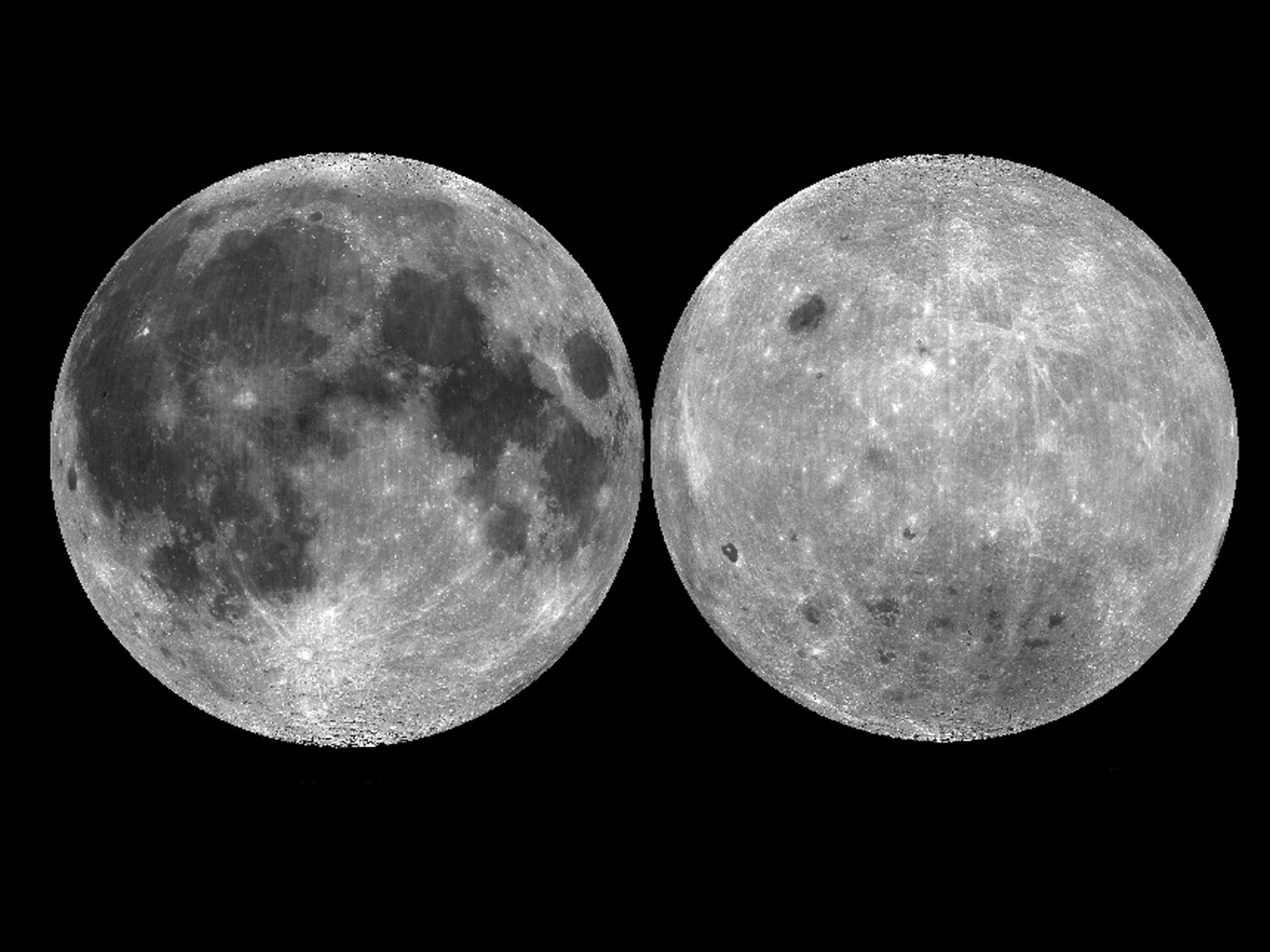
When the first photos of the Moon’s farside were obtained, people usually expressed the difference between the back and the front in terms of “more craters on the back.” It might be better to express it as “more lava plains on the front.”
Like the craters on the farside, the lava plains (called maria) were formed by impacts — in fact, some of the largest the Moon has ever suffered — mostly early in its history. These impacts formed huge basins that penetrated to great depths where the Moon’s materials were molten, so that lava, darker in tone than surface rocks, erupted and filled up the floors of all these structures.
Probably the largest of these is the North Polar Basin on the Moon’s back side. It’s so old that its rim features and lava floor have been mostly destroyed by later craters. A similarly old, eroded giant basin is Oceanus Procellarum on the front side. It was later almost demolished by the more recent, but still early, giant Imbrium impact basin, whose samples date at 3.8 billion to 3.9 billion years old — only 600 million years after the formation of the solar system’s planetary bodies. The prominent Mare Imbrium lavas flooded Imbrium’s floor mostly about 2 billion to 3.8 billion years ago — though some interesting sampled lava eruptions there have been estimated to have ages as young as 1 billion years.
Those ancient lava plains suggest it’s possible that the Earth-facing side actually got more of the large impact basins than the farside in those first few hundred million years. The Moon was closer to Earth in the early millennia, and Earth-passing asteroids might have been deflected by Earth’s gravity and attracted by the Moon’s gravity, crashing into the Earth-facing side of the Moon.
William K. Hartmann
Senior Scientist Emeritus,
Planetary Science Institute, Tucson, Arizona