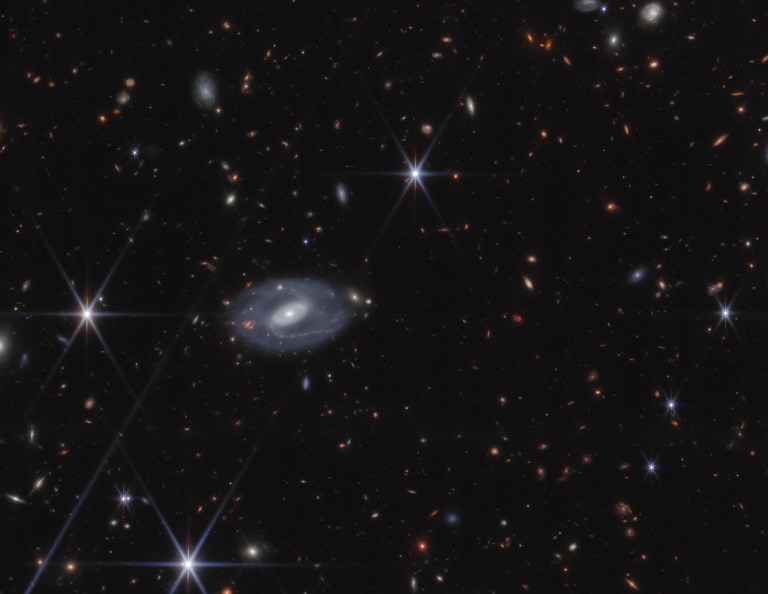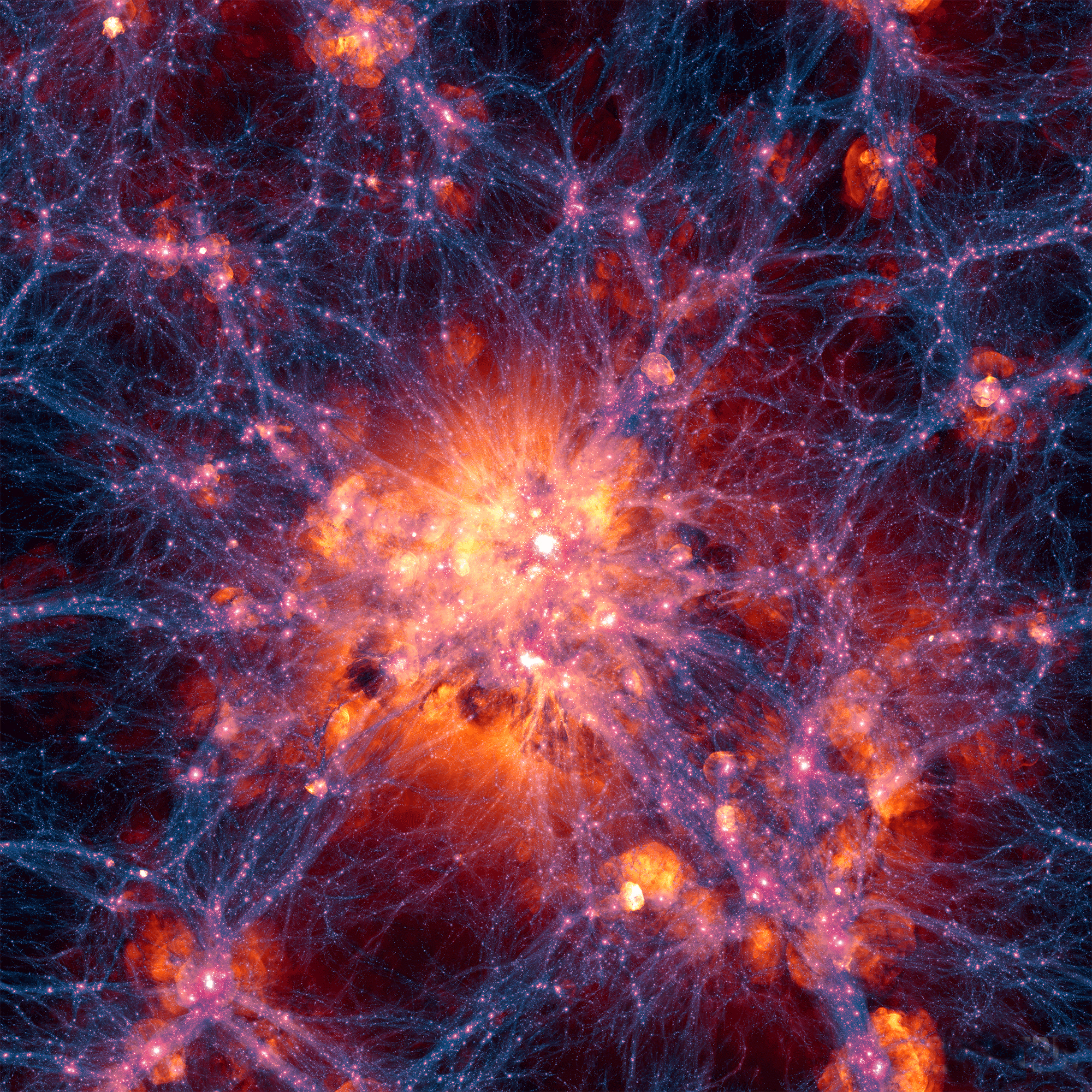
There is a pattern found in nature. It is indeed the largest pattern there is. It is so vast that it spans the universe, filling up its observable volume. The pattern is made of individual units in the same way your body is made of cells — if each of your cells were a galaxy with hundreds of billions of suns.
This pattern is the cosmic web, and it holds the secrets to the fate of the entire universe.
The web is caught between two opposing forces, which happen to be the two great cosmological mysteries of our time: dark matter and dark energy. The invisible pull of dark matter helped assemble the cosmic web. Dark energy threatens to tear it apart.
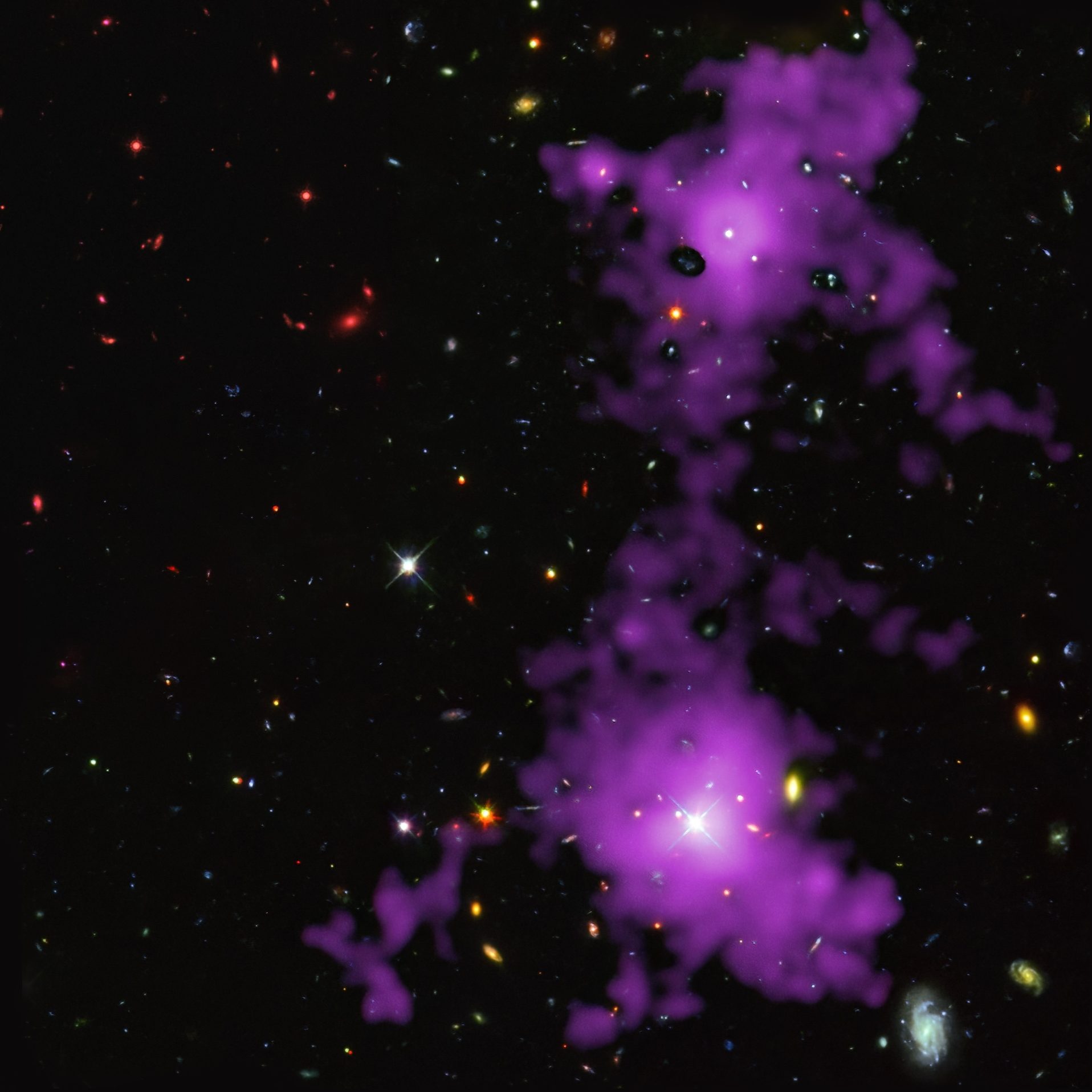
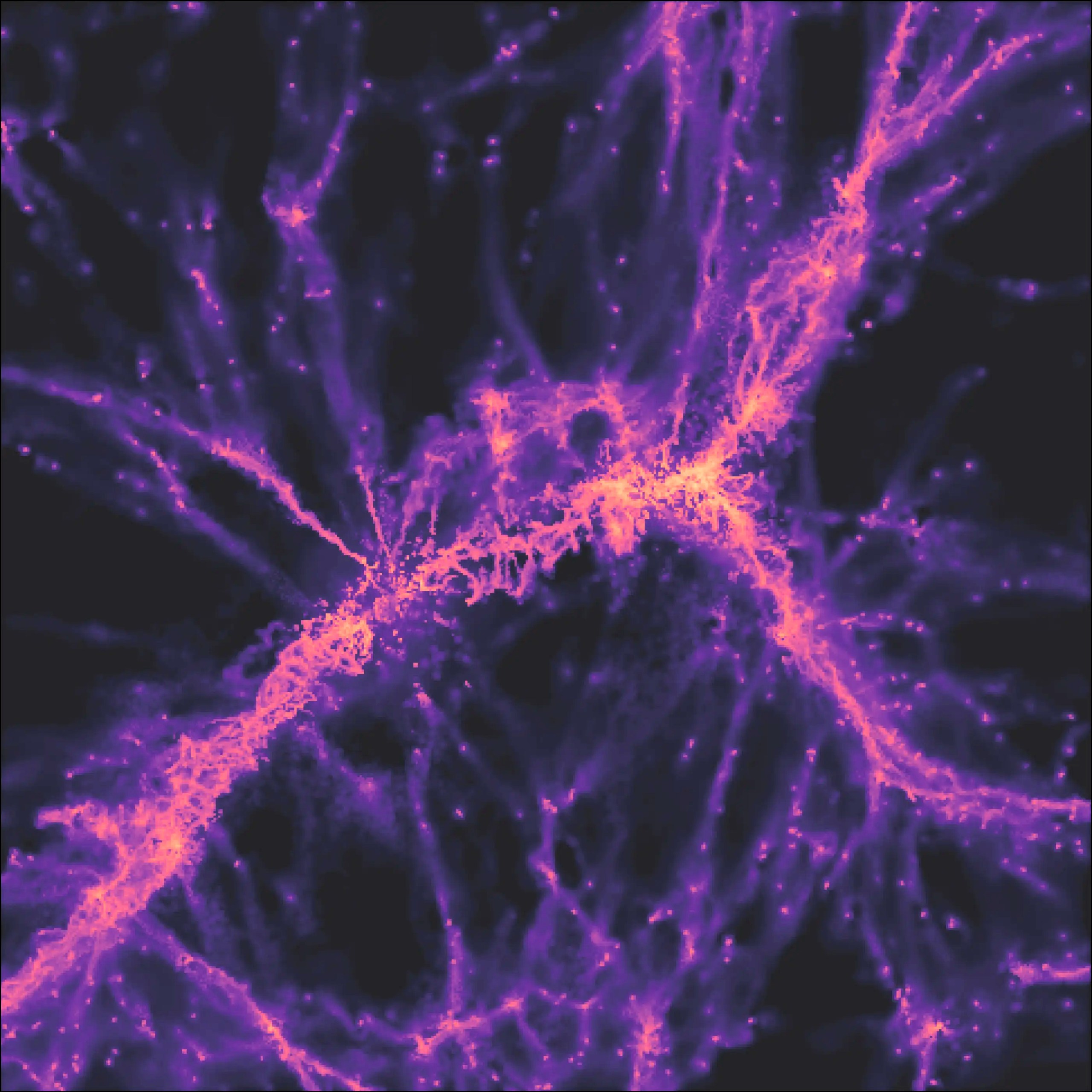
After nearly a century of effort, we have mapped and studied less than a percent of all the galaxies in the observable universe, which spans a diameter of more than 90 billion light-years. But even with that slim effort, we have traced out the fundamental components of the cosmic web. There are the tight, dense clumps, known as galaxy clusters, where thousands of galaxies are packed within relatively compact regions of around a few million light-years. There are also long, thin filaments stretching for millions of light-years that connect those clusters. And then there are giant, two-dimensional walls, like sheets of galaxies billowing in the cosmic web. Finally there are the voids, vast regions of almost nothing, the great cosmic deserts that make up most of the volume of the universe.
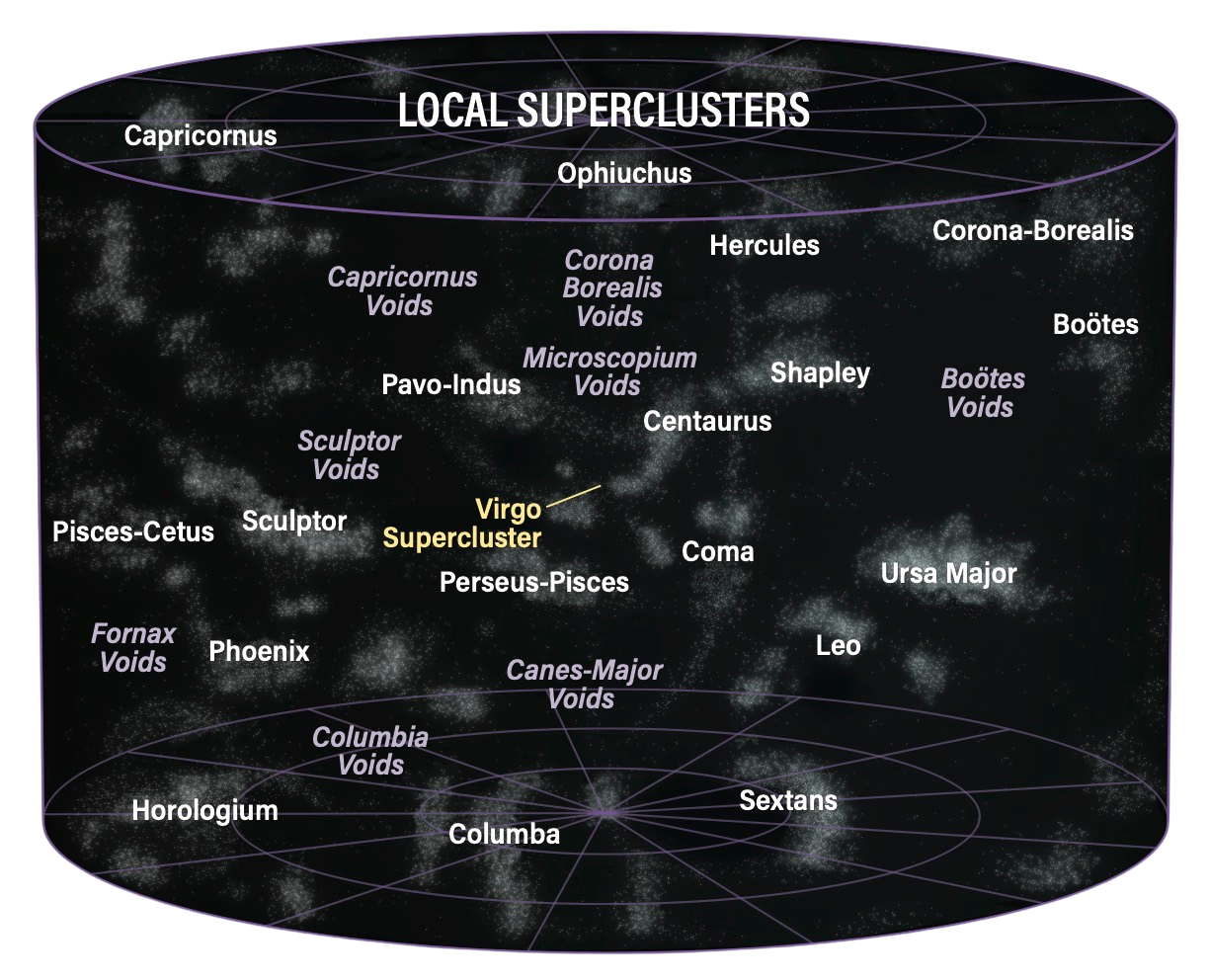
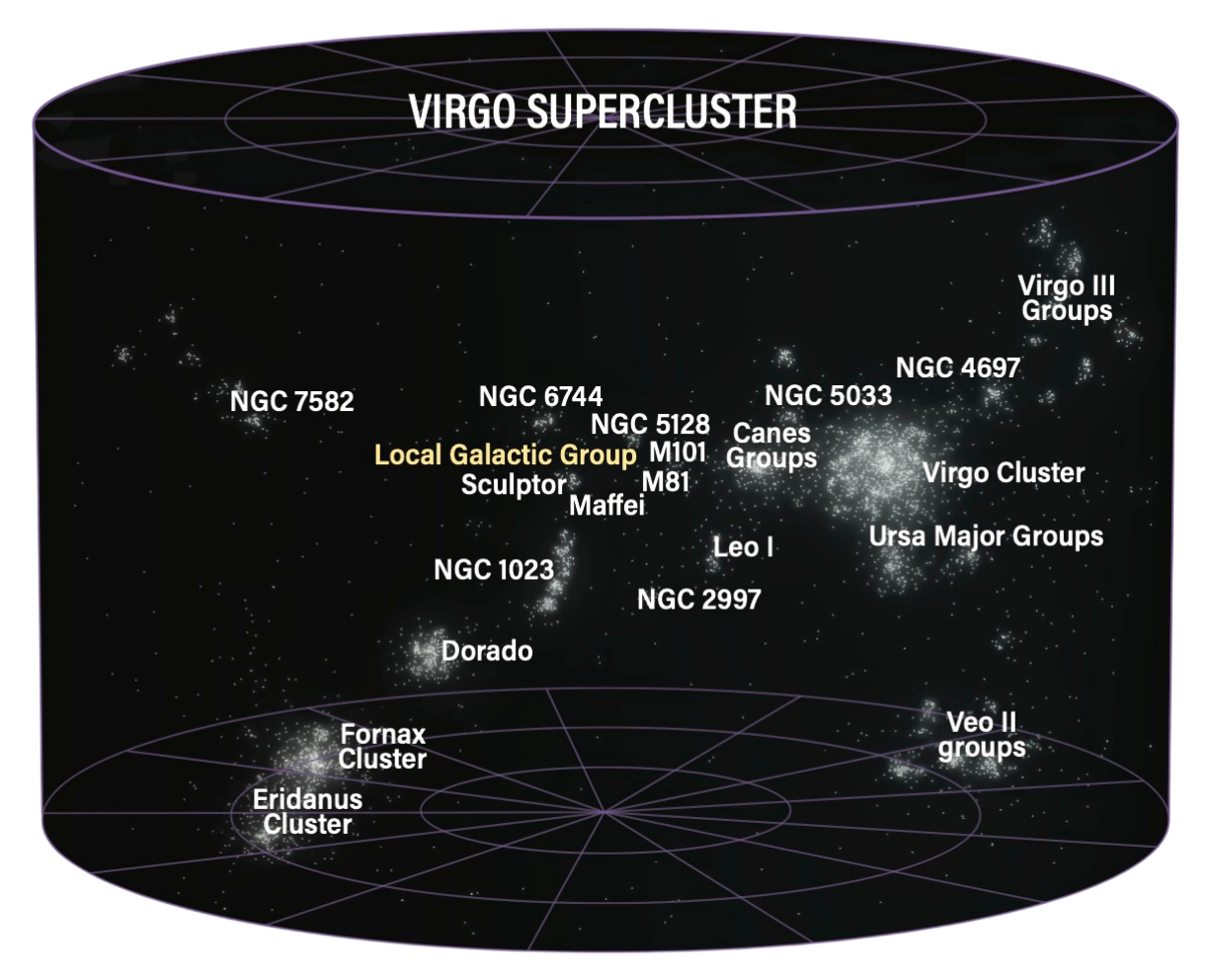
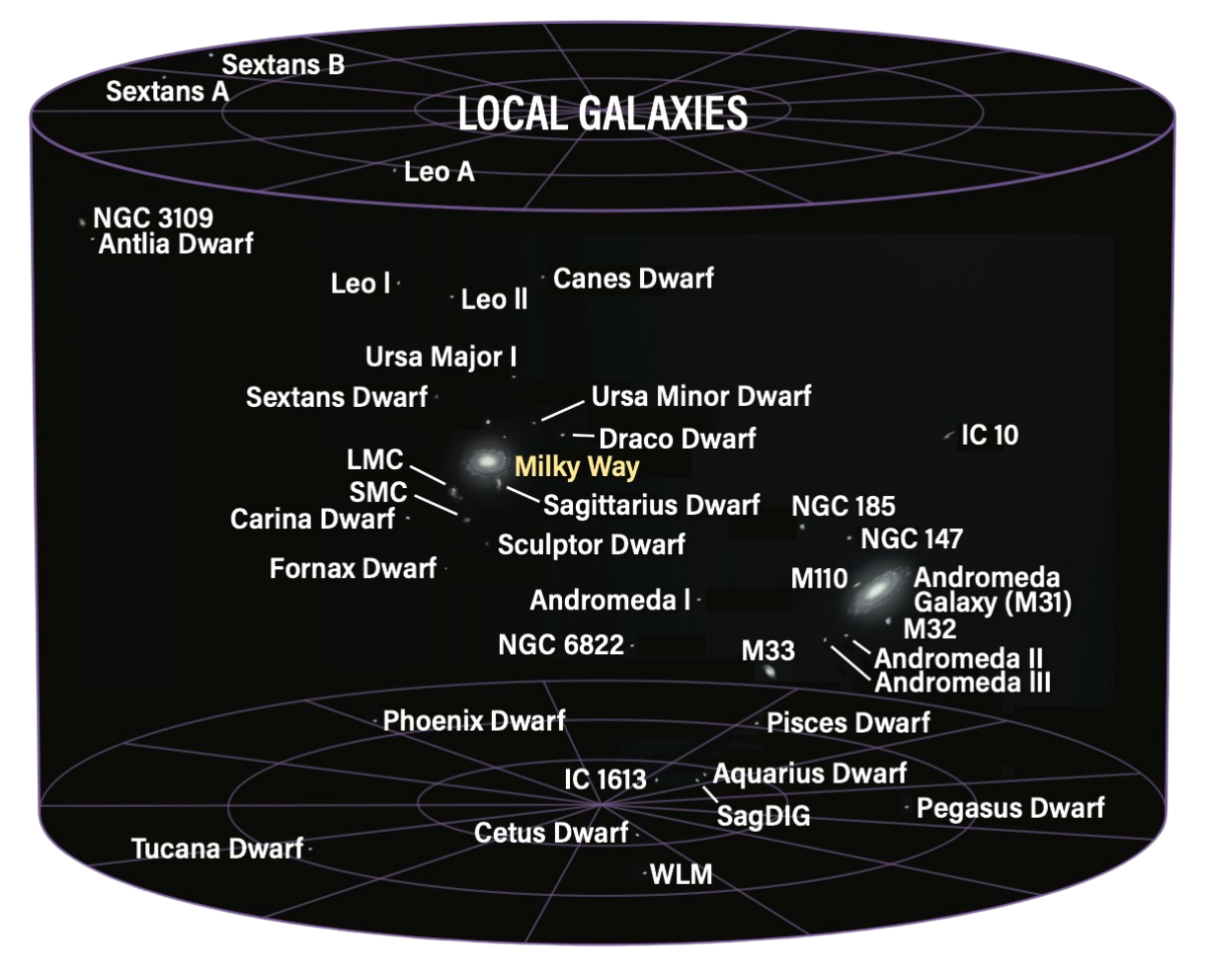
Extensive surveys have revealed, and even named, portions of the nearby cosmic web. The Milky Way, our nearest neighbor the Andromeda Galaxy (M31), and the Triangulum Galaxy (M33) make up the major members of the Local Group, a clump of galaxies bound together by mutual gravity.
The nearest cluster to us is Virgo, which contains roughly 2,000 galaxies, sitting about 65 million light-years away. Along with every other member of the Local Group, we’re headed toward the Virgo Cluster, pulled by its enormous gravity outweighing that of a thousand trillion Suns.
The Virgo Cluster is itself a member of a long filamentary branch known as the Virgo Supercluster. But that branch is just one piece of a much larger structure, called the Laniakea Supercluster, taken from the Hawaiian word for “bountiful heaven.” It’s an immense assembly of millions of galaxies twisting and winding its way through more than a hundred million light-years of the cosmos.
Between all of these grand structures are the nearby voids. One of them, the Boötes Void, measures 300 million light-years across. It does contain some dim, faint galaxies, the way that an oasis can spring up even in the deepest deserts, but otherwise it’s almost entirely empty of matter.
The cosmic web, with all of this complexity, has not always been here. It took billions of years to evolve, and it’s in that evolution that we find the keys to the universe’s fate.
Our place in the web
Assembly required
In the early universe, matter was much more uniform. There were no great density variations from place to place. But there were tiny differences, laid down in the earliest moments of the Big Bang, that served as seeds of what was to come. As time went on, gravity did its work, pulling more and more material onto those tiny seeds. As they grew, they became greedy, reaching out even farther to attract more matter.
Over hundreds of millions of years, the rich got richer and the poor got poorer. First came the galaxies, then the groups. Then groups assembled into clusters. The walls and filaments condensed. And the first voids appeared, the cosmic quarries that had been mined for material to build the cosmic web.
The properties, structure, and evolution of the cosmic web are intimately tied to the fundamental laws and parameters that govern the universe. If the cosmos followed different rules or was made of other kinds of material, then the present-day cosmic web would be entirely different.
Today we know that the vast majority of the universe, around 95 percent, is of a form unknown to modern physics. All of the ordinary matter and light that we know makes up only a tiny portion of the cosmos. The next largest chunk, comprising around 25 percent of all the stuff in the universe, is dark matter, a form of matter that is invisible, emitting no light. The remainder is dark energy, the unknown force that appears to be accelerating the expansion of the universe.
Regular matter, dark matter, and dark energy all have a hand in building the cosmic web. Indeed, we only ever get to see a slim portion of the true cosmic web, even with our most comprehensive galaxy surveys. That’s because most of the web is dark matter. Like lighthouses twinkling on a distant shore, the galaxies act as tracers of where the true concentrations of matter really are. Dark matter serves as the bones of the cosmic web and, through its gravitational influence, allows for galaxies to form in its densest regions.
On the other hand, dark energy is tearing the cosmos apart. The mysterious accelerated expansion first made its presence felt about 5 billion years ago. It’s weak, just a gentle push on the natural expansion of the universe. But it’s relentless, and it shows no signs of stopping anytime soon.
This effect overwhelms gravitational attraction at large scales. Our Local Group will stay intact, our bonds of gravity strong enough to resist accelerated expansion. But we will never reach the Virgo Cluster. Sometime from now, likely billions of years in the future, our headlong rush toward that cluster will slow to a crawl, stop, and reverse, forever remaining tantalizingly out of reach.
The fate of the universe
The Virgo, Laniakea, and every other large supercluster will not last much longer. Eventually the entire cosmic web will disintegrate. What the universe took billions of years to construct will eventually dissolve.
This is why the cosmic web is so crucial to our understanding of the makeup of the universe: the present-day arrangement of galaxies sits on the transition point between the building efforts of dark matter and the destructive effects of dark energy. The more we can learn about the cosmic web, the more we can learn about the hidden, dark side of the cosmos.
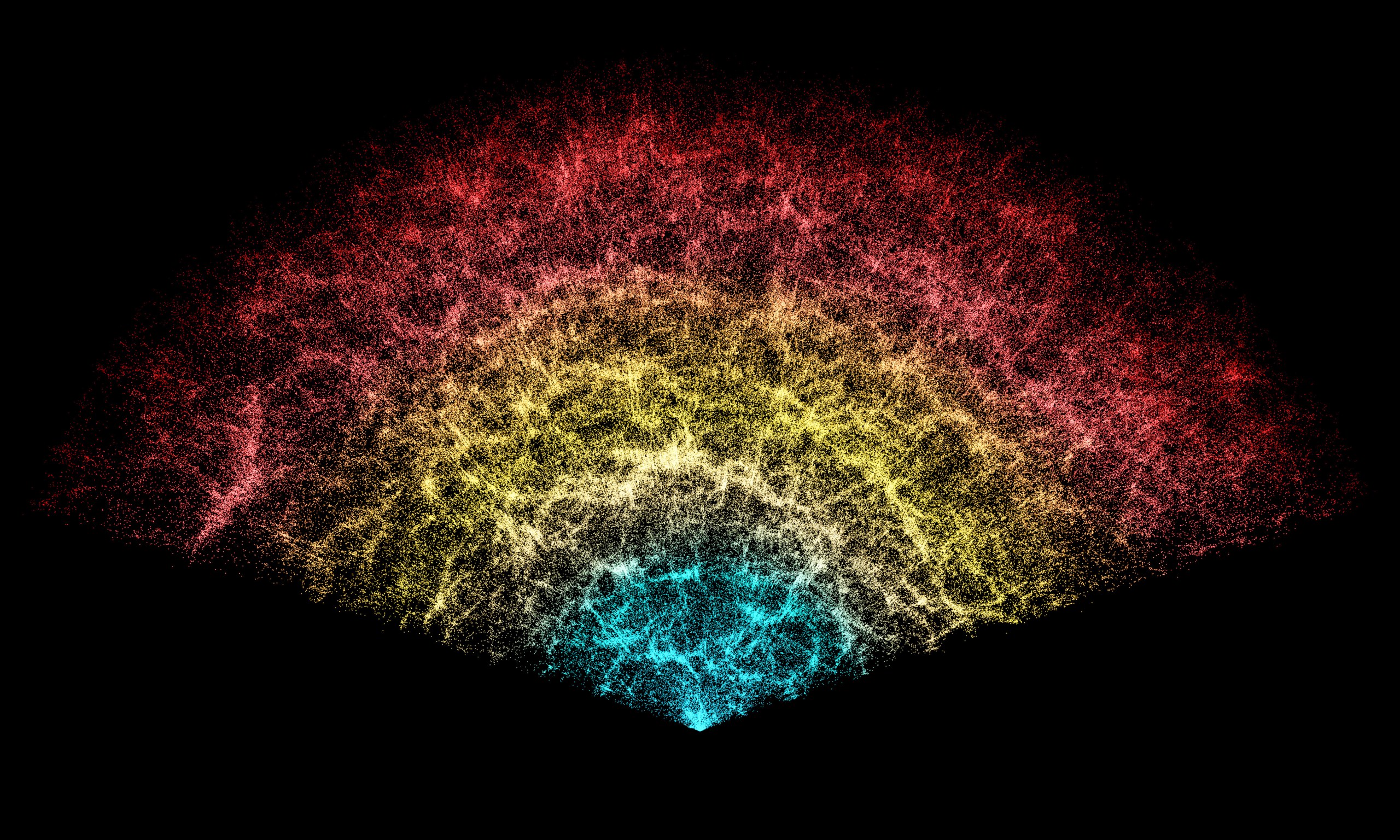
In April 2025, the Dark Energy Spectroscopic Instrument (DESI) collaboration released a shocking new result after years of careful analysis. Perched atop Kitt Peak in southeastern Arizona, the 4-meter telescope has spent the past several years amassing detailed measurements of more than 13 million galaxies. The survey is only about a quarter through its planned set of targets, but it’s already found something curious.
In addition to the familiar structures of the cosmic web like clusters and filaments, there is another signature imprinted on the cosmos in the form of baryon acoustic oscillations, or BAOs. The BAOs were created in the first few hundred thousand years after the Big Bang, when the universe was so compact that matter and light couldn’t separate, locked together in a hot soup of plasma dense enough for sound waves to crash through it. But once the plasma cooled and became neutral, the light broke free from the matter, and the sound waves froze in place.
Like a snapshot captured right after a snare drum’s been struck, the resonant shells of compressed matter stayed where they were. These locations acted as a source of extra gravitational attraction. Billions of years later, the BAOs show up in our galaxy surveys as regions of slightly higher density than average, embedded within the larger cosmic web.
BAOs are critical to modern cosmology because they are what’s known as a standard ruler. We know how big they’re supposed to be, thanks to the physics of sound waves and our precise measurements of the cosmic microwave background (CMB) — the light released at the moment the universe cooled from a plasma to a neutral gas. Put them together, and the predicted size of the BAO shells falls out: about a billion light-years in diameter. By comparing those predictions to how big they actually appear, we can tease out the evolution of the universe by mapping the expansion rate at various points in time, like marking the height of a child on your door frame through the years.
DESI’s latest analysis of BAO data, published in 2025, suggests that the distances inferred from the BAO standard ruler are slightly larger than what a standard cosmological model calibrated to the CMB would predict. When combined with other cosmological data, the DESI results showed that dark energy might be weakening with time, if ever so slightly. It’s not an ironclad result, but it is suggestive. We don’t know what dark energy is, and cosmologists currently assume that it’s constant. But compelling evidence that it does change would help theorists in their pursuit of an explanation for the mysterious acceleration.
![[your alt text]](https://www.astronomy.com/wp-content/uploads/2026/06/ASY-CW0626_16_c11d7b.jpg)
Some of the structure of the cosmic web can be traced back to sound waves propagating through the early universe — when the cosmos was much smaller and denser. Credit: Astronomy: Roen Kelly
Growing tensions
The DESI results come on the heels of another troubling measurement in cosmology: Over the last decade, observations have begun to disagree about the present-day expansion rate of the universe, a value known as the Hubble constant. This disagreement is known as the Hubble tension. Estimates taken from distant supernovae point to a higher value than measurements taken from the early universe, especially of the cosmic microwave background. And after years of attempts to rectify this tension, the evidence for it has only grown stronger.
The cosmic web may hold the answer. But to find that answer, cosmologists have to turn to massive computer simulations.
Imagine I gave you a cupcake, and your task was to re-create the recipe. You have to figure out the ingredients that went into the batter, and the precise cooking steps that went into making it. To make it more challenging, you only get one cupcake, and worst of all, you only get to taste little bits of it here and there.
The universe is our cupcake. There’s only one cosmos, and we only get slim samples of the cosmic web. But we know what the universe is made of: dark matter, dark energy, and a sprinkling of normal matter. And we know that physical laws — both known and unknown — govern the evolution of the universe.
We can’t physically rebake the universe, but we can simulate it. We can take its ingredients, subject them to physical laws, and follow their evolution using computer simulations that solve the complex, interconnected equations that tie everything together.
The cosmic web may hold the answer. But to find that answer, cosmologists have to turn to massive computer simulations.
This is how we know, for example, that the cosmic web is largely made of dark matter. In simulated universes containing only regular matter, there’s not enough gravitational attraction to build large structures, not even galaxies, in the 13.8 billion years of cosmic history. It’s only by adding dark matter — and its invisible gravitational influence — that we’re able to get a cosmic web that matches the statistical properties of observed galaxies in surveys.
This is where the simulations become indispensable. While we can see the galaxies, we are effectively blind to the dark-matter scaffolding that dictates the web’s growth. By running massive digital recreations of the cosmos, we can see if a specific flavor of dark matter or a certain strength of dark energy results in the same kind of skeleton we observe, with structures like Laniakea. Any proposed solution to the Hubble tension must pass this test: If a recipe doesn’t bake the right cupcake, it gets tossed in the trash.
Bounty of knowledge
The cosmic web is dizzyingly complex and rich with information. But the galaxies in the web aren’t shaped by dark matter and dark energy alone. Star formation, black holes, the mergers and cannibalization of smaller galaxies — all of these processes leave their mark on the cosmic web, too.
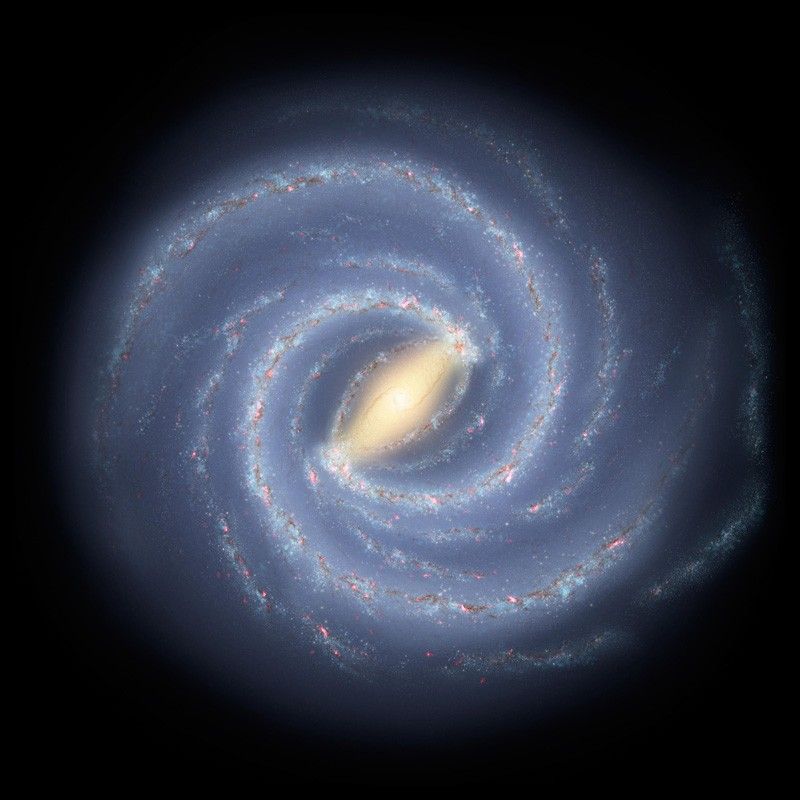
Our Milky Way Galaxy owes its properties — a few hundred billion stars and a diameter of 100,000 light-years, next door to Andromeda within the Local Group, racing toward the Virgo Cluster — to a combination of all of these factors. For cosmologists, separating the dark matter and dark energy signal from the other polluting factors is a difficult task, even after a century of research.
And so researchers have traditionally turned to simple summary statistics to guide them, like the average distance between galaxies. Despite their simplicity, these techniques have proved remarkably powerful, uncovering crucial cosmological clues like the BAO signal and validating the existence of dark energy.
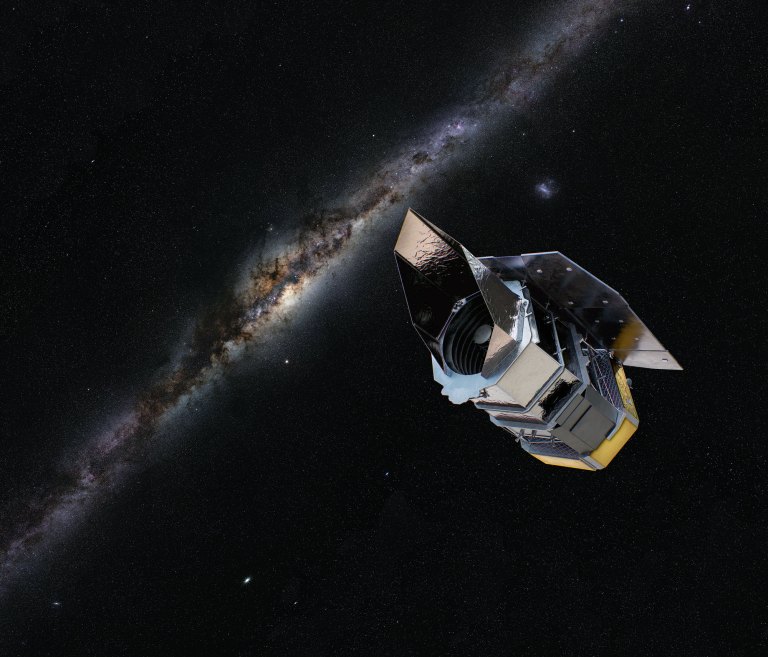
Modern and upcoming surveys hope to squeeze even more information out of the cosmic web. In addition to current ground-based campaigns like DESI, both NASA and ESA have developed space-based cosmological observatories.
The European-led effort is Euclid, a space telescope that launched in 2023 to the Earth-Sun L2 point, around 1 million miles (1.5 million kilometers) from Earth. The U.S. effort, NASA’s Nancy Grace Roman Telescope, is nearly complete and on track to launch this fall.
Complementing these is the Vera C. Rubin Observatory, built by the U.S. National Science Foundation and the Department of Energy, which is conducting a 10-year survey that will provide a massive dataset of hundreds of millions of galaxies.
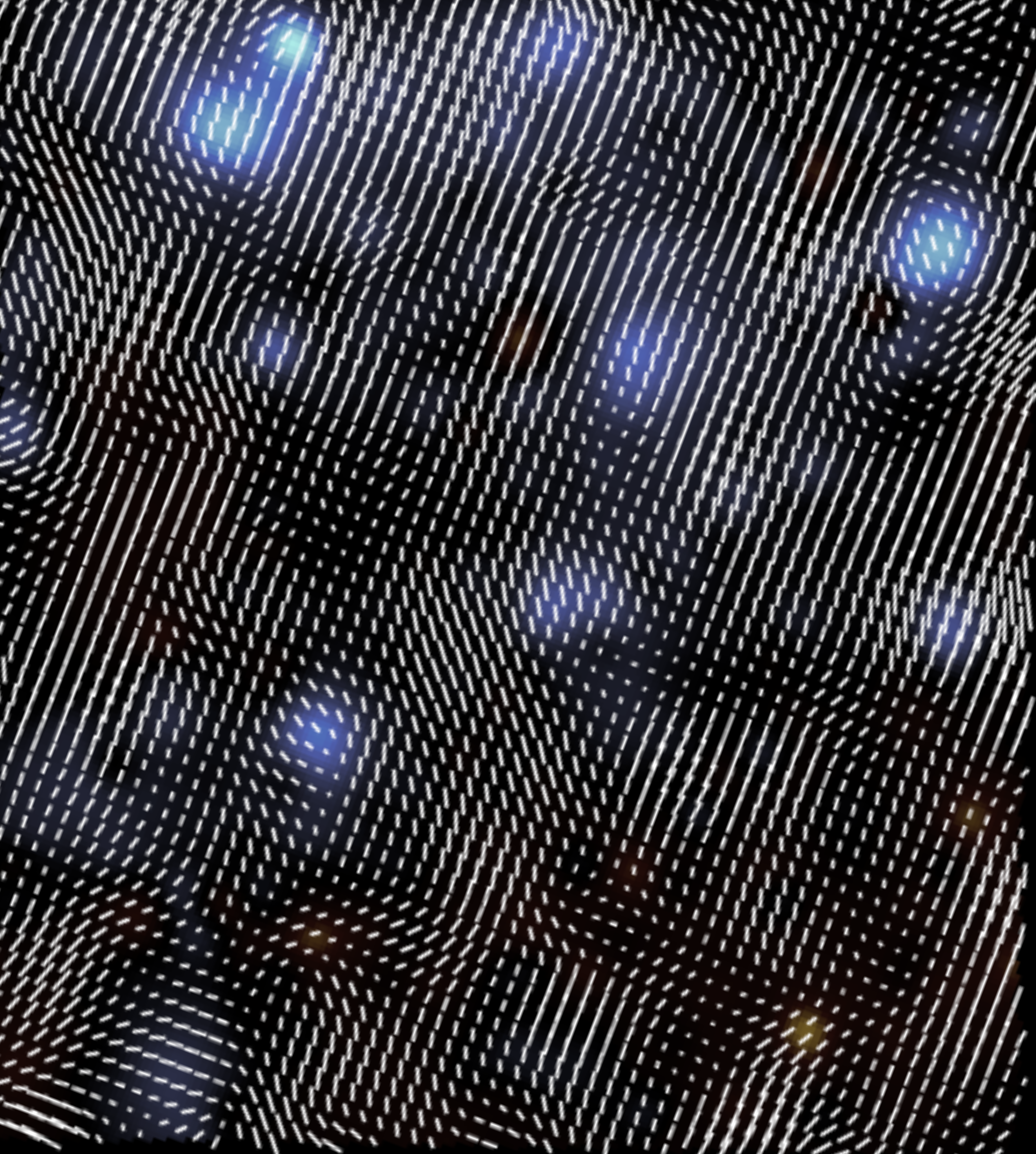
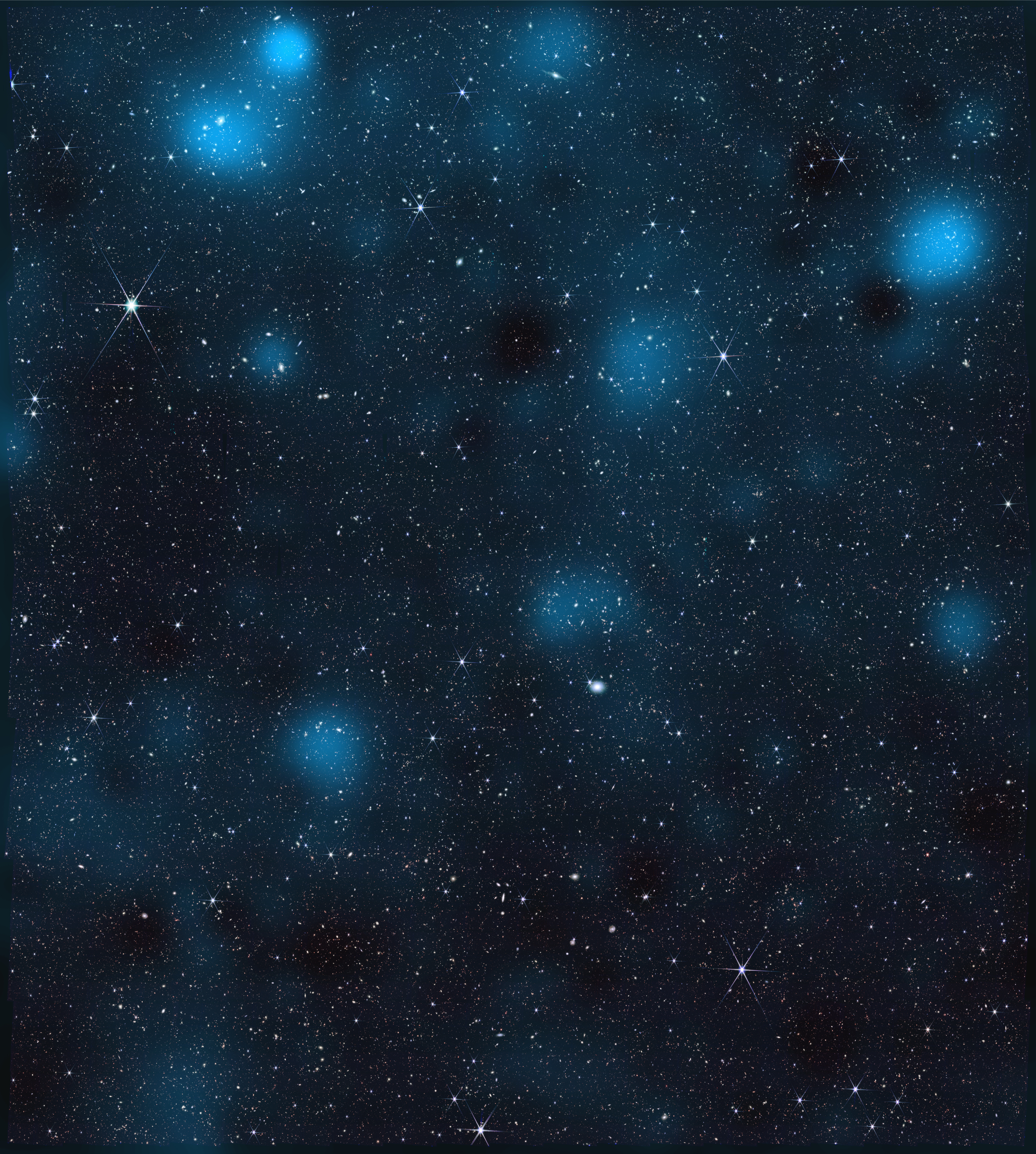
These surveys will employ traditional techniques and summary statistics. But they will also use new tools in their dissection of the cosmic web. For example, new surveys are exploiting an effect called cosmic shear. As light from distant galaxies filters through the cosmic web, the light gets bent here and there by the influence of gravity as it passes by dense filaments. This distorts — or shears — the images of galaxies ever so slightly, and by studying that distortion cosmologists can map out in detail where the dark matter is hiding.
Another new technique leverages cosmic voids. Long forgotten as the empty deserts in the cosmic web, the voids are actually rich with information. Their sizes, shapes, and distributions reflect the influence of dark energy in the past 5 billion years. Indeed, because they are empty of matter, they are filled with dark energy — they are the locations where accelerated expansion is actively tearing apart the universe, and in time the voids will continue to expand and dissolve everything around them.
Our forays into the wider universe are just beginning, and we are just now starting to unveil the cosmic web for what it is. The largest pattern found in nature, the cosmic web is beautiful, intricate, effervescent … and the key to understanding everything.
Paul Sutter is a cosmologist, science communicator, NASA external advisor, and U.S. cultural ambassador. He is an associate research scientist at Johns Hopkins University.