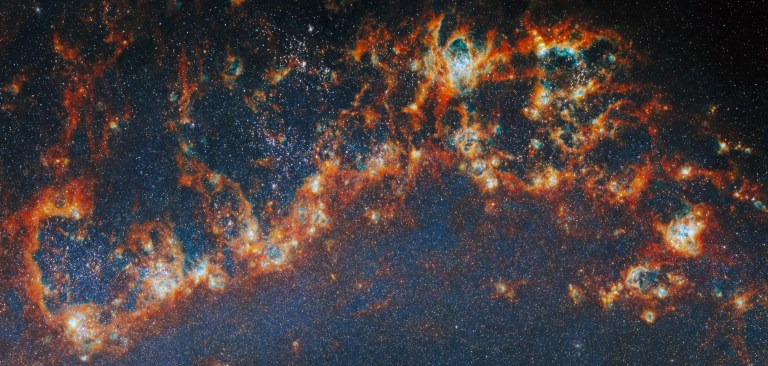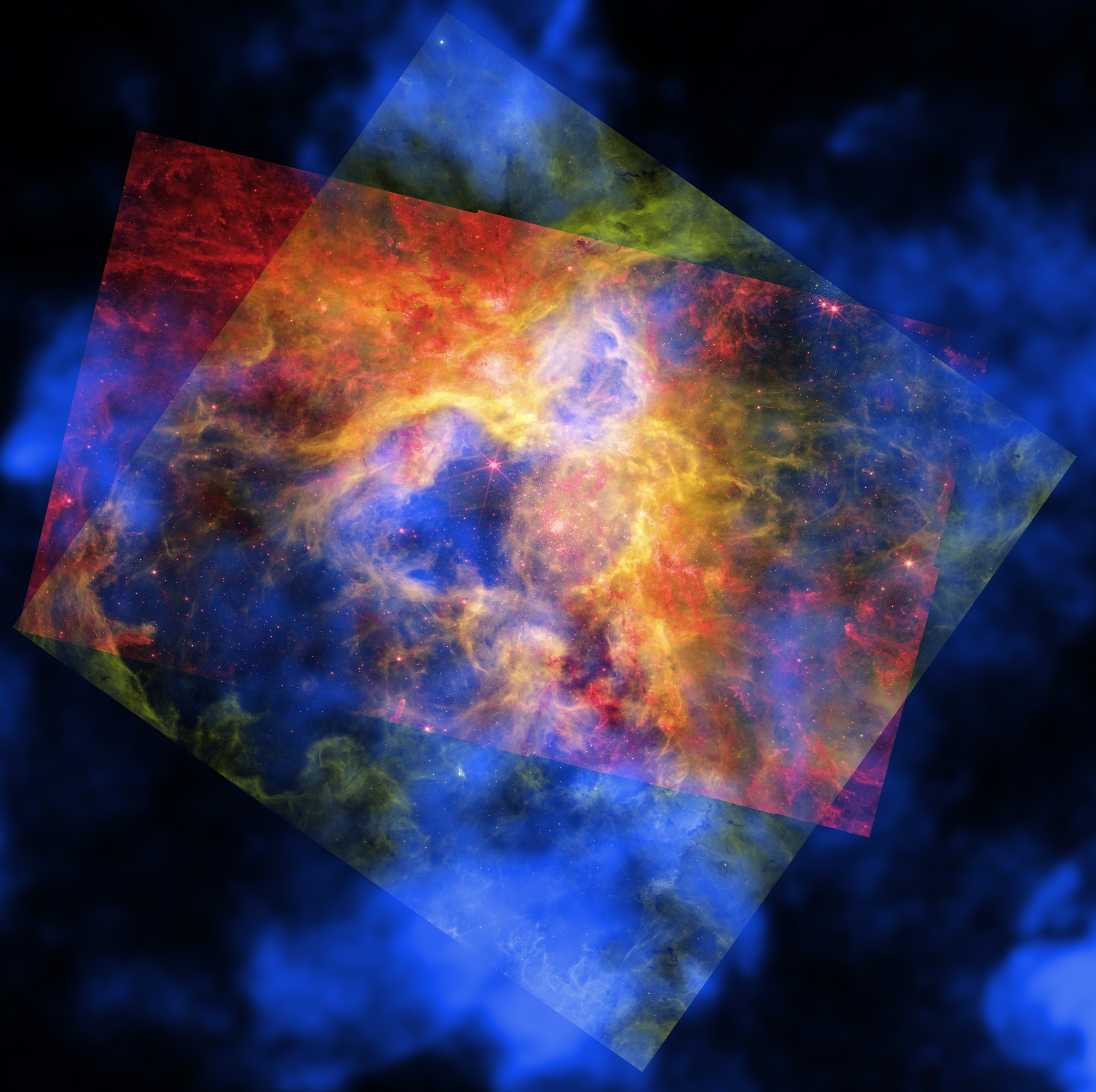

Translucent layers of light captured by three space telescopes overlap to build this composite of the Tarantula Nebula (30 Doradus) in the Large Magellanic Cloud. Diffuse clouds of blue X-ray light from NASA’s Chandra X-ray Observatory mark hot gas blown off of young, massive stars that has been superheated by winds and shock waves. The red filaments and tendrils — the Tarantula’s “legs” — reveal dusty material still birthing new stars and planets, as well as the pinpoint lights of young stars in infrared data from JWST. Green data from Hubble Space Telescope optical images reveals hydrogen gas warmer than JWST can see, along with scattered individual stars. Where all three layers converge at center, the colors bleed together into oranges, purples, and yellows, creating a complete view of the nebula across a wide range of wavelengths.
Brooks Mendenhall is a staff writer at Astronomy, based in Chattanooga, Tennessee, fueled by an unending curiosity about the universe. A former classroom teacher, he has a knack for breaking down complex concepts for a wide audience.