The Royal Swedish Academy of Sciences awarded Francis Halzen, principal investigator of the IceCube Neutrino Observatory and professor of physics at the University of Wisconsin-Madison, the Nobel Prize in physics on Oct. 6, 2026. Halzen’s work on high-energy neutrinos has shaped our understanding of the universe’s mysterious and powerful natural particle accelerators.
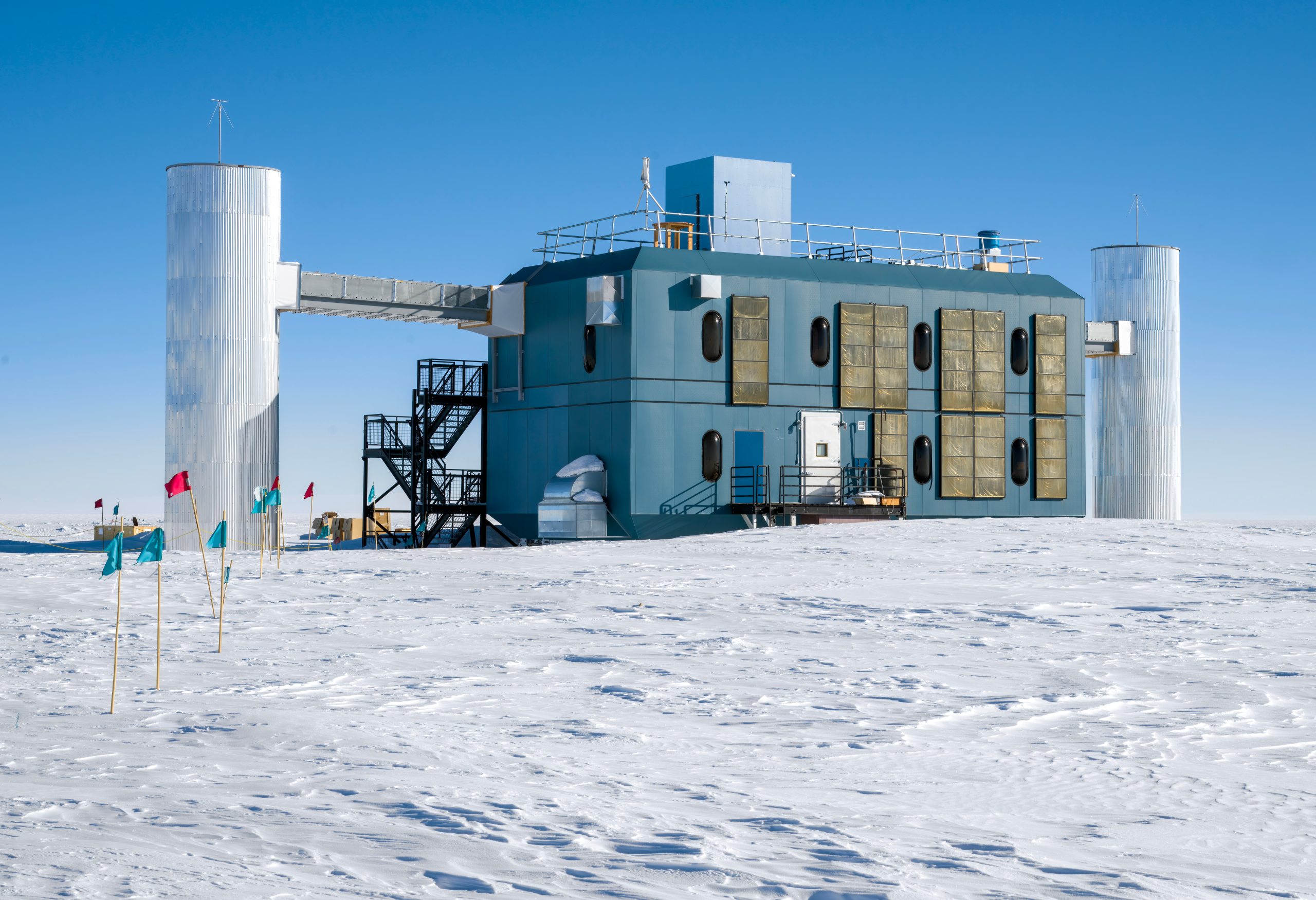
Halzen is the sole recipient of this year’s prize. The academy honored him “for decisive contributions to the IceCube Neutrino Observatory and the discovery of high-energy neutrinos of astrophysical origin.” IceCube is the world’s largest neutrino telescope. Situated at the South Pole, it has no mirror or lens. Instead, it’s built into a billion-ton cubic kilometer (0.24 cubic mile) of Antarctic ice. It comprises thousands of light sensors spread through the ultra-pure ice, waiting for a neutrino to collide with an atom by chance. It was Halzen who proposed using the ice sheet itself as a particle detector. The idea paid off in 2013, when IceCube detected the first neutrinos from beyond the solar system, opening a new way to study the cosmos.
“IceCube is like no other telescope in the world. And there is no other scientist quite like Francis Halzen, whose idea to create a neutrino detector under almost a mile of ice has led to a remarkable multinational and multi-institutional scientific collaboration and a fundamental shift in how we think about the universe,” said Eric M. Wilcots, University of Wisconsin-Madison interim chancellor, in a press release.
Ghost particles
Neutrinos are everywhere. Right now, the chargeless subatomic particles are streaming through Earth and your body, even though you’ll never feel them. They have almost no mass and rarely interact with matter, lending them the nickname “ghost particles.”
Natural particle accelerators deep in the cosmos, like supermassive black holes, fling out all varieties of particles at energies up to a million times higher than anything we can reach in labs on Earth. The charged particles from those sources, known as cosmic rays, are deflected by magnetic fields that they encounter, meaning they arrive at us from random directions. Neutrinos, lacking charge, travel in straight lines after they are emitted and maintain both their initial direction and energy. Detect one, and it points right back to its origin, carrying a cosmic message no other particle can provide.
Neutrinos are one of the four messengers of multi-messenger astronomy, alongside cosmic rays, gravitational waves, and electromagnetic radiation (light). Researchers combine these independent signals to study distant cosmic events like flaring supermassive black holes, supernova explosions, and black hole mergers.
A telescope made of ice
In 1988, Halzen proposed searching for neutrinos using South Pole ice. The ice is made of water molecules, which in turn contain atoms of hydrogen and oxygen. When a neutrino strikes an atomic particle like a proton or a neutron, the collision sprays out short-lived secondary particles like muons and pions — this interaction is the only way to detect the otherwise ghostly messengers.
Antarctic ice has some particularly important qualities: It is incredibly thick, highly compressed, and transparent. As the secondary particles created by the neutrino collision move through the transparent ice, they outpace their own light and leave behind a glow known as Cherenkov radiation.
Within a few years of Halzen’s proposal, researchers began building prototype sensors, eventually starting construction on IceCube in 2004. IceCube was finished in 2011. It is funded by the U.S. National Science Foundation and run by an international collaboration led by the Wisconsin IceCube Particle Astrophysics Center at UW-Madison.
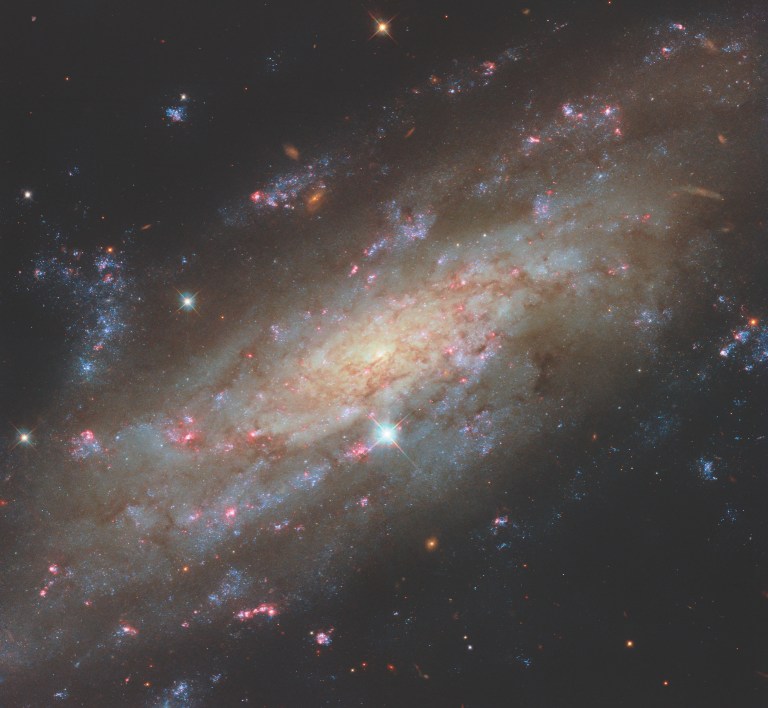
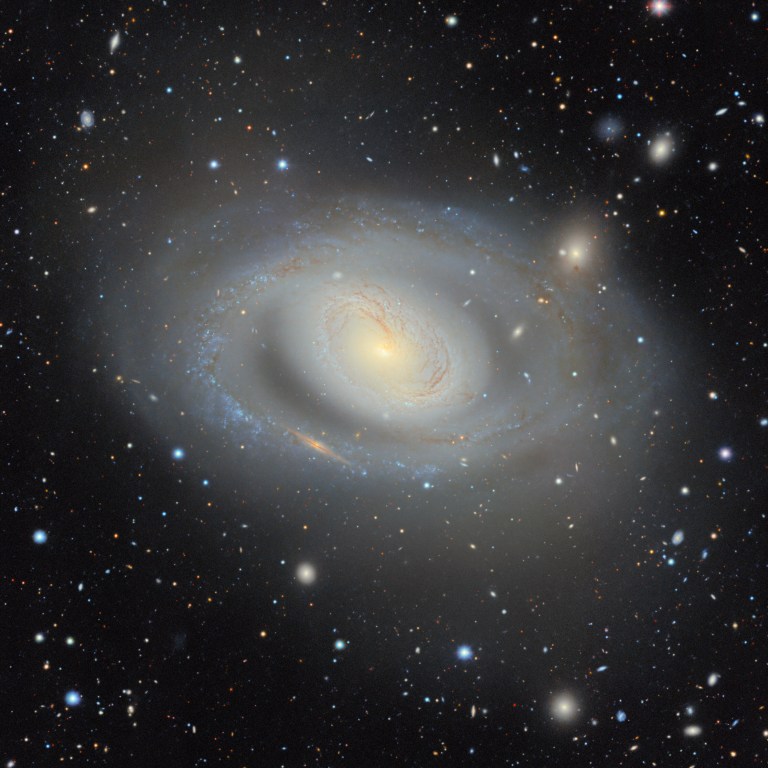
The initial 2013 detection, which Physics World named its Breakthrough of the Year, was only the start. In September 2017, the observatory traced a high-energy neutrino back to a supermassive black hole in the constellation Orion, whose powerful jet is pointed right at Earth. In 2022, it found evidence that even obscured feeding supermassive black holes can send neutrinos our way, following the detection of one from the shrouded central black hole inside a galaxy 47 million light-years away. And a year later, it created the first image of our own Milky Way Galaxy in something other than light: a “photograph” using neutrinos, based on a decade of IceCube measurements.
RELATED: How do neutrino telescopes work?
A prestigious honor for an unusual project
The prize comes with an award of 12 million Swedish kronor (about $1.2 million USD). Halzen is the 23rd Nobel Prize recipient connected to UW-Madison and the sixth physicist. The last UW-Madison faculty member to win was Howard Temin in 1975, for his discovery of reverse transcriptase — an enzyme used by viruses like HIV and Hepatitis B to replicate.
“This is a celebration of a very unusual project,” said Halzen. “It is difficult to imagine that we could have pulled this off anywhere but at UW-Madison with its unique research infrastructure. The success of this project involved some luck, and I was fortunate to be at UW, where unconventional ideas can thrive and where I had the support of a remarkable community, from talented engineers at the Physical Sciences Laboratory to long-time colleagues on the faculty and supportive administrators.”
IceCube recently finished an upgrade, its first significant expansion since 2011. It keeps recording neutrino collisions around the clock. Each detection adds to our understanding of the energetic environments that create these particles. As Mark Pearce, chair of the Nobel Committee for Physics, noted, Halzen’s vision and persistence have opened the way to “a new kind of astronomy,” and that new field is just getting started.
Brooks Mendenhall is a staff writer at Astronomy, based in Chattanooga, Tennessee, fueled by an unending curiosity about the universe. A former classroom teacher, he has a knack for breaking down complex concepts for a wide audience.