In a new study, astronomers detail observations of what could be the first known exosatellite — a natural object orbiting a world beyond our solar system in the same way our Moon orbits Earth. However, the massive, gaseous body they observed bears little resemblance to the Moon we know.
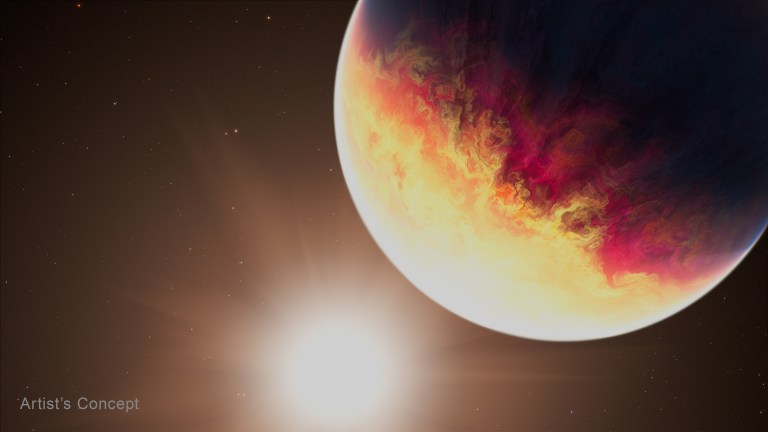
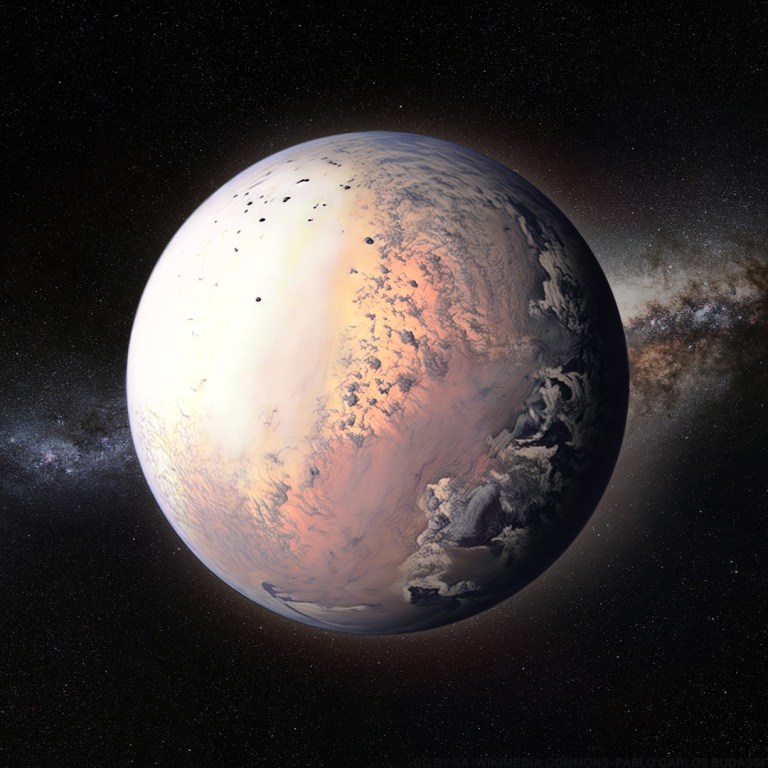
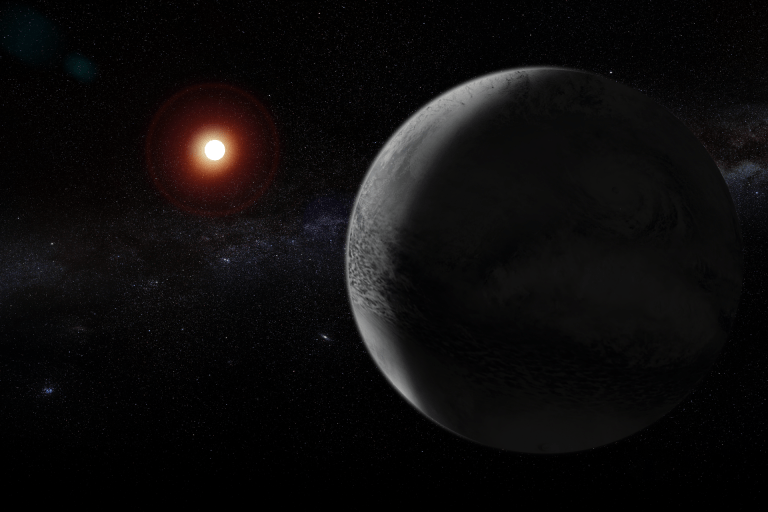
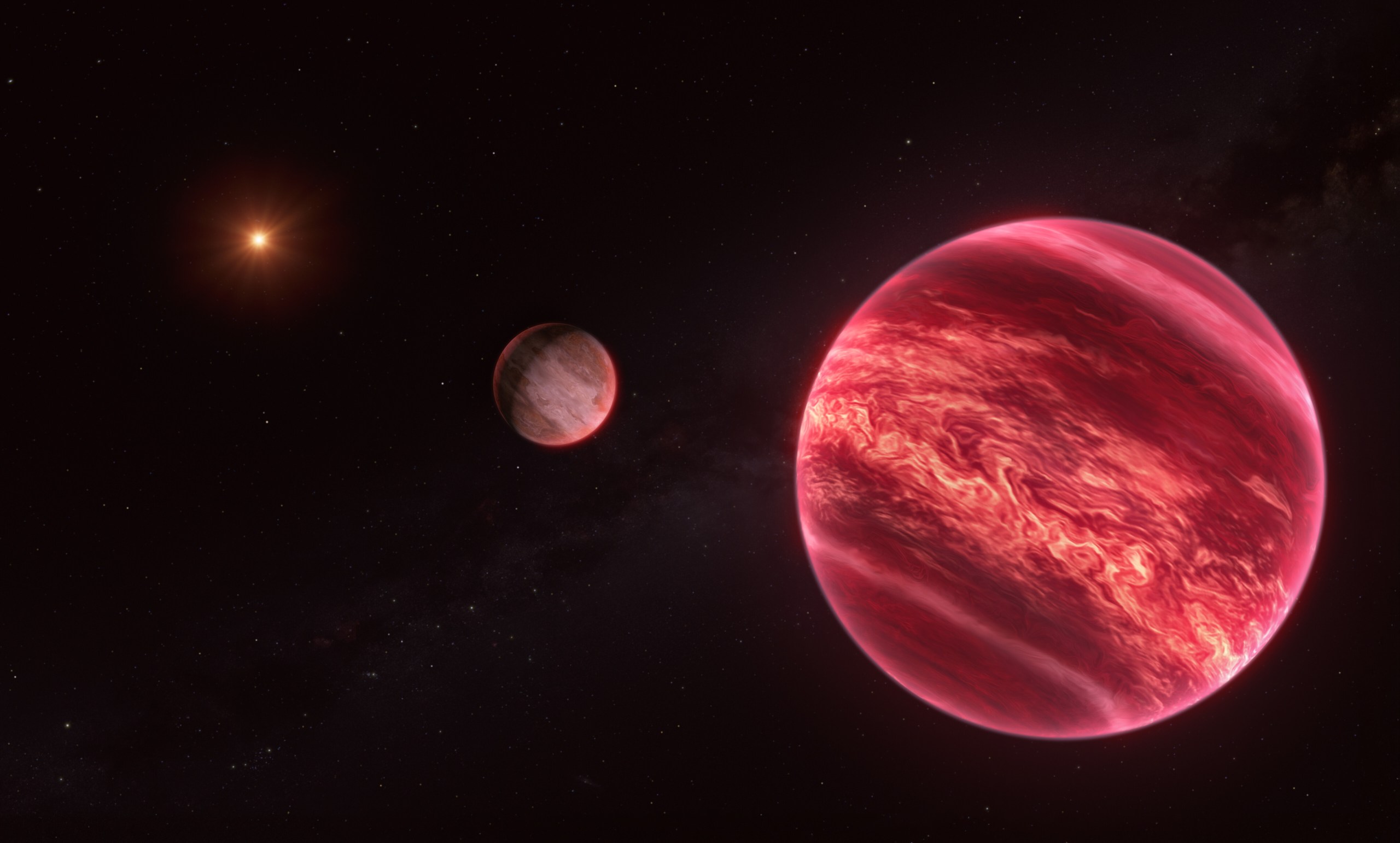
The study, published July 22 in Nature, describes a stellar system some 73 light-years from Earth that exhibits what they call a three-tiered hierarchy — in other words, an object orbiting another object that orbits its host star. Our own solar system also has three tiers: The Moon orbits Earth, which orbits the Sun. Kevin Hoy, an astronomer at the European Southern Observatory (ESO) and Universidad Diego Portales in Santiago, Chile, and his team observed the brown dwarf CD-35 2722 b with ESO’s Very Large Telescope over more than two years, tracking subtle shifts in its spectrum. Those shifts are due to the gravitational effects of an unseen companion orbiting the brown dwarf roughly every 170 days. The brown dwarf, in turn, orbits the star CD-35 2722 — making this, if confirmed, the first observed three-tiered system beyond our own.
But this exosatellite brings up a separate question: whether it also counts as the first exomoon. That comes down to how astronomers define objects in a system that doesn’t look anything like ours. “The exosatellite is clearly massive enough to be a planet, but it does not orbit a star, though it orbits an object that orbits a star,” Hoy said in an ESO press release. “Being the third wheel in this system makes us want to call it a moon, even if it is nothing like the small, rocky moons we have in our system.”
Why haven’t we found any exomoons?
Since the first exoplanet was discovered in 1992, researchers have now cataloged more than 6,000 worlds beyond our solar system — but they have yet to confirm a detection of an exosatellite orbiting any of them. Given six of our eight planets host a combined total of over 400 known moons, it seems inevitable that exomoons must be out there. So why haven’t we found any?
Astronomers mostly find exoplanets in one of two ways: The transit method watches for the dip in starlight as a planet crosses its star, while the radial velocity method watches the star itself wobble under the influence of a planet’s gravity, measuring how its spectrum shifts as it moves toward and away from the observer. Both work best on planets sitting close to their star, which makes the transit dip and the gravitational wobble stronger and easier to measure. However, simulations have found that planets that end up on short, close orbits tend to lose moons quickly. Essentially, the planets easiest to find are the ones least likely to have a moon. Not surprisingly, early searches for exomoons, which largely relied on observing transiting exoplanets close to their stars, came up empty.
More recently, exomoon hunters have turned the radial velocity technique on exoplanets. This method requires obtaining a direct spectrum of a planet, meaning the planet must be emitting its own light. While we’re used to seeing planets via the light they reflect from their stars, gas giants like Jupiter do emit infrared light, making the technique feasible in principle — albeit very challenging with current technology.
It also requires a certain set of circumstances. The majority of known Jupiter-like planets reside very close to their stars. This means that although they are very hot, their light cannot be isolated from its host star — and they’re unlikely to have moons anyway.
So previous efforts with this technique have targeted four giant planets with more distant orbits in the HR 8799 system, as well as the brown dwarfs GQ Lup b and HR 7672 b. Brown dwarfs are objects that straddle the line between stars and planets, but are easier to observe than planets as they emit more light. But even these attempts ran into the problem of starlight bleeding into the target’s spectrum, muddying the data. Astronomers tried correcting that contamination mathematically, but that introduced its own errors, and none of those searches produced a confirmed signal.
How did they find the first exosatellite?
But CD-35 2722 has a much wider separation between it and its host star — about 60 times the average Earth-Sun distance, or 1.5 times the average distance of Pluto from the Sun. This allowed Hoy and his colleagues to isolate the brown dwarf’s spectrum from starlight almost entirely with no need to correct for contamination. As a result, their observations offer the best evidence yet for an exosatellite.
Hoy’s team pointed the CRIRES+ instrument — a powerful, high-resolution spectrograph — on ESO’s Very Large Telescope toward CD-35 2722 b, gathering 23 usable radial velocity observations between October 2023 and February 2026. The lack of stellar contamination meant their data were more precise than earlier attempts at brown dwarfs, revealing a periodic signal consistent with at least one object tugging on the brown dwarf.
That signal points to a satellite with a minimum mass of about 0.9 Jupiter mass, completing a lap every 170 days at a distance of roughly 0.2 astronomical unit. (One astronomical unit is the distance from the Earth to the Sun.)
Is it really a moon?
Follow-up observations are still needed to confirm the initial detection. But in the meantime, CD-35 2722 b raises a question: Is its satellite a moon? While the exosatellite occupies the same place in the system’s hierarchy as moons do in our solar system, it doesn’t orbit a planet but a brown dwarf, which are often referred to as “failed stars.”
Ironically, under the International Astronomical Union’s definition, this object better meets the criteria for a planet — not a moon — since planets can include bodies orbiting brown dwarfs. The authors suggest that this definition may need revision: While the system’s central star will keep shining steadily for billions of years, a brown dwarf cooling and dimming within tens of millions of years. By the time CD-35 2722 b reaches the age of our own solar system, it will be radiating barely 1 percent as much light as it does now, creating vastly different outcomes for the bodies each object hosts. For these reasons, the authors argue that it “may be worth revisiting the inclusion of brown dwarfs as planet hosts in this definition.” Astronomers already, for example, withhold the word “planet” from free-floating objects that drift through space attached to no star at all.
Researchers say the confusion around what to call CD-35 2722 b’s satellite highlights the limits of terms and definitions derived from the objects found in our solar system — and how our solar system does not necessarily represent the norm throughout the universe. “We have a clear delineation between the planets and the Sun in the Solar System, so defining things like moons is simple. In the CD-35 2722 system, where we are blurring the lines between stars, planets, and moons, the whole thing becomes more complicated to describe,” said Alice Zurlo, an astrophysicist at Universidad Diego Portales in the ESO press release.
What comes next?
Whatever this object ends up being called, it’s already opening doors for planetary science.If the detection holds up, it gives planetary scientists a real exosatellite to test their models of how planets form.
It also raises strange new possibilities for life. Some researchers have argued that exosatellites could stay warm through tidal heating — the friction generated as a host’s gravity repeatedly stretches and squeezes an orbiting body, the same mechanism that keeps Jupiter’s moons geologically active. This means these exosatellites could potentially remain habitable far outside the zones where starlight alone sustains liquid water. Hoy’s team doubts that applies to the exosatellite they’ve found, but they say the possibility is worth further study as more exosatellites turn up.
Brooks Mendenhall is a staff writer at Astronomy, based in Chattanooga, Tennessee, fueled by an unending curiosity about the universe. A former classroom teacher, he has a knack for breaking down complex concepts for a wide audience.