Looking for a sky event this week? Check out our full Sky This Week column.
June 8: Venus and Jupiter close in
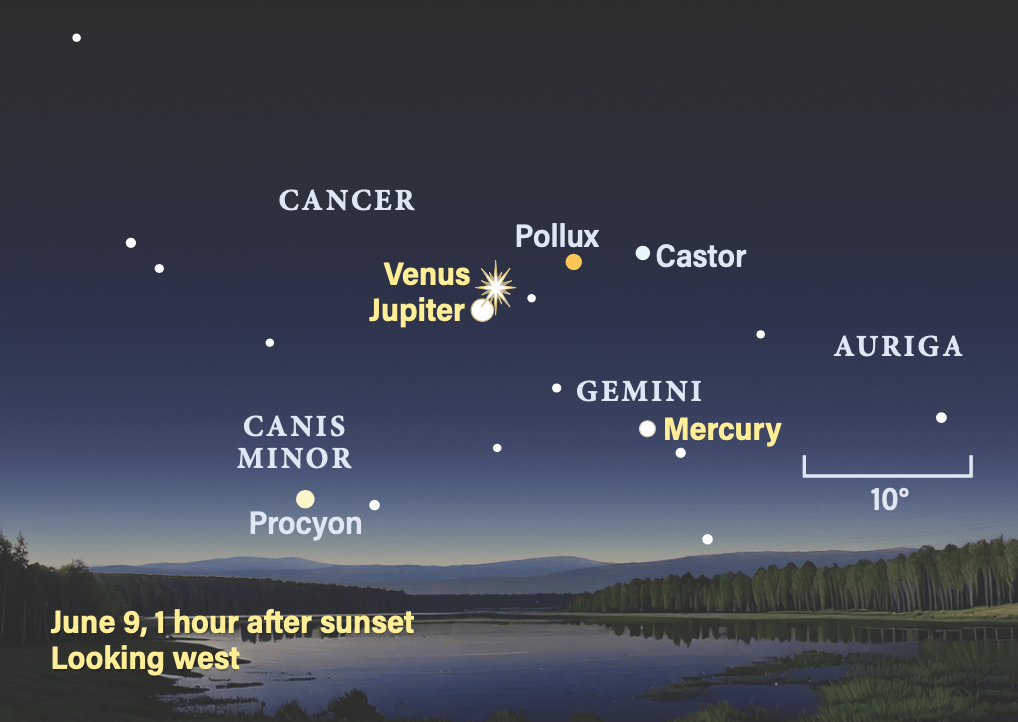
Venus and Jupiter have now inched closer together and stand 1.6° apart in the evening sky; the former officially passed due north of the latter at 8 A.M. EDT this morning.
Compare the view this evening with that from yesterday. Note how Venus has moved slightly east of its previous position, while Jupiter appears to sit in the same place. That’s because Venus is much closer to Earth and thus appears to move faster across our sky. Closer to the horizon, Mercury has also moved slightly east of where it sat yesterday, pulling farther away from Epsilon Geminorum.
Once again, Venus and Jupiter are visible in the same field of view with binoculars or a finder scope. Using a telescope at higher magnification will allow you to zoom in on each planet separately to compare their sizes, showing that massive Jupiter appears more than twice as wide as Venus, despite the latter’s proximity to Earth.
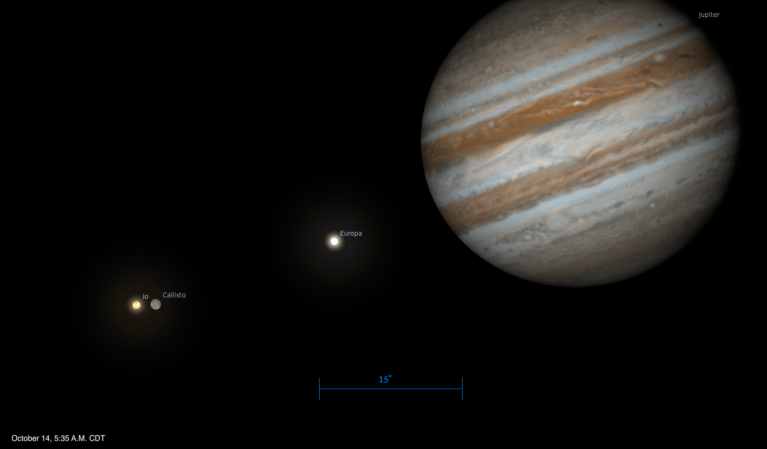
Early in the evening, the shadows of both Callisto and Europa are visible crossing the jovian cloud tops. Callisto’s shadow lags behind Europa’s as they move from east to west; the latter’s shadow is also larger. Europa’s shadow transit ends around 10:15 CDT, with Jupiter starting to sink low in the Midwest and after the planet has set along the East Coast. Callisto’s shadow continues to cross for nearly three hours more, and remains visible as the planet sets across the western U.S. Callisto and Europa themselves lie west of Jupiter, while Io lies alone to the east. Ganymede spends the evening crossing behind the large planet, then trekking through its long shadow, remaining invisible until after the planet has set even for West Coast observers.
The Moon passes 4° north of Neptune at 3 P.M. EDT, although neither is visible at that time. They can be found tomorrow morning in the predawn sky, when the Moon stands closer to Saturn, which is just under 9° east of Neptune.
Sunrise: 5:31 A.M.
Sunset: 8:28 P.M.
Moonrise: 1:37 A.M.
Moonset: 2:21 P.M.
Moon Phase: Waning crescent (32%)
*Times for sunrise, sunset, moonrise, and moonset are given in local time from 40° N 90° W. The Moon’s illumination is given at 10 P.M. local time from the same location.
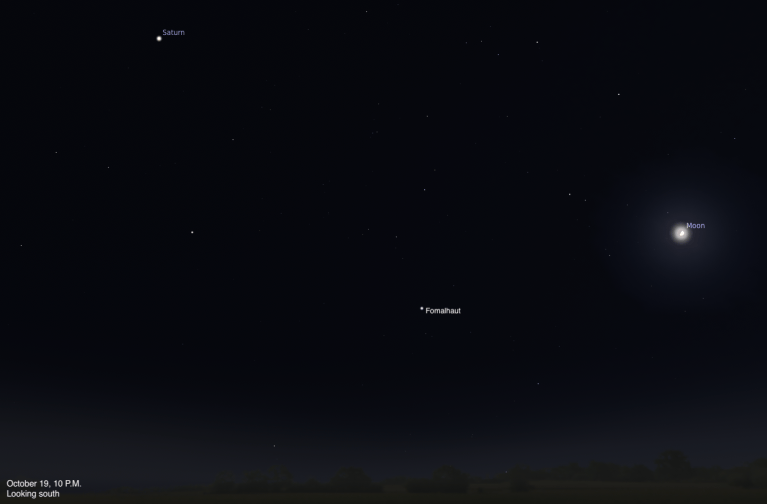
The Moon passes 6° due north of Saturn at 8 A.M. EDT on June 10; an hour before dawn on the 10th, the pair is high in the eastern sky, perfect for early risers to enjoy.
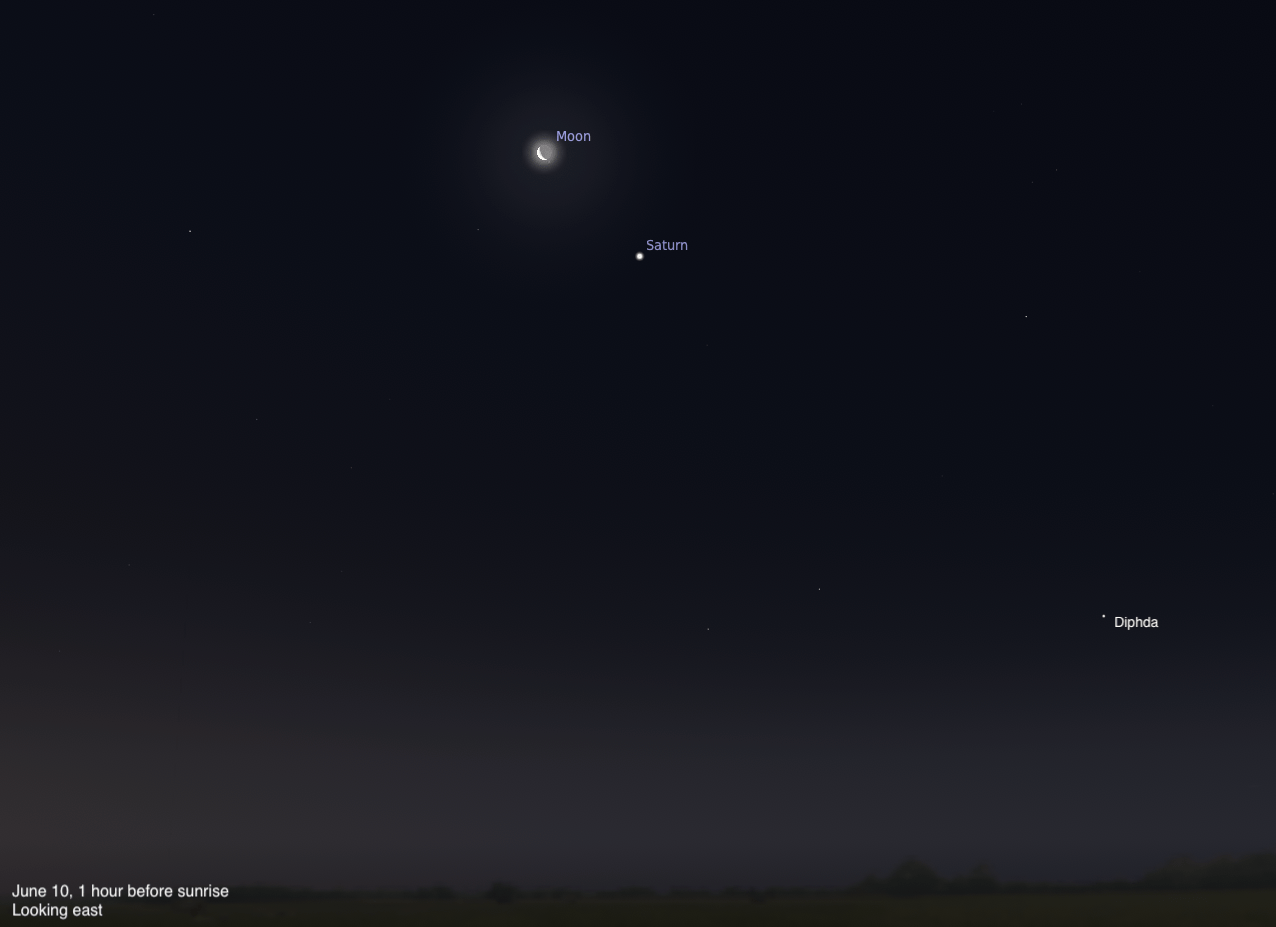
Saturn is the brightest point of light in this region of the sky, sitting close to the southern border of Pisces. Glowing at magnitude 0.8, it should be easily visible even with the crescent Moon nearby. Mars lies far to the pair’s lower left, glowing at magnitude 1.3. It’s already nearly 10° high an hour before dawn, so you should be able to spot it as well.
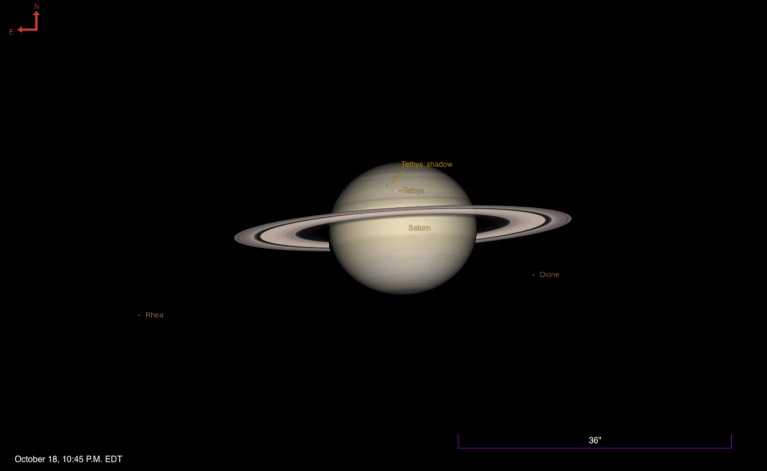
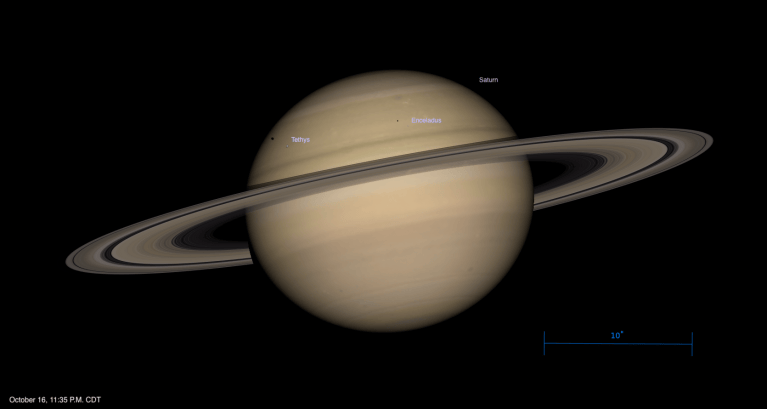
Turn a telescope on Saturn and you’ll be greeted by a view of its lovely rings, stretching some 38” from end to end. They are tilted some 8.5° to our line of sight, showing off their southern face. You may also spot Titan, Saturn’s largest moon, some 40” southwest of the planet and glowing around magnitude 8.5. Fainter 10th-magnitude Tethys, Rhea, and Dione all lie east of the ringed world, but may be more difficult to spot, particularly as the sky brightens. If you want to catch them, try looking an hour or two earlier, while the sky is still well and truly dark.
Zooming back out, Cetus the Whale lies to the lower right of the Moon and Saturn. You may be able to make out a few of the large constellation’s brighter stars, particularly 2nd-magnitude Beta Ceti, also called Diphda or Deneb Kaitos. Although its designation as Beta indicates it comes in second, Diphda actually outshines Cetus’ alpha star, magnitude 2.5 Menkar. Additionally, Menkar lies in far northeastern Cetus, where it doesn’t rise until very shortly before the Sun, rendering it invisible in the brightening sky.