Looking for a sky event this week? Check out our full Sky This Week column.
June 7: The sky’s sunflower
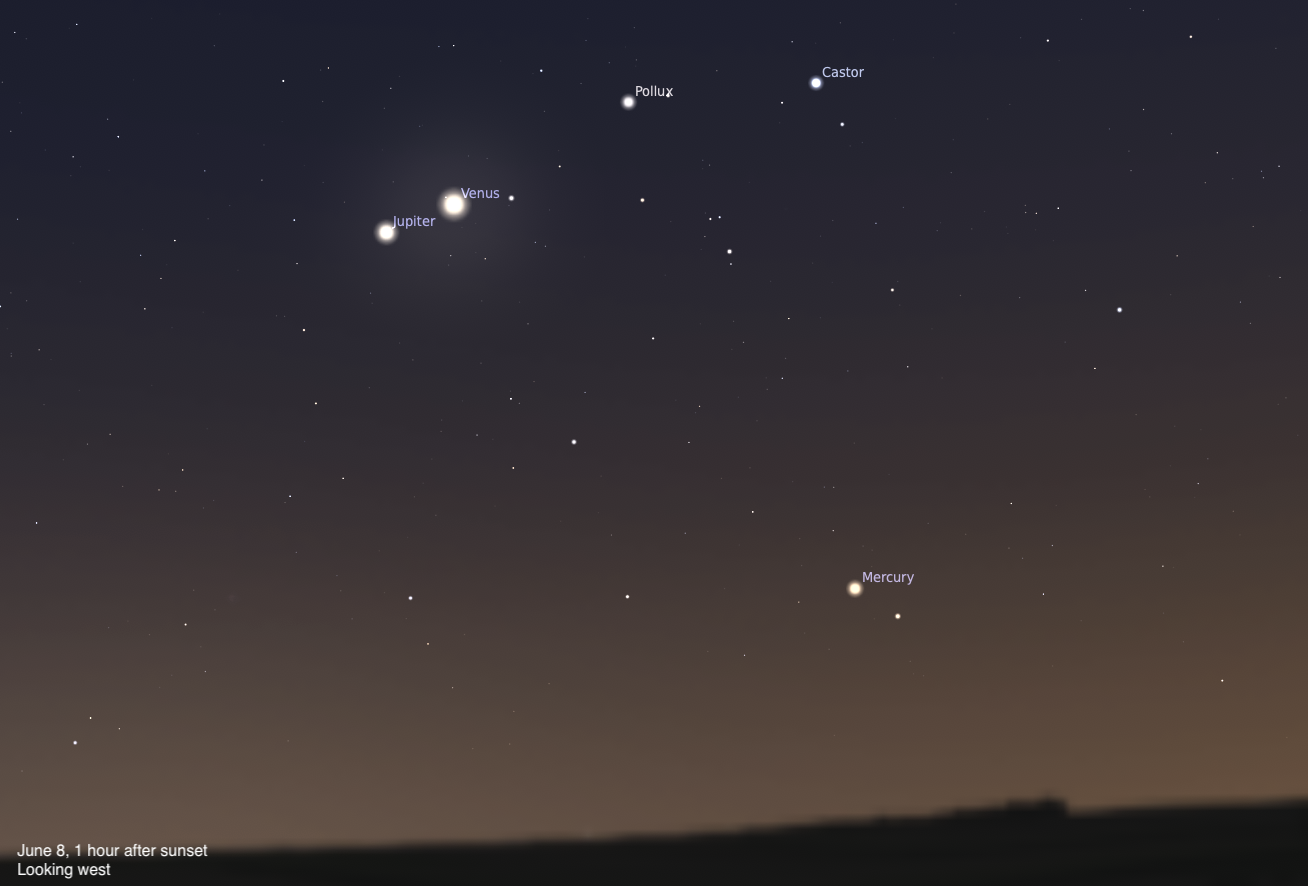
Venus passes 5° south of the star Pollux at noon EDT. You can view them after sunset in the west, as Venus and Jupiter are closing in for a conjunction. Tonight the planets are 1.7° apart, standing in line with Pollux in the evening sky. An hour after sunset, the trio is just under 20° high. Magnitude 1.2 Pollux, which lies to the left of Gemini’s alpha star, Castor, is highest in the sky. About 4.9° to Pollux’s lower left is Venus, blazing at magnitude –4.0. And less than 2° to Venus’ lower left is magnitude –1.9 Jupiter.
Compare the two planets in binoculars or a finder scope, where you can view them simultaneously. Venus appears 14″ across, showing off a gibbous disk that’s more than 75% lit. Jupiter, despite its greater distance, stretches more than twice that width — 33” — and appears fully illuminated. East Coast and Midwest observers using a telescope may be able to catch the Galilean moon Io transiting the jovian disk with its shadow; only those in the Central time zone will see Io’s transit end, shortly after 10 P.M. CDT. The shadow continues its journey for nearly another hour.
You may also spot magnitude 0.0 Mercury, much closer to the horizon and hanging some 12.2° below Castor. The small planet lies close to the 3rd-magnitude star Epsilon (ε) Geminorum, which may not appear until the sky grows darker.
Sunrise: 5:31 A.M.
Sunset: 8:27 P.M.
Moonrise: 1:15 A.M.
Moonset: 1:14 P.M.
Moon Phase: Waning crescent (43%)
*Times for sunrise, sunset, moonrise, and moonset are given in local time from 40° N 90° W. The Moon’s illumination is given at 10 P.M. local time from the same location.