Looking for a sky event this week? Check out our full Sky This Week column.
February 8: Europa takes a trek across Jupiter
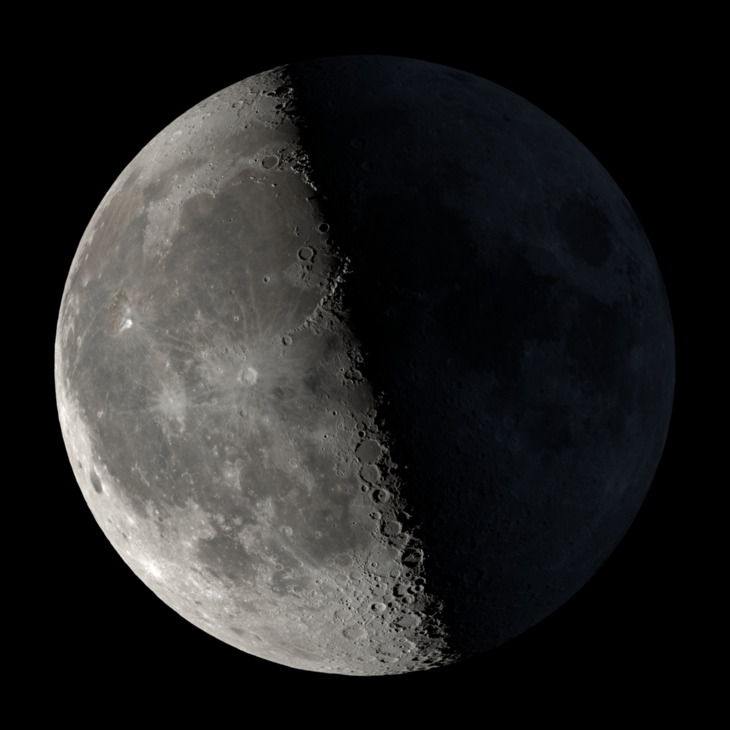
Last Quarter Moon occurs at 7:43 A.M. EST on Monday, February 9. This phase is best viewed in the early-morning hours; early risers can catch it before dawn, and our satellite remains visible in the sky even after the Sun has risen.
An hour before dawn this morning, the Moon floats high in the south, amid the stars of Libra and to the right of the claws of Scorpius. (We’ll return here tomorrow morning as well, as the Moon moves into Scorpius in preparation for a close pass of the bright star Antares tomorrow night.)
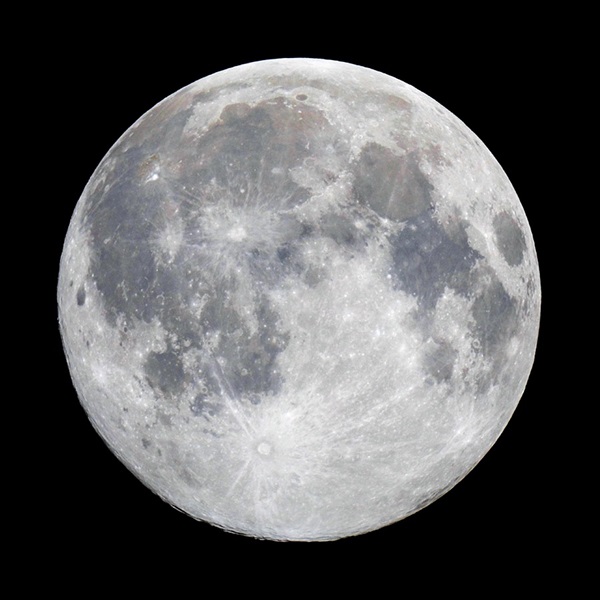
The Last Quarter Moon is lovely to view through binoculars or a small scope. Night has reached midway across the nearside, cloaking half in darkness while half remains in sunlight. Still visible this morning in the lunar north just on the sunward side of the terminator dividing night and day are the Apennine Mountains, curving gently along the edge of Mare Imbrium (the Sea of Rains). Just below Imbrium is a bright, round crater with a large, tangled set of rays stretching outward in all directions like a cartoon Sun. This is Copernicus, some 58 miles (93 kilometers) across and less than a billion years old. Those rays reach outward some 500 miles (800 km) across the surrounding terrain, visible because they are the lighter material from beneath the surface excavated during the impact that formed the crater.
Sunrise: 7:00 A.M.
Sunset: 5:29 P.M.
Moonrise: 12:58 A.M.
Moonset: 10:30 A.M.
Moon Phase: Waning crescent (44%)
*Times for sunrise, sunset, moonrise, and moonset are given in local time from 40° N 90° W. The Moon’s illumination is given at 10 P.M. local time from the same location.
Let’s return to the early-morning sky on Tuesday, February 10, an hour before dawn to check on the Moon’s progress. Now in Scorpius, our waning satellite is close to the 3rd-magnitude star Pi (π) Scorpii and less than 8° from Antares, the Scorpion’s bright red heart.
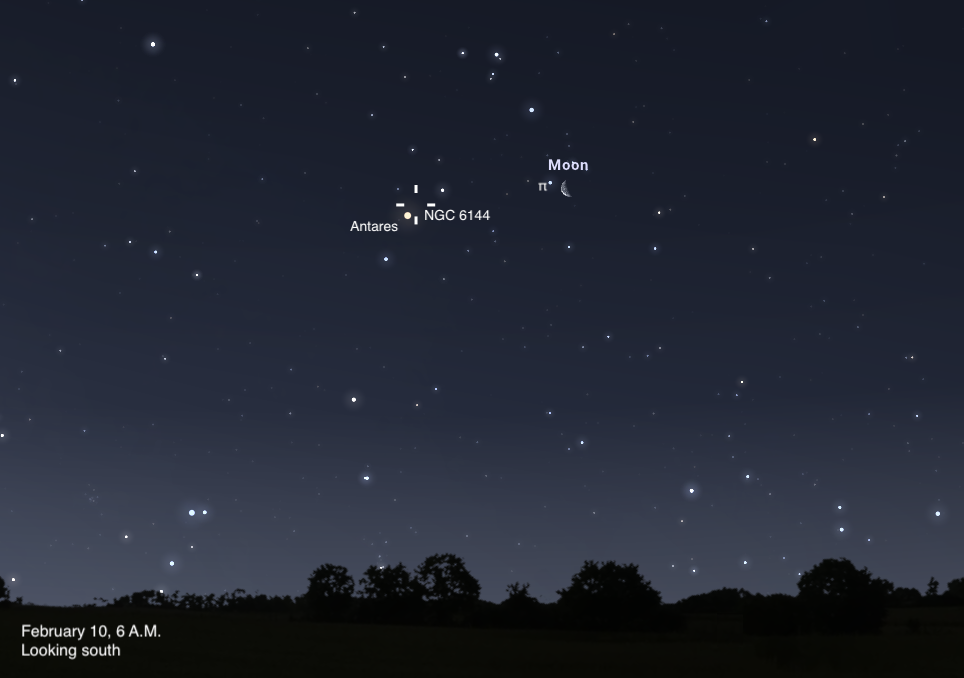
While your gaze is on this region of the sky this morning, point your telescope over to Antares itself. Just 0.6° northwest of this magnitude 1.1 star is the globular cluster NGC 6144. Both are visible together at low powers, but Antares is so much brighter than the cluster that NGC 6144 itself can be better seen by zooming in on this object alone. You can simply adjust the view so Antares falls out of your field, or switch to higher magnification or a larger scope. NGC 6144 is nearly 30,000 light-years away. Spanning just under 10’, its center is tightly packed and difficult to resolve in smaller scopes, but you may be able to pick out member stars around its outer edges.
The Moon reaches apogee, the farthest point from Earth in its orbit, at 11:52 A.M. EST. At that time, our satellite will be 251,392 miles (404,576 km) away.