Looking for a sky event this week? Check out our full Sky This Week column.
June 3: Juno stands still
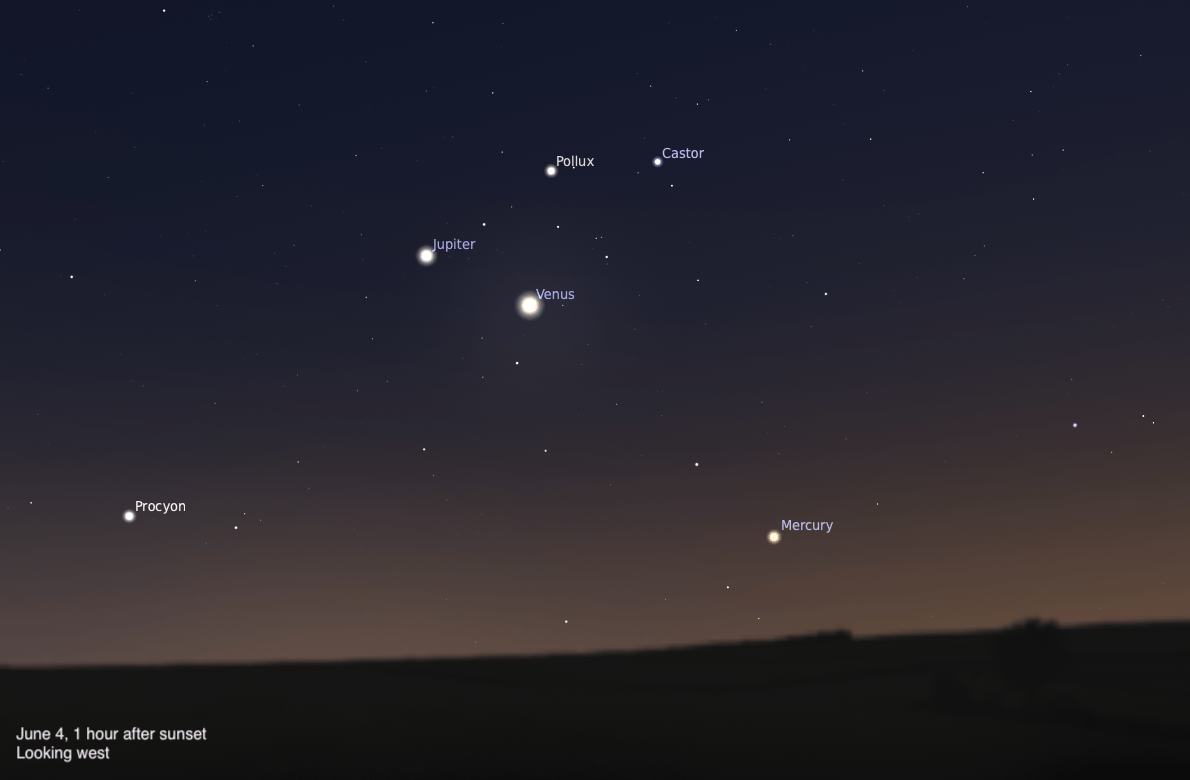
Jupiter passes 6° due south of Pollux at 7 A.M. EDT, although neither object is visible in the daylit sky. Instead, check out the scene after sunset this evening, with Jupiter still south of Pollux and also still lined up nicely with Venus and Mercury. You have a while to enjoy the view as well — Mercury, which sets first, won’t disappear below the horizon until more than an hour and a half after sunset.
By the time darkness falls, there are several points of light gathered in the west. Three planets stand in line from lower right to upper left. Closest to the ground is magnitude –0.3 Mercury, while Venus — brightest at magnitude –4.0 — is in the middle. To Venus’ upper left is Jupiter, at magnitude –1.9. Castor and Pollux, the heads of Gemini the Twins, sit to the upper right (north) of Venus and Jupiter.
Another bright star, magnitude 0.4 Procyon in Canis Minor, is also visible above the horizon, now roughly level with Mercury but far to its left (southeast).
If you’ve got a telescope, take some time to compare Mercury and Venus before the former sets. Mercury is now 60% lit, its gibbous disk spanning 7” on the sky. Venus is twice as wide — 14” — and more of it also appears illuminated at 78%. However, when you look at Venus you are not seeing down to the bare surface, as with Mercury. Instead, we see sunlight bouncing off Venus’ cloud tops, as its atmosphere is too thick to allow us to view the ground.
Jupiter dwarfs them both — despite its greater distance, it is physically so much larger that it spans 33” on the sky. It is fully lit, with all four of its Galilean moons stretched out to the planet’s east.
Sunrise: 5:32 A.M.
Sunset: 8:25 P.M.
Moonrise: —
Moonset: 8:56 A.M.
Moon Phase: Waning gibbous (81%)
*Times for sunrise, sunset, moonrise, and moonset are given in local time from 40° N 90° W. The Moon’s illumination is given at 10 P.M. local time from the same location.
Now that the Red Planet is rising roughly an hour before the Sun, let’s check in on Mars in the predawn sky of June 5. The nearby world now has time to climb well above the horizon, leading to easier viewing even as the sky is growing light.
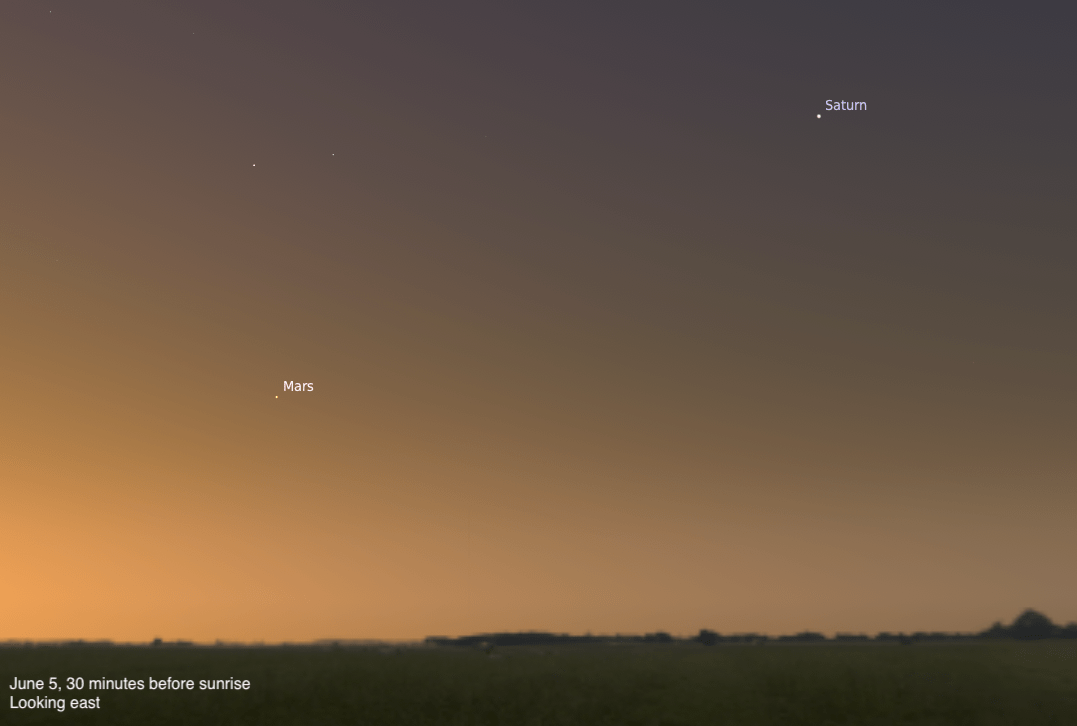
Half an hour before sunrise, Mars is 12° above the eastern horizon, shining at magnitude 1.3. If you have any trouble spotting it in the growing twilight, try for it with binoculars — but make sure to put them away at least several minutes before sunrise from your location. Brighter Saturn, shining at magnitude 0.8, lies some 30.5° west of Mars. Like the planets in the evening sky, these two worlds trace out the ecliptic in the morning sky, showing its shallower angle with respect to the horizon.
Unfortunately, peering at Mars through a telescope will show little more than the view with binoculars — the planet is just 4” across, with no surface detail visible at that size.