Mercury reaches greatest elongation in the evening sky this month. Venus and Jupiter have a spectacular conjunction, and later in the month the Moon occults Venus. Meanwhile, Jupiter drops deeper into twilight as it sinks toward next month’s conjunction with the Sun. The morning sky hosts ever-more-prominent Saturn, while Mars and Uranus meet in Taurus.
Soon after sunset, look west for Mercury, at its best evening apparition for the year. On June 1, it’s an easy object 10° high 30 minutes after sunset. If you’re in doubt about finding Mercury, first find bright Jupiter and Venus — which, like Mercury, lie along the ecliptic. Extend a line through the brighter planets (higher in the west) down toward the horizon and you’ll find Mercury, shining at magnitude –0.5.
Mercury dims to magnitude 0 by the 8th, but climbs to 12° high 30 minutes after sunset. It’s hard not to pay attention to Jupiter and Venus 14° above Mercury — on the 8th and 9th, these planets are at their closest. We’ll visit them shortly.
Mercury continues to slowly fade but climb higher, reaching greatest elongation on the 15th, when it stands 25° east of the Sun. At magnitude 0.5, it remains an easy object. Lucky observers may also see a young crescent Moon standing 5° high 30 minutes after sunset.
On the 16th, the Moon is more obvious, roughly 4° from both Mercury and Jupiter, forming a nice triangle. Venus stands 7° above Jupiter. It’s a photogenic grouping in the deepening twilight.
By June 20, Mercury is magnitude 0.8 and stands 4.5° west of Jupiter. The bright star Pollux in Gemini now forms the point of an elongated triangle with the two planets. On the 25th, Mercury has faded another 0.5 magnitude and is more difficult to spot as it drops closer to the horizon, with Jupiter following more slowly. Look for Mercury 4° high 45 minutes after sunset, with Jupiter less than 4° away.
June opens with Jupiter and Venus roughly 7.5° apart. Venus is brighter at magnitude –4.0; Jupiter comes in at magnitude –1.9 and shaves 0.1 magnitude off by midmonth. Watch each night as Venus climbs higher to meet Jupiter. Both planets are visible within 30 minutes of sunset and stand more than 20° high in the western sky. In the first week of June, both planets set by 11:30 p.m. local daylight time, so there’s plenty of time to observe them.
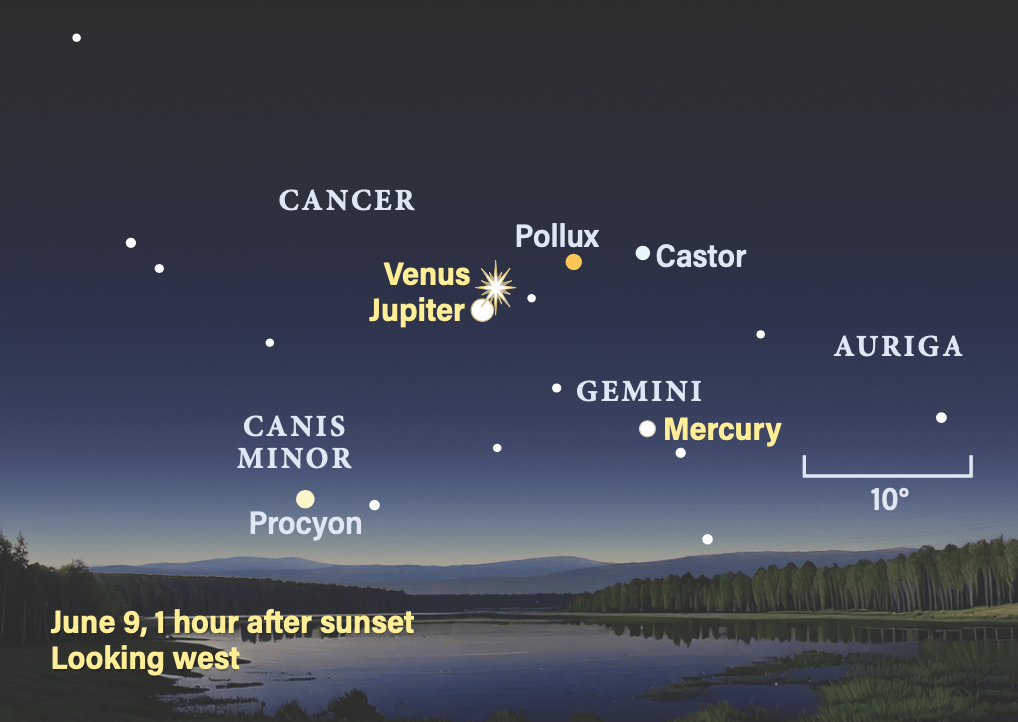
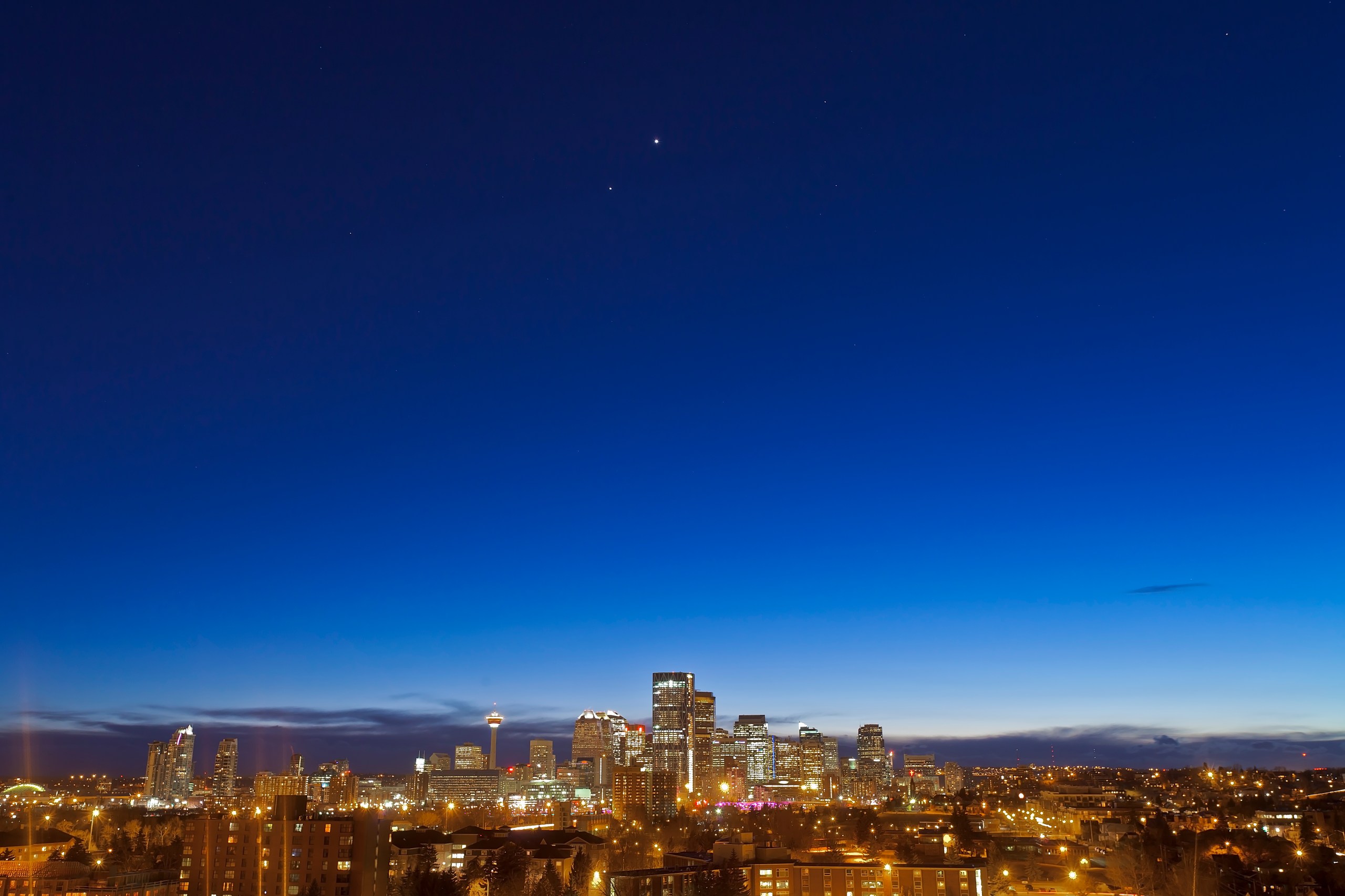
Venus and Jupiter reach a stunning conjunction in early June. For two nights, June 8 and 9, they’re at their closest. On June 8, the gap spans 1.7°, and the next night they’re 1.6° apart. The pair is joined by the brightest stars in Gemini, Castor and Pollux, just a few degrees away.
Both planets are visible in low-power telescopes (1.7° or greater field of view) on the nights they’re closest. On the 9th, Venus reveals a 77-percent-lit disk spanning 14″.
Jupiter, meanwhile, is 33″ wide even though it is far more remote. Three of the four Galilean moons are visible, with Ganymede hidden behind the planet. Callisto and Europa lie to the west, with both moons’ shadows on the jovian cloud tops this evening.
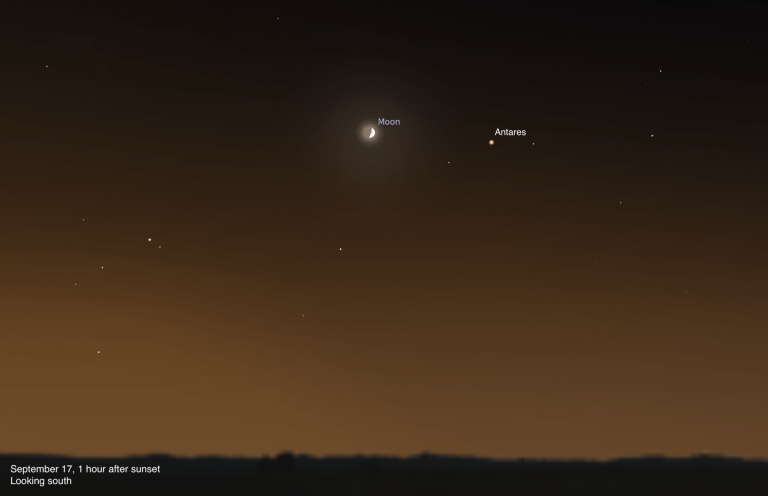
After the conjunction, Venus continues east relative to the background stars. On the 17th, the crescent Moon occults Venus in daylight. The event is visible across the contiguous U.S., and timing depends on your location. Venus disappears from Baltimore’s sky at 3:49 p.m. EDT; from Austin, Texas, at 2:24 p.m. CDT; and from Denver at 12:55 p.m. MDT. You can find disappearance and reappearance times at www.lunar-occultations.com/iota/bstar/0617venus.htm for many cities. Venus’ reappearance at the bright limb of the Moon is hard to catch but will be well worth viewing because Venus appears as a brilliant jewel in contrast with the lunar limb.
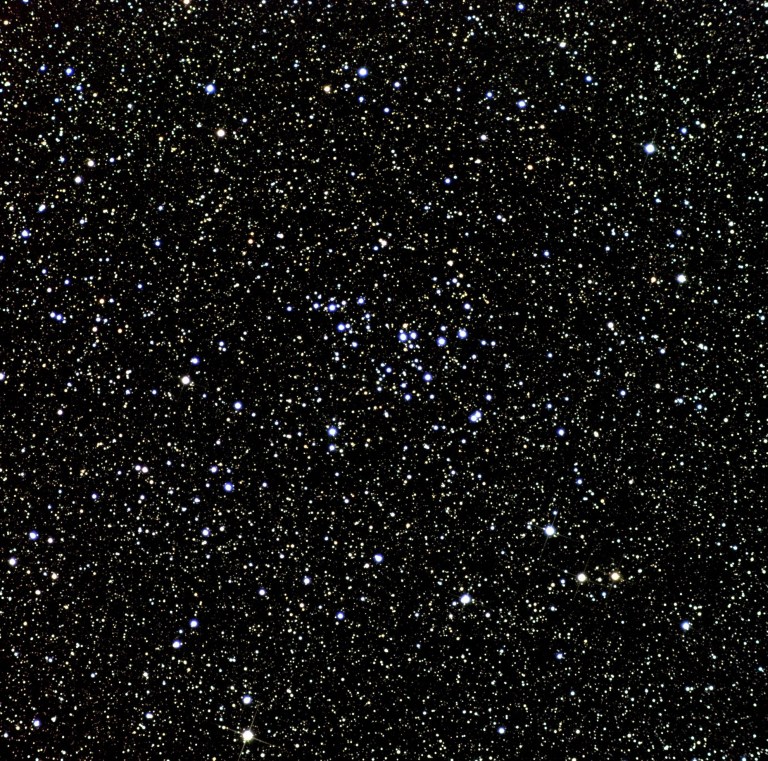
A few hours later, the Moon crosses the Beehive star cluster (M44). The eastern half of the U.S. gets the better view, seeing some stars disappear at the dark limb. By the time evening falls across the Mountain time zone, stars are reappearing at the bright limb in twilight, a difficult observation. Venus shines 2.3° northwest of the cluster.
On June 18, the gap between M44 and Venus closes to only 1.3° — a stunning binocular sight. On the 19th, Venus stands 45′ north of M44.
The line of planets in the western sky on the 20th is a lovely sight, spanning 16° from Venus to Mercury, with Jupiter 11° from Venus. Castor and Pollux, 12° and 8° northwest of Jupiter, respectively, add to the elegant scene. Mercury is first to set at 10 p.m. local daylight time, followed 20 minutes later by Jupiter. Venus sets at 11 p.m.
By the end of June, Venus has moved into Leo and stands 17° high in the west 45 minutes after sunset. Jupiter is only 5° high, quickly lost in twilight.
Returning to Jupiter, there are a few noteworthy events early in the month. On June 7, Io is occulted by the planet’s disk at 9:32 p.m. MDT. Europa follows it behind Jupiter’s limb at 10:11 p.m. MDT.
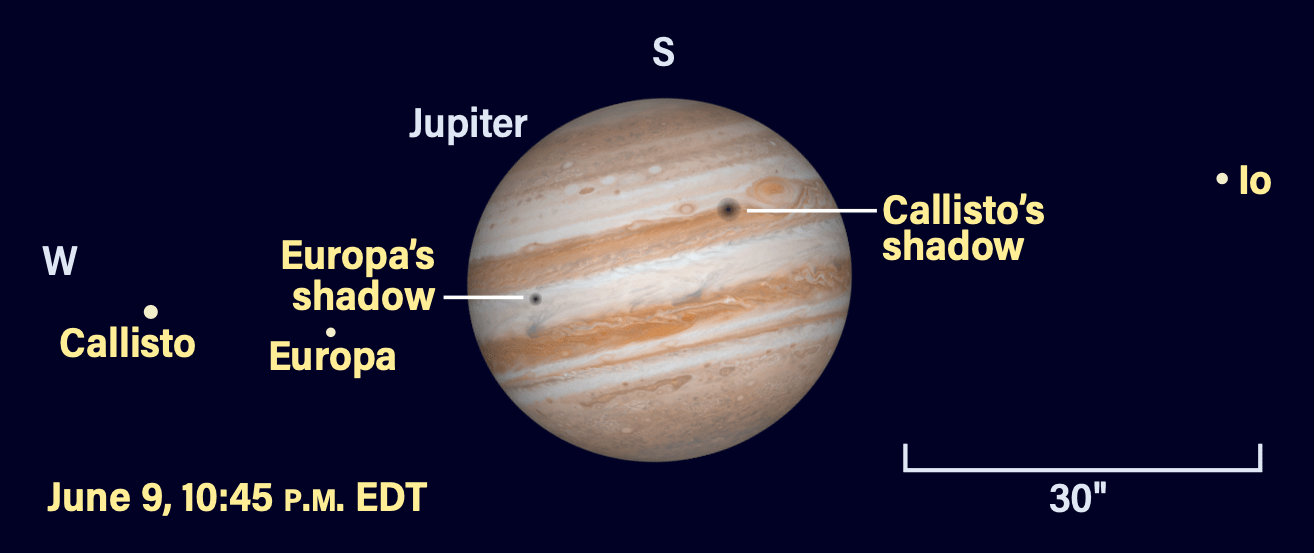
On June 9, two shadows are crossing Jupiter’s disk from east to west as night falls across the Midwest. Europa’s shadow leads, with Callisto’s larger shadow following. Callisto and Europa stand west of Jupiter. Europa’s shadow ends its transit at 10:13 p.m. CDT, as Jupiter is getting quite low in the Midwest. Callisto’s shadow transit ends after Jupiter sets along the Pacific coast.
Io and its shadow transit on June 15. Io’s transit begins at 9:49 p.m. CDT and its shadow follows 42 minutes later. The next night, Europa makes a similar transit. Because of its wider orbit, Europa’s shadow follows 79 minutes later. Europa’s ingress (9:37 p.m. EDT) is visible across the eastern half of the U.S., with the remainder of the event visible as darkness falls across the rest of the country. Note that Ganymede is occulted at 10:04 p.m. PDT, only visible from the West Coast. Callisto undergoes a similar occultation the following evening, June 17, at 9:30 p.m. CDT, as the Sun is setting in the Mountain time zone.
It’s a challenge to catch events as Jupiter sinks in the west, but fun to try. Good luck!
Now we switch to the morning sky, where Neptune, rises around 2:30 a.m. local daylight time on June 1, and before 1 a.m. by the 30th. As June opens, magnitude 7.8 Neptune is 3° southwest of 44 Piscium. From 44 Psc, scan with binoculars 2° southwest to find a group of five stars highlighted by a nice 7th-magnitude star. Neptune lies 0.7° from this star, along the same line. As June progresses, Neptune moves closer to this grouping. By June 30, Neptune is only 8′ west of an 8th-magnitude field star in the grouping. On this date, Neptune stands some 30° high in the southeast at the onset of twilight, offering fine opportunities to spot the bluish-hued planet through your telescope. A waning crescent Moon stands 4.5° northwest of Neptune on June 9.
Saturn rises about half an hour after Neptune and is 10° above the eastern horizon 100 minutes before sunrise on the 1st. By the end of June, Saturn is 27° high in the southeast two hours before sunrise, and getting better each day. It is magnitude 0.7, outshining all the stars in this region.
Telescopes show the tilt of Saturn’s rings, reaching 9° by the 30th and revealing their southern side, along with the planet’s southern hemisphere. Saturn’s disk spans 17″ at the equator and 15.5″ at the poles. The rings reach 39″ across.
Titan, Saturn’s brightest moon, crosses due north of Saturn between June 2nd and 3rd. It appears northeast of the planet on the 2nd, and northwest of it on the 3rd. On the following night (the 4th), a field star of the same brightness as Titan lies less than 1′ northeast of Titan, so watch for that.
Tethys and Dione undergo a series of transits and shadow transits, only detectable in careful video capture by experienced observers. Dione passes due north of Saturn the mornings of June 19 and 30. Iapetus nears Saturn June 25, standing 1.9′ due north of the planet. It’s heading to a western elongation in mid-July, when it will be at its brightest. During June, Iapetus shines near 11th magnitude.
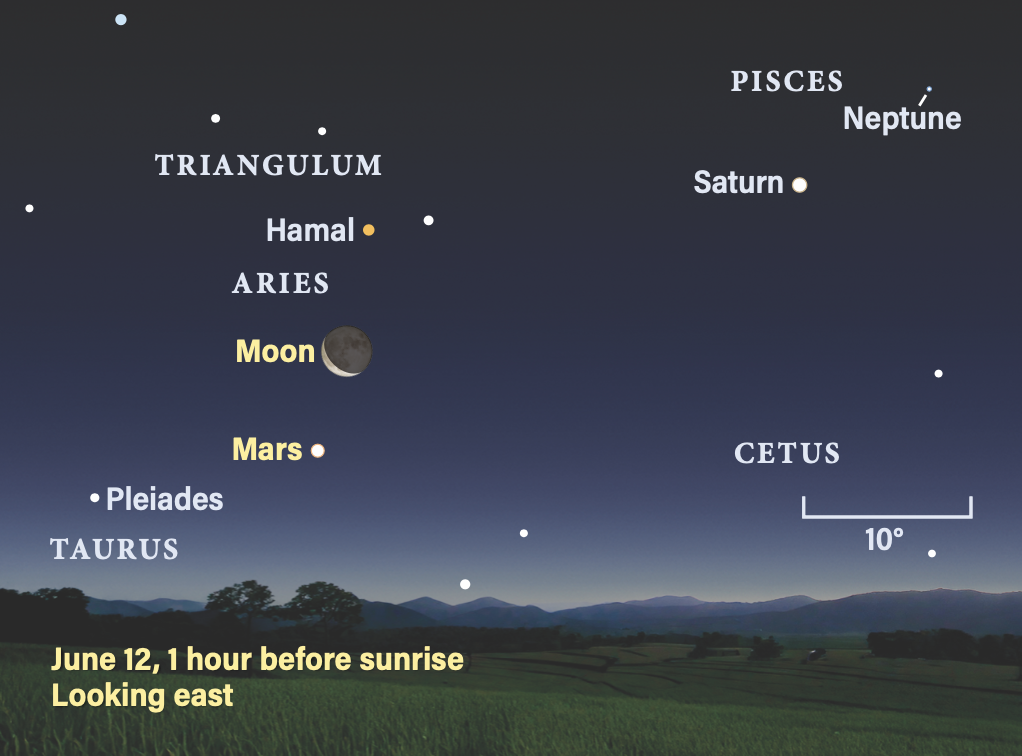
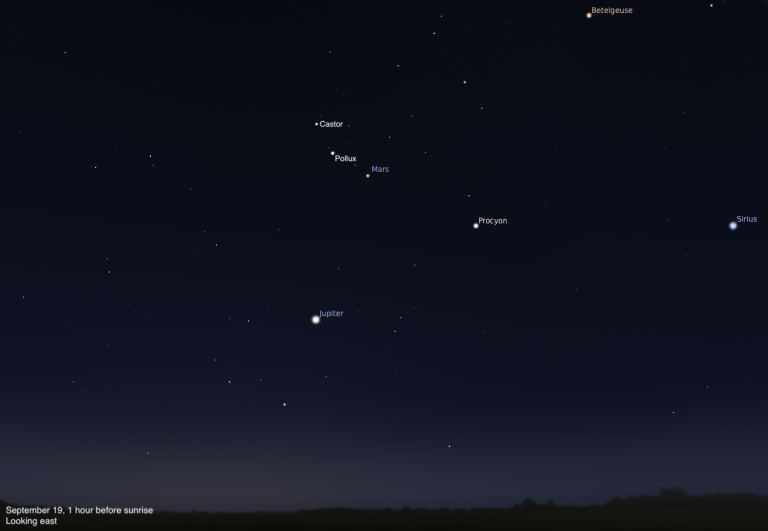
Mars rises 90 minutes before the Sun in early June. A great time to spot the Red Planet is June 12, when the waning crescent Moon hangs some 6.5° above magnitude 1.3 Mars in morning twilight. Mars moves from Aries into Taurus by June 20 and stands just under 5° south of the Pleiades star cluster (M45) on June 27. Compare Mars with Aldebaran, which rises about an hour after Mars at the end of June.
Mars’ disk is 4″ in a telescope, barely revealing surface detail. There’s no opposition of Mars this year, but by the end of December its disk will reach 10″ in diameter, with opposition in February 2027.
Uranus reached conjunction with the Sun last month and isn’t visible in early June. By the 15th, it rises a little over an hour before the Sun. The dim, magnitude 5.8 planet is challenging, but by June 30 it is more than 10° high in the east an hour before sunrise. On that day, Uranus is just 2.5° east of Mars in Taurus.
The summer solstice occurs June 21 at 04:25 a.m. EDT.
Rising Moon: Craters, cracks, and domes
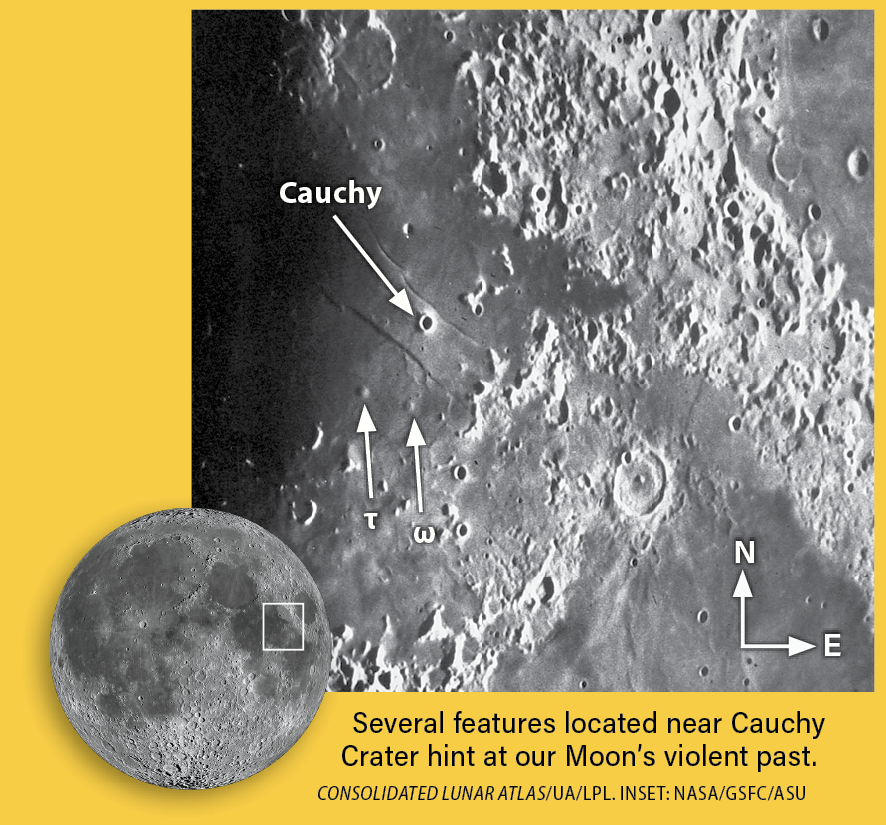
Today’s Sea of Tranquillity was once untranquil. It began 4 billion years ago with a giant impact excavating a large basin. Millions of years later, lava erupted through the breaks in the floor, from cracks along stress lines created by other large impacts. During a second round of upwelling lava, the terrain heaved unevenly from below, causing a scarp or fracture, while in other places lava tubes collapsed into rilles. Nearby, some volcanoes made it to the surface, but the failed ones created domes. Space rocks slamming in millennia later added the final touch.
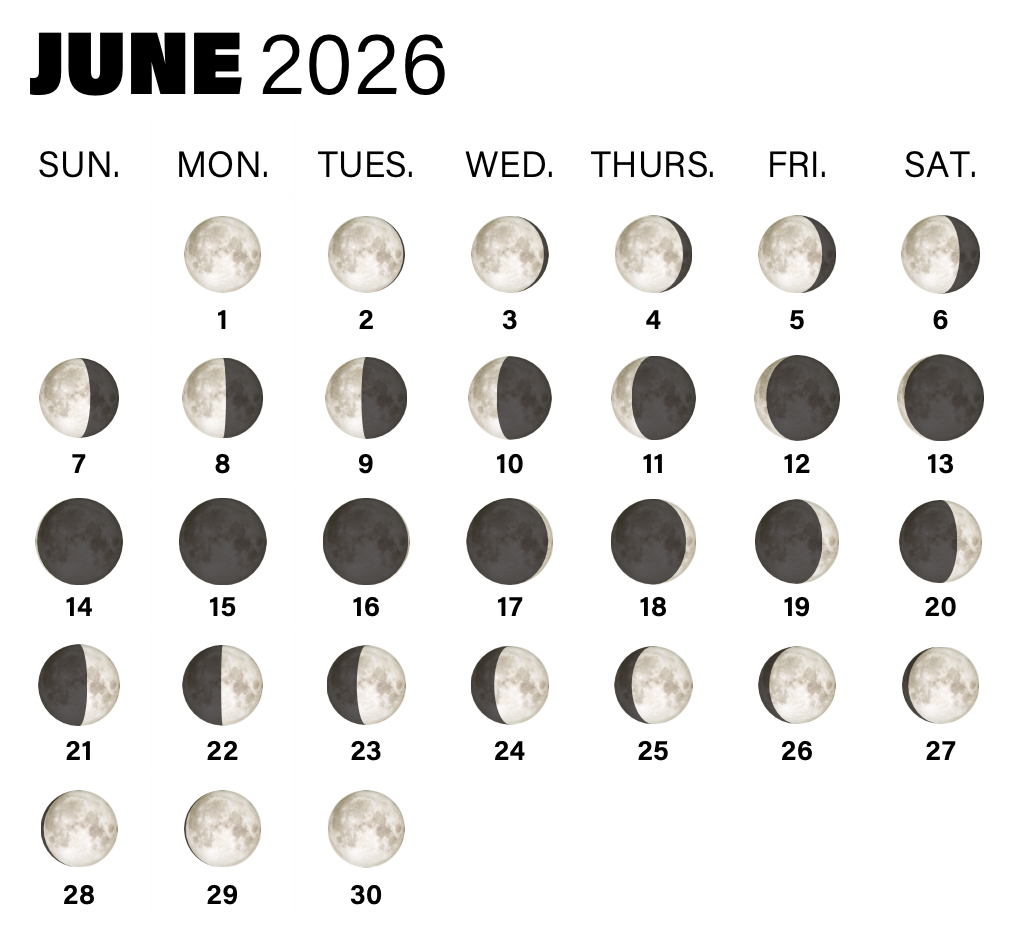
Roughly five days after New Moon, on the 19th, the Sun rises on the fascinating region of crater Cauchy, just north of the terminator’s midpoint. The terminator is the line dividing night from day, but at such a young age, the dark face of our sister Luna might be modestly lit by gray earthshine, sunlight reflected from Earth’s dayside.
The crater itself is a small, 7-mile-wide simple impact feature with nice sharp edges — evidence of relative youth. Immediately to Cauchy’s north is a prominent rille. Years of tiny impacts have softened its edges. Within a couple of Earth days, the higher Sun angle shines directly into the rille, wiping out the shadows and making it all but invisible.
South of Cauchy, a prominent fault scarp lies parallel to the rille. Well known to lunar hounds, the fault is second only to the famous Straight Wall. At sunrise the scarp casts a nice, sharp shadow westward, but the dark line also disappears a couple of Earth evenings later.
A real bonus in this region at the edge of Mare Tranquillitatis is a pair of lava domes. Look for the small light-dark pairing caused by these hills protruding into the sunlight. The eastern dome, cataloged as omega (ω), is likely a shield volcano, while the western one, tau (τ), appears to have been formed by uplifting from below.
Meteor Watch: Light up the night
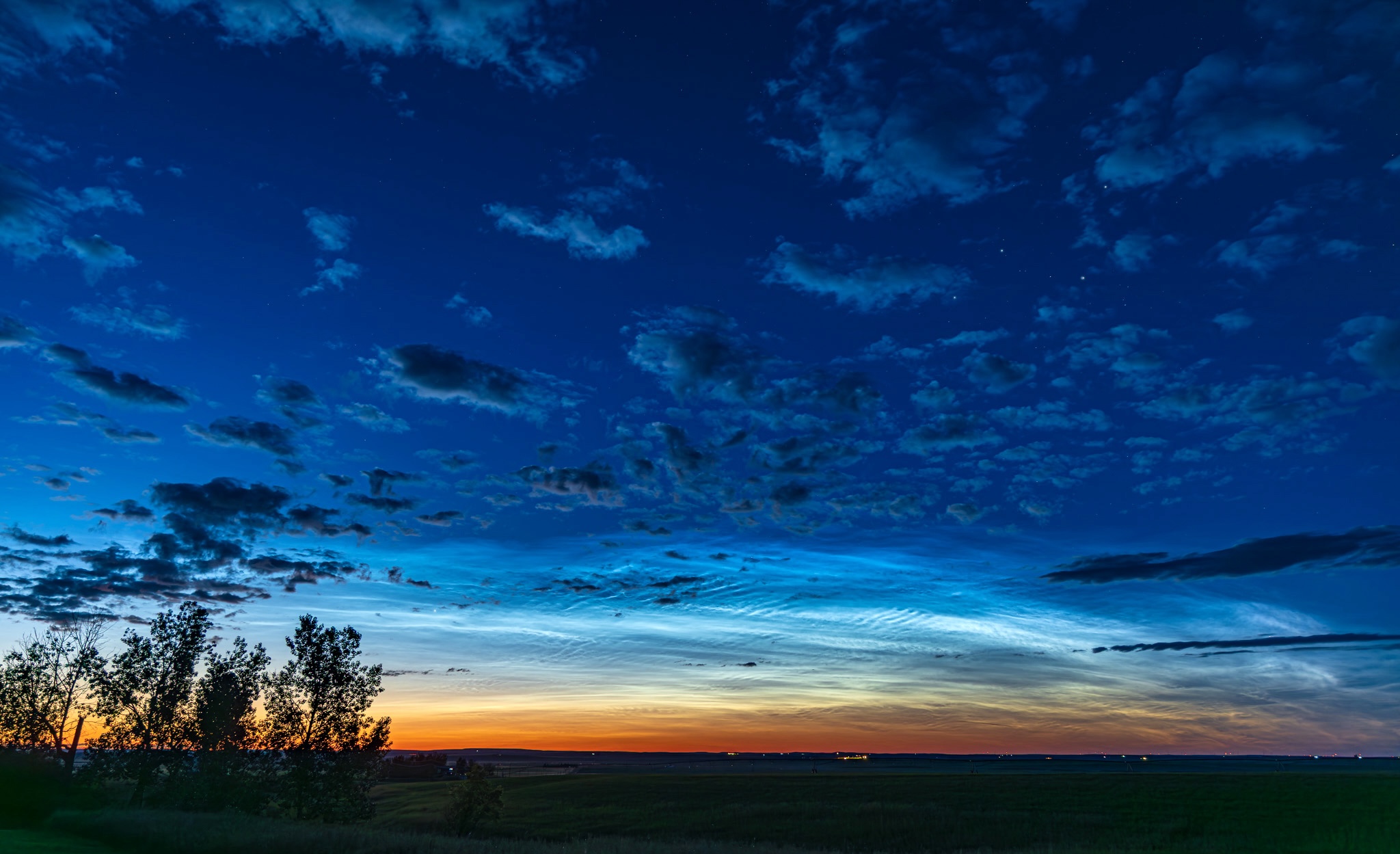
There aren’t any major meteor showers this month. However, another phenomenon in Earth’s atmosphere is of interest. The summer season is a great time to look for noctilucent (night-glowing) clouds. These occur when ice crystals form on high-flying dust particles and are typically visible from latitudes between 55° and 70° north. Their pearly-white appearance remains sunlit long after any lingering regular clouds show up dark against the deepening twilight. This is because noctilucent clouds are much higher than regular clouds — more than 50 miles up, some 10 times the height of cirrus clouds.
At the same time, be on the lookout for the occasional fireball, which can happen at any time of night.
Comet Search: Summer companion
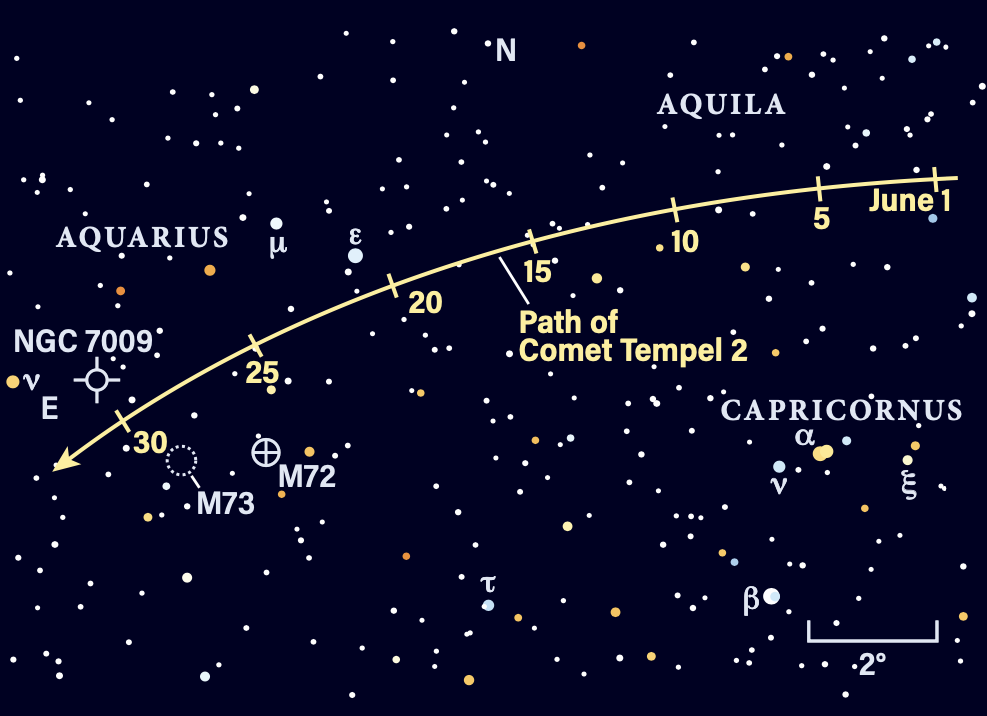
Charles Messier missed this one: Peaking next month, short-period Comet 10P/Tempel is now putting on its best showing since 1967. The solar heat is already enough for both gas and dust production to give us a decent telescopic target brighter than 9th magnitude. Head out of the city during New Moon to see it in small scopes and large binoculars, with the best views toward the end of the short night, following the Milky Way’s core.
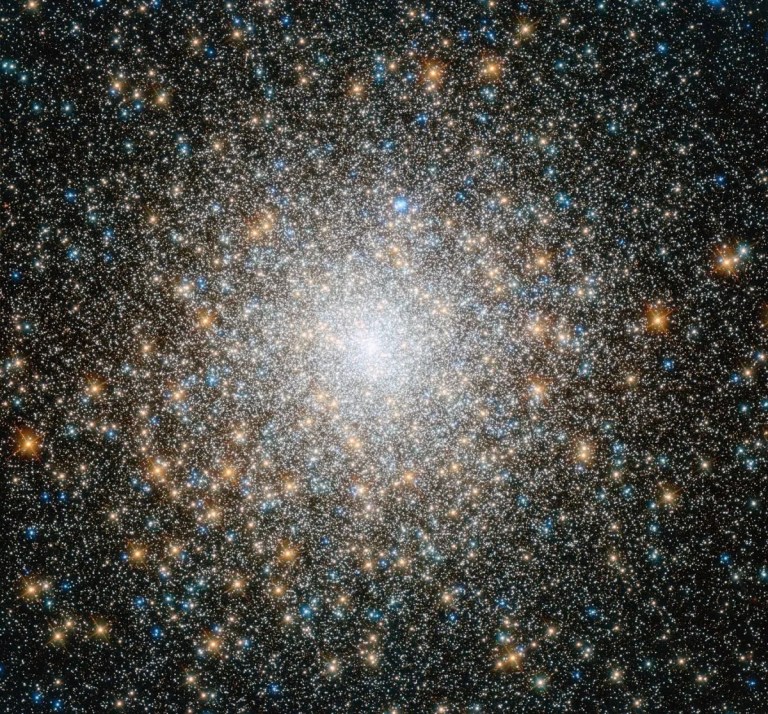
Also called Tempel 2, this comet can appear like a globular cluster at low power. First take in M2, an easy magnitude 6.5, then slew over to M75 at magnitude 8.5 and M72 at magnitude 9.3. Note the brightness profile of each for comparison to Tempel 2: How quickly does the comet’s glow intensify into the middle? Can you notice that the southeast flank is sharply defined as the solar wind pushes back the dust?
With the inner and outer parts of Tempel 2’s orbit not far from Mars and Jupiter, respectively, gravity’s relentless tug kept the comet just too far and too faint for the prolific hunter Messier. Discovery had to wait until 1873 provided a good return geometry for Wilhelm Tempel to lay eyes on it.
Locating Asteroids: Two for one everywhere
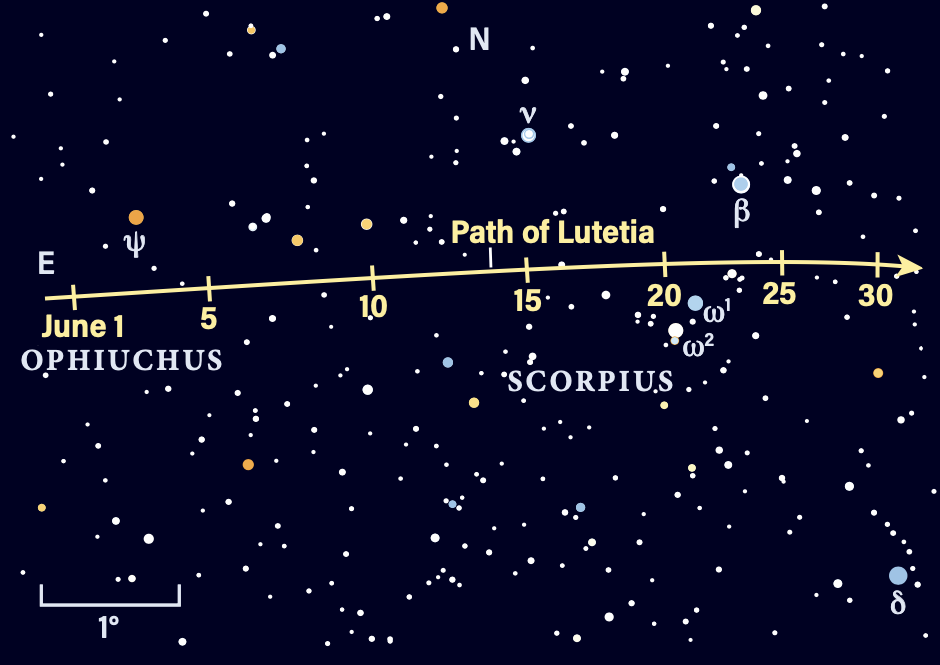
Each shift of the telescope brings another wonderful sight into view for our earthbound eyes. No matter the light pollution or phase of the Moon, stars shine through the eyepiece — and often enough, an asteroid. 21 Lutetia is a modest 80-mile-wide main-belt world glowing at 10th magnitude this month, which a 6-inch scope can pick up from the suburbs.
On the 4th, Lutetia approaches a 10th-magnitude field star; on the 16th, it’s near a 9th-magnitude neighbor. The 23rd and 24th have our rock sliding between even brighter distant suns. There are a lot of background stars as we peer toward the center of our galaxy. To be sure you’ve positively identified the asteroid, make a quick sketch of the field with at least three dots, then come back another night to confirm which one has moved.
Since you’re buzzing Scorpius’ brain, look at Omega1 (ω1) and Omega2 (ω2) Scorpii through binoculars, and follow up in the scope with dazzling Beta1 (β1) and Beta2 (β2) just to the north. And Nu (ν) Scorpii stood out for Agnes Clerke as the most beautiful quadruple in the heavens. Do you agree?
The Rosetta spacecraft took a close look at Lutetia back in 2010, while on its way to Comet 67P/Churyumov–Gerasimenko.
Star Dome
The map below portrays the sky as seen near 35° north latitude. Located inside the border are the cardinal directions and their intermediate points. To find stars, hold the map overhead and orient it so one of the labels matches the direction you’re facing. The stars above the map’s horizon now match what’s in the sky.
The all-sky map shows how the sky looks at:
midnight June 1
11 p.m. June 15
10 p.m. June 30
Planets are shown at midmonth