Looking for a sky event this week? Check out our full Sky This Week column.
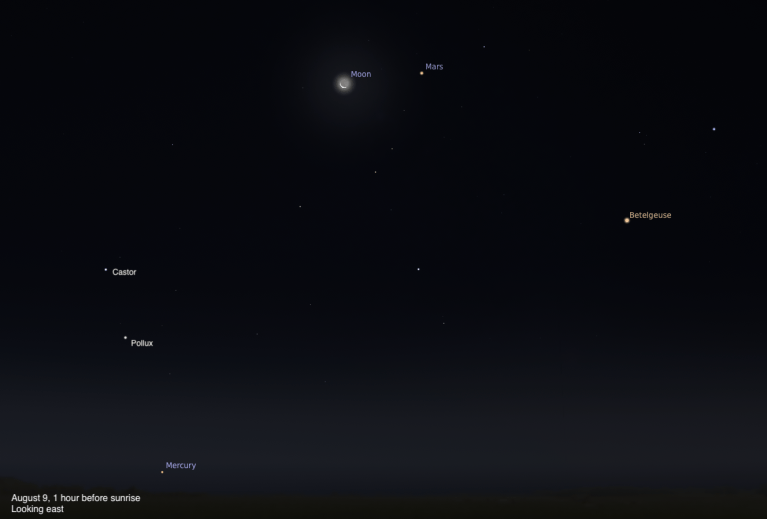
August 9: The Moon and Mars
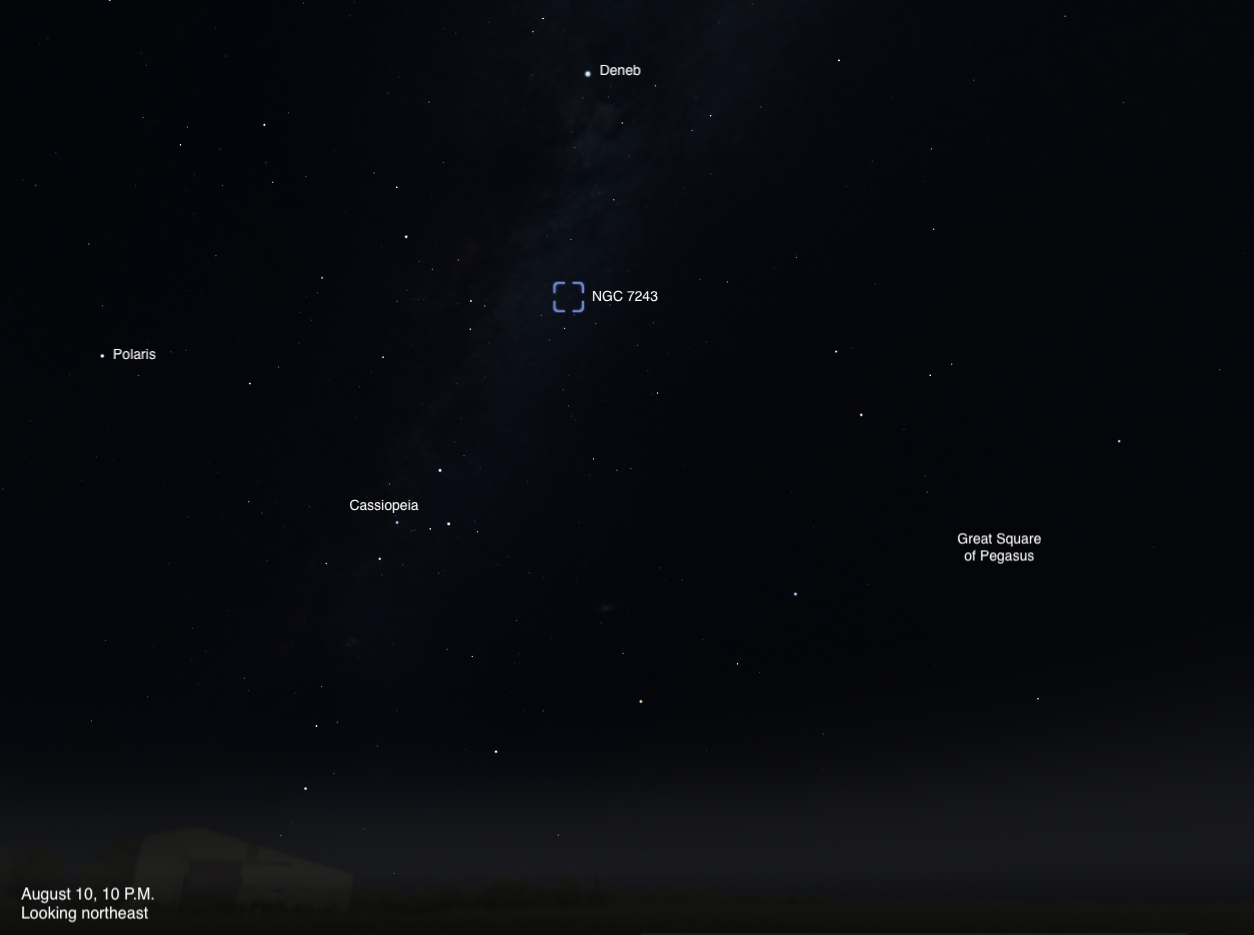
This evening, the small constellation Lacerta sits just below cross-shaped Cygnus in the eastern sky after dark. The zig-zagging outline of the Lizard lies roughly 20° east (to the lower left early in the evening) of bright Deneb, the tail of the Swan and one of the three anchor points in the easy-to-spot Summer Triangle.
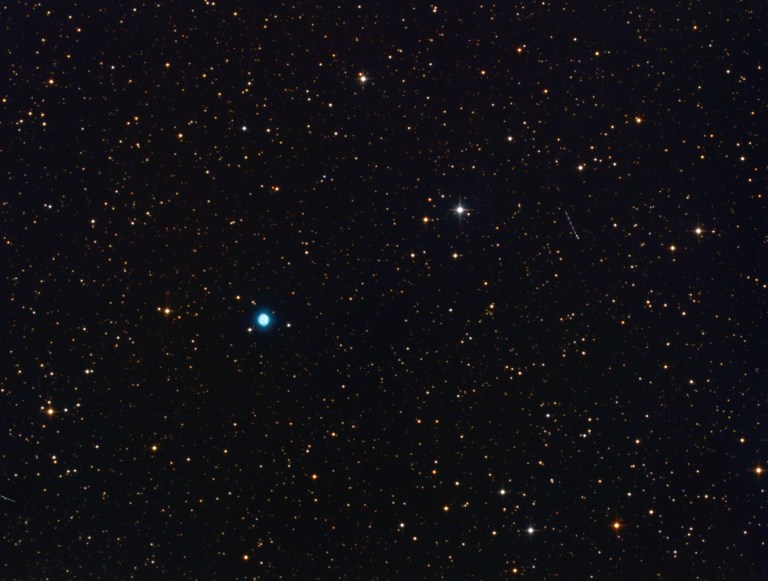
Lacerta is home to the open cluster NGC 7243. Shining at magnitude 6.4, this is a great target for binoculars or any small scope. You’ll find it just 2.6° due west of Alpha (α) Lacertae, Lacerta’s brightest star (magnitude 3.8). Spanning about 21”, NGC 7243 contains a few dozen stars. Its brightest star sits right in the center of the cluster, glowing at magnitude 8.0, with fainter stars crowding in around it. Many more stars become visible as you bump up your magnification, so once you’ve centered the cluster, drop in an eyepiece with higher magnification to see just how many of its member stars you can bring out.
Sunrise: 6:07 A.M.
Sunset: 8:03 P.M.
Moonrise: 3:15 A.M.
Moonset: 6:59 P.M.
Moon Phase: Waning crescent (4%)
*Times for sunrise, sunset, moonrise, and moonset are given in local time from 40° N 90° W. The Moon’s illumination is given at 10 P.M. local time from the same location.
Alison Klesman is senior editor of Astronomy magazine. She holds a Ph.D. in astronomy and has studied a variety of topics, from minor planets to supermassive black holes.