Looking for a sky event this week? Check out our full Sky This Week column.
August 5: Iapetus at superior conjunction
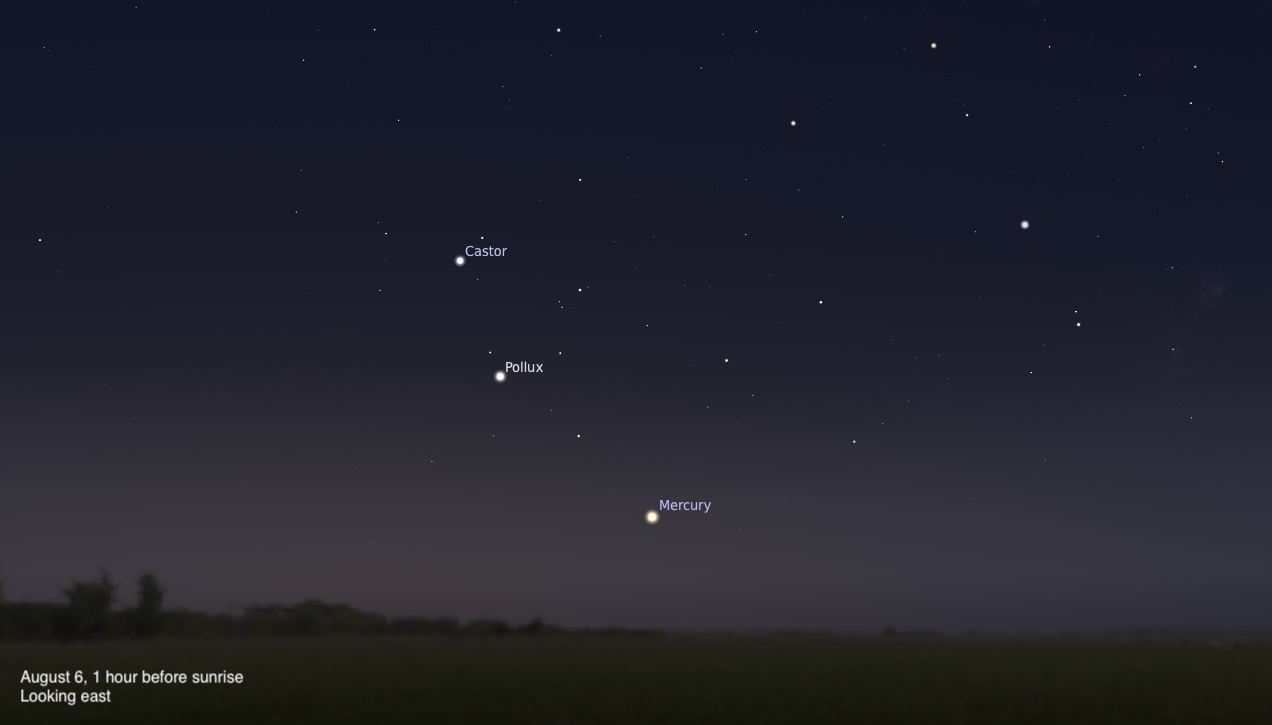
As Gemini rises shortly before the Sun this morning, the planet Mercury is just over 7° due south of the constellation’s beta star, Pollux. An hour before sunrise, nearly all of Gemini has cleared the eastern horizon, and Mercury shines at magnitude –0.3 nearly 5° high. You’ll spot it to the lower right of Pollux, which is the brightest star in the Twins and sits closer to the horizon than Castor (Alpha [α] Geminorum), which is a tad fainter and stands about 4.5° directly above Pollux as the constellation rises.
If you’ve got a telescope, you’ll note that Mercury has changed in appearance from earlier this week. Its disk now spans 7” but is more than half lit, showing off a 54%-illuminated gibbous phase. Again, you’ll need steady seeing to clearly make out the phase, but you may get lucky if you spend some time with it as the sky slowly lightens. As always, make sure to put away optics several minutes before sunrise from your location to protect your eyes.
Early this morning is also great time to visualize the ecliptic — the plane of our solar system. Once you spot Mercury above the horizon, look to its far upper right for fainter magnitude 1.3 Mars in Taurus, near the tip of one of the Bull’s horns. Draw a line from the horizon up through Mercury and extend it through Mars — that’s the ecliptic, along which all the major planets lie.
Sunrise: 6:03 A.M.
Sunset: 8:08 P.M.
Moonrise: —
Moonset: 2:45 P.M.
Moon Phase: Waning crescent (39%)
*Times for sunrise, sunset, moonrise, and moonset are given in local time from 40° N 90° W. The Moon’s illumination is given at 10 P.M. local time from the same location.
The Moon crosses in front of the Pleiades starting around midnight EST in an event called an occultation, visible largely to observers along the U.S. East Coast shortly after moonrise early on August 7, although the region will be quite low. For the best view, get to a location with a clear, dark eastern horizon, ideally at an altitude above your surroundings. Even then the greater amount of air we must look through at the horizon may muddy the view early on.
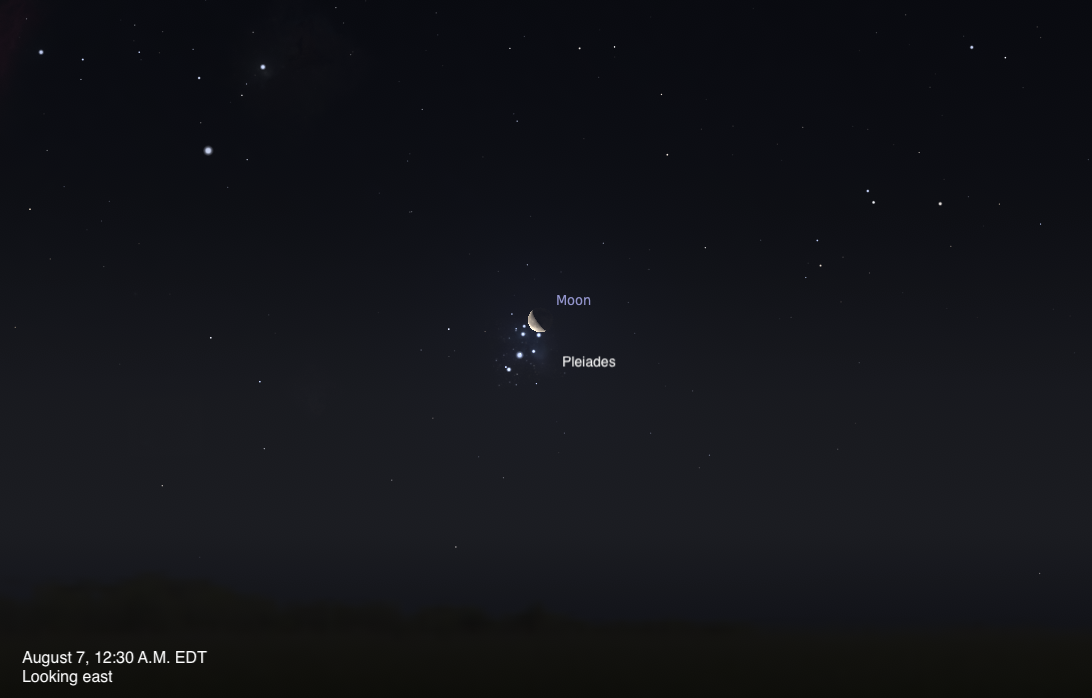
For those in the western two-thirds of the U.S., the occultation will either be underway (in the Midwest) or over by the time the Moon rises, although you can still watch our satellite pull away, bit by bit, from the bright star cluster.
For those with a view of the event, it begins just minutes after midnight EST on the 6th (so, a few minutes into the 7th), as the crescent Moon plows through the northern region of the cluster. Our satellite will temporarily block stars that may include Electra, Celaeno, Taygeta, Maia, and Sterope — exactly which stars will be blotted out depends on your location. The timing is also heavily location dependent — you can find a table of occultation timings for 40 cities in North America on the website of the International Occultation Timing Association here. If your location will see the occultation, it will be listed by date. The duration of each occultation also depends on location, but will generally last a little less than an hour before a given star reappears at the trailing dark limb of the Moon.
Alison Klesman is senior editor of Astronomy magazine. She holds a Ph.D. in astronomy and has studied a variety of topics, from minor planets to supermassive black holes.