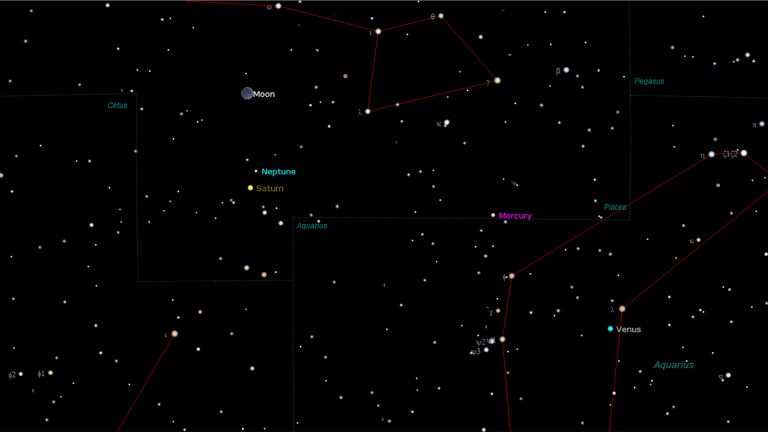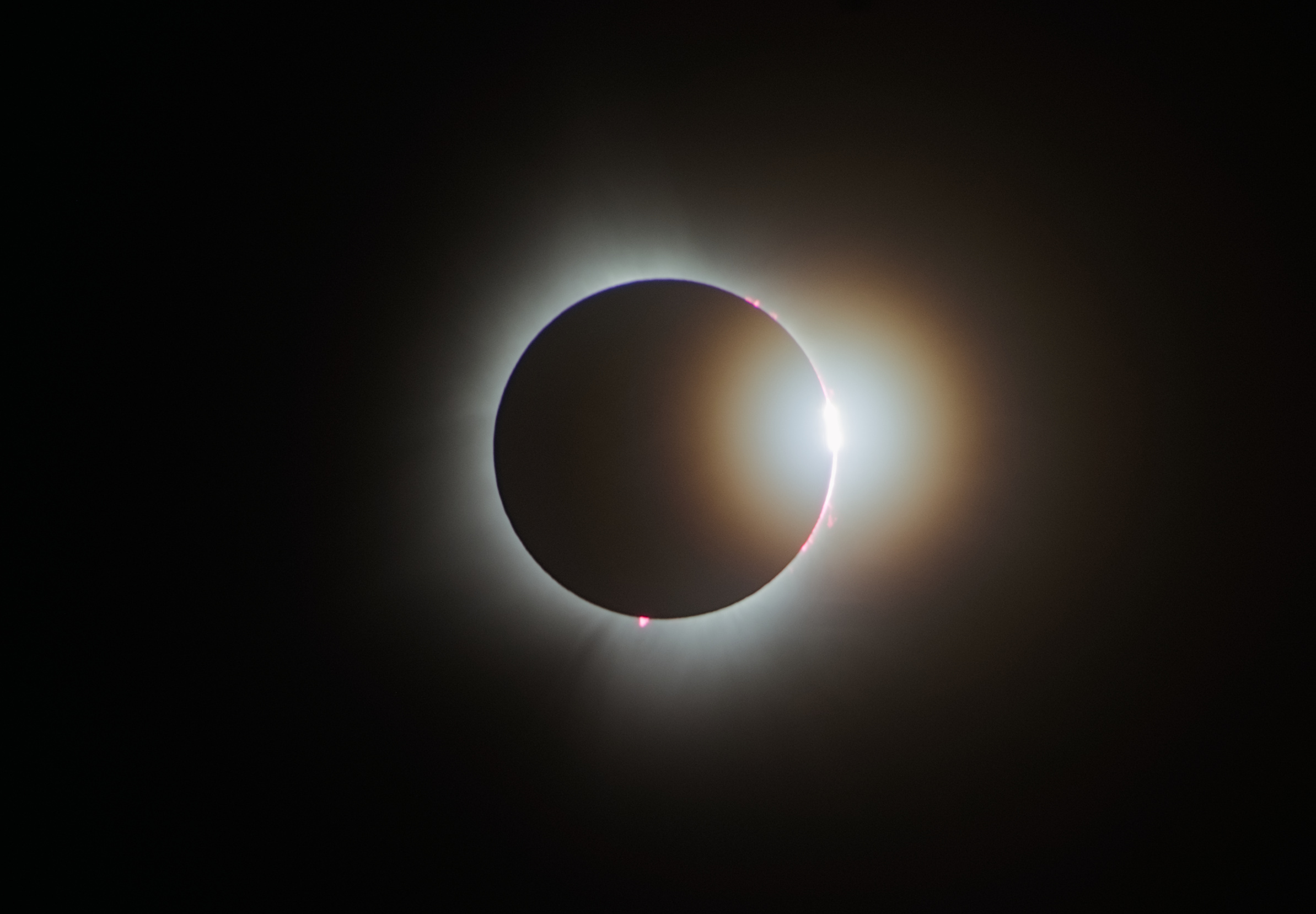
On August 12, the New Moon’s shadow will fall over a portion of Earth’s surface. When that happens, the Sun will temporarily disappear from the sky in a total solar eclipse. These breathtaking events are spectacular and ethereal, as the sky falls dark during the day, leaving only the soft glow of our star’s outer atmosphere, the corona, visible for a short time.
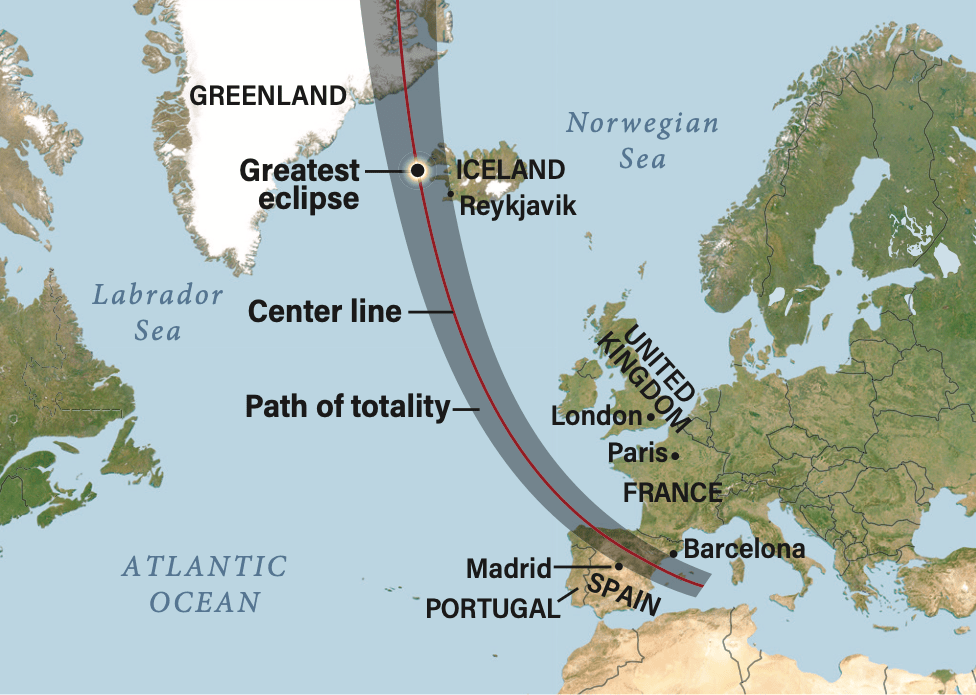
The August 12 total solar eclipse will pass over Greenland, Iceland, and Spain, where the luckiest observers will see roughly 2 minutes of totality. But many parts of the rest of the world, including portions of the U.S., will experience a partial solar eclipse, with the dark Moon taking a bite out of the solar disk.
Why total solar eclipses happen
Total solar eclipses eclipses, in which the Moon perfectly covers the disk of the Sun, occur because although the Sun is 400 times larger than the Moon, the Moon is 400 times closer than the Sun, rendering their disks the same apparent size in our sky. So, when the two line up perfectly from our point of view, we get a total solar eclipse. They can only happen during New Moon, when the Moon sits between Earth and the Sun.
Why don’t solar eclipses happen every month, then, or once per lunar orbit (every New Moon)? The Moon’s orbit around Earth is slightly tilted with respect to Earth’s orbit around the Sun (the plane of the latter is called the ecliptic). Because of that tilt, the Moon often isn’t aligned with the Sun in our sky precisely when it is New and eclipses do not occur.
Related: 25 solar eclipse facts
But when the planes of the orbits do happen to align at the right time, we can get an eclipse. This month, such an alignment takes place when New Moon occurs at 1:37 P.M. EDT on August 12.
Where the total solar eclipse is visible
Solar eclipses are not visible worldwide — in this case, the narrow path of totality travels only across Greenland, Iceland, and Spain, as well as a tiny sliver of far northeastern Portugal. The longest eclipse visible along this path will be 2 minutes 18 seconds of totality, off the west coast of Iceland. In Reykjavik, observers will see roughly 1 minute of totality, while on the farthest point west along the Icelandic coast, totality will last nearly 2 minutes. Northeastern Spain will also receive nearly 2 minutes of totality all along the central region of the shadow.
Watch the eclipse live
You don’t have to be along the path to see totality: NASA will be livestreaming the total solar eclipse as well. Visit nasa.gov/live to see where coverage will be hosted, or watch via the embedded player below.
Where to see a partial solar eclipse
While totality is only visible along a narrow corridor where the Moon’s shadow is darkest, some of the rest of the world will see a partial solar eclipse, where only a portion of the Sun’s disk is covered by the Moon. That will be visible across parts of Europe, Russia, Africa, and North America, including Alaska and portions of the northeastern and eastern U.S. For example, London will see 91% of the Sun covered by the Moon, Paris sees a 92% partial eclipse, Rome sees 69% of the Sun disappear, and Stockholm sees an 81% partial solar eclipse. In North America, Nova Scotia will see some 33% of the Sun’s disk covered and Anchorage gets a 28% eclipse, while Toronto sees 8% of the Sun covered and Winnipeg gets a 5% eclipse. On the U.S. East Coast, Boston sees a 16% partial eclipse, New York City sees a 9% partial eclipse, and Virginia Beach sees a 2% partial eclipse.
You can visit timeanddate.com’s page for the August 12 total solar eclipse to view an interactive map and determine whether you will see any portion of the eclipse, as well as the timing of the event. Note that during a partial eclipse, you must use eclipse glasses labeled with ISO 12312–2 or ISO 12312–2:2015 when viewing the Sun at all times. Sunglasses are not sufficient to protect your eyes. Make sure your glasses or filters are not scratched or otherwise damaged. If you choose to view the Sun through a solar telescope or with a solar filter, make sure to cover the finder scope to avoid accidentally glancing through it. You can find more tips for safe solar observing on Astronomy.com here.
More sky events to come
For those in the U.S. disappointed by the view (or perhaps total lack thereof), just wait — in two weeks, on Aug. 27, a beautiful 96% partial lunar eclipse will grace the skies. We’ll make sure to highlight that event as well so you’ll know when and how to see it.
And today’s astronomical events don’t culminate with the eclipse: The Perseid meteor shower also peaks overnight on August 12/13, under completely dark skies due to the New Moon. Check out our Sky This Week column for August 7 to 14 for more details on how to view the Perseids, particularly in the early-morning hours of August 13, when the radiant will be highest.
Alison Klesman is senior editor of Astronomy magazine. She holds a Ph.D. in astronomy and has studied a variety of topics, from minor planets to supermassive black holes.