Friday, August 7
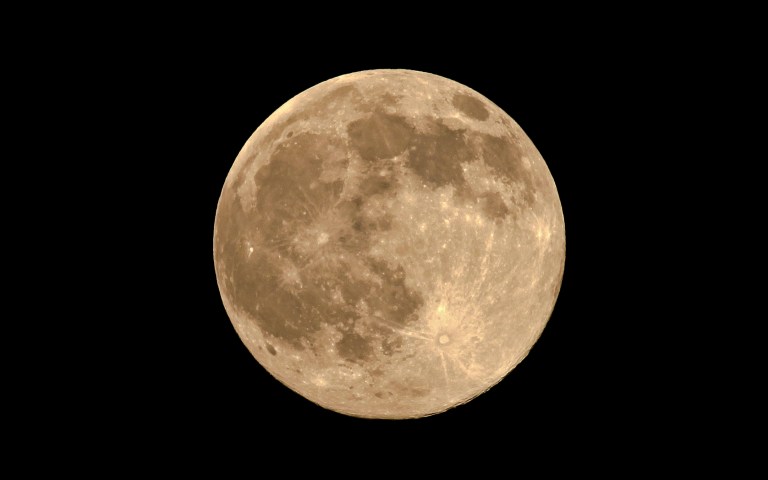
The Moon passes 5° north of Uranus at 1 P.M. EDT. The pair is visible in the early-morning sky, along with a lunar occultation of the Pleiades just after moonrise. Check out the August 7 entry in last week’s Sky This Week column for more details.
Late tonight, there’s a good hour of viewing time to try to catch Comet 10P/Tempel (also known as Tempel 2), which rises around 9:30 P.M. local daylight time and climbs above the most turbulent air at the horizon around midnight. By local midnight, Tempel 2 is some 18° high in the south, to the upper right of the bright star Fomalhaut in Piscis Austrinus and near that constellation’s border with Capricornus.
To find the comet, start by centering 1st-magnitude Fomalhaut in binoculars or, better yet, a telescope. From this star, move about 9.7° west-northwest to 5th-magnitude Lambda (λ) Piscis Austrini, then continue another 3.6° in the same direction along that same line to land on the comet’s location.
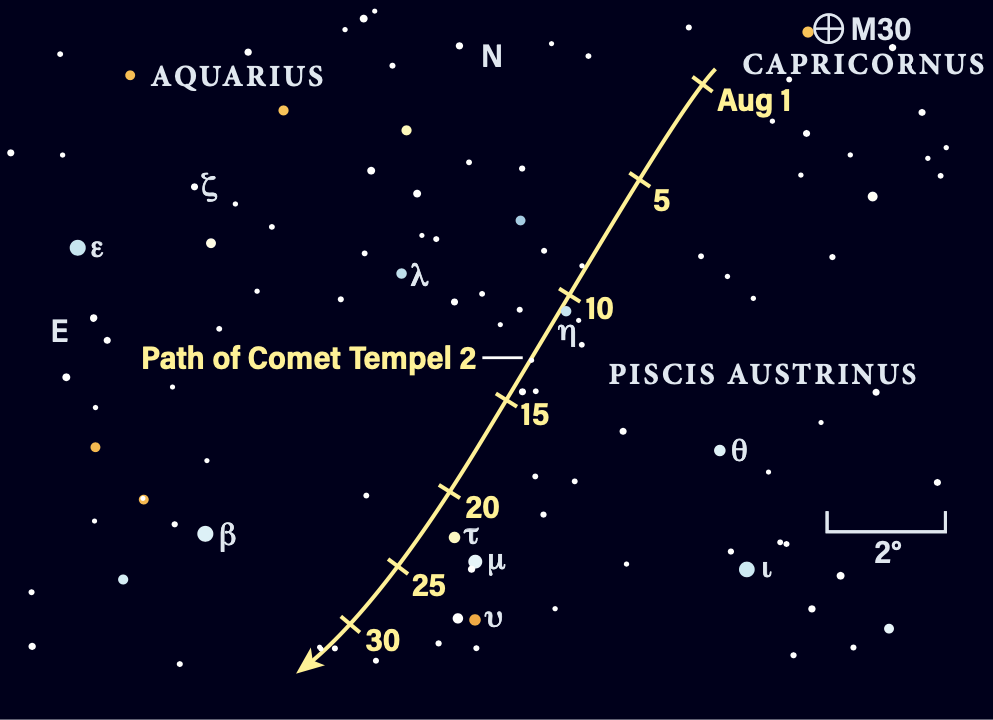
Once you’ve spotted the comet, compare it with the look of nearby globular M30 in Capricornus. The cluster is located just 5.7° northwest of the comet’s position. Which of the two objects is bigger, and which is brighter and more concentrated toward the center?
Sunrise: 6:04 A.M.
Sunset: 8:07 P.M.
Moonrise: 12:09 A.M.
Moonset: 3:59 P.M.
Moon Phase: Waning crescent (28%)
*Times for sunrise, sunset, moonrise, and moonset are given in local time from 40° N 90° W. The Moon’s illumination is given at 10 P.M. local time from the same location.
Saturday, August 8
Let’s spend tonight with the Little Gem, a planetary nebula also cataloged as NGC 6818. It is highest in the sky around 11 P.M., when it is some 35° above the southern horizon. It’s located in the northeastern corner of Sagittarius, to the upper left of the Teapot asterism at this time of night.
To find it, locate 3rd-magnitude Beta (β) Capricorni in Capricornus (to the upper left of Sagittarius) and simply slide 9° due west. You’ll want a telescope to enjoy this planetary — a small one will do, but as always, the larger the better. NGC 6818 glows at magnitude 9.3 and spans some 48” on the sky. In a small telescope, it appears about half as large, roughly 25” across. That’s compact enough to lend it relatively high surface brightness, making it a great target for smaller scopes, even if you may see less overall detail.
Once you do find NGC 6818, you may see why it has another name: The Green Mars Nebula. The first half of that moniker comes from the planetary’s color, whose glowing gas appears blue-green to the eye. The second half may be less obvious, but relates to the nebula’s perceived size on the sky — a diameter of 25” is roughly the same size as Mars during its closest approaches to the Sun, so amateur astronomers have likened the appearance of this glowing globe to the Red Planet, for all that their colors are opposite.
Sunrise: 6:05 A.M.
Sunset: 8:05 P.M.
Moonrise: 12:59 A.M.
Moonset: 5:09 P.M.
Moon Phase: Waning crescent (18%)
Sunday, August 9
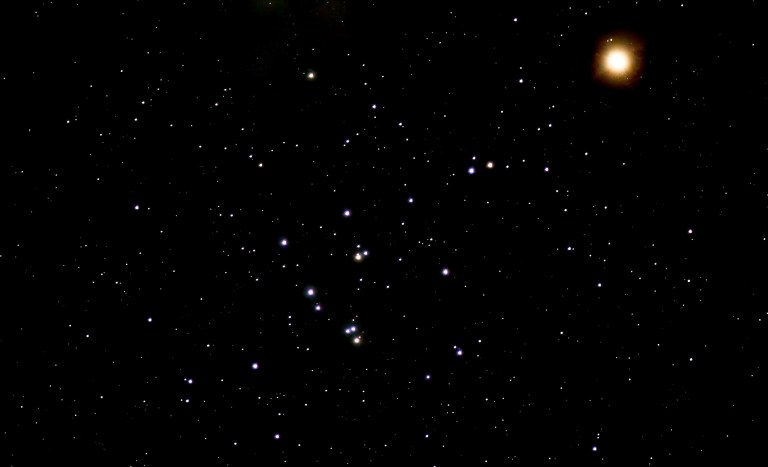
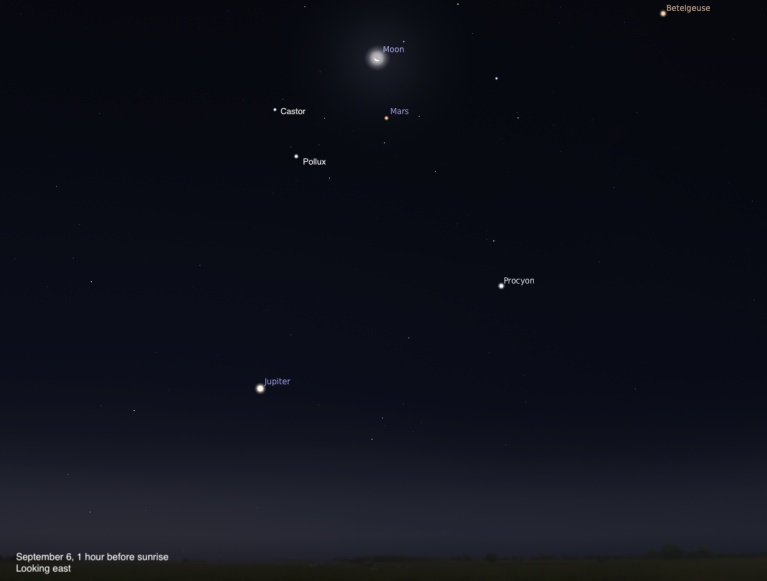
The Moon passes 4° north of Mars at 2 A.M. EDT; the pair is visible together in the early-morning sky, some 30° high in the east an hour before sunrise. They straddle the border of Gemini and Taurus, to the upper left of the familiar hourglass-shaped figure of Orion the Hunter, bisected by his famous belt.
Mars is magnitude 1.3, a bright reddish point of light in this region of the sky, just to the right of the delicate waning crescent Moon. Higher in the sky and to the right of the pair is the red giant Aldebaran, brighter than Mars at magnitude 0.9 but shining with a similar hue, thanks to this star’s advanced age, which has cooled its temperature. Compare both Mars and Aldebaran to Betelgeuse, the magnitude 0.5 red giant shoulder of Orion, which also shines orangey-red.
Far below and to the left is Mercury, just 4° above the eastern horizon an hour before sunrise. Despite its low altitude, it’s shining brightly at magnitude –0.6, making it easy to spot as long as your horizon is clear. Through a telescope, Mercury spans 6” and is 65% lit. Compare that with Mars, whose phase is 93% but appears just a bit smaller, 5”. This is because although Mercury is physically smaller than Mars, the latter now lies farther from Earth, which diminishes its apparent size in our sky.
As always, make sure to put away any optics well before sunrise from your location, which may differ from the time given below.
Sunrise: 6:06 A.M.
Sunset: 8:04 P.M.
Moonrise: 2:01 A.M.
Moonset: 6:09 P.M.
Moon Phase: Waning crescent (10%)
Monday, August 10
The Moon reaches perigee, the closest point to Earth in its orbit, at 7:18 A.M. EDT. At that time, our satellite will be 225,734 miles (363,284 kilometers) away.
This evening, the small constellation Lacerta sits just below cross-shaped Cygnus in the eastern sky after dark. The zig-zagging outline of the Lizard lies roughly 20° east (to the lower left early in the evening) of bright Deneb, the tail of the Swan and one of the three anchor points in the easy-to-spot Summer Triangle.
Lacerta is home to the open cluster NGC 7243. Shining at magnitude 6.4, this is a great target for binoculars or any small scope. You’ll find it just 2.6° due west of Alpha (α) Lacertae, Lacerta’s brightest star (magnitude 3.8). Spanning about 21”, NGC 7243 contains a few dozen stars. Its brightest star sits right in the center of the cluster, glowing at magnitude 8.0, with fainter stars crowding in around it. Many more stars become visible as you bump up your magnification, so once you’ve centered the cluster, drop in an eyepiece with higher magnification to see just how many of its member stars you can bring out.
Sunrise: 6:07 A.M.
Sunset: 8:03 P.M.
Moonrise: 3:15 A.M.
Moonset: 6:59 P.M.
Moon Phase: Waning crescent (4%)
Tuesday, August 11
The Moon passes 2° north of Mercury at 9 A.M. EDT. Early risers can catch the pair in the morning sky just before sunrise, with the delicate crescent Moon just above the bright point of Mercury in the east. They rise together in Cancer about 90 minutes ahead of the Sun and climb higher as the sky lightens with the oncoming dawn.
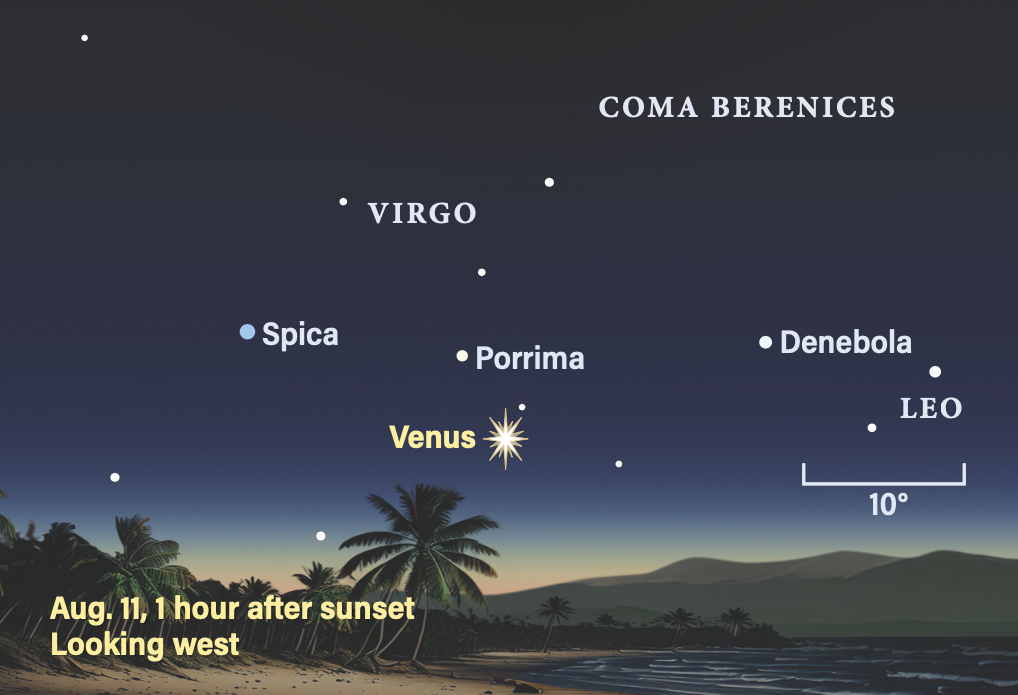
In the evening sky, Venus is reaching dichotomy, the moment when it is exactly half-lit. You’ll find magnitude –4.4 Venus some 20° high in the west as the Sun sets. It’s so bright, it will be the first light to pop out of the darkening sky, so you can pick it up easily in optics (make sure the Sun has completely disappeared below the horizon before doing so). In fact, observing Venus earlier in the evening is best, as the background sky makes viewing the bright planet’s phase easier. Its apparent size of 23” should also help.
Look closely at that phase. Venus is predicted to appear 50.4% lit this evening, and 49.9% by tomorrow. But during evening apparitions, Venus often appears to reach dichotomy earlier than predicted — does it perhaps already appear less than 50% lit when you study it this evening? The reason this occurs is called the Schröter effect, after Johann Schröter, who first noted it in the late 18th century. Astronomers believe it’s due to the way sunlight scatters off the thick clouds blanketing the world.
Consider coming back tomorrow and the next few days after that to compare the view and watch as the planet’s phase wanes.
Sunrise: 6:08 A.M.
Sunset: 8:02 P.M.
Moonrise: 4:33 A.M.
Moonset: 7:38 P.M.
Moon Phase: Waning crescent (1%)
Wednesday, August 12
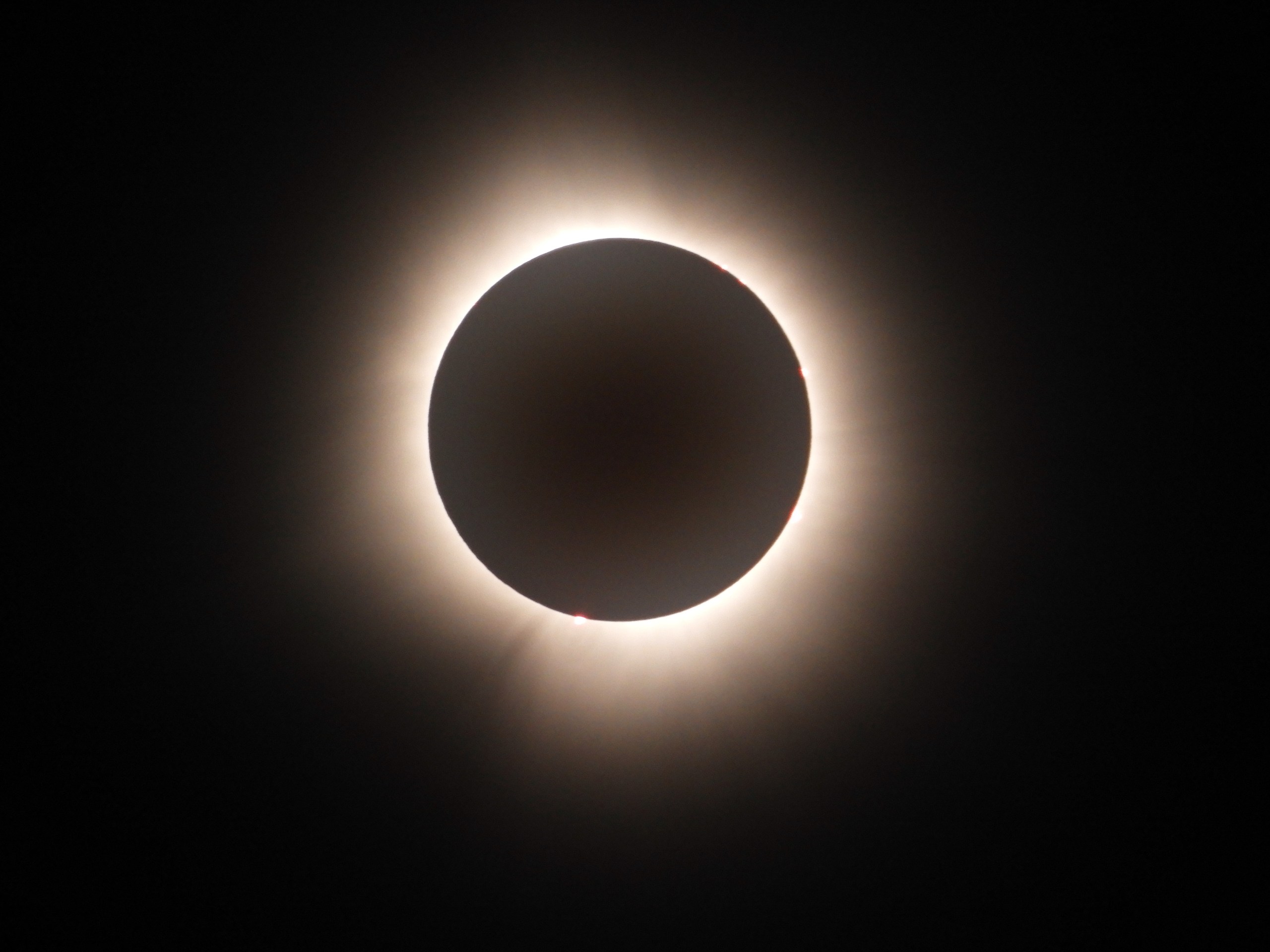
New Moon occurs at 1:37 P.M. EDT, bringing us a total solar eclipse. The event is not visible worldwide — in this case, the narrow path of totality travels only across Greenland, Iceland, and Spain, as well as a tiny sliver of far northeastern Portugal. The longest eclipse visible along this path will be 2 minutes 18 seconds of totality, off the west coast of Iceland. In Reykjavik, observers will see roughly 1 minute of totality, while on the farthest point west along the Icelandic coast, totality will last nearly 2 minutes. Northeastern Spain will also receive nearly 2 minutes of totality all along the central region of the shadow.
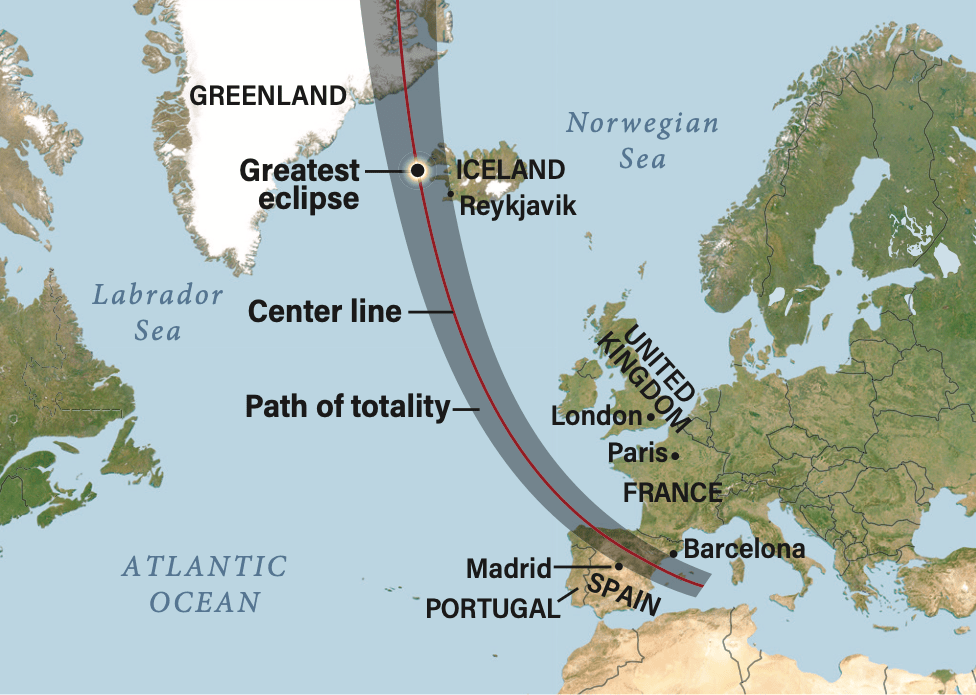
NASA will be livestreaming the total solar eclipse as well, so you don’t have to be along the path to see it. Visit nasa.gov/live to see where coverage will be hosted, or watch via the embedded player below.
While totality is only visible along a narrow corridor where the Moon’s shadow is darkest, some of the rest of the world will see a partial solar eclipse, where only a portion of the Sun’s disk is covered by the Moon. That will be visible across parts of Europe, Russia, Africa, and North America, including Alaska and portions of the northeastern and eastern U.S. For example, London will see 91% of the Sun covered by the Moon, Paris sees a 92% partial eclipse, Rome sees 69% of the Sun disappear, and Stockholm sees an 81% partial solar eclipse. In North America, Nova Scotia will see some 33% of the Sun’s disk covered and Anchorage gets a 28% eclipse, while Toronto sees 8% of the Sun covered and Winnipeg gets a 5% eclipse. On the U.S. East Coast, Boston sees a 16% partial eclipse, New York City sees a 9% partial eclipse, and Virginia Beach sees a 2% partial eclipse.
You can visit timeanddate.com’s page for the August 12 total solar eclipse to view an interactive map and determine whether you will see any portion of the eclipse, as well as the timing of your eclipse. Note that during a partial eclipse, you must use eclipse glasses labeled with ISO 12312–2 or ISO 12312–2:2015 when viewing the Sun at all times. You can find more tips for safe solar observing on Astronomy.com here.
And for those in the U.S., you aren’t totally missing out — in two weeks, on Aug. 27, a beautiful 96% partial lunar eclipse will grace the skies. We’ll make sure to highlight that event as well so you’ll know when and how to see it.
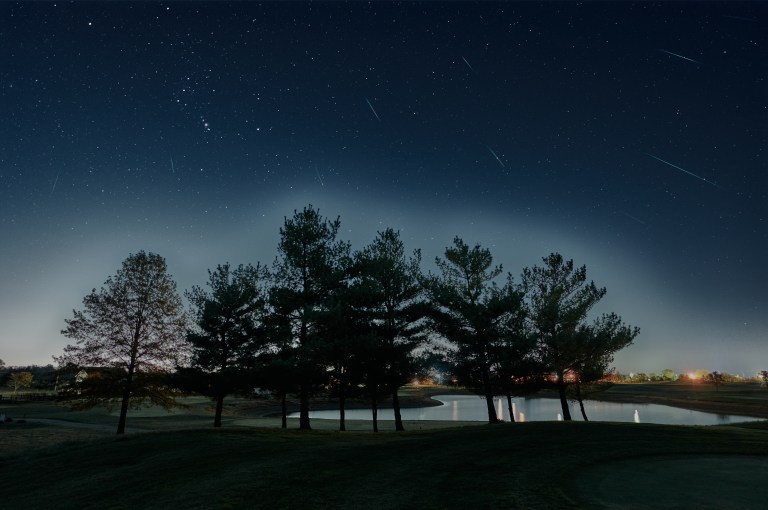
And today’s astronomical events aren’t over yet: The Perseid meteor shower peaks overnight tonight, under completely dark skies due to the New Moon. You’ll likely start catching meteors from the shower late tonight, as the radiant in northern Perseus is circumpolar (always visible) from many midnorthern latitudes and rises up from near the horizon a few hours after dark. It is highest in the early-morning hours, however, so your best chances for the most spectacular show will be early on the morning of the 13th — keep reading for more details in tomorrow’s entry.
Sunrise: 6:09 A.M.
Sunset: 8:01 P.M.
Moonrise: 5:52 A.M.
Moonset: 8:09 P.M.
Moon Phase: New
Thursday, August 13
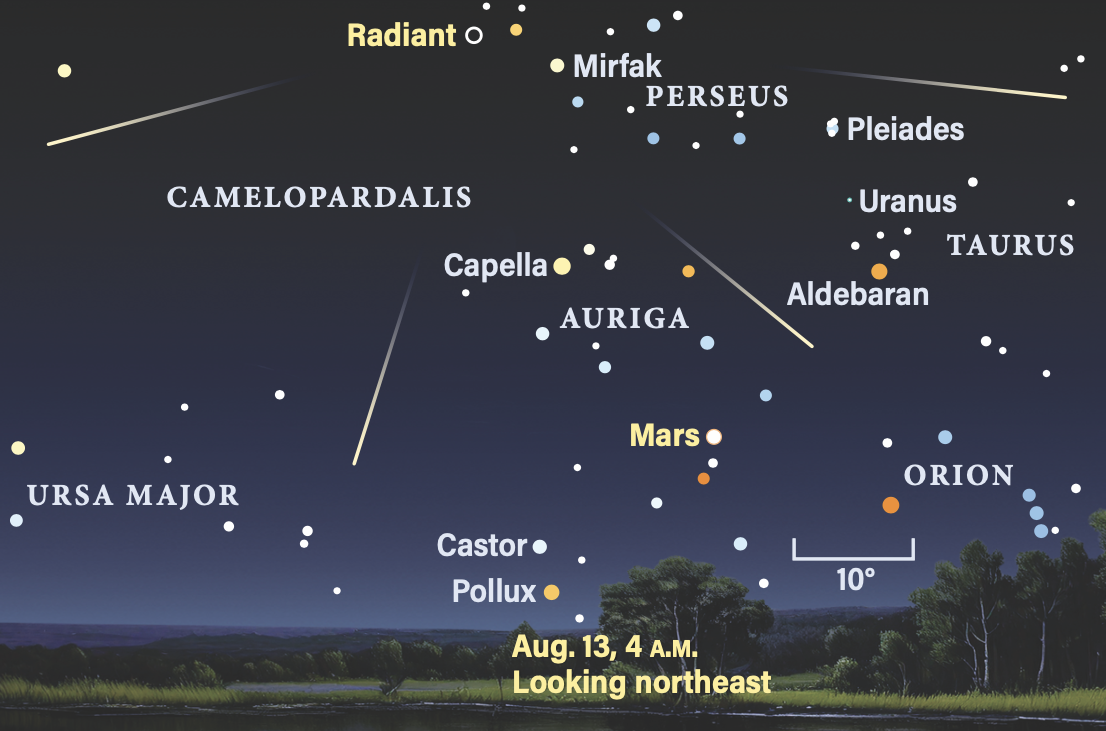
The early-morning hours of August 13 will be the best time to view this year’s Perseid meteor shower, peaking under the New Moon that brought August 12’s total solar eclipse.The shower’s high rate, lack of moonlight, and calendar date (when weather is warm in the Northern Hemisphere) mean it will be one of the best this year.
During the hours prior to dawn, observers are on the hemisphere of Earth that is turning into the meteor stream, creating the greatest show. Under dark skies, you may see some 60–80 meteors per hour in the few hours prior to dawn. Even observers under city lights will see bright meteors, though only about 30 or so per hour at best, as the lights wash out fainter streaks.
The Perseids’ radiant lies in northern Perseus, about 8° northwest (to the upper left) of 2nd-magnitude Mirfak. This is the point away from which shower meteors appear to stream, so to see the longest trails, you’ll want to look some 40° to 60° away from the radiant, to either side in the sky. You don’t need a telescope or any equipment to view a meteor shower, and your best bet is to constantly scan the sky with your eyes to catch shooting stars as they occur.
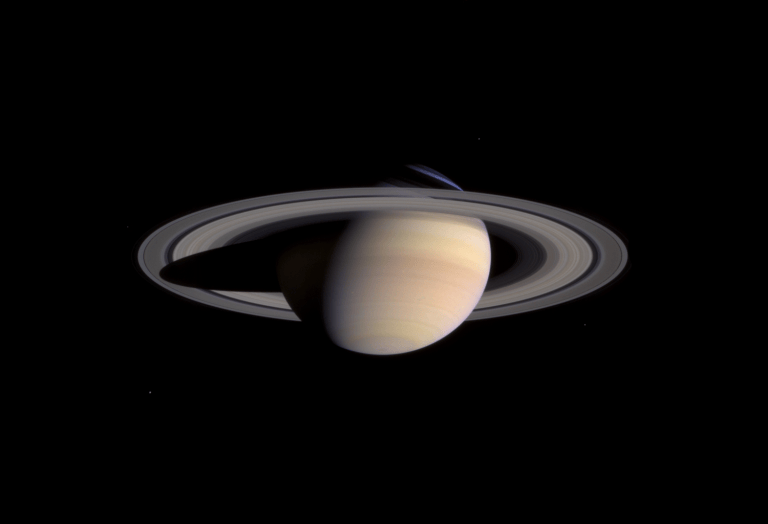
If you do happen to have your telescope out (it’s fine to take breaks from meteor watching to enjoy some deep-sky viewing under moonless skies!), make sure to swing it over to Saturn, which is 50° high in the south around 4 A.M. local daylight time. There, you’ll spot the ringed planet’s brightest moon, mid-8th-magnitude Titan, about 40” southwest of the disk as it passes by on its 16-day orbit. Tomorrow morning, Titan will stand southeast of Saturn.
Sunrise: 6:10 A.M.
Sunset: 7:59 P.M.
Moonrise: 7:08 A.M.
Moonset: 8:35 P.M.
Moon Phase: Waxing crescent (3%)
Friday, August 14
Mercury is passing less than 1° from the open cluster M44 (also called the Beehive Cluster) in Cancer, visible for a short time before sunrise this morning. To have the best chance of viewing the pair, you’ll want a clear, flat eastern horizon free of lights or buildings and trees. If you can get to an observing location above your surroundings, all the better.
The pair rises some 70 minutes ahead of sunrise; about 40 minutes prior to dawn, they are nearly 5° high in the east. Mercury should be easy to spot at magnitude –1.1, and once you’ve found it, zoom in with binoculars or a telescope to look for the cluster’s stars against the brightening sky. Make sure to put away any optical aid at least several minutes before sunrise.
You’ll also likely spot Jupiter, a bit brighter than Mercury at magnitude –1.8, located to Mercury’s lower left. It rises 10 minutes after Mercury — about an hour before sunrise — so is lower, but its brighter magnitude should help it stand out. The planets are roughly 1.7° apart this morning. Tomorrow they will rise together and they meet in a conjunction as Mercury passes 0.6° north of Jupiter at 5 A.M. EDT. We’ll definitely feature the pairing in next week’s column.
Sunrise: 6:11 A.M.
Sunset: 7:58 P.M.
Moonrise: 8:20 A.M.
Moonset: 8:59 P.M.
Moon Phase: Waxing crescent (7%)
Alison Klesman is senior editor of Astronomy magazine. She holds a Ph.D. in astronomy and has studied a variety of topics, from minor planets to supermassive black holes.