Credit: Astronomy magazine: Roen Kelly
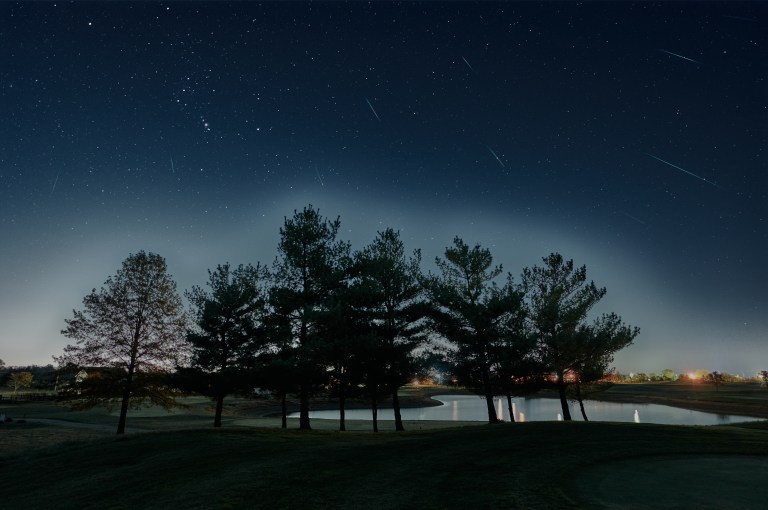
The annual Geminid meteor shower, whose peak occurs on the night of December 13, usually puts on a great show. Occurring less than a month after the Leonid meteor shower, the Geminid shower generally produces the brightest meteors of the year. In 2025, the Moon will be a waning crescent, so its light won’t affect viewing, even after it rises around 1:30 a.m. local time.
Geminid facts
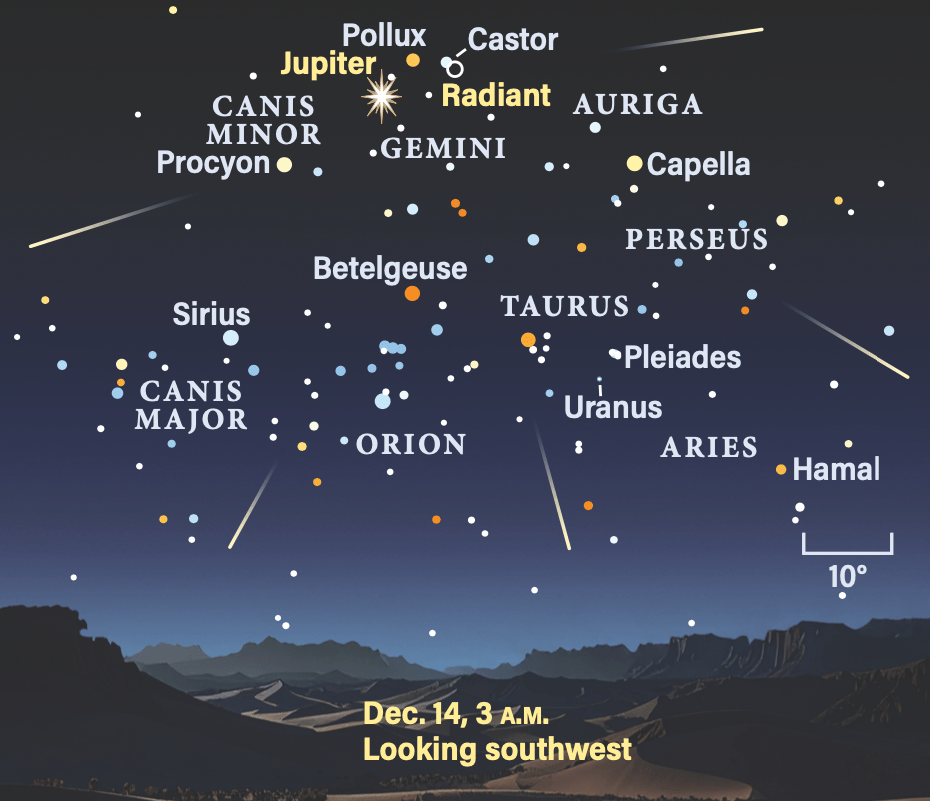
The Geminids are so named because if you traced all the meteor trails backward, they would meet within the boundaries of the constellation Gemini. This point is called the “radiant” of the meteor shower. The actual radiant is approximately 3° northwest of the 1st-magnitude star Castor (Alpha Geminorum).
Geminid meteors move relatively slowly, and many leave trails that remain visible even after the meteor itself has faded. In 2025, the peak occurs during the early morning hours December 14 for observers in Europe and Asia, and late on the 13th for those in the United States.
What are meteors?
Meteors are small – mostly sand-grain size – particles of rock and metal that Earth sweeps up during its orbit around the Sun. In space, these particles are called “meteoroids.” When they burn up in the atmosphere, they are called “meteors.” If they survive the fiery ordeal of passage through our thick blanket of air and land on Earth, they are then known as “meteorites.” No meteorites are generated from meteor showers – the particles are too small.
Where do meteor showers come from?
All meteor showers except the Geminids are caused by the passage of comets. When a comet swings around the Sun, it leaves a trail of debris (small meteoroids). Sometimes, the orbit of this debris crosses Earth’s orbit. When Earth runs into this stream of particles, we experience a meteor shower.
One-of-a-kind meteor shower
Astronomers first noted the Geminid shower in 1862 and searched for its parent comet for more than a century. In 1983, astronomers discovered the asteroid 3200 Phaethon, and they soon realized its orbit is identical to the Geminid meteoroid stream. This was the first time an asteroid had been linked to a meteor shower. Some researchers suggest that Phaethon is, in fact, a worn-out comet.
Observing the event
The best viewing for this year’s Geminids will be after sunset Saturday when the sky darkens. Usually, after midnight is the best time to observe a meteor shower, and this one is no exception unless you live in the Western time zone of the U.S. The Geminid peak occurs Sunday morning at 2 a.m. EST. If you’re unable to be out that late, you can begin watching at dusk. Geminids that appear then may be what observers call “skimmers,” those which contact only the top of our atmosphere and don’t target Earth. The trails of skimmers can be quite long. Some may even produce a streak that goes halfway across the sky.
Geminids can appear in any part of the sky. To maximize your chances of seeing these meteors, though, face generally east and look one-third to one-half of the way up in the sky from dusk to about 9 p.m.
From 9 p.m. to midnight, look generally from halfway up in the sky to overhead. At any time, glancing around won’t hurt anything. If you observe late into the night, focus your gaze overhead. The hourly rate of the Geminids is among the best of any meteor shower. From a dark site, and before the Moon comes up, you can expect to see about 30 meteors per hour.
To maximize the chances of seeing Geminids, a clear, dark sky is preferable. Dark means at least 40 miles from a major city. No optical aid (telescope or binoculars) is required. The naked eye works best for meteor showers because your field of view is not restricted. Suggested gear includes a reclining lawn chair, lots of warm clothing — more than you think you’ll need — cookies or fruit, and a warm, non-alcoholic beverage. Alcohol interferes with the eye’s dark adaption as well as the visual perception of events. So, don’t booze it up.
Geminid mythology
Gemini the Twins is where the radiant of this meteor shower lies. According to Roman mythology, this constellation represents two legendary brothers (Castor and Polydeuces) who accompanied the hero Jason (leader of the Argonauts) on his epic voyage to recover the Golden Fleece. Castor and Pollux (the names of the constellation’s two brightest stars) were the twin sons of Jupiter and Leda and were born in an egg, supposedly because Jupiter had taken the form of a swan prior to seducing Leda.
In a bit of a coincidence this year, the planet Jupiter lies quite close to Castor and Pollux. Jupiter will be the brightest starlike object in the sky.
Easy observing
Meteor showers are fun events to share with family and friends. So go out, get comfortable, and look up to see pieces of an asteroid streaking across our sky. Good luck!