
Sky This Week is brought to you in part by Celestron.
Friday, August 1
First Quarter Moon occurs at 8:41 A.M. EDT. The Moon then reaches apogee — the farthest point from Earth in its orbit — at 4:36 P.M. EDT, when it will be 251,134 miles (4041,61 km) away.
Corona Borealis the Northern Crown is now high in the west after sunset. Although this constellation is not large, it is relatively bright, with more than 20 stars readily visible to the naked eye. The curved shape of the Crown itself is outlined by seven stars. Starting in the northwest and moving clockwise, they are Theta (θ), Beta (β), Alpha (α), Gamma (γ), Delta (δ), Epsilon (ε), and Iota (ι) Coronae Borealis. The brightest is Alpha CrB, which sits roughly in the middle of the curve of stars and shines at magnitude 2.2. Its proper name is Alphecca. The next brightest star is Beta, at magnitude 3.7.
There’s been a lot of talk in the past year about brief, temporary addition to the Northern Crown: the nova T Coronae Borealis, or T CrB. Recurrent novae are stars that flare up more than once, and T CrB is just about due. When it flares, it will brighten from 10th magnitude — invisible to the naked eye — to 2nd magnitude, as bright as Alphecca! For just a few days, it will add another star to the constellation from its location 1° southeast of Epsilon.
T CrB flares once every 80 years or so, but the exact timing of the event is uncertain. Astronomers thought it might appear last year, but so far the star hasn’t yet brightened. But with every day that passes, the coming nova is more likely — so keep your eyes on the sky and let us know if you spot a new star there! The images below show the constellation as it normally appears (at left) and as it should appear with T CrB in view.

Sunrise: 5:59 A.M.
Sunset: 8:13 P.M.
Moonrise: 2:03 P.M.
Moonset: 11:54 P.M.
Moon Phase: Waxing gibbous (52%)
*Times for sunrise, sunset, moonrise, and moonset are given in local time from 40° N 90° W. The Moon’s illumination is given at 12 P.M. local time from the same location.
Saturday, August 2
Mars is now moving through Virgo, sitting low in the western sky after sunset. Shining at magnitude 1.6, the planet is at its faintest for the year; in the coming months, it will slowly start brightening again, but with a price. It’s now closing in on the Sun from our point of view, heading for solar conjunction early next year. It will remain visible only until about mid-November before it drops entirely from view.
Tonight, though, the Red Planet is still some 10° high an hour after sunset. It is passing close to 4th-magnitude Beta (β) Virginis, also called Zavijava, and today Mars stands just 8′ southeast of this star. They are readily visible together in binoculars or a telescope, presenting a nice contrast between the star’s pinpoint white glow and the planet’s ruddy, 4”-wide disk. Mars is too far from us to really see surface features, as it is now some 197 million miles (317 million km) away. But compare that with Zavijava, a relatively nearby star, which sits 36 light-years distant.
According to stellar expert Jim Kaler, Zavijava is a relatively Sun-like star with about a quarter more mass than our Sun. It is a little less than twice as wide and about 3.5 times as bright as our star.
Sunrise: 6:00 A.M.
Sunset: 8:12 P.M.
Moonrise: 3:06 P.M.
Moonset: —
Moon Phase: Waxing gibbous (61%)

Sunday, August 3
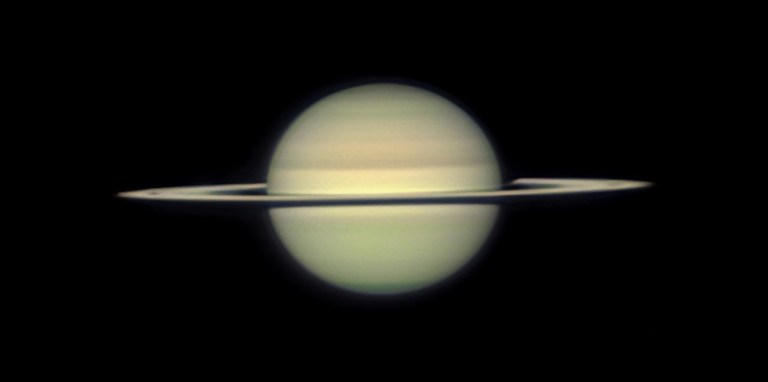
U.S. observers can catch the first of two transits of Titan’s shadow across Saturn this month — and one of the last few of the year, before cosmic alignment that allows the shadow to cross the cloud tops comes to an end.
Saturn now rises shortly after 10 P.M. local daylight time and is located in Pisces, hanging below the Circlet asterism. Shining at magnitude 0.8, it’s brighter than the nearby stars, making it easy to pick out in the sky. By local midnight, it is roughly 20° high in the east. Point your telescope at the ringed world, and you should also capture distant Neptune (magnitude 7.7) in your field of view. The ice giant is just over 1° north of Saturn, and will sit exactly due north of Saturn in just a few days.
Saturn’s rings are, as always, stunning. They are also quite thin, with the narrow axis spanning just 2.5”. They stretch more than 40” from end to end.
But today, our attention is on the northeastern limb of Saturn. Note that Titan, easily visible at mid-8th-magnitude, lies some 15” from the planet. But at 2:03 A.M. EDT — note this is just after midnight in the Mountain time zone and still late on the 2nd in the Pacific time zone — Titan’s shadow begins to appear on the northeastern limb, taking nearly 20 minutes to fully appear. The shadow slowly crosses from east to west, reaching roughly midway on the disk around 4:30 A.M. EDT. Titan is now 10” from the planet.
The shadow finally reaches the northwestern limb and begins to disappear around 5:12 A.M. MDT — after sunrise in the Midwest, leaving only the western half of the U.S. to view its exit. As with ingress, it takes about 20 minutes for the shadow to fully disappear.
There’s an added bonus for imagers: During this time, two of Saturn’s smaller, fainter moons are also transiting. Enceladus (magnitude 11.8) and Tethys (magnitude 10.3) appear just north of the rings for much of the shadow’s transit. Timing-wise, Enceladus begins to transit around 2:10 A.M. EDT, while Tethys’ transit begins around 2:33 A.M. EDT. They take 2.5 hours to cross the disk and will be difficult to see visually, but may be picked up by imaging.
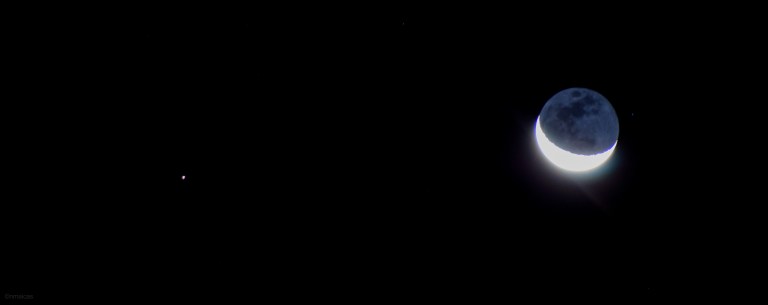
The Moon passes 0.3° south of Antares in Scorpius at 10 P.M. EDT this evening — easily viewed in darkness along the East Coast as well as parts of the Midwest as twilight is fading. However, even farther west you can view them together, if slightly farther apart as time passes.
You can catch the pair in the southern sky, no special equipment required. The Moon is now a little less than three-quarters lit, making its way toward the Full phase. Antares, Scorpius’ brightest star, shines at magnitude 1.1 and should be visible even with the bright Moon nearby. Its ruddy color is due to its temperature, which has fallen with age. The massive red giant star is nearing the end of its life; it will go out in a brilliant supernova blast, perhaps within about a million years or so.
Sunrise: 6:01 A.M.
Sunset: 8:11 P.M.
Moonrise: 4:09 P.M.
Moonset: 12:25 A.M.
Moon Phase: Waxing gibbous (70%)
Monday, August 4
Lyra the Harp is one of three famous constellations that soar overhead during shorter summer nights. Along with Cygnus the Swan and Altair the Eagle, Lyra hosts one of the three stars that form the Summer Triangle asterism.
But this constellation also holds so much more. One of its many treasures is M56, a magnitude 8.3 globular cluster that’s gorgeous through binoculars or any telescope.
By 10 P.M. local daylight time, Lyra’s brightest star, magnitude 0 Vega, stands 80° high above the eastern horizon. To its lower right (south-southeast) is magnitude 3.3 Gamma Lyrae. Below this star in the sky is Beta Cygni, the head of Cygnus the Swan, also known as the famous double star Albireo. And about halfway between these two stars is M56. More precisely, you can find M56 3.8° northwest of Albireo.
M56 looks like a fuzzy patch of light through binoculars. Generally only the inner 3’ or so is easily visible. Higher magnification with a telescope will start to break that patch up into individual stars, including a particularly bright blue star just west of its center. The cluster itself also sits in a field rich with stars along the Milky Way’s plane, making zooming out and taking in a broader view quite enjoyable as well.
Sunrise: 6:02 A.M.
Sunset: 8:10 P.M.
Moonrise: 5:09 P.M.
Moonset: 1:03 A.M.
Moon Phase: Waxing gibbous (79%)
Tuesday, August 5
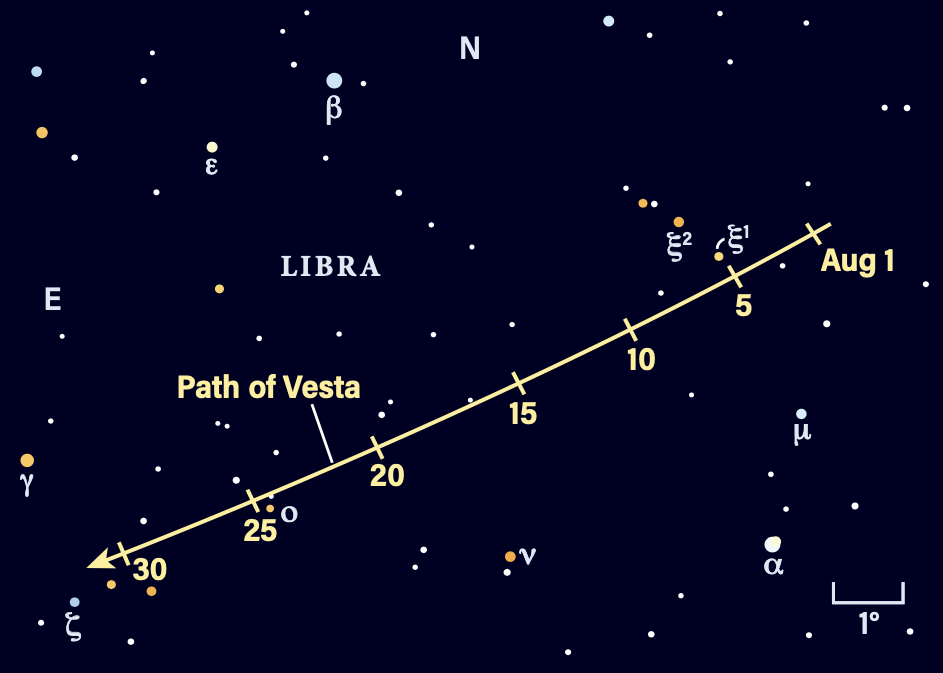
Asteroid 4 Vesta is making its way through northwestern Libra, visible in the evening hours as the region slowly sets. Tonight it is passing near the star Xi1 (ξ1) Librae, making it a bit easier to identify. It is also not far from Xi2 Lib.
The best time to look for Vesta is earlier in the evening, after darkness has fallen but before Libra gets too low in the southwest. Around 10 P.M., Vesta is still 20° high. To find it easily, first stop at magnitude 2.3 Alpha Lib, a wide double star. From this pair, it’s a short skip of just under 2° due north to magnitude 5.3 Mu (μ) Lib. Then move 2.5° north-northeast, and you’ll land right on magnitude 5.6 Xi1, which tonight is less than half a degree northeast of Vesta. Note that nearby is similarly bright magnitude 5.5 Xi2 Lib, which lies about 0.7° northeast of Xi1. Together with Vesta, the three form a roughly straight line this evening, with Xi2 in the northeast and Vesta in the southwest. At magnitude 7.3, Vesta is by far the faintest of the trio.
Sunrise: 6:02 A.M.
Sunset: 8:09 P.M.
Moonrise: 6:04 P.M.
Moonset: 1:51 A.M.
Moon Phase: Waxing gibbous (86%)
Wednesday, August 6
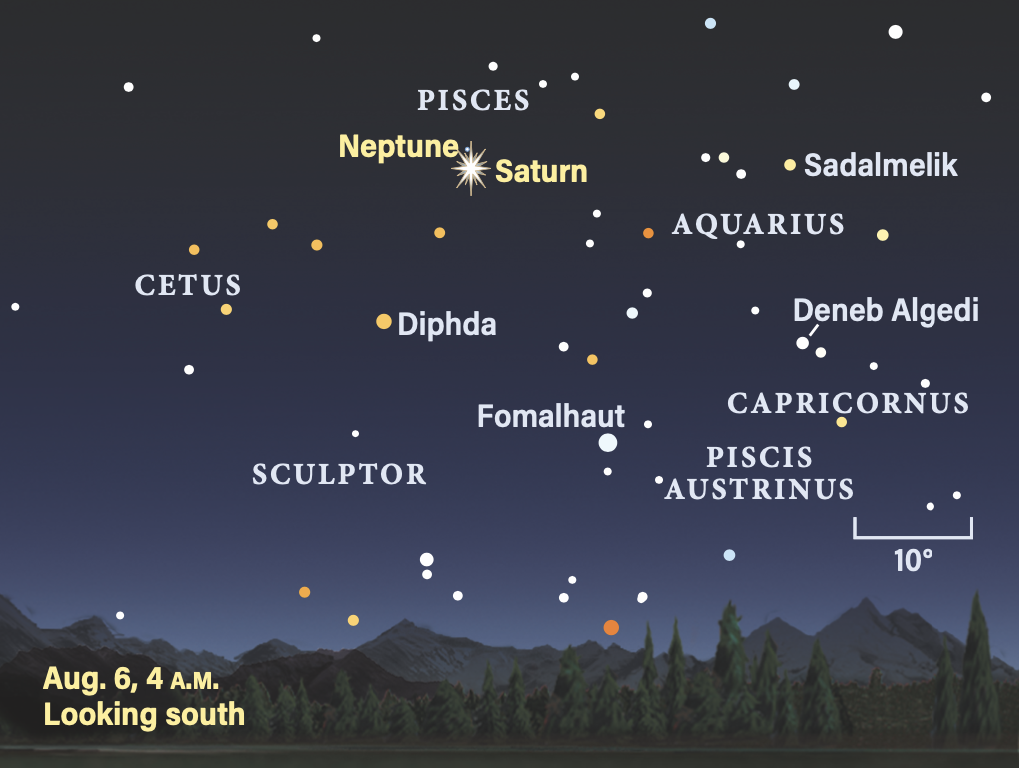
Saturn passes 1.1° due south of Neptune at 6 A.M. EDT. The pair of planets is visible overnight, rising around 10 P.M. local daylight time and setting after sunrise. They stand highest in the sky around 4 A.M. local daylight time, when they are 50° above the southern horizon.
Saturn stands out in southwestern Pisces as the brightest point of light, sitting to the lower left of the Circlet if you’re facing south at 4 A.M. Zoom in with a telescope to spot the planet’s 19”-wide disk and 42”-wide rings, which now show off their southern sunlit face. The planet’s brightest moon, Titan, lies nearly 3’ west of Saturn’s center, while fainter moons cluster closer in. You may see the planet’s three 10th-magnitude moons: Tethys is just east of the eastern tip of the rings, while Dione is west of their western tip. Rhea is southwest of the planet, slowly moving toward the disk — it disappears into the planet’s dark shadow just minutes after 4 A.M. CDT, so you may or may not see it, depending on when you look.
And, of course, just 1.1° north of Saturn is Neptune. Glowing at magnitude 7.7, the distant world spans 2” on the sky — a testament to its distance, nearly 2 billion miles (3 billion km) beyond Saturn. Study that tiny disk, which may appear bluish-gray to the sharp-eyed observer.
The outer planets appear to move slowly relative to the background (and each other) because of their great distance. Saturn will now pull away from Neptune, moving southwest, but the planets still end the month less than 2° apart.
Sunrise: 6:03 A.M.
Sunset: 8:08 P.M.
Moonrise: 6:52 P.M.
Moonset: 2:47 A.M.
Moon Phase: Waxing gibbous (92%)
Thursday, August 7
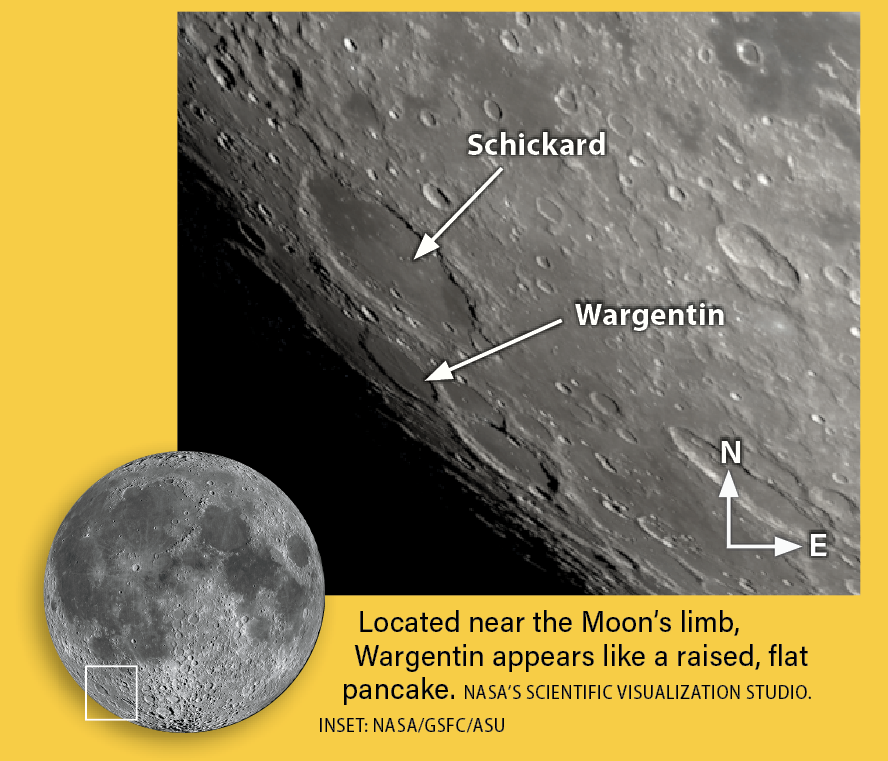
If you’re still up in the very early hours on Thursday, turn southwest to catch the waxing Moon before it sets. Most of the nearside is on display, and we’re looking specifically toward the southwestern limb for the large, flat crater Schickard and a nearby feature called the Wargentin pancake. They lie just northwest of the bright, heavily cratered southern polar region.
Schickard is roughly 132 miles (212 km) wide, but less than 1 mile (1.5 km) deep. From Schickard, look just a little closer to the darkened limb and you’ll see Wargentin — a raised, flat, dark oval that many observers think looks like a pancake. Although it is now a lava-covered plateau, Wargentin likely started as a crater that later filled with lava. You can confirm that the feature is relatively young by its lack of overlaid craters — only two tiny craterlets are generally visible with medium scopes and good seeing.
Although there are only a few hours to catch this feature this morning, it’s worth it — return tonight and you’ll see that the shadows have changed as dawn sweeps across the lunar landscape, washing away the contrast in this region.
This evening, asteroid 2 Pallas reaches opposition at 5 P.M. EDT. It’s located in the tiny constellation Delphinus, standing 50° high in the southeast two hours after sunset. You can find magnitude 9.4 Pallas with binoculars or a telescope just 1° west of magnitude 3.6 Beta Delphini, one of the four stars in the diamond-shaped asterism known as Job’s Coffin. Beta forms the southwesternmost point in this diamond; moving clockwise from Beta, the other three stars are magnitude 4.4 Delta, magnitude 4.3 Gamma, and magnitude 3.8 Alpha Delphini.
Sunrise: 6:04 A.M.
Sunset: 8:06 P.M.
Moonrise: 7:33 P.M.
Moonset: 3:51 A.M.
Moon Phase: Waxing gibbous (97%)
Friday, August 8
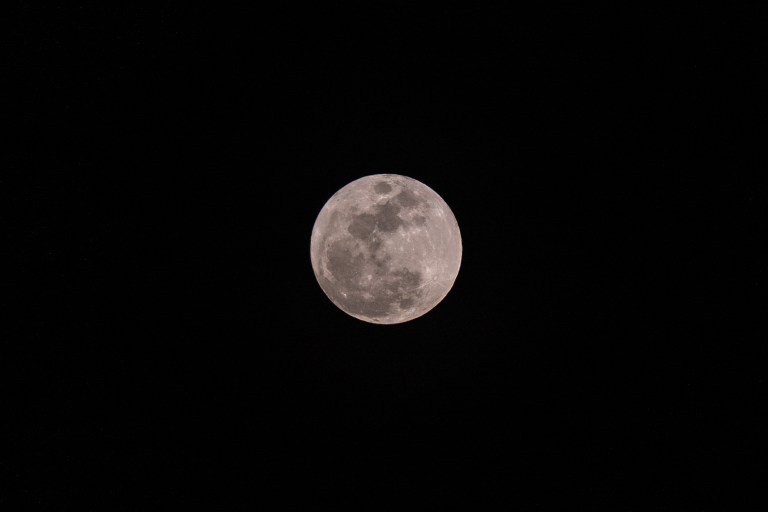
The Moon passes 0.0009° north of Pluto at 1 A.M. EDT; however, like most recent passes of the Moon by the tiny dwarf planet, our nearly Full satellite’s glow will simply drown out any of the faint light from the distant world.
With the Moon so bright, our deep-sky options are limited. But the northern sky’s standout globular, M13 in Hercules, is placed just right to give it a try tonight. Around 10 P.M. local daylight time, M13 is some 70° high in the west and won’t fully set until an hour before sunrise. Glowing at magnitude 5.8, it will show up well in binoculars or any telescope. You can find it about ⅓ of the way along a line drawn from Vega in Lyra to Arcturus in Boötes. Once you’ve located the Keystone of Hercules, you can home in on the cluster’s location by looking ⅔ of the way along a line from magnitude 3.0 Zeta (ζ) to magnitude 3.5 Eta (η) Herculis. Although visible as a dim smudge of light to the naked eye on a dark night, tonight you will need your optics to find it.
This great globular spans roughly 20’ and houses several hundred thousand stars, making it an incredibly old, dense ball of stars to be marveled at. Take your time, slowly bumping up the magnification to see more and ever-fainter stars appear at the edges of its dense core.
Sunrise: 6:05 A.M.
Sunset: 8:05 P.M.
Moonrise: 8:06 P.M.
Moonset: 5:01 A.M.
Moon Phase: Waxing gibbous (99%)