Occasionally I see references in Astronomy to the speed of something as “supersonic.” I’m having trouble reconciling this term with velocities typically found among astronomical objects. Wouldn’t “relativistic” be closer to the truth? Anything close to sonic speeds in Earth’s atmosphere wouldn’t cover much distance in outer space.
Peter Ianchiou
Tucson, Arizona
One would certainly think that in the vast celestial playfields most objects would dart about at extreme velocities. Relativistic speeds are generally defined as anything above 10 to 20 percent the speed of light (which is denoted by the letter c). Since the speed of light equals exactly 299,792.458 kilometers per second, or about 186,282 miles per second, 0.1c equals approximately 18,628 miles (29,979 km) per second.
But macroscopic objects such as stars and planets move at speeds that are much slower than relativistic. Our own Sun is moving at a speed of 155 miles (250 km) per second relative to the galactic nucleus — just 0.083 percent of light speed. It doesn’t cover much distance at such a speed; this is why it will require 225 million years or so to complete one orbit.
The fastest known star, a hypervelocity star called J0927–6335, is racing along at 1,389 miles (2,235 km) per second. While the ultra-speedy J0927–6335 would leave the comparatively lethargic Sun dust-coated and shamefaced, its impressive velocity is still equal only to 0.74 percent that of light, or 0.0074c. Thus, not even the fastest known star is moving at 1 percent the speed of light. And because no exoplanet yet discovered has attained an orbital velocity close to this value, we can also rule out the possibility that any planet’s velocity could ever be described as relativistic.
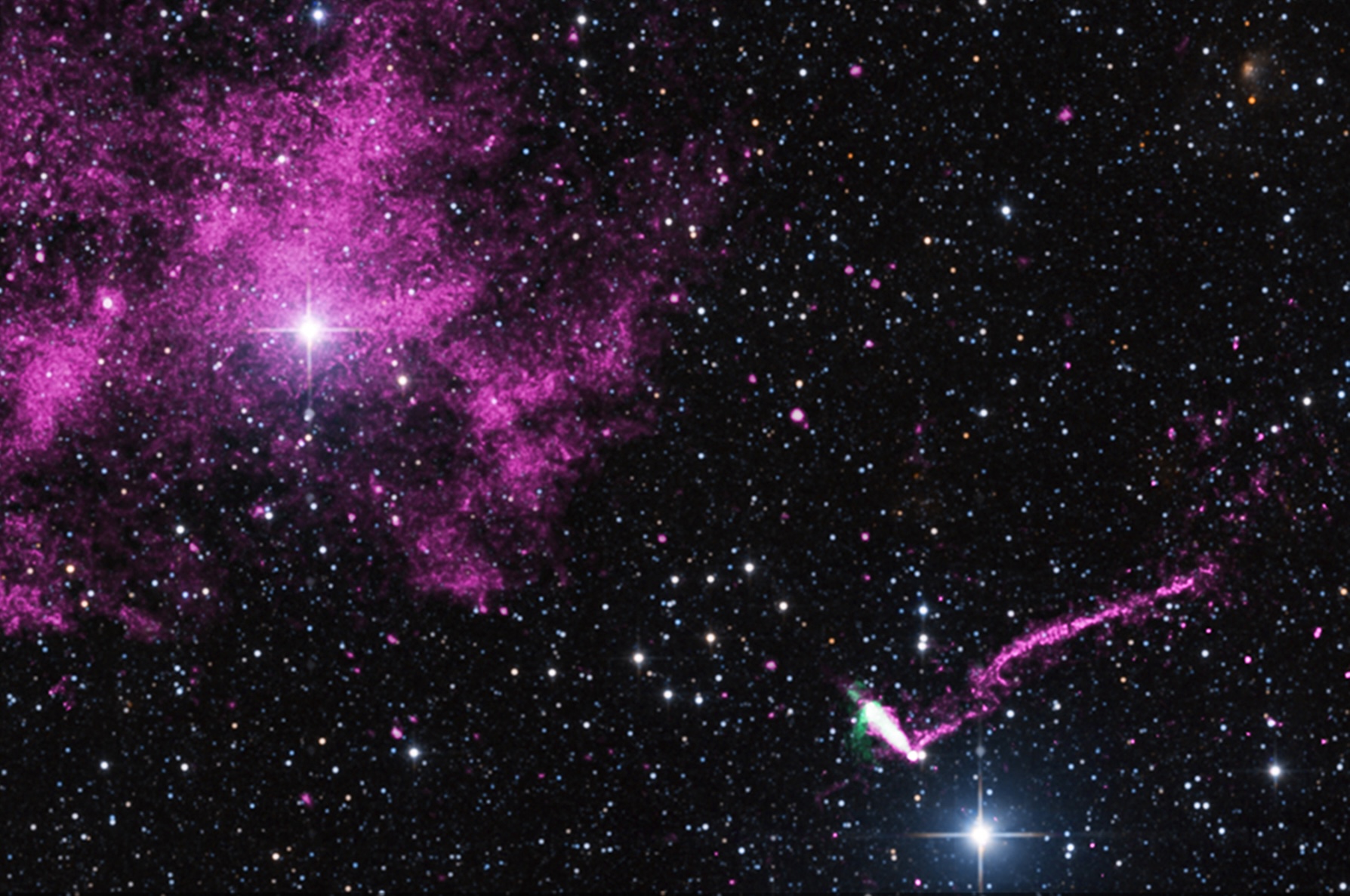
However, the particles that comprise astrophysical jets are expelled from objects such as black holes, quasars, and neutron stars at relativistic speeds. For instance, the pulsar IGR J11014–6103 (associated with the Lighthouse Nebula in the constellation Carina) is blasting out a jet approximately 37 light-years long, which shoots its particles at a velocity nearly equal to 80 percent the speed of light. This velocity is most assuredly relativistic. Remember that in this instance, it is particles — i.e., atoms — that have attained these velocities, not highly massive objects.
The term supersonic refers to speeds in excess of the speed of sound, but there’s a catch: Sound needs a medium to travel through. And the speed of sound is different in different mediums. The speed of sound is different in water and air, and even then depends on factors like temperature and pressure. At sea-level pressure and a temperature of 68 degrees Fahrenheit (20 degrees Celsius), the speed of sound equals about 767 mph (1,186 km/h). But the speed of sound in the atmosphere of Mars or inside a nebula or molecular cloud in deep space is very different. In hot interstellar gas, the speed of sound can be hundreds of thousands of miles per hour.
So in most cases, when astronomers call an object supersonic, their point of reference is the speed of sound in its local surroundings. A star moving through a nebula can be described as supersonic if it is moving faster than sound waves move through the interstellar gas around it. (Sometimes, we can easily see that this is the case because of the presence of a glowing bow shock, just like the shock that forms in front of a fighter jet as it breaks the sound barrier.) And while Earth’s average orbital velocity of about 19 miles per second (30 km/s) is modest relative to typical sound and wave speeds in the interplanetary medium, the solar wind itself moves past Earth at around 250 miles per second (400 km/s). This flow is supersonic relative to the surrounding plasma (and the solar wind forms a bow shock upwind of Earth and its magnetic field).
However, these motions are nowhere near relativistic.
Edward Herrick-Gleason
Astronomy educator, St. John’s, Newfoundland and Labrador