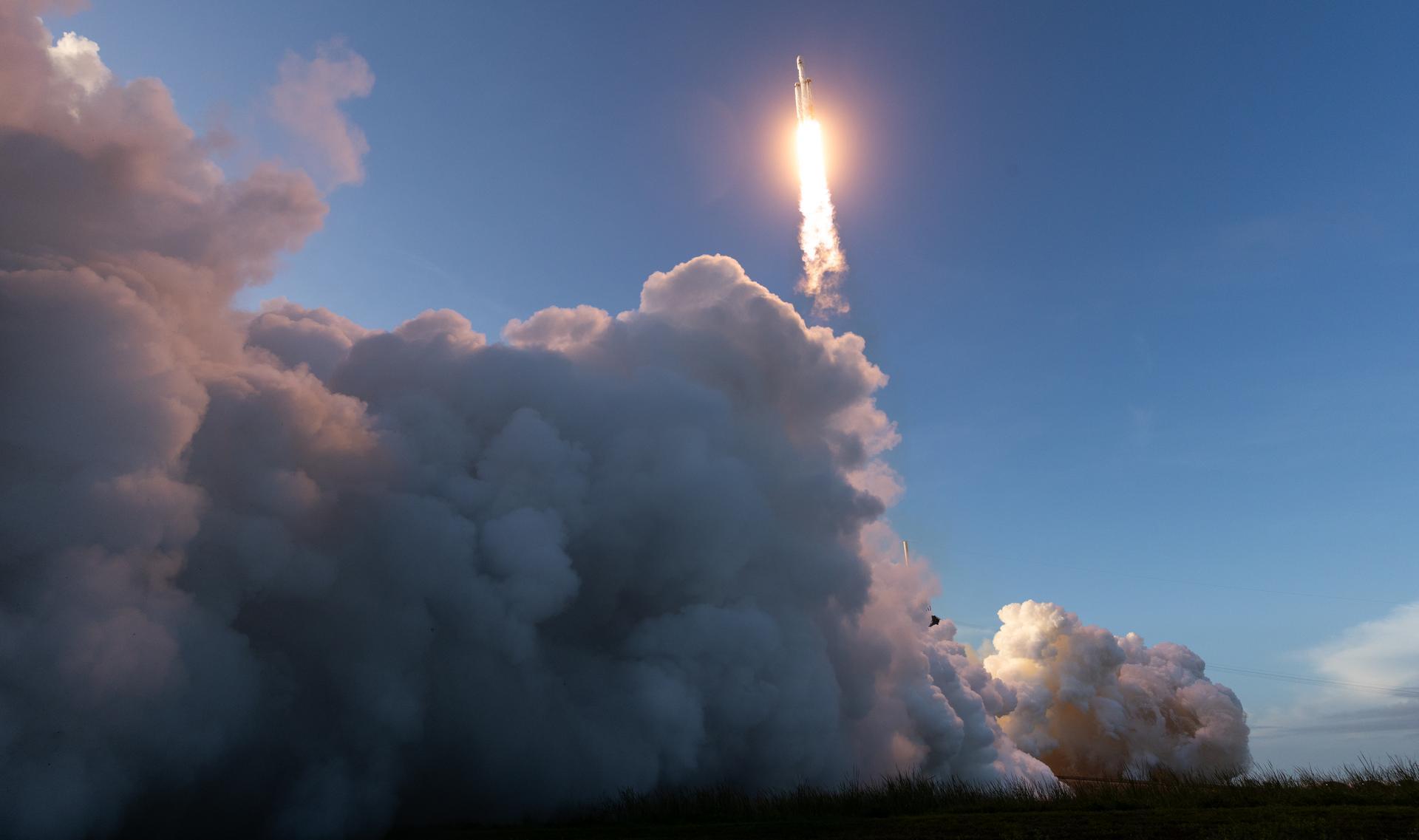
The journey of a million miles began with a successful launch Sunday morning. NASA’s next-generation observatory, the Nancy Grace Roman Space Telescope, took off from Kennedy Space Center in Florida on Aug. 30 at 7:26 a.m. EDT.
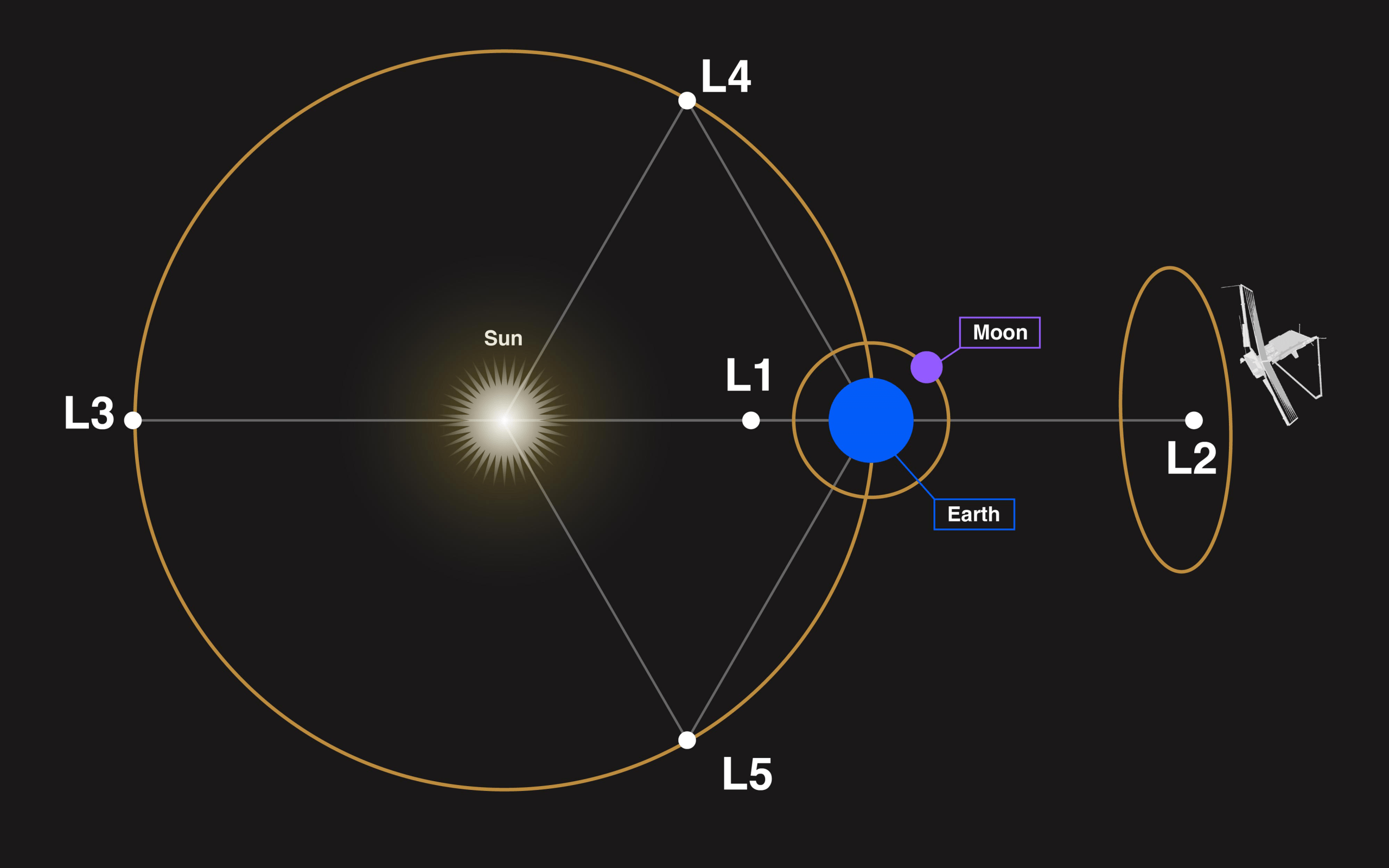
A SpaceX Falcon Heavy — the company’s heavy-lift rocket, composed of three Falcon 9 boosters strapped together — carried the Nancy Grace Roman Space Telescope for about 31 minutes before the spacecraft separated and struck out on its own toward the second Sun-Earth Lagrange point, known as L2, where it will orbit the Sun in sync with Earth. The $4.3-billion telescope will spend three months in transit before settling into orbit, beginning a commissioning period, then scanning the sky for clues to dark energy, dark matter, and thousands of new exoplanets.
“Roman is on her way,” NASA Administrator Jared Isaacman posted to X Sunday morning. “Years of work, extraordinary engineering, and one incredible launch. Congratulations to the entire NASA team and our partners who made this mission possible. The Nancy Grace Roman Space Telescope is about to open an entirely new window into our universe.”
What is the Nancy Grace Roman Space Telescope?
Nancy Grace Roman, NASA’s first chief astronomer, spent her career advocating for space-based observatories. Her namesake telescope started out as a project called the Wide Field Infrared Survey Telescope, or WFIRST, when the 2010 Astronomy and Astrophysics Decadal Survey named it as one of the field’s highest priorities. In 2012, the National Reconnaissance Office donated a pair of 2.4-meter wide-field mirrors to NASA that were originally intended for use in spy satellites. One of them was set aside for WFIRST, although NASA didn’t formally greenlight the project until 2016.
The first Trump administration proposed defunding it in three consecutive budgets, arguing the telescope had grown too expensive. Congress overruled each request and capped the project’s development-phase costs at $3.2 billion to keep it on track. A fourth threat came in 2025, when the administration’s 2026 budget request proposed cuts of roughly 60% to Roman’s budget; Congress again stepped in, appropriating $300 million to carry the telescope to launch. NASA finished assembling the observatory in April 2026, under budget and ahead of schedule. Roman left the pad a whole nine months before NASA’s anticipated launch date.
RELATED: How Roman will unlock the universe
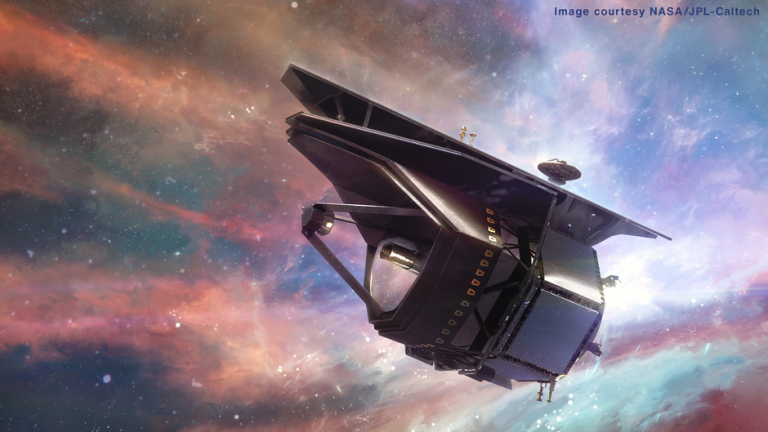
Roman is about 42 feet long (13 meters) and 14 feet wide (4.3 meters) and weighs about 18,000 pounds (8,200 kilograms). At its core sits a hexagonal bus built around a central cylinder, which houses the observatory’s power, propulsion, and attitude-control systems.
Roman has two instruments on board: the Wide Field Instrument (WFI) and the Coronagraph. The WFI gives the telescope a field of view 100 times larger than Hubble’s and will allow Roman to take 300-megapixel images of the cosmos in infrared and visible light. The Coronagraph blocks a star’s light, allowing Roman to directly image faint planets and dusty disks hiding near them.
Most of Roman’s five-year mission will go to three core surveys. The High-Latitude Wide-Area Survey will map roughly 5,000 square degrees of sky, tracing dark energy based on how its gravity bends light from distant galaxies. The High-Latitude Time-Domain Survey will hunt thousands of Type Ia supernovae that astronomers use to measure how fast the universe is expanding. And the Galactic Bulge Time-Domain Survey will stare at the crowded center of the Milky Way and is expected to turn up more than 100,000 new exoplanets.
The long road to launch
Last year at NASA’s Goddard Space Flight Center, the spacecraft endured vibration tests, an acoustic chamber replicating the noise of launch, and thermal-vacuum testing before being cleared to make the trip to Florida.
Roman traveled by semi-trailer truck to port in Baltimore, packed inside the aptly named 16-foot-tall CHARIOT (Conditioned Housing for Air, Road, Imaging optics assembly, and Observatory Transport).
Then Roman was loaded onto a barge to complete its journey to Florida by boat, arriving at Kennedy nine days later.
Once at Kennedy, technicians fueled the spacecraft with hydrazine. Roman is too big to fly with its solar array and aperture cover unfurled, so engineers folded them flat against the spacecraft to fit inside Falcon Heavy’s payload fairing in preparation for launch.
“Throughout the process of Roman’s build, the team … has been making sure that it’ll all fit well within that fairing. It’s definitely a tight fit … for Roman here today,” remarked a NASA commentator during the launch’s livestream.
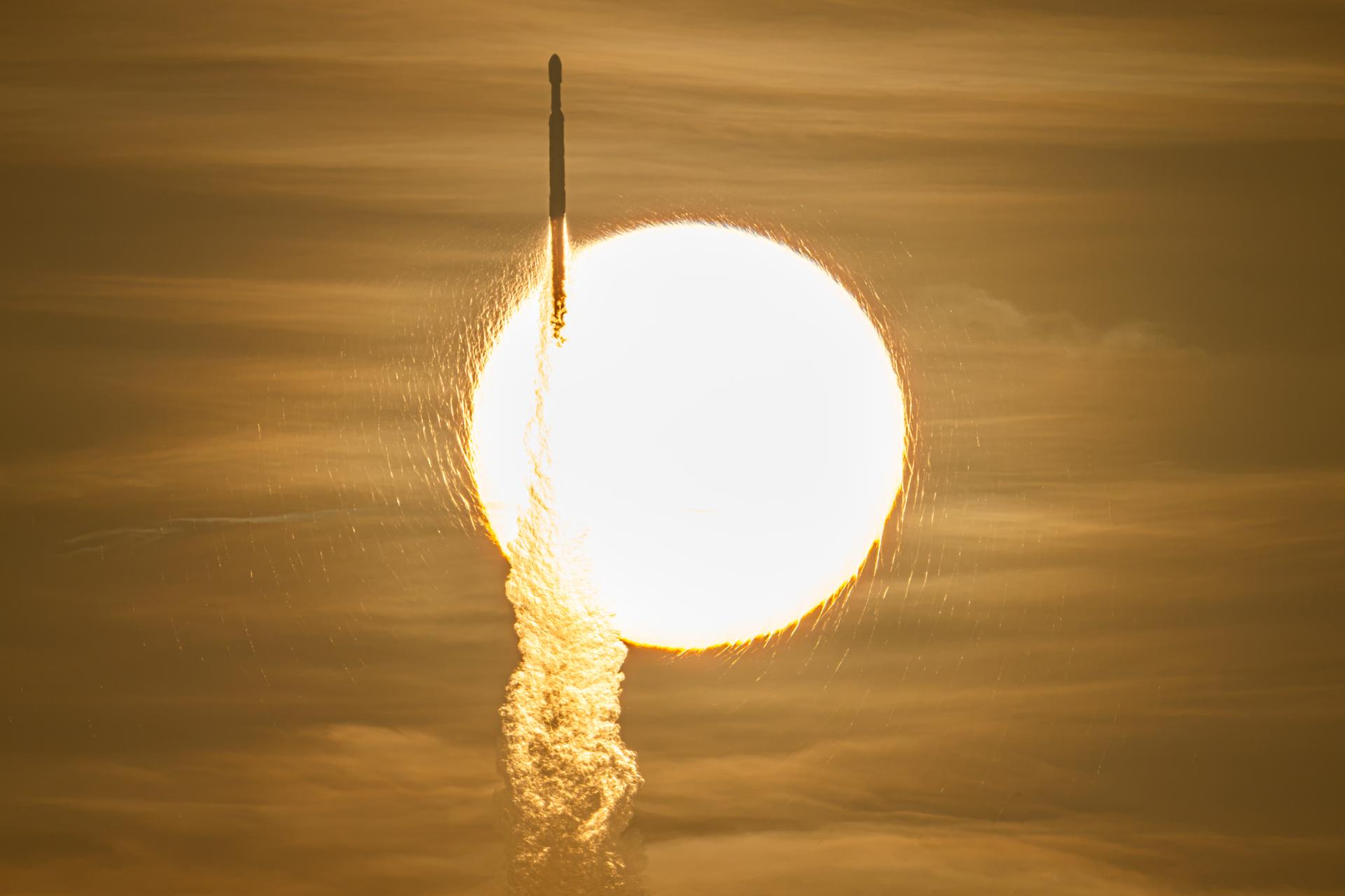
Everything was nominal for Sunday’s launch, which went off without a hitch. After NASA handed control of the countdown to Falcon Heavy’s onboard computers, the launch director gave a final “go” with about 45 seconds left on the clock.
Falcon Heavy lifted off right on time at 7:26 a.m. EDT, its 27 Merlin engines producing more than 5 million pounds of thrust (2.3 million kg) to push Roman off the pad. Its two side boosters separated about two and a half minutes later, turned around, and landed back at Cape Canaveral.
The payload fairing fell away around four minutes after launch, exposing Roman to space once the vehicle had escaped Earth’s atmosphere.
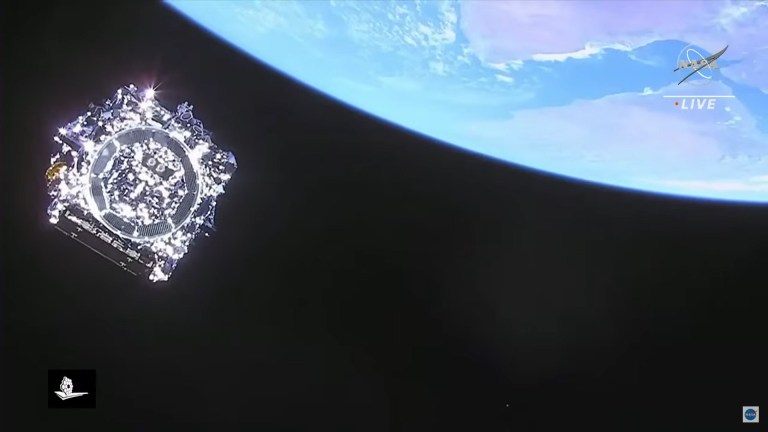
Then around 31 minutes after liftoff, at an altitude of roughly 740 kilometers, the telescope separated from the rocket’s upper stage.
“Nancy Grace Roman Space Telescope flying free on its way to Lagrange 2,” a NASA commentator announced during the livestream, “and to open a new eye on the universe.”
Roman unfurled its solar arrays within the hour. “I could never believe that this moment would actually happen,” said Dominic Benford, the mission’s program scientist, watching from Kennedy, “and it is here, far more beautiful than I could have anticipated.”
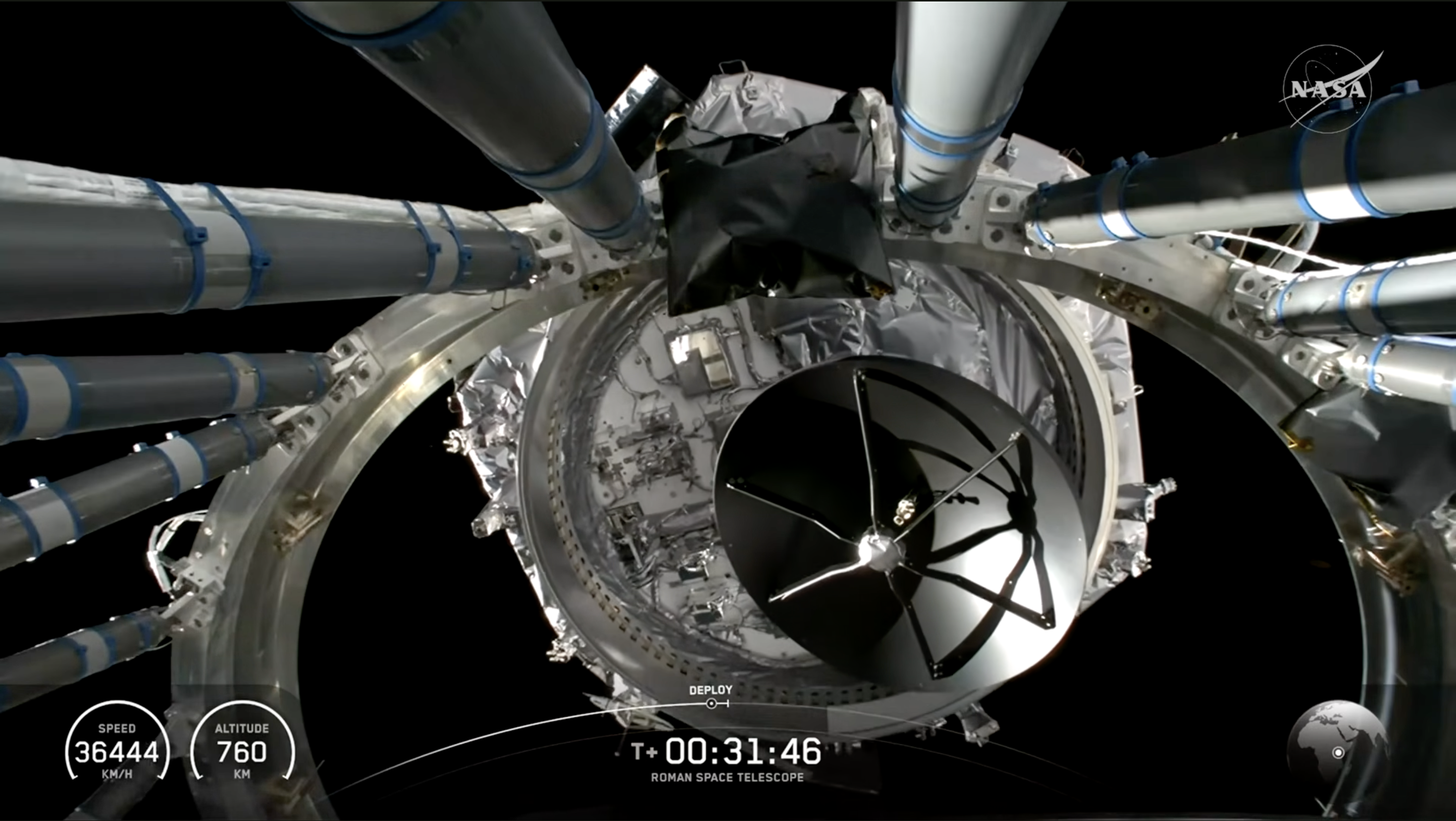
Before Roman can begin conducting science work, it still has to get to L2. The telescope will spend the next several months in transit, making at least one mid-course correction and deploying its antenna along the way.
Once Roman is in position, the team moves into commissioning — turning on the instruments and confirming everything works before science can begin. “We’re gonna be checking out Roman for about a month, and then we’re gonna be aligning and focusing the telescope, making sure we get all the pointing right,” said Jeremy Perkins, a member of Roman’s science commissioning team, in a NASA broadcast during launch. “That’s where we’re really just checking out the instruments, pointing them at the sky, getting our first starlight on the detectors for the first time.”
NASA expects to release Roman’s first public images in early 2027.
A presidential interruption
Despite his administration’s repeated attempts to cut Roman’s budget, President Trump was clearly excited about the launch — excited enough that he called Isaacman in the middle of the post-launch press conference to offer his congratulations. Isaacman stepped out of the briefing to take the call, then returned and held his phone up to the microphone.
“Okay. I just want to thank everybody and congratulate you. Boy, it looked beautiful on television.” Trump told the room. He added, “Jared’s doing a fantastic job, you are doing a fantastic job, and I’m supplying you all that money.” Ars Technica’s Eric Berger noted that this kind of presidential enthusiasm is rare for NASA and could work in the agency’s favor as it heads into its next budget fight.
Brooks Mendenhall is a staff writer at Astronomy, based in Chattanooga, Tennessee, fueled by an unending curiosity about the universe. A former classroom teacher, he has a knack for breaking down complex concepts for a wide audience.